
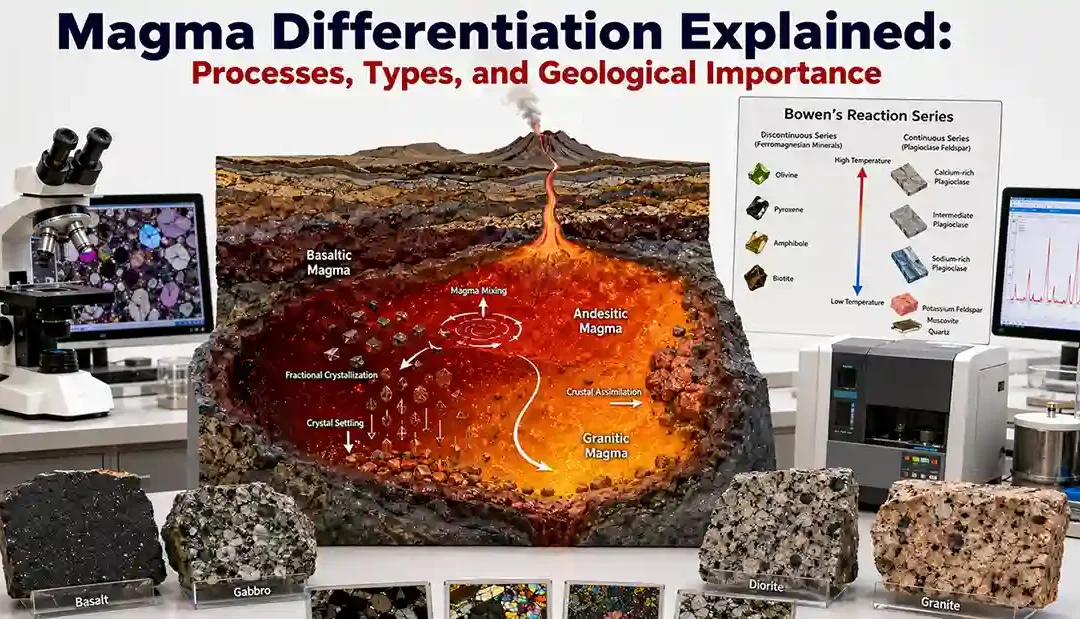
Magma differentiation is the process by which a single parent magma evolves into magmas with different chemical compositions. Rather than remaining chemically uniform, magma changes continuously as minerals crystallize, melt, settle, mix, or interact with surrounding rocks. These changes explain why a single magma source can produce a wide variety of igneous rocks ranging from basalt and gabbro to andesite, diorite, granite, and rhyolite.
Several geological processes contribute to magma differentiation, including fractional crystallization, partial melting, magma mixing, crustal assimilation, and liquid immiscibility. Together, these mechanisms control the mineral composition, texture, and chemical evolution of igneous rocks throughout Earth's crust and mantle.
Understanding magma differentiation is fundamental to igneous petrology, volcanology, geochemistry, mineralogy, and economic geology.
This topic should be studied together with Partial Melting, Fractional Crystallization, and Bowen's Reaction Series.
What Is Magma Differentiation?
Magma differentiation is the chemical evolution of magma from its original composition into new magmas with different mineral and chemical characteristics.
During differentiation:
- Magma composition changes.
- Minerals crystallize in sequence.
- New minerals become stable.
- Silica content usually increases.
- Different igneous rocks form.
This process is also called magmatic differentiation.
Why Does Magma Differentiate?
Fresh magma rarely remains unchanged.
Its composition evolves because:
- Minerals crystallize at different temperatures.
- Crystals separate from the melt.
- Magma mixes with other magmas.
- Surrounding rocks melt into the magma.
- Partial melting produces different initial magmas.
These processes continuously modify magma chemistry.
Main Processes of Magma Differentiation
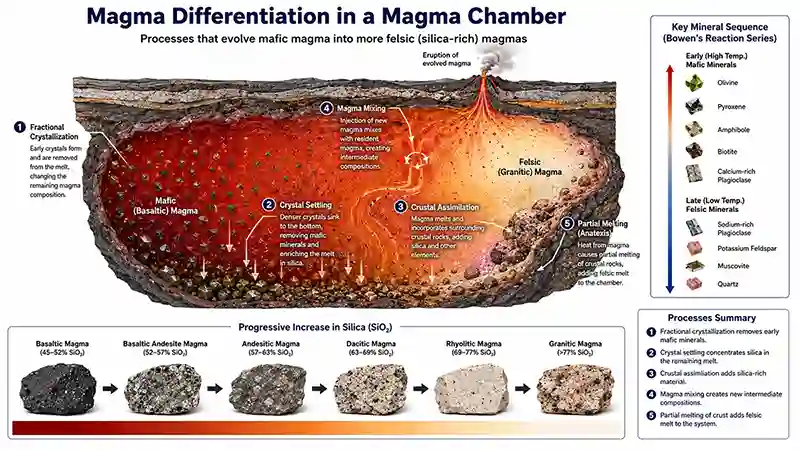
Several mechanisms contribute to magma evolution.
Fractional Crystallization
Fractional crystallization is the most important differentiation process.
As magma cools:
- Olivine crystallizes first.
- Pyroxene follows.
- Amphibole and biotite form later.
- Quartz and potassium feldspar crystallize last.
Removing early minerals leaves the remaining magma richer in silica.
Partial Melting
Partial melting generates magmas of different compositions from the same source rock.
Low-melting minerals melt first, producing silica-rich magma while refractory minerals remain solid.
Crustal Assimilation
As magma rises, it may melt surrounding crustal rocks.
Assimilation introduces:
- Silica
- Potassium
- Sodium
- Aluminum
This commonly makes magma more felsic.
Magma Mixing
Two magmas with different compositions may combine.
Examples include:
- Basalt + Rhyolite
- Basalt + Andesite
Mixing produces intermediate magma compositions.
Liquid Immiscibility
Rarely, one magma separates into two chemically distinct liquids.
This process contributes to specialized ore deposits.
Chemical Changes During Differentiation
As magma evolves:
Elements That Increase
- Silicon
- Potassium
- Sodium
- Water
- Rare Earth Elements
- Uranium
- Thorium
Elements That Decrease
- Magnesium
- Iron
- Calcium
These changes gradually transform mafic magma into felsic magma.
Mineral Evolution During Differentiation
Minerals crystallize according to Bowen's Reaction Series.
High-Temperature Minerals
- Olivine
- Pyroxene
- Calcium-rich Plagioclase
Intermediate Minerals
- Amphibole
- Biotite
- Sodium-rich Plagioclase
Low-Temperature Minerals
- Potassium Feldspar
- Muscovite
- Quartz
Each stage changes the chemistry of the remaining magma.
Igneous Rocks Produced
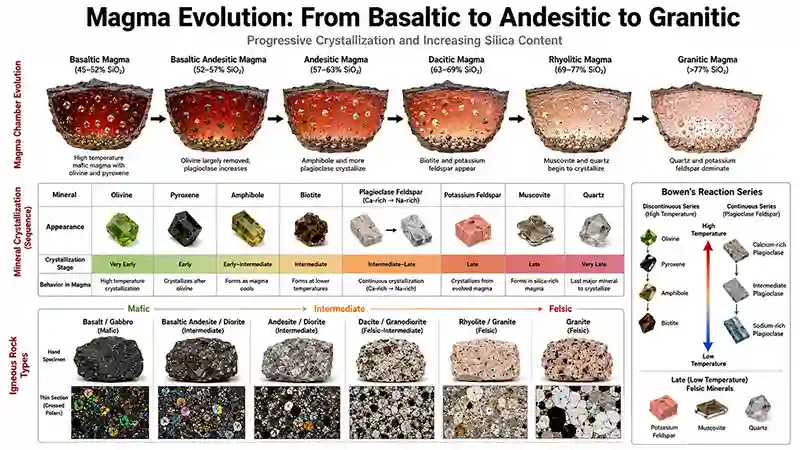
Magma differentiation produces many igneous rocks.
| Magma Type | Typical Rocks | Dominant Minerals |
|---|---|---|
| Ultramafic | Peridotite | Olivine, Pyroxene |
| Mafic | Basalt, Gabbro | Pyroxene, Plagioclase |
| Intermediate | Andesite, Diorite | Amphibole, Biotite |
| Felsic | Granite, Rhyolite | Quartz, Feldspar, Muscovite |
Magma Differentiation in Plate Tectonics
Different tectonic environments produce different differentiation trends.
| Tectonic Setting | Typical Magma |
| Mid-Ocean Ridge | Basalt |
| Subduction Zone | Andesite |
| Continental Rift | Basalt to Rhyolite |
| Continental Collision | Granite |
| Mantle Plume | Basalt |
Each setting produces distinctive mineral assemblages.
Relationship with Bowen's Reaction Series
Bowen's Reaction Series describes the order in which minerals crystallize from cooling magma. Magma differentiation explains how removing those minerals changes the composition of the remaining melt.
Together, they provide the foundation for understanding igneous petrology.
Economic Importance
Magma differentiation concentrates economically valuable elements.
Late-stage differentiated magmas commonly become enriched in:
- Lithium
- Tin
- Tungsten
- Rare Earth Elements
- Uranium
- Niobium
- Tantalum
- Zirconium
These elements often form pegmatites and hydrothermal ore deposits.
Geological Importance
Magma differentiation helps explain:
- Formation of continental crust
- Diversity of igneous rocks
- Layered igneous intrusions
- Volcanic evolution
- Ore deposit formation
- Crustal growth
It is one of the primary mechanisms controlling Earth's igneous evolution.
Laboratory Identification
Geologists study magma differentiation using:
- Petrographic Microscopy
- X-Ray Diffraction (XRD)
- Electron Microprobe Analysis (EPMA)
- Scanning Electron Microscopy (SEM)
- Whole-rock geochemistry
- Isotope geochemistry
- Experimental petrology
These methods reconstruct magma history and mineral evolution.
Applications
Magma differentiation studies are important in:
- Igneous Petrology
- Volcanology
- Mineralogy
- Geochemistry
- Economic Geology
- Planetary Geology
- Mining Exploration
- Experimental Petrology
Advantages of Studying Magma Differentiation
Studying magma differentiation helps scientists:
- Understand magma evolution
- Explain igneous rock diversity
- Predict volcanic behavior
- Explore mineral deposits
- Reconstruct tectonic environments
- Interpret crustal evolution
Limitations
Interpreting magma differentiation may be challenging because:
- Several differentiation processes may occur simultaneously.
- Magma mixing can obscure original compositions.
- Crustal assimilation may modify magma chemistry.
- Accurate interpretation often requires detailed geochemical and isotopic analyses.
For comprehensive interpretation, combine magma differentiation studies with:
- Partial Melting
- Fractional Crystallization
- Bowen's Reaction Series
- Mineral Formation
- Volcanic Minerals
- Minerals in Igneous Rocks
- Petrographic Microscopy
- Mineral Chemistry Analysis
Comparison Table
| Differentiation Process | Main Mechanism | Result |
| Fractional Crystallization | Crystal Removal | Silica-Rich Residual Magma |
| Partial Melting | Selective Melting | New Magma Generation |
| Crustal Assimilation | Melting of Country Rock | More Felsic Magma |
| Magma Mixing | Combination of Two Magmas | Intermediate Composition |
| Liquid Immiscibility | Separation of Magma Liquids | Specialized Ore Formation |
Summary Table
| Feature | Magma Differentiation |
| Main Process | Chemical Evolution of Magma |
| Major Mechanisms | Fractional Crystallization, Assimilation, Mixing, Partial Melting |
| Main Products | Mafic to Felsic Magmas |
| Common Study Methods | Petrography, XRD, EPMA, Geochemistry |
| Geological Importance | Igneous Rock Diversity and Crustal Evolution |
What is magma differentiation?
Magma differentiation is the process by which a parent magma changes composition through crystallization, assimilation, mixing, and other processes, producing new magma types.
What is the most important process of magma differentiation?
Fractional crystallization is generally considered the dominant mechanism because early-formed minerals are removed from the melt, changing the composition of the remaining magma.
How is magma differentiation different from partial melting?
Partial melting generates magma from solid rocks, while magma differentiation changes the composition of magma after it has formed.
Why does magma become richer in silica?
Early-crystallizing minerals remove magnesium, iron, and calcium from the melt, leaving the remaining magma relatively enriched in silica, sodium, and potassium.
How do geologists study magma differentiation?
They use petrographic microscopy, X-ray diffraction (XRD), electron microprobe analysis (EPMA), scanning electron microscopy (SEM), whole-rock geochemistry, isotope geochemistry, and experimental petrology to reconstruct magma evolution.
Final Thoughts
Magma differentiation is one of the key processes responsible for the tremendous diversity of igneous rocks found on Earth. Beginning with a single parent magma, mechanisms such as fractional crystallization, partial melting, crustal assimilation, and magma mixing gradually modify chemical composition, producing magmas that range from basaltic to granitic. These changes also concentrate economically important elements and help build continental crust.
By combining field observations with petrographic microscopy, mineral chemistry, geochemical modeling, X-ray diffraction, and experimental petrology, geologists can reconstruct the history of magma chambers, understand volcanic systems, and explore valuable mineral resources. Magma differentiation remains a cornerstone of igneous petrology, volcanology, geochemistry, and economic geology.
Continue Learning
Continue exploring igneous processes with these related guides: