
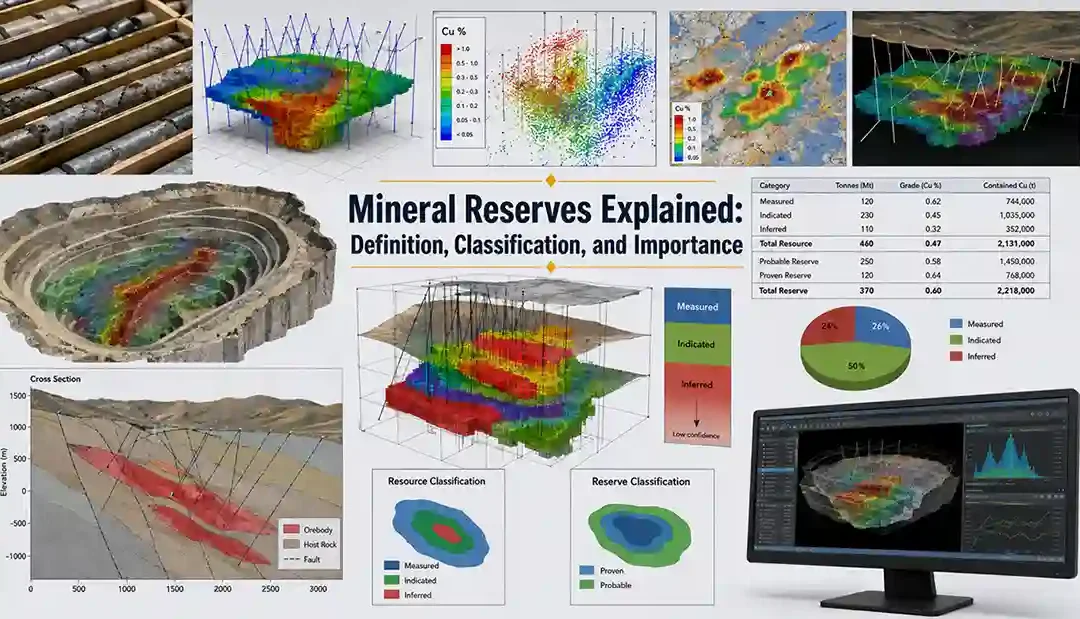
Not every mineral deposit can be mined profitably. Before mining companies invest billions of dollars into developing a mine, they must determine whether a deposit contains enough economically recoverable material.This is where mineral reserves become important.
Mineral reserves represent the portion of a mineral resource that can be extracted economically under current conditions. They are one of the most important measurements used in mining, investment, and resource management.
What Are Mineral Reserves?
A mineral reserve is the economically mineable part of a measured or indicated mineral resource.
A reserve must satisfy several requirements:
- geological confidence
- mining feasibility
- economic viability
- legal permissions
- environmental considerations
In simple terms, a mineral reserve is a resource that can currently be mined profitably.
Mineral Resources vs Mineral Reserves
Many people confuse resources and reserves.
Mineral Resource
A concentration of minerals with reasonable prospects for economic extraction.
Mineral Reserve
The economically mineable portion of a mineral resource.
Resource vs Reserve
| Feature | Mineral Resource | Mineral Reserve |
|---|---|---|
| Geological Evidence | Yes | Yes |
| Economic Evaluation | Limited | Complete |
| Mine Planning | Not Required | Required |
| Profitability Proven | No | Yes |
| Ready for Mining | Not Always | Usually |
Why Mineral Reserves Matter
Mineral reserves are important because they:
Support Mine Development
Provide confidence for investment.
Guide Production Planning
Help determine mine life.
Attract Investors
Demonstrate economic value.
Improve Resource Management
Allow efficient extraction planning. Without reserves, mining projects cannot move forward.
How Mineral Reserves Are Estimated
Reserve estimation combines:
Geological Data
Understanding the deposit.
Drill Results
Confirming ore continuity.
Ore Grade Analysis
Determining metal concentration.
Mining Studies
Evaluating extraction methods.
Economic Assessments
Determining profitability.
The Reserve Estimation Process
1. Exploration
Locate mineralization.
2. Drilling
Collect geological information.
3. Resource Estimation
Calculate mineral resources.
4. Feasibility Study
Assess economic viability.
5. Reserve Conversion
Convert resources into reserves.
Reserve Estimation Workflow
| Stage | Purpose |
|---|---|
| Exploration | Discover deposit |
| Drilling | Collect data |
| Resource Estimation | Define resources |
| Feasibility Study | Evaluate economics |
| Reserve Declaration | Establish reserves |
Mineral Reserve Classifications
Most international reporting systems classify reserves into two main categories.
1. Proven Mineral Reserves
Proven reserves have:
- high geological confidence
- detailed drilling information
- demonstrated economic viability
They represent the most reliable reserve estimates.
2. Probable Mineral Reserves
Probable reserves have:
- slightly lower confidence
- sufficient economic evidence
- realistic mining potential
They are still considered economically mineable.
Reserve Categories
| Category | Confidence Level |
|---|---|
| Proven Reserve | Very High |
| Probable Reserve | High |
Relationship Between Resources and Reserves
Resources are typically classified as:
Measured Resources
Highest geological confidence.
Indicated Resources
Moderate confidence.
Inferred Resources
Lowest confidence.
Reserve conversion generally follows:
Measured Resource → Proven Reserve
Indicated Resource → Probable Reserve
Resource and Reserve Hierarchy
| Classification | Confidence |
|---|---|
| Inferred Resource | Low |
| Indicated Resource | Moderate |
| Measured Resource | High |
| Probable Reserve | High |
| Proven Reserve | Very High |
Cut-Off Grade
The cut-off grade determines the minimum grade required for profitable mining.
For example:
- low-grade material may remain unmined
- high-grade material becomes ore
The cut-off grade changes depending on:
- metal prices
- operating costs
- recovery rates
Factors Affecting Mineral Reserves
Reserve estimates can change because of:
Commodity Prices
Higher prices may increase reserves.
Mining Technology
Improved methods increase recoverability.
Operating Costs
Higher costs may reduce reserves.
Geological Information
Additional drilling improves confidence.
Government Regulations
Permitting affects reserve status.
Feasibility Studies
Before reserves are declared, mining companies conduct:
Preliminary Feasibility Studies
Initial economic evaluation.
Definitive Feasibility Studies
Detailed mine planning and economics.
These studies determine whether a project can operate profitably.
Reserve Reporting Standards
Most mining companies report reserves using recognized standards.
Examples include:
JORC Code
NI 43-101
CRIRSCO
These standards ensure consistency and transparency.
Mineral Reserves and Mine Life
Reserve size directly influences:
Mine Life
How long a mine can operate.
Production Planning
Annual output rates.
Financial Forecasting
Expected revenues.
Large reserves often support decades of mining activity.
Examples of Mineral Reserves
Common reserve types include:
Gold Reserves
Measured in ounces or tonnes.
Copper Reserves
Measured in tonnes of contained metal.
Iron Ore Reserves
Measured in ore tonnage and grade.
Lithium Reserves
Measured in lithium content.
Coal Reserves
Measured in recoverable tonnage.
Modern Reserve Modeling
Modern reserve estimation uses:
- 3D geological models
- geostatistics
- AI-assisted analysis
- mine planning software
- resource simulation
These technologies improve reserve accuracy and confidence.
Why Mineral Reserves Are Important for Investors
Investors often evaluate:
- reserve size
- reserve grade
- reserve life
- production potential
Companies with large proven reserves often attract greater investment interest.
Mineral Reserves Summary
| Aspect | Description |
|---|---|
| Definition | Economically Mineable Resource |
| Main Categories | Proven, Probable |
| Basis | Geological + Economic Analysis |
| Purpose | Mine Planning |
| Importance | Investment & Production |
A mineral reserve is the economically mineable part of a mineral resource that has been evaluated through geological and economic studies.
A resource has geological potential, while a reserve has demonstrated economic viability.
Proven reserves are the highest-confidence category of mineral reserves with strong geological and economic support.
Probable reserves are economically mineable reserves with slightly lower confidence than proven reserves.
Yes. Changes in metal prices, technology, costs, and geological information can increase or decrease reserves.
Final Thoughts
Mineral reserves are the foundation of mine development and investment decisions. They represent the portion of Earth's mineral resources that can be mined economically and responsibly under current conditions.
Through exploration, drilling, resource estimation, and feasibility studies, geologists and mining engineers transform mineral discoveries into proven and probable reserves that support modern mining operations. Understanding mineral reserves is essential for anyone studying economic geology, mining, or natural resource management.
Continue learning with → /mineral-resources-explained/, /ore-deposits-explained/, and /mineral-exploration-explained/.