
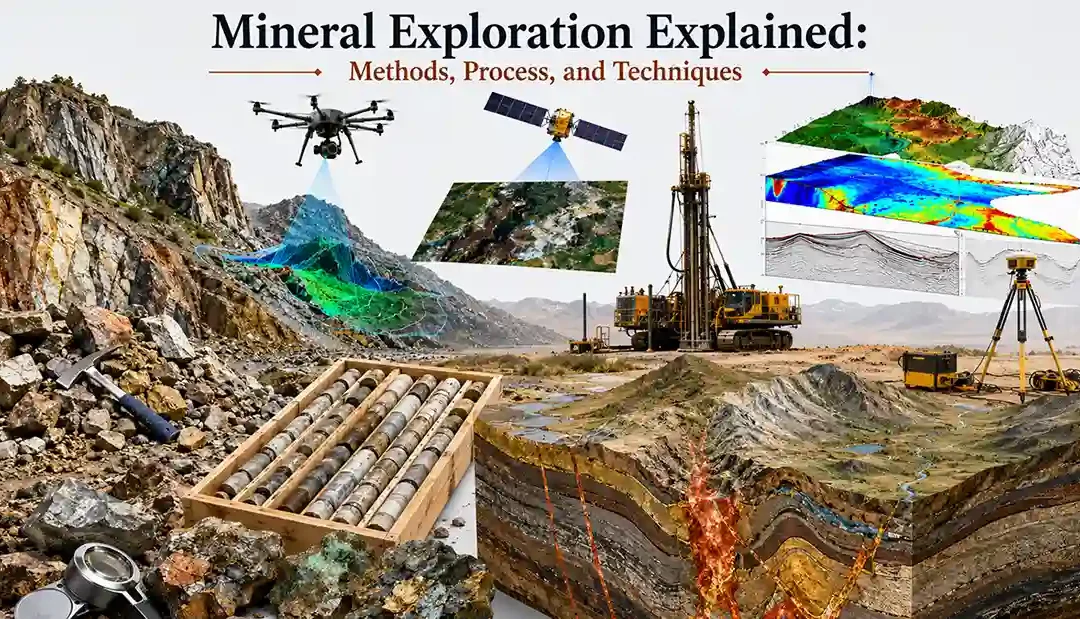
Mineral exploration is the scientific process of searching for valuable mineral deposits within Earth's crust. Before a mine can be developed, geologists must first locate, evaluate, and verify the existence of economically viable mineral resources.
Mineral exploration is essential for discovering:
- gold deposits
- copper resources
- iron ore
- lithium deposits
- rare earth elements
- industrial minerals
Modern exploration combines geology, geochemistry, geophysics, remote sensing, and drilling technologies to identify hidden mineral resources.
What Is Mineral Exploration?
Mineral exploration is the process of locating and evaluating mineral deposits that may be economically mined in the future.
The goal is to answer:
- Where are the minerals?
- How large is the deposit?
- What is the ore grade?
- Can it be mined profitably?
Exploration is the first stage of the mining cycle.
Exploration and Mining Relationship
| Stage | Purpose |
|---|---|
| Exploration | Find deposits |
| Resource Evaluation | Estimate size |
| Mine Planning | Design extraction |
| Mining | Extract ore |
| Processing | Recover minerals |
Why Mineral Exploration Is Important
Mineral exploration helps:
Discover New Resources
Locate previously unknown deposits.
Support Economic Growth
Provide future mining opportunities.
Supply Critical Minerals
Support renewable energy technologies.
Improve Resource Security
Reduce dependence on imports.
Without exploration, future mineral supplies would eventually decline.
The Mineral Exploration Process
Exploration typically progresses through several stages.
1. Regional Reconnaissance
Identify promising geological regions.
2. Prospect Identification
Locate potential mineralized zones.
3. Detailed Exploration
Collect detailed geological data.
4. Drilling
Test underground mineralization.
5. Resource Estimation
Calculate size and grade.
6. Feasibility Studies
Determine economic potential.
Stages of Mineral Exploration
| Stage | Objective |
|---|---|
| Reconnaissance | Find targets |
| Prospecting | Locate mineralization |
| Detailed Surveys | Define targets |
| Drilling | Verify resources |
| Resource Estimation | Measure deposit |
| Feasibility | Assess economics |
Geological Mapping
Geological mapping is often the first exploration method used.
Geologists study:
- rock types
- geological structures
- faults
- folds
- alteration zones
Mapping helps identify areas favorable for mineral deposits.
Geochemical Exploration
Geochemistry analyzes chemical elements in:
Soil
Detect buried mineralization.
Rocks
Identify ore-related elements.
Stream Sediments
Locate upstream mineral sources.
Water Samples
Detect dissolved metals.
Common pathfinder elements include:
- arsenic
- copper
- zinc
- lead
- gold
Geophysical Exploration
Geophysical methods detect hidden deposits without excavation.
Major techniques include:
Magnetic Surveys
Measure magnetic variations.
Gravity Surveys
Detect density differences.
Electrical Methods
Measure conductivity.
Seismic Surveys
Map subsurface structures.
Electromagnetic Surveys
Locate conductive ore bodies.
Common Geophysical Methods
| Method | Detects |
|---|---|
| Magnetic | Magnetic Minerals |
| Gravity | Dense Ore Bodies |
| Electrical | Conductive Minerals |
| Seismic | Geological Structures |
| Electromagnetic | Sulfide Deposits |
Remote Sensing
Modern exploration increasingly uses:
Satellite Imagery
Large-scale geological analysis.
Drone Surveys
High-resolution mapping.
Hyperspectral Imaging
Mineral identification.
LiDAR
Detailed topographic mapping.
Remote sensing helps identify targets quickly and efficiently.
Exploration Drilling
Drilling is the only way to directly test a deposit underground.
Common drilling methods include:
Diamond Drilling
Produces cylindrical rock cores.
Reverse Circulation Drilling
Collects rock chips.
Rotary Drilling
Used for large-scale programs.
Drilling confirms:
- ore grade
- deposit thickness
- depth
- continuity
Drill Core Logging
After drilling, geologists examine:
- rock types
- mineralization
- structures
- alteration zones
Drill cores provide critical information about underground geology.
Resource Estimation
Geologists estimate:
Ore Grade
Amount of valuable material.
Tonnage
Size of the deposit.
Resource Classification
Level of confidence.
These estimates determine whether a deposit may become a mine.
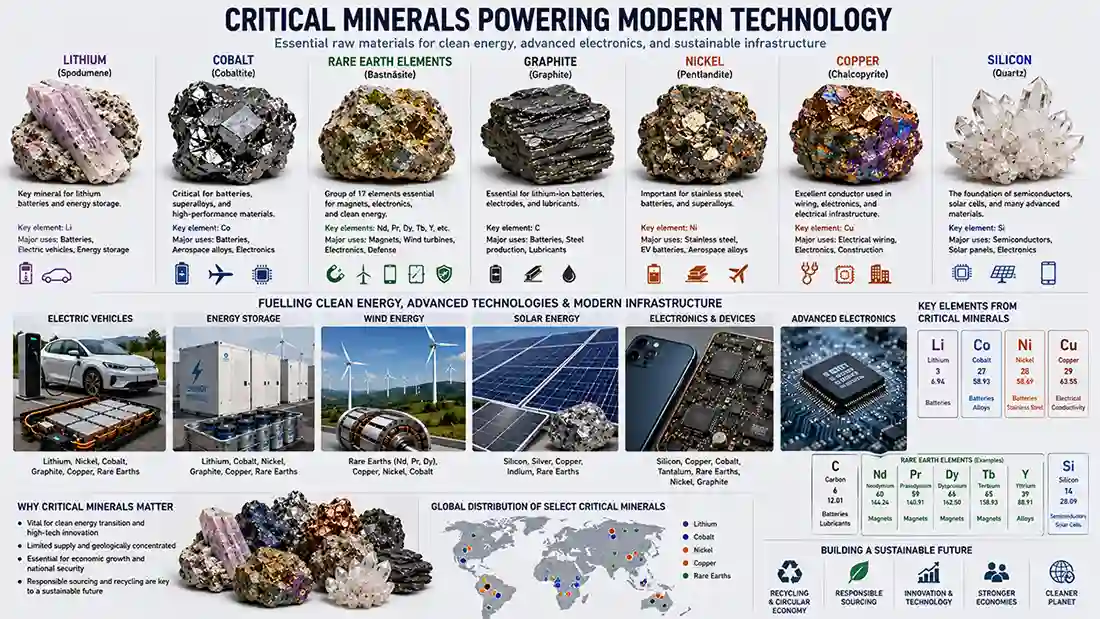
Exploration for Critical Minerals
Exploration is increasingly focused on:
- lithium
- cobalt
- nickel
- rare earth elements
- graphite
- copper
These resources are essential for:
- electric vehicles
- renewable energy
- battery storage
Learn more → critical-minerals-for-technology
Mineral Exploration Technologies
Modern exploration uses:
- GIS software
- artificial intelligence
- machine learning
- drones
- satellite imagery
- 3D geological modeling
These technologies improve exploration efficiency and success rates.
Challenges in Mineral Exploration
Deep Deposits
Easier deposits have often already been found.
Exploration Costs
Drilling programs are expensive.
Environmental Regulations
Permitting can be complex.
Geological Complexity
Ore deposits are difficult to predict.
Despite these challenges, exploration remains essential for future resource discovery.
Famous Mineral Discoveries
Notable discoveries made through exploration include:
- Olympic Dam
- Voisey's Bay
- Escondida
- Oyu Tolgoi
These discoveries transformed regional economies and global mineral supply.
Major Exploration Methods
| Method | Purpose |
|---|---|
| Geological Mapping | Identify favorable rocks |
| Geochemistry | Detect mineral anomalies |
| Geophysics | Locate hidden deposits |
| Remote Sensing | Regional targeting |
| Drilling | Confirm mineralization |
Mineral exploration is the process of searching for and evaluating mineral deposits that may be economically mined.
Drilling is considered the most important method because it directly tests underground mineralization.
Geological mapping involves studying and recording rock types, structures, and geological features at the surface.
Geophysical surveys help detect hidden mineral deposits without excavation.
It ensures future supplies of metals, industrial minerals, and critical resources needed for society and technology.
Final Thoughts
Mineral exploration is the foundation of the mining industry and one of the most important activities in economic geology. Through geological mapping, geochemical surveys, geophysical methods, remote sensing, and drilling, geologists discover the mineral resources that support modern civilization.
As demand for critical minerals and renewable energy resources grows, mineral exploration will remain essential for securing future supplies and advancing sustainable resource development.
Continue learning with → ore-deposits-explained, economic-geology-explained, and mining-and-mineral-extraction.