
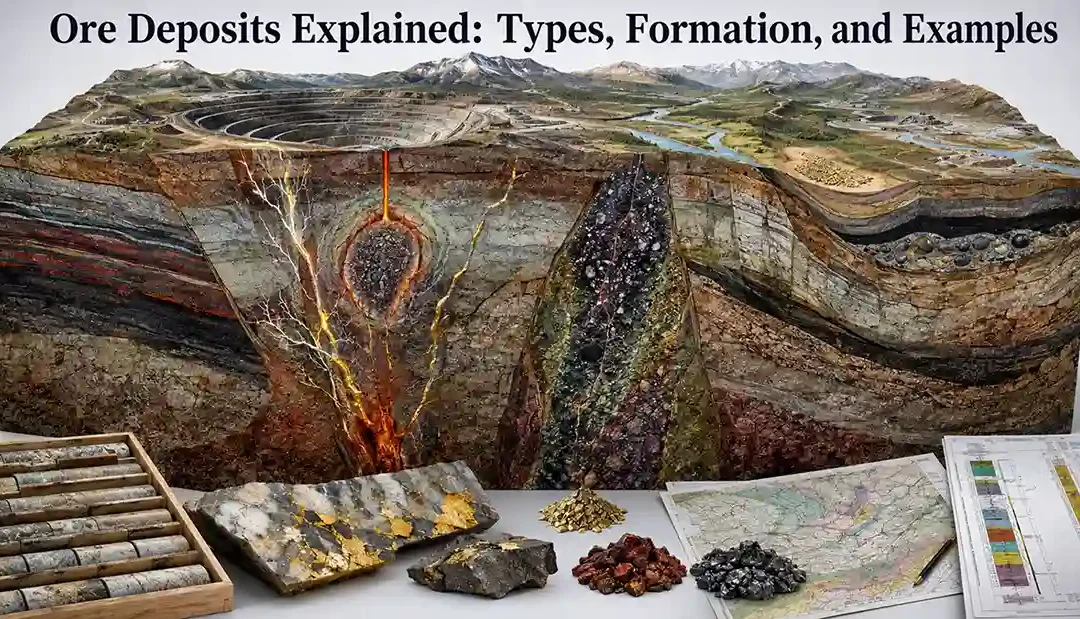
Ore deposits are the foundation of the mining industry and the primary source of the metals used in modern society. From the copper in electrical wiring to the gold in electronics and the iron used in steel production, nearly every metal originates from an ore deposit.
Economic geologists study ore deposits to understand:
- how valuable minerals form
- where they occur
- how they can be discovered
- whether they can be mined profitably
Understanding ore deposits is one of the most important topics in economic geology.
What Is an Ore Deposit?
An ore deposit is a naturally occurring concentration of valuable minerals that can be extracted economically.
An ore deposit must contain:
- valuable minerals
- sufficient concentration
- economic value
- recoverable resources
Not every mineral occurrence is an ore deposit. Many mineral deposits contain useful minerals but lack the concentration needed for profitable extraction.
Ore Deposit vs Mineral Deposit
Mineral Deposit
Any concentration of minerals within Earth's crust.
Ore Deposit
A mineral deposit that can be mined profitably.
Mineral Deposit vs Ore Deposit
| Feature | Mineral Deposit | Ore Deposit |
|---|---|---|
| Valuable Minerals | Yes | Yes |
| Economic Value | Not Always | Yes |
| Mining Potential | Possible | Proven |
| Profitability | Uncertain | Economic |
Components of an Ore Deposit
Most ore deposits contain:
Ore Minerals
Minerals that contain valuable metals.
Examples:
- chalcopyrite
- galena
- sphalerite
- cassiterite
Gangue Minerals
Non-economic minerals associated with ore.
Examples:
- quartz
- calcite
- feldspar
- mica
How Ore Deposits Form
Ore deposits form through geological processes that concentrate valuable elements into economically significant quantities.
Major formation processes include:
- magmatic activity
- hydrothermal circulation
- sedimentation
- weathering
- metamorphism
Major Types of Ore Deposits
Magmatic Ore Deposits
Form directly from cooling magma.
Examples:
- chromite deposits
- platinum group element deposits
- nickel sulfide deposits
These deposits develop when heavy minerals crystallize and settle within magma chambers.
Hydrothermal Ore Deposits
Hydrothermal deposits form when hot fluids transport and deposit metals.
Common commodities:
- gold
- silver
- copper
- lead
- zinc
Hydrothermal systems create many of the world's richest ore deposits.
Porphyry Deposits
Large hydrothermal systems associated with igneous intrusions.
Examples:
- copper porphyries
- molybdenum porphyries
- gold-copper porphyries
Porphyry deposits supply much of the world's copper.
Sedimentary Ore Deposits
Form through sedimentary processes.
Examples:
- banded iron formations
- phosphate deposits
- manganese deposits
These deposits often cover large geographic areas.
Placer Deposits
Form through weathering and erosion.
Heavy minerals accumulate in:
- river channels
- beaches
- stream beds
Examples:
- gold placers
- diamond placers
- cassiterite placers
Metamorphic Ore Deposits
Created or modified by heat and pressure.
Examples:
- graphite deposits
- talc deposits
- some gemstone deposits
Major Ore Deposit Types
| Deposit Type | Example Commodity |
|---|---|
| Magmatic | Chromite |
| Hydrothermal | Gold |
| Porphyry | Copper |
| Sedimentary | Iron |
| Placer | Gold |
| Metamorphic | Graphite |
Hydrothermal Ore Deposits
Hydrothermal systems form when:
- magma heats groundwater
- hot fluids dissolve metals
- fluids move through fractures
- minerals precipitate and form ore bodies
These deposits often contain:
- gold
- silver
- copper
- zinc
- lead
Ore Grades
Ore grade measures the concentration of valuable material within an ore deposit.
Examples:
Gold
Measured in grams per tonne (g/t).
Copper
Measured as a percentage.
Iron
Measured as percentage Fe.
Higher grades generally mean higher economic value.
Major Metals Produced from Ore Deposits
Iron
Steel production.
Copper
Electrical systems.
Gold
Investment and technology.
Silver
Electronics and jewelry.
Zinc
Galvanized steel.
Nickel
Battery manufacturing.
Ore Deposits and Mining
Before a mine is developed, geologists evaluate:
Resource Size
How much ore exists?
Ore Grade
How rich is the deposit?
Mining Method
Can it be mined efficiently?
Economic Feasibility
Will the project be profitable?
Ore Deposit Exploration
Common exploration methods include:
Geological Mapping
Studying rocks and structures.
Geochemical Surveys
Analyzing soils and rocks.
Geophysical Surveys
Detecting buried mineralization.
Diamond Drilling
Confirming ore bodies underground.
Why Ore Deposits Matter
Ore deposits provide the raw materials needed for:
- infrastructure
- transportation
- technology
- renewable energy
- manufacturing
Without ore deposits, modern civilization would not have access to essential metals and minerals.
Importance of Ore Deposits
| Industry | Resource Obtained |
|---|---|
| Construction | Iron Ore |
| Electronics | Copper, Gold |
| Energy | Uranium |
| Transportation | Aluminum, Iron |
| Renewable Energy | Lithium, Nickel |
An ore deposit is a concentration of valuable minerals that can be mined profitably.
Ore deposits form through geological processes such as magmatism, hydrothermal activity, sedimentation, weathering, and metamorphism.
Hydrothermal deposits are among the most important because they contain many major metal resources.
Ore grade is the concentration of valuable minerals within an ore deposit.
Ore deposits provide the metals and minerals needed for construction, manufacturing, technology, and energy production.
Final Thoughts
Ore deposits are the Earth's natural concentrations of valuable minerals and metals. They form through a variety of geological processes and provide the resources needed to support modern civilization.
From gold-bearing hydrothermal veins to giant copper porphyry systems and iron-rich sedimentary formations, ore deposits are central to economic geology, mineral exploration, and mining. Understanding how these deposits form helps geologists discover new resources and manage them responsibly for future generations.
Continue learning with → economic-geology-explained,and mineral-resources-explained.