
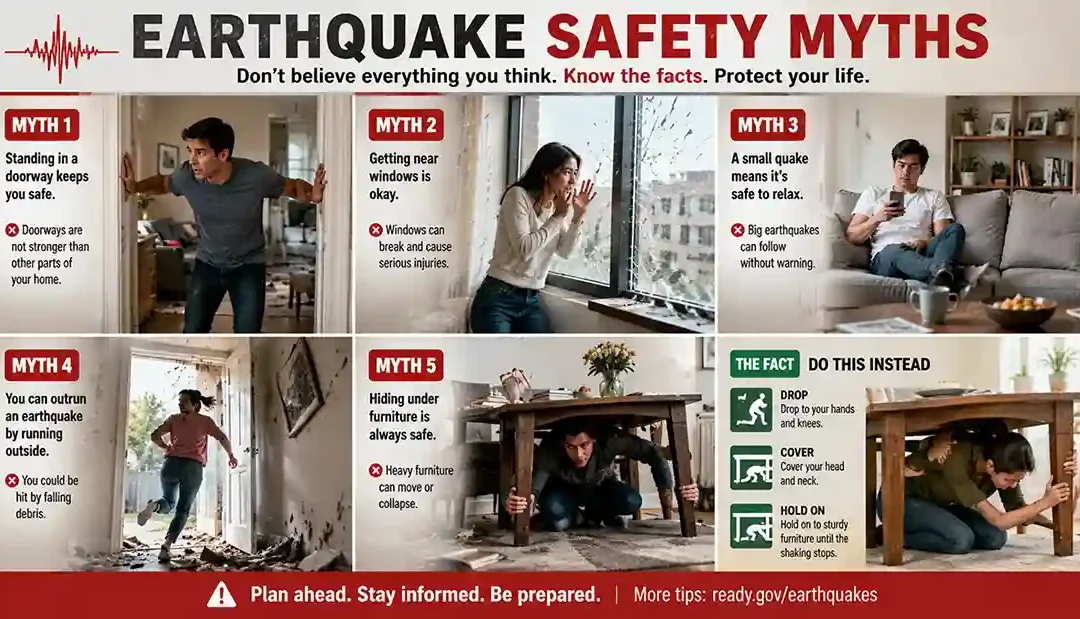
Earthquakes happen suddenly, which means people often rely on instinct, old advice, or misinformation during emergencies. Unfortunately, many popular earthquake “safety tips” are outdated or incorrect.
Some myths can actually:
- increase injuries
- delay evacuation
- create panic
- place people in more dangerous locations
Understanding the truth behind earthquake safety myths can help people make safer decisions during strong shaking.
If you’re new to earthquakes, begin here → what is an earthquake
Most Dangerous Earthquake Safety Myths
Most Dangerous Earthquake Safety Myths
Common earthquake misconceptions that may increase danger during emergencies.
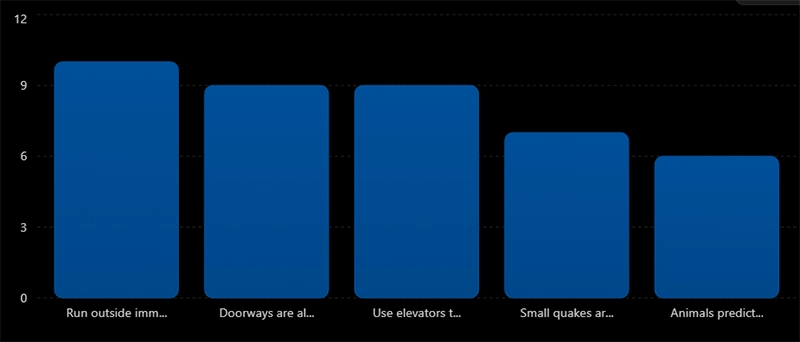
Myth 1: “You Should Run Outside Immediately”
This is one of the most dangerous earthquake myths.
Why It’s Wrong
Outside areas near buildings may contain:
- falling glass
- collapsing walls
- flying debris
- power line hazards
In many situations, staying indoors and taking cover is safer during shaking.
Modern Safety Recommendation
- Drop,
- Cover, and
- Hold On
Learn more → what not to do during an earthquake
Myth 2: “Doorways Are the Safest Place”
Older buildings sometimes had stronger doorframes.
But modern homes and buildings are different.
Why This Myth Is Misleading
Doorways:
- may not be structurally stronger
- offer little protection from falling debris
- can become crowded and dangerous
Modern earthquake guidance usually recommends sturdy furniture instead.
Myth 3: “Use Elevators During Evacuation”
Elevators can become extremely dangerous during earthquakes.
Possible Risks
- power failures
- mechanical damage
- trapped occupants
- sudden stops between floors
Stairs are generally safer after shaking stops.
Myth 4: “Small Earthquakes Are Never Dangerous”
Even moderate earthquakes can cause:
- injuries
- falling debris
- structural damage
Important Fact
Shallow earthquakes can sometimes feel stronger than larger deep earthquakes.
Earthquake danger depends on:
- depth
- location
- building quality
- local geology
Myth 5: “Earthquakes Can Be Predicted Exactly”
Scientists can identify:
- high-risk regions
- active fault systems
- long-term earthquake probabilities
But they cannot currently predict:
- exact dates
- exact locations
- exact magnitudes
No scientific method can reliably predict earthquakes precisely today.
Learn more → earthquake prediction methods
Myth 6: “Animals Always Predict Earthquakes”
Some animals may react strangely before earthquakes.
However:
- evidence is inconsistent
- behavior is difficult to verify scientifically
- unusual behavior does not reliably predict earthquakes
Scientists continue researching this topic, but no proven animal prediction system exists.
Myth 7: “Modern Buildings Never Collapse”
Modern buildings are often safer because of seismic engineering.
But:
- extremely powerful earthquakes can still cause damage
- poor construction remains dangerous
- older structures inside modern cities may still collapse
Earthquake-resistant does not mean earthquake-proof.
Learn more → earthquake safety in buildings
Myth 8: “Aftershocks Are Always Small”
Most aftershocks are smaller than the main earthquake.
But some can still be:
- powerful
- damaging
- dangerous to weakened buildings
Aftershocks can continue for days, weeks, or even months.
Learn more → earthquake aftershocks explained
Earthquake Myth vs Reality
| Myth | Reality |
|---|---|
| Run outside immediately | Falling debris can be deadly |
| Doorways are safest | Sturdy furniture is usually safer |
| Elevators are safe during quakes | Elevators can fail |
| Earthquakes can be predicted exactly | Exact prediction is not possible |
| Small earthquakes are harmless | Some still cause injuries |
Correct information improves earthquake survival.
Why Earthquake Misinformation Spreads
Earthquake myths often survive because:
- older advice gets repeated
- movies exaggerate disasters
- panic spreads quickly during emergencies
- outdated information remains online
Scientific earthquake safety guidance continues improving over time.
Countries With Strong Earthquake Safety Education
Earthquake-prone countries often teach updated safety practices through:
- school drills
- emergency broadcasts
- workplace training
- public awareness campaigns
Examples include:
- Japan
- New Zealand
- Chile
- California
Prepared communities usually experience fewer injuries.
Why Modern Earthquake Safety Focuses on Protection
Modern earthquake safety research shows:
- most injuries come from falling debris
- immediate protective action saves lives
- calm decision-making improves survival
That’s why modern guidance emphasizes: Drop, Cover, and Hold On
Can Early Warning Systems Reduce Dangerous Mistakes?
Some countries use:
- earthquake early warning systems
- mobile alerts
- automated emergency alarms
These systems may provide:
- a few seconds of warning
- enough time to take cover properly
Learn more → earthquake early warning systems
Usually no — falling debris can make outdoor areas dangerous.
Modern safety guidance usually recommends sturdy furniture instead.
No — exact earthquake prediction is not currently possible.
No — some aftershocks can still be dangerous.
Final Thoughts
Earthquake safety myths can increase danger during real emergencies by spreading outdated or incorrect advice. Understanding accurate earthquake safety information helps people react faster, avoid dangerous mistakes, and protect themselves more effectively during strong shaking.
Preparedness, scientific knowledge, and calm decision-making remain some of the best tools for earthquake survival.