
When a major earthquake strikes, the sudden violent shaking can shatter buildings, split roads, and disrupt communities in seconds. Yet for the survivors of a seismic disaster, the initial rupture is rarely the end of the ordeal. In the minutes, days, and months following the initial event, the ground often continues to tremble under the influence of an aftershock earthquake.
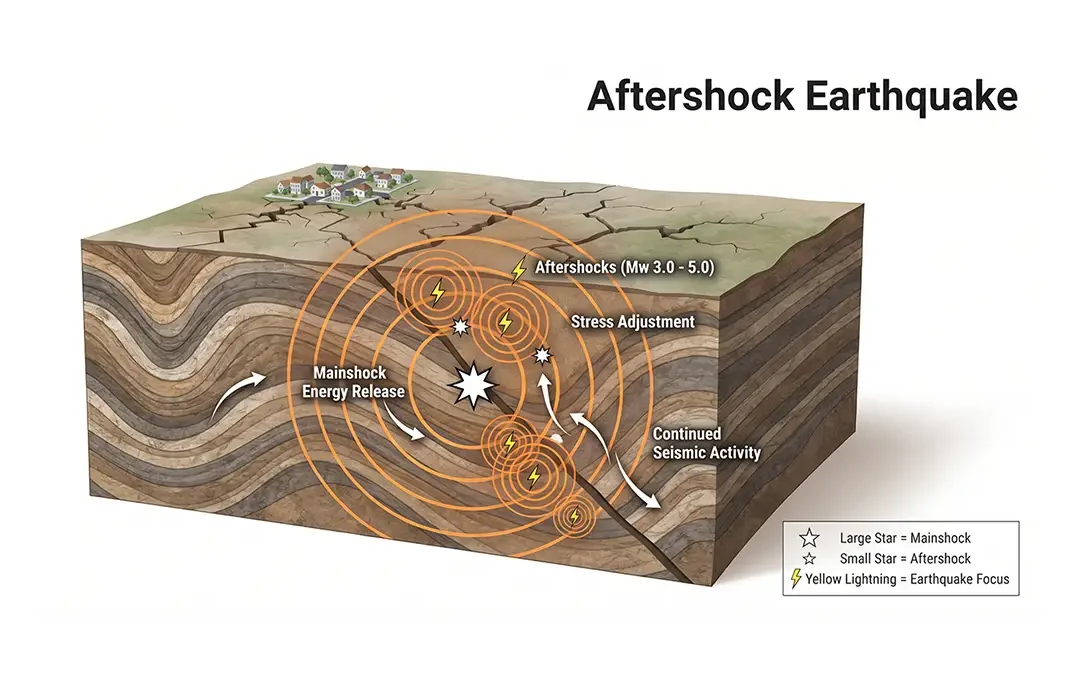
An aftershock earthquake is a smaller earthquake that occurs in the same general region following a larger preceding earthquake (known as the mainshock). When a geological fault slips violently, it does not instantly relieve all the tectonic strain stored in Earth's crust. Instead, aftershocks represent the crust's natural process of settling, redistributing mechanical stress, and establishing a new state of equilibrium.
If you’re new to earthquakes, begin here → what is an earthquake
Main Earthquake Sequence Types
Chronological Earthquake Sequence Types
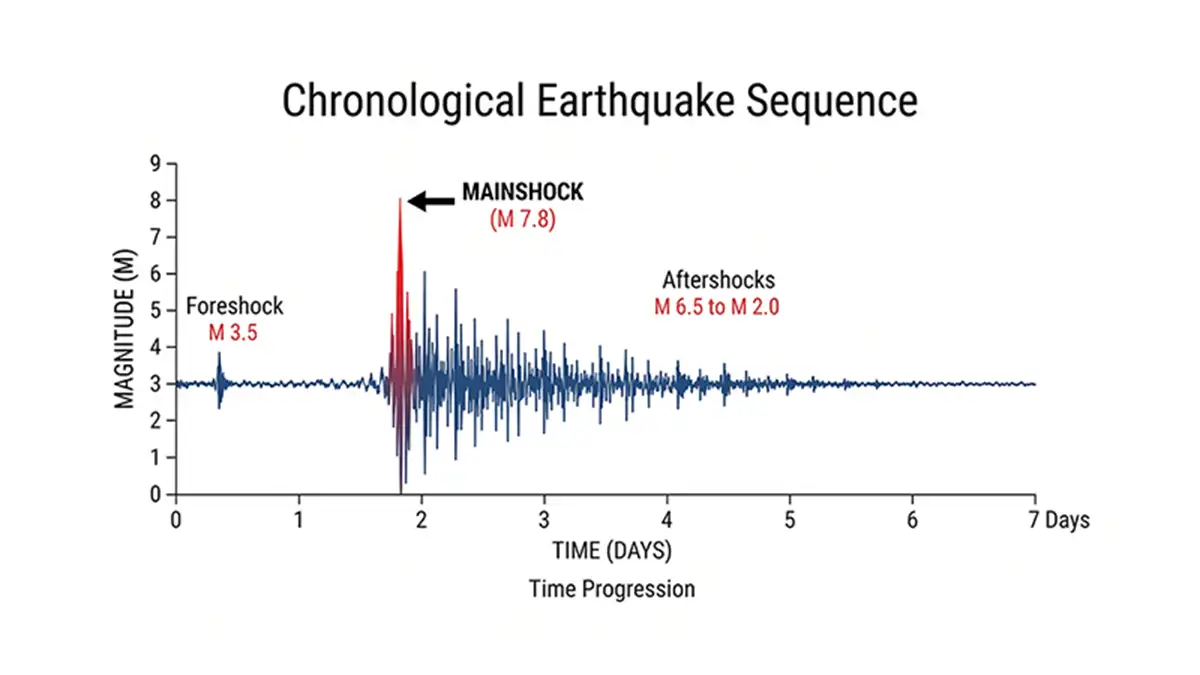
Earthquakes rarely happen in total isolation. Seismologists classify seismic events within an earthquake sequence based on their relative size and chronological order. Comparison of the three main earthquake sequence categories.
- Foreshock: A relatively small earthquake that precedes a larger earthquake in the same location. Not all earthquakes have foreshocks; geologists cannot determine whether an earthquake is a foreshock until a larger event occurs afterward.
- Mainshock: The largest earthquake in a given seismic sequence. It releases the majority of the total seismic energy.
- Aftershock: A series of smaller earthquakes that follow the mainshock within its rupture zone.
| Earthquake Stage | Description |
|---|---|
| Foreshocks | Smaller earthquakes occurring before the mainshock |
| Mainshock | The largest earthquake in the sequence |
| Aftershocks | Smaller earthquakes occurring after the mainshock |
What Is an Aftershock?
In seismology, an aftershock is defined as any secondary seismic event that occurs within the structural rupture zone of a larger previous earthquake and is caused by the physical adjustments of the fault system.
When a major earthquake happens, tectonic plates slide past, under, or over one another along a fracture known as a fault line. The primary point of rupture releases immense amounts of stored elastic energy. However, fault surfaces are not smooth, polished planes; they are jagged, rough, and locked by uneven friction.
Because the initial rupture is imperfect, adjacent blocks of rock around the fault are left under severe, localized mechanical stress. As these strained sections fracture and slip to accommodate the new displacement, they trigger smaller secondary quakes.
The spatial area where these secondary tremors occur is called the aftershock zone. The size of an aftershock zone is directly proportional to the size of the mainshock's rupture surface. A moderate magnitude 5.0 quake might produce an aftershock zone spanning only a few kilometers, whereas a catastrophic magnitude 9.0 subduction earthquake can generate an aftershock zone extending over 500 to 1,000 kilometers along a plate boundary.
Why Do Aftershocks Happen?
When a major earthquake occurs:
- the fault suddenly slips
- stress redistributes underground
- nearby rocks and fault segments adjust
- additional smaller ruptures occur
These smaller adjustments create aftershocks.
How Long Do Aftershocks Last?
The duration of an aftershock sequence depends heavily on the magnitude of the mainshock and the regional tectonic setting:
- Small to Moderate Quakes (Magnitude 5.0–6.0): Aftershocks typically taper off within a few weeks to several months.
- Major Quakes (Magnitude 7.0–7.9): Measurable aftershocks routinely persist for one to three years.
- Great Megathrust Quakes (Magnitude 8.0–9.5): Aftershock sequences can continue for decades.
A famous example is the 1811–1812 New Madrid Earthquakes in the central United States. Because the earthquakes occurred within a stable continental interior where tectonic stress accumulates and relaxes very slowly, geologists have identified ongoing low-level micro-earthquakes in Missouri and Tennessee that are likely lingering aftershocks from the 1811 events, continuing more than 200 years later.
Similarly, the massive 2011 Tohoku Earthquake (Mw 9.1) in Japan produced tens of thousands of recorded aftershocks, with notable magnitude 6.0+ aftershocks continuing to rattle the coastline more than a decade after the initial disaster.
Can Aftershocks Be Dangerous?
Yes.
Large aftershocks can:
- collapse already damaged buildings
- trigger landslides
- create panic
- disrupt rescue operations
In some disasters, aftershocks caused additional destruction after the main earthquake.
Where Aftershocks Usually Occur
Aftershocks usually happen:
- along the original fault
- near the rupture zone
- in nearby stressed crustal regions
Some aftershock zones stretch hundreds of kilometers.
Difference Between Foreshocks and Mainshock
| Type | Happens When? |
|---|---|
| Foreshock | Before the main earthquake |
| Mainshock | Largest earthquake |
| Aftershock | After the main earthquake |
Scientists often cannot identify a foreshock until after the main earthquake occurs.
Famous Earthquake Aftershock Sequences
1. Christchurch Earthquake Sequence
The Christchurch earthquake sequence included:
- hundreds of aftershocks
- repeated urban shaking
- long-term seismic activity
Explore → earthquakes Christchurch NZ
2. Japan Tohoku Aftershocks
After the 2011 Tohoku earthquake:
- thousands of aftershocks occurred
- seismic activity continued for years
- some aftershocks exceeded magnitude 7
Learn more → earthquakes Tokyo region
3. Turkey–Syria Earthquake Aftershocks
The 2023 earthquake sequence included:
- strong aftershocks
- widespread regional seismic activity
- continued structural risk after the main event
Explore → Istanbul fault zone
Why Scientists Monitor Aftershocks Closely
Aftershocks help scientists:
- map hidden fault ruptures
- understand stress redistribution
- study earthquake behavior
- estimate future hazard zones
Modern seismic networks track aftershocks in real time.
Learn more → earthquake monitoring technology
Can Aftershocks Trigger More Earthquakes?
Sometimes.
Large earthquakes can transfer stress to nearby faults.
This may:
- increase seismic activity
- trigger additional earthquakes
- activate nearby fault systems
Earthquake systems are often interconnected underground.
Can Aftershocks Be Predicted?
Scientists cannot predict exact aftershocks.
But they can estimate:
- likely aftershock zones
- general probability
- expected frequency decline over time
Learn more → earthquake prediction methods
Fault adjustments after a major earthquake.
Days, months, or even years after very large earthquakes.
Yes — especially near damaged buildings.
Usually no, but some large events initially mistaken as mainshocks later become classified as foreshocks.
Conclusion
Aftershocks are a natural part of the earthquake cycle and occur because Earth’s crust continues adjusting after a major seismic rupture. Although they are usually smaller than the original earthquake, aftershocks can still remain dangerous and continue for long periods after major seismic events.
Understanding aftershocks helps explain why earthquake activity often continues long after the first major shaking stops.