
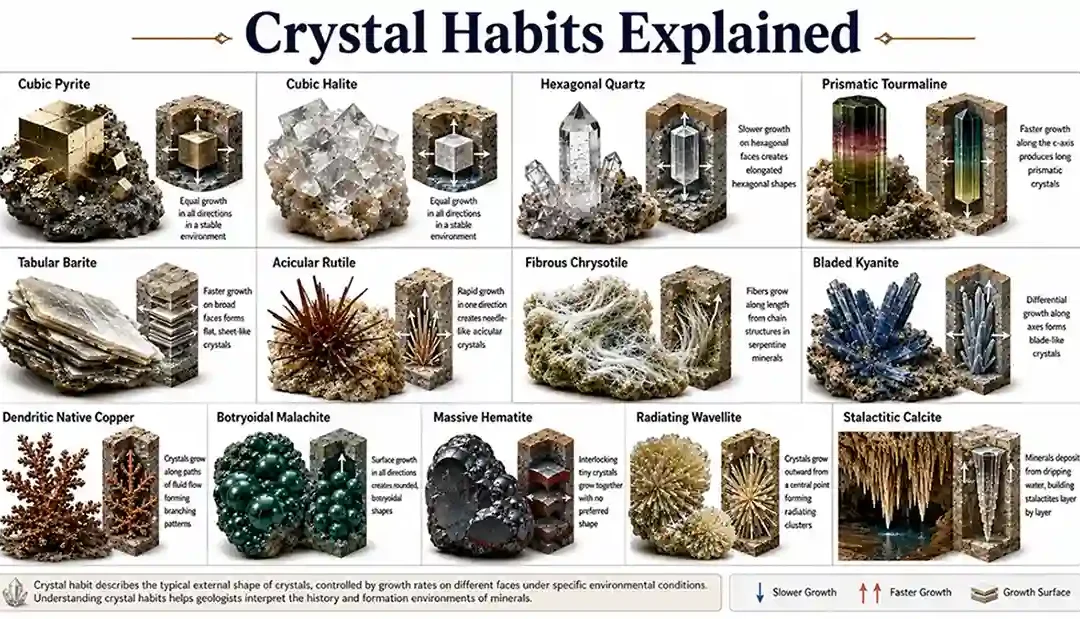
Crystal habit describes the external shape or appearance that a mineral crystal develops during growth. Although a mineral's internal atomic arrangement determines its crystal structure, environmental conditions such as available space, temperature, pressure, and growth rate influence its outward form.
The same mineral can display different crystal habits depending on where and how it forms. For example, quartz may grow as long hexagonal prisms in open cavities, massive aggregates in veins, or fine-grained crystals in igneous rocks.
Crystal habits are one of the first characteristics geologists use to identify minerals in the field and laboratory. Understanding crystal habits helps explain crystal growth, mineral identification, and geological environments.
This topic should be studied together with How Crystals Form Explained, Crystal Growth Environments Explained, and Mineralogy Explained.
What Is Crystal Habit?
Crystal habit is the characteristic external shape that a mineral develops during crystal growth.
Crystal habit depends on:
- Crystal structure
- Growth environment
- Available space
- Growth rate
- Temperature
- Pressure
- Chemical composition
It describes how a crystal looks, not its internal atomic arrangement.
Crystal Habit vs Crystal Structure
Although the terms are sometimes confused, they are different.
| Crystal Habit | Crystal Structure |
|---|---|
| External shape | Internal atomic arrangement |
| Visible to the eye | Visible using crystallographic methods |
| Influenced by growth conditions | Fixed by atomic structure |
| May vary | Remains constant for a mineral species |
For example, quartz always has the same crystal structure but may display several different crystal habits.
Why Crystal Habits Are Important
Crystal habits help geologists:
- Identify minerals
- Interpret crystal growth conditions
- Recognize geological environments
- Study mineral deposits
- Distinguish similar minerals
Many minerals can be identified quickly by their characteristic habit.
Common Crystal Habits
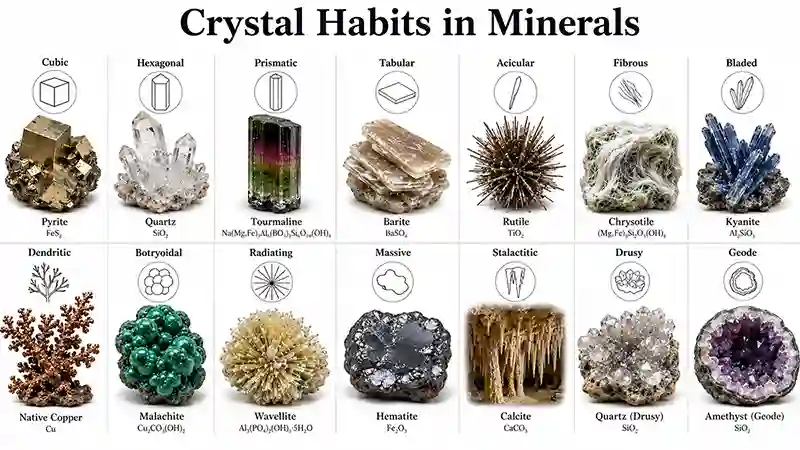
Cubic
Cube-shaped crystals.
Examples:
- Halite
- Pyrite
- Galena
Hexagonal
Six-sided prism-shaped crystals.
Examples:
- Quartz
- Beryl
Prismatic
Long, elongated crystals.
Examples:
- Tourmaline
- Pyroxene
Tabular
Flat, plate-like crystals.
Examples:
- Barite
- Feldspar
Acicular
Needle-like crystals.
Examples:
- Rutile
- Natrolite
Fibrous
Very fine thread-like crystals.
Examples:
- Chrysotile
- Gypsum
Bladed
Long, flattened crystals resembling knife blades.
Examples:
- Kyanite
- Barite
Dendritic
Branching crystals resembling trees.
Examples:
- Native Copper
- Manganese Oxides
Botryoidal
Rounded, grape-like masses.
Examples:
- Malachite
- Hematite
- Goethite
Radiating
Crystals growing outward from a central point.
Examples:
- Wavellite
- Pyrite
Massive
No visible crystal faces.
Examples:
- Hematite
- Magnetite
- Quartz
Stalactitic
Hanging cylindrical crystal growth.
Examples:
- Calcite
- Aragonite
Drusy (Druzy)
Surface covered by numerous tiny sparkling crystals.
Examples:
- Quartz
- Calcite
Geode Habit
Hollow rocks lined with inward-growing crystals.
Common minerals:
- Quartz
- Amethyst
- Calcite
Factors Affecting Crystal Habit
Several conditions influence crystal habit.
Available Space
Open cavities allow crystals to develop well-formed crystal faces. Crowded environments produce irregular crystals.
Growth Rate
Slow growth generally produces well-developed crystals. Rapid growth often forms skeletal or fibrous habits.
Temperature
Temperature influences crystal size and shape. Higher temperatures may favor different growth directions.
Pressure
Pressure affects crystal stability and morphology.
Chemical Environment
Different fluid compositions may alter crystal habit.Trace elements can modify crystal growth.
Crystal Habits of Common Minerals
Quartz
Common habits:
- Hexagonal
- Prismatic
- Massive
- Drusy
Pyrite
Common habits:
- Cubic
- Pyritohedral
- Massive
Calcite
Common habits:
- Rhombohedral
- Scalenohedral
- Stalactitic
- Massive
Tourmaline
Typically develops long prismatic crystals.
Kyanite
Usually forms bladed crystals.
Halite
Typically develops cubic crystals.
Malachite
Commonly occurs as botryoidal masses.
Hematite
May occur as:
- Massive
- Botryoidal
- Specular
Geological Importance
Crystal habits help geologists:
- Identify mineral species
- Interpret crystal growth environments
- Understand hydrothermal systems
- Study ore deposits
- Recognize metamorphic conditions
Habit often provides important clues before laboratory testing.
Laboratory Investigation
Crystal habits are examined using:
- Hand specimen observation
- Petrographic Microscopy
- Scanning Electron Microscopy (SEM)
- X-Ray Diffraction (XRD)
- Goniometers
- Digital Crystal Modeling
These methods help relate external morphology to internal crystal structure.
Applications
Understanding crystal habits is important in:
- Mineralogy
- Crystallography
- Gemology
- Petrology
- Economic Geology
- Mining
- Materials Science
- Museum Identification
Advantages of Studying Crystal Habits
Studying crystal habits helps scientists:
- Identify minerals quickly
- Interpret crystal growth conditions
- Understand mineral formation
- Recognize geological environments
- Improve mineral classification
- Support exploration geology
Limitations
Crystal habit alone cannot always identify a mineral.
Some limitations include:
- The same mineral may display several different habits.
- Different minerals can develop similar crystal habits.
- Crystal faces may be damaged by weathering or transport.
- Laboratory analyses are often needed to confirm mineral identity.
For comprehensive understanding, combine this topic with:
- Crystal Structure of Minerals Explained
- How Crystals Form Explained
- Crystal Growth Environments Explained
- Crystal Chemistry Explained
- Mineralogy Explained
- Optical Mineralogy Explained
- X-Ray Diffraction in Mineralogy
- Petrographic Microscopy
Comparison Table
| Crystal Habit | Description | Common Minerals |
| Cubic | Cube-shaped | Halite, Pyrite |
| Hexagonal | Six-sided prism | Quartz, Beryl |
| Prismatic | Elongated | Tourmaline |
| Tabular | Flat plates | Barite |
| Acicular | Needle-like | Rutile |
| Fibrous | Thread-like | Chrysotile |
| Bladed | Knife-like | Kyanite |
| Botryoidal | Grape-like | Malachite |
| Dendritic | Tree-like | Native Copper |
| Massive | No crystal faces | Hematite |
Summary Table
| Feature | Crystal Habits |
| Definition | External Shape of Crystal Growth |
| Controlled By | Growth Conditions and Crystal Structure |
| Main Types | Cubic, Hexagonal, Prismatic, Fibrous, Massive, etc. |
| Study Methods | Hand Sample, SEM, XRD, Petrography |
| Geological Importance | Mineral Identification and Growth Environment |
Crystal habit is the characteristic external shape or appearance of a mineral crystal that develops during crystal growth.
No. Crystal habit refers to a crystal's external shape, while crystal structure describes the internal arrangement of atoms within the crystal.
Changes in temperature, pressure, available space, growth rate, and fluid chemistry can cause the same mineral to develop different external shapes while keeping the same crystal structure.
Common crystal habits include cubic, hexagonal, prismatic, tabular, acicular, fibrous, bladed, dendritic, botryoidal, massive, radiating, stalactitic, drusy, and geode habits.
Crystal habits help geologists identify minerals, interpret crystal growth conditions, recognize geological environments, and understand mineral-forming processes.
Final Thoughts
Crystal habits provide one of the easiest ways to recognize and understand minerals. While the internal crystal structure remains fixed, external crystal shapes vary according to the conditions under which minerals grow. From perfect cubic pyrite and hexagonal quartz to botryoidal malachite and bladed kyanite, crystal habits reflect the interaction between atomic structure and the geological environment.
By studying crystal habits alongside crystal chemistry, crystal growth, and mineralogy, geologists gain valuable insights into mineral identification, crystal formation, and Earth's geological history. Crystal habit remains one of the most useful visual characteristics in mineral science.
Continue Learning
Continue exploring crystal science with these related guides: