
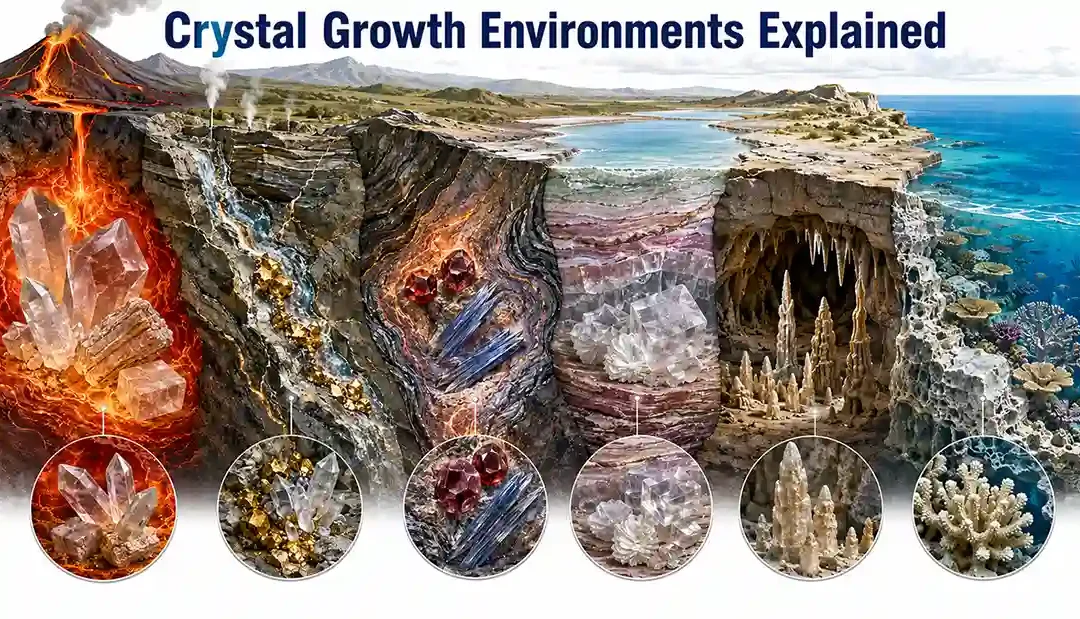
Crystals form in a wide variety of geological environments, each providing the conditions necessary for atoms to organize into ordered crystal structures. These crystal growth environments differ in temperature, pressure, fluid chemistry, cooling rate, and available space, producing the enormous diversity of minerals found on Earth.
Some crystals grow deep beneath Earth's surface within slowly cooling magma, while others develop from hot hydrothermal fluids, evaporating lakes, metamorphic rocks, caves, or even living organisms. Each environment produces distinctive mineral assemblages that help geologists reconstruct Earth's geological history.
Understanding crystal growth environments is fundamental to mineralogy, crystallography, petrology, geochemistry, economic geology, and Earth science.
This topic should be studied together with How Crystals Form Explained, Crystal Growth in Minerals Explained, Experimental Mineralogy Explained, and Mineralogy Explained.
What Are Crystal Growth Environments?
Crystal growth environments are natural settings where minerals crystallize under specific physical and chemical conditions.
Each environment is defined by:
- Temperature
- Pressure
- Chemical composition
- Water availability
- Cooling rate
- Space for crystal growth
- Geological processes
Together, these factors determine which minerals form and how large they become.
Why Crystal Growth Environments Matter
Different environments produce different minerals.
By studying crystal growth environments, geologists can:
- Identify mineral origins
- Reconstruct geological history
- Interpret tectonic settings
- Locate mineral deposits
- Understand rock formation
- Predict mineral stability
Major Crystal Growth Environments
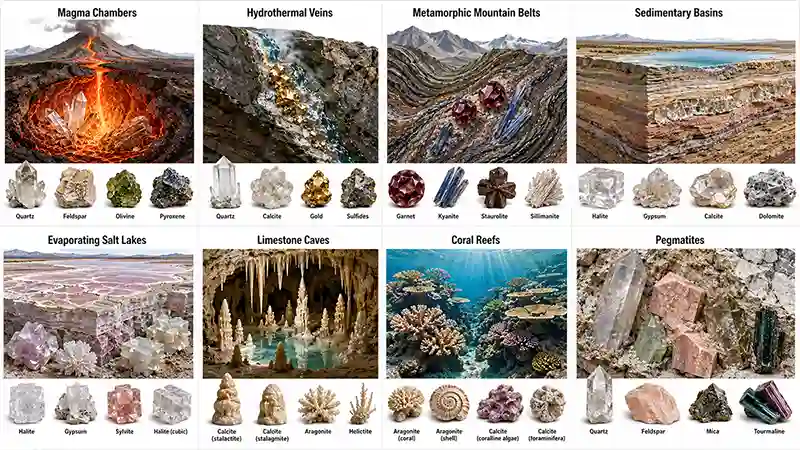
Magmatic Environment
Crystals form as magma slowly cools beneath Earth's surface.
Typical minerals include:
- Quartz
- Feldspar
- Olivine
- Pyroxene
- Amphibole
- Biotite
Slow cooling allows large crystals to develop.
Common rocks:
- Granite
- Gabbro
- Diorite
Hydrothermal Environment
Hot, mineral-rich fluids circulate through fractures in rocks.
As fluids cool, dissolved minerals crystallize.
Common minerals include:
- Quartz
- Calcite
- Fluorite
- Pyrite
- Galena
- Chalcopyrite
- Gold
Hydrothermal systems produce many valuable ore deposits.
Metamorphic Environment
Existing minerals recrystallize under high temperature and pressure without melting.
Common minerals include:
- Garnet
- Kyanite
- Andalusite
- Sillimanite
- Staurolite
- Talc
These minerals record metamorphic conditions.
Sedimentary Environment
Minerals crystallize from water or chemical precipitation near Earth's surface.
Common minerals include:
- Calcite
- Dolomite
- Siderite
- Chert
These environments form many sedimentary rocks.
Evaporite Environment
Evaporation concentrates dissolved salts until crystals begin to grow.
Common minerals include:
- Halite
- Gypsum
- Sylvite
- Anhydrite
Typical environments:
- Salt lakes
- Coastal lagoons
- Inland basins
Cave Environment
Groundwater carrying dissolved calcium carbonate deposits crystals inside caves.
Common features include:
- Stalactites
- Stalagmites
- Flowstone
- Calcite crystals
Crystal growth is usually slow but continuous.
Biomineralization Environment
Living organisms control crystal formation.
Common biominerals include:
- Calcite
- Aragonite
- Hydroxyapatite
- Silica
- Magnetite
Produced by:
- Corals
- Mollusks
- Bones
- Teeth
- Diatoms
Pegmatitic Environment
Pegmatites crystallize from the final stages of cooling magma.
Characteristics:
- Extremely slow growth
- Abundant fluids
- Giant crystal formation
Common minerals include:
- Quartz
- Feldspar
- Muscovite
- Tourmaline
- Beryl
- Spodumene
Pegmatites produce some of the world's largest crystals.
Factors Controlling Crystal Growth
Several variables determine crystal growth.
Temperature
Controls:
- Crystal size
- Growth rate
- Mineral stability
Higher temperatures generally increase crystal growth rates.
Pressure
Pressure affects:
- Crystal structure
- Mineral stability
- Density
Deep-Earth environments produce unique high-pressure minerals.
Chemical Composition
The available elements determine which minerals can crystallize.
Examples:
- Silicon-rich magma produces quartz.
- Calcium-rich waters produce calcite.
Fluid Availability
Water and hydrothermal fluids transport dissolved ions needed for crystal growth. Fluid-rich environments often produce well-formed crystals.
Growth Time
Longer growth periods generally produce larger crystals. Rapid cooling produces microscopic crystals.
Available Space
Open cavities allow crystals to develop well-defined crystal faces. Restricted environments produce irregular crystal shapes.
Examples of Crystal Growth Environments
| Environment | Common Minerals |
|---|---|
| Magmatic | Quartz, Feldspar, Olivine |
| Hydrothermal | Quartz, Pyrite, Gold |
| Metamorphic | Garnet, Kyanite |
| Sedimentary | Calcite, Dolomite |
| Evaporite | Halite, Gypsum |
| Cave | Calcite |
| Biological | Aragonite, Hydroxyapatite |
| Pegmatitic | Beryl, Tourmaline |
Geological Importance
Crystal growth environments help geologists:
- Understand mineral formation
- Identify ore deposits
- Interpret tectonic history
- Study magma evolution
- Reconstruct ancient environments
- Explain metamorphic processes
Mineral assemblages often reveal the environment in which they formed.
Laboratory Simulation
Scientists recreate crystal growth environments using:
- Hydrothermal autoclaves
- High-temperature furnaces
- Diamond anvil cells
- High-pressure presses
- Controlled crystallization chambers
Experimental mineralogy helps verify natural crystal growth processes.
Laboratory Investigation
Crystal growth environments are studied using:
- Petrographic Microscopy
- X-Ray Diffraction (XRD)
- Electron Microprobe Analysis (EPMA)
- Scanning Electron Microscopy (SEM)
- Raman Spectroscopy
- Fluid Inclusion Analysis
- Stable Isotope Analysis
These methods reveal mineral composition, crystal structure, and growth history.
Applications
Understanding crystal growth environments is important in:
- Mineralogy
- Petrology
- Geochemistry
- Economic Geology
- Mining
- Gemology
- Environmental Geology
- Planetary Geology
Advantages of Studying Crystal Growth Environments
Studying crystal growth environments helps scientists:
- Predict where minerals form
- Discover valuable mineral deposits
- Explain crystal size and shape
- Interpret geological processes
- Improve laboratory crystal growth
- Reconstruct Earth's history
Limitations
Studying crystal growth environments has several challenges:
- Natural environments often change over time, altering crystal growth conditions.
- Multiple geological processes may overprint earlier mineral assemblages.
- Some environments are inaccessible, such as deep magma chambers and the mantle.
- Laboratory simulations cannot perfectly reproduce every natural condition.
For comprehensive understanding, combine this topic with:
- How Crystals Form Explained
- Crystal Growth in Minerals Explained
- Experimental Mineralogy Explained
- Crystal Chemistry Explained
- Mineralogy Explained
- Hydrothermal Minerals Explained
- Pegmatite Minerals Explained
- Biomineralization Explained
Comparison Table
| Growth Environment | Main Conditions | Common Minerals |
| Magmatic | Cooling Magma | Quartz, Feldspar |
| Hydrothermal | Hot Fluids | Quartz, Pyrite |
| Metamorphic | Heat & Pressure | Garnet, Kyanite |
| Sedimentary | Chemical Precipitation | Calcite, Dolomite |
| Evaporite | Water Evaporation | Halite, Gypsum |
| Cave | Groundwater | Calcite |
| Biological | Living Organisms | Aragonite, Hydroxyapatite |
| Pegmatitic | Late-Stage Magma | Beryl, Tourmaline |
Summary Table
| Feature | Crystal Growth Environments |
| Definition | Natural Settings Where Crystals Grow |
| Major Controls | Temperature, Pressure, Chemistry, Fluids |
| Main Environments | Magmatic, Hydrothermal, Metamorphic, Sedimentary, Biological |
| Study Methods | XRD, SEM, Petrography, Fluid Inclusions |
| Geological Importance | Mineral Formation and Ore Deposits |
Crystal growth environments are natural geological settings where minerals crystallize under specific conditions of temperature, pressure, chemistry, and fluid availability.
Pegmatitic environments often produce the largest mineral crystals because they contain abundant fluids and cool slowly, allowing crystals to grow over long periods.
Each environment has unique physical and chemical conditions that determine which elements are available and which minerals are stable enough to crystallize.
Yes. Through biomineralization, organisms such as corals, mollusks, and vertebrates produce minerals including calcite, aragonite, hydroxyapatite, and silica.
Geologists examine mineral assemblages, crystal textures, fluid inclusions, isotope compositions, and crystal structures using techniques such as petrographic microscopy, X-ray diffraction (XRD), scanning electron microscopy (SEM), and geochemical analysis.
Final Thoughts
Crystal growth environments provide the conditions that allow minerals to develop their unique crystal structures, sizes, and compositions. From slowly cooling magma chambers and hydrothermal veins to evaporating lakes, caves, metamorphic belts, and living organisms, each environment leaves a distinct mineralogical signature that helps geologists interpret Earth's history.
By combining field observations with laboratory analyses and experimental mineralogy, scientists can understand where crystals form, why different minerals occur together, and how geological processes shape our planet. Crystal growth environments remain a fundamental concept in mineralogy, petrology, geochemistry, and economic geology.
Continue Learning
Continue exploring crystal formation and mineral science with these related guides: