
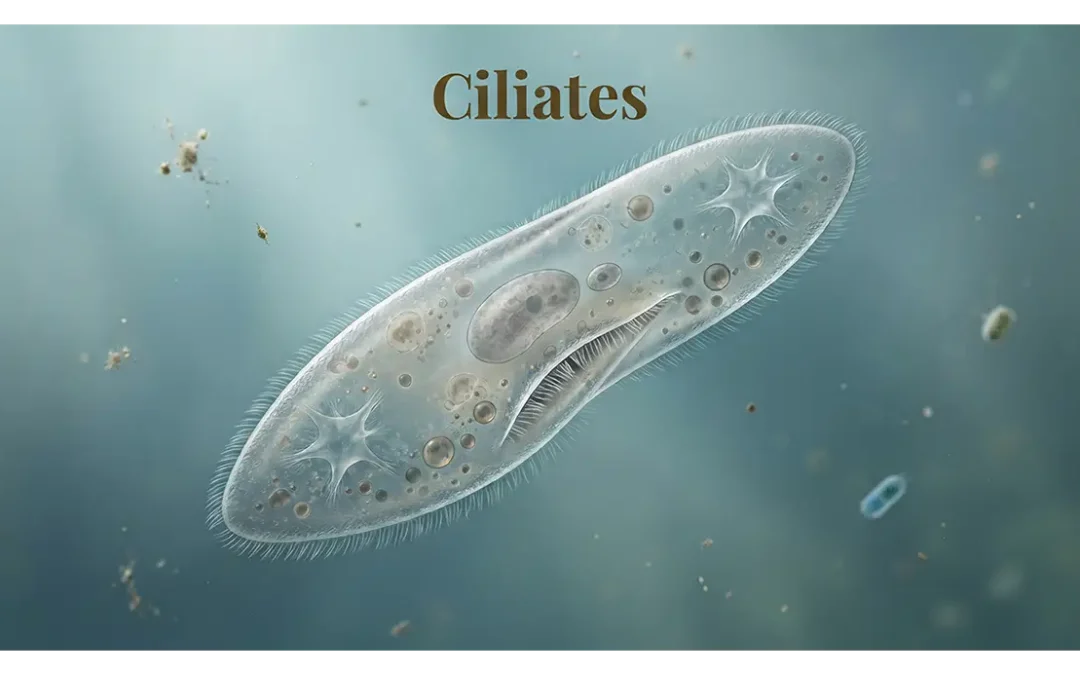
Ciliates are microscopic, single-celled organisms known for their hair-like structures called cilia. These tiny organisms live in freshwater, marine environments, moist soils, and other habitats where water or moisture supports their activities. Although many ciliates are invisible to the unaided eye, they play important roles in aquatic food webs, nutrient cycling, and microbial communities.
One of the best-known examples is Paramecium, a slipper-shaped organism that moves through water using coordinated ciliary beats. Other ciliates have different body forms and lifestyles. Some remain attached to surfaces, some capture food from surrounding water, and others live in close association with animals.
Ciliates are especially interesting because a single cell can perform functions that larger organisms accomplish through specialized tissues and organs. They obtain nutrients, respond to environmental changes, remove waste, and reproduce without having a nervous system or multicellular body.
What Are Ciliates?
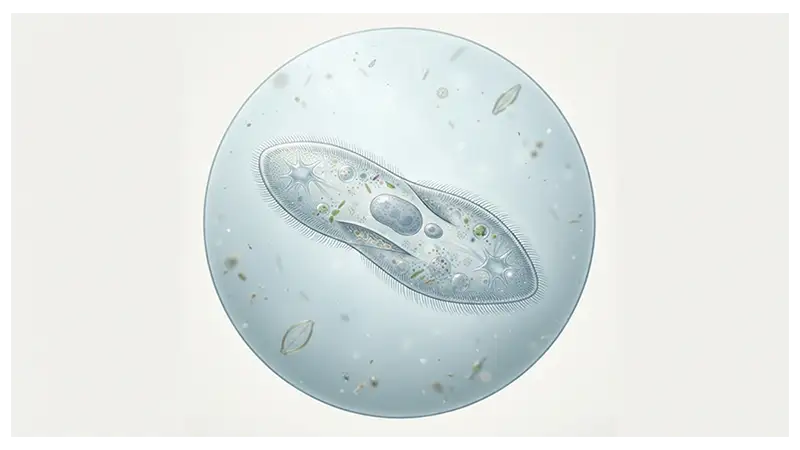
Ciliates are single-celled eukaryotic organisms belonging to the group Ciliophora. A eukaryote is an organism whose cells contain a nucleus and other membrane-bound structures. Unlike bacteria, which lack a true nucleus, ciliates possess complex cellular organization.
Their defining feature is the presence of cilia during at least one stage of their life cycle. These short, hair-like structures extend from the cell surface and beat in coordinated patterns. Depending on the species, they help the organism swim, create water currents, capture food, or attach to surfaces.
Ciliates occur in a wide range of environments. Many inhabit ponds, lakes, streams, oceans, and waterlogged soils. Others live in the digestive systems or on the surfaces of animals, where they may have neutral, beneficial, or harmful relationships with their hosts.
Most familiar ciliates are microscopic, but their size varies considerably. Some are only a few micrometres long, while others can be seen as tiny moving specks under suitable lighting. Their shapes also differ: some are oval, some elongated, and others trumpet-shaped or covered with distinctive surface structures.
The name Ciliophora refers to the cilia that characterize this group. Ciliates are not animals, plants, or fungi. They are eukaryotic microorganisms with their own evolutionary history and a level of cellular complexity that makes them important subjects in biology.
What Are the Main Characteristics of Ciliates?
Ciliates share several defining biological features, although their exact appearance and behavior vary among species.
Single-celled organization: Each ciliate is made of one cell that carries out all essential life functions. It does not have organs such as a stomach, heart, or brain, but its internal structures coordinate feeding, movement, waste removal, and reproduction.
Cilia: Most ciliates have numerous cilia over part or all of their surface during some stage of development. The structures are built from microtubules and are anchored in the cell by specialized basal bodies. Their coordinated movement supports swimming and feeding.
A true nucleus: Ciliates are eukaryotes. Most have two functionally different types of nuclei: a macronucleus, which manages everyday cellular activity, and one or more micronuclei, which are involved in reproduction and genetic exchange.
Flexible body forms: Some ciliates have a relatively firm outer covering called a pellicle that helps maintain their shape while allowing movement. Others can change their outline more noticeably or possess specialized structures for attachment.
Complex feeding mechanisms: Many species consume bacteria, algae, and other tiny organisms. They may direct food toward an oral region using cilia, surround food particles in a feeding structure, or capture prey through specialized cell features.
Asexual reproduction: Many ciliates reproduce by cell division, often through a process called binary fission. Under suitable conditions, this can allow populations to increase rapidly.
Genetic exchange: Some ciliates undergo conjugation, during which compatible cells temporarily join and exchange genetic material associated with their micronuclei. This process is different from simply producing two new cells.
Not every ciliate has exactly the same arrangement of cilia, feeding structures, or nuclei. These variations help scientists distinguish species and understand how different lineages have adapted to their environments.
How Are Ciliates Structured?
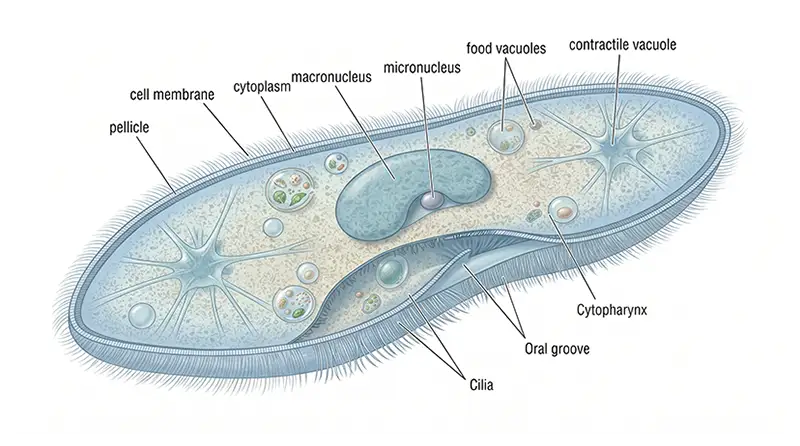
Although a ciliate consists of only one cell, its internal organization can be highly specialized. Different structures work together to keep the organism alive.
Cell membrane and pellicle
The cell membrane forms the boundary between the cytoplasm and the surrounding environment. It regulates the movement of substances into and out of the cell. In many ciliates, a supporting layer beneath the membrane contributes to a covering known as the pellicle. This helps maintain body shape without making the organism a rigid shell.
Cytoplasm
The cytoplasm contains the cell's internal components and provides the environment in which many biochemical reactions occur. It includes organelles, storage materials, and structures needed for movement, digestion, and other activities.
Macronucleus and micronucleus
Many ciliates possess two kinds of nuclei with different functions.
- Macronucleus: Controls most routine cellular processes, including gene expression associated with growth, metabolism, and daily activity.
- Micronucleus: Contains genetic material used during sexual processes and inheritance.
The arrangement differs among groups. Some species have more than one micronucleus, and the macronucleus may have an unusual structure compared with the nuclei of other eukaryotes.
Food vacuoles
Many ciliates form food vacuoles after taking in food particles. These membrane-bound compartments contain the ingested material while enzymes break it down. Useful nutrients pass into the cytoplasm, while undigested remains are eventually expelled.
Contractile vacuoles
Freshwater ciliates often have contractile vacuoles that collect and expel excess water. Water tends to enter their cells by osmosis because the surrounding freshwater contains fewer dissolved substances than the cell interior. Without effective water regulation, the cell could swell excessively. Contractile vacuoles are particularly important in freshwater species, although their number, shape, and activity vary.
Oral and supporting structures
Many ciliates have specialized regions for taking in food. In Paramecium, for example, cilia direct particles toward an oral groove and into a feeding passage. Other ciliates possess different feeding arrangements, and some have reduced or highly modified oral structures.
The combination of these components allows one cell to perform an impressive range of tasks without relying on tissues or organs.
How Do Cilia Help Ciliates Move and Feed?
Cilia are the most recognizable feature of ciliates, but their role extends beyond locomotion. Their coordinated beating allows many species to control movement and manipulate the water around them.
Each cilium contains a framework of microtubules and is powered by molecular motors that use energy from the cell. A cilium bends through a repeated cycle, producing movement through water. When numerous cilia beat in coordinated patterns, their combined force can propel the organism forward, rotate it, or change its direction.
In Paramecium, waves of ciliary activity move across the surface, allowing the organism to swim. Changes in the direction or pattern of beating can help it respond to obstacles or unfavourable conditions. This behavior is not the same as conscious decision-making; it results from cellular mechanisms responding to physical and chemical signals.
Cilia also play a major role in feeding. In many species, their movement generates water currents that carry bacteria, algae, and suspended particles toward a specialized feeding region. Food may then be enclosed in a membrane-bound vacuole for digestion.
Not all ciliates use cilia in the same way. Some have clusters of cilia that function like small paddles, while others possess fused ciliary structures called cirri that assist with movement along surfaces. Certain species are attached to submerged objects and use cilia mainly to draw food-bearing water toward them.
Ciliary arrangement is therefore an important feature in ciliate biology. By examining the location, structure, and movement of these tiny projections, researchers can learn how different species feed, travel, and interact with their surroundings.
How Do Ciliates Obtain Food and Digest It?
Most ciliates obtain nutrients by consuming other microscopic organisms or organic particles. Their diets depend on their species and habitat, but common food sources include bacteria, small algae, and other protists.
Many free-living ciliates are active consumers of bacteria. By grazing on bacterial populations, they influence microbial communities and help transfer energy from bacteria to larger organisms in aquatic food webs. Some species also consume algae or capture other small prey.
In a typical feeding process, cilia create currents that move food particles toward an oral region. The cell takes in suitable material, enclosing it in a food vacuole. Digestive enzymes then break down the contents into smaller molecules that can be absorbed and used for energy, growth, and cellular maintenance.
Undigested remains are released from the cell. The exact route depends on the species and its cellular organization. In Paramecium, waste from food processing is expelled through a specialized region of the cell surface.
Some ciliates use different strategies. Certain species capture prey with specialized structures, while others live in the digestive systems of animals and feed on material available in that environment. A small number of ciliates are associated with photosynthetic partners or obtain nutrients through other specialized relationships.
Ciliates themselves also serve as food for tiny aquatic animals and other predators. Their feeding activity therefore connects bacterial and algal production with higher levels of the food web.
Their importance is not limited to consuming microorganisms. By processing organic matter and influencing the abundance of bacteria and algae, ciliates contribute to the movement of nutrients through ecosystems.
How Do Ciliates Reproduce?
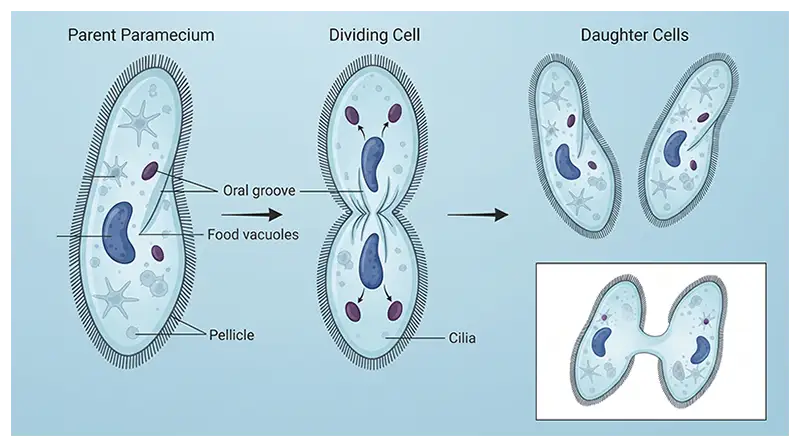
Ciliates reproduce through asexual processes and, in many species, sexual processes involving genetic exchange. The details vary among groups, but two important mechanisms are binary fission and conjugation.
Binary fission
Binary fission is a common form of asexual reproduction in ciliates. During this process, the cell grows and duplicates the components required for division. Its genetic material is organized and distributed, and the parent cell separates into two daughter cells.
In many ciliates, division involves the macronucleus and micronucleus behaving differently. The micronucleus typically divides through mitosis, while the macronucleus divides by a process that does not use the same mitotic mechanism. New oral structures and other cell components must also develop so that each daughter cell can function.
Under favourable conditions, some species can divide repeatedly, allowing populations to grow quickly. The actual rate depends on temperature, food supply, water chemistry, species, and other environmental conditions.
Conjugation
Conjugation is a sexual process that involves temporary contact between compatible cells and the exchange or reorganization of genetic material. It is particularly well studied in Paramecium.
During a typical conjugation process, micronuclei undergo divisions and specialized nuclei are exchanged or combined, depending on the species. Genetic material is reorganized, and new nuclear structures develop. The cells generally separate afterward.
Conjugation is not the same as ordinary cell division. It does not immediately increase the number of cells in the way binary fission does. Instead, it contributes to genetic variation and can help reset aspects of nuclear organization.
Other reproductive processes
Some ciliates have reproductive cycles more complex than these basic examples. Certain groups form resistant stages under stressful conditions, and nuclear development can differ significantly across lineages. It is therefore inaccurate to assume that every ciliate follows an identical reproductive sequence. Together, cell division and genetic exchange allow ciliates to maintain populations while also generating genetic diversity.
How Are Ciliates Classified?
Ciliates belong to the eukaryotic group Ciliophora, which is widely recognized as a distinct evolutionary lineage. Their classification reflects shared ancestry as well as differences in cellular structure, ciliary arrangement, reproduction, and genetic characteristics.
Traditional classifications relied heavily on visible features. Scientists examined body shape, the distribution of cilia, feeding structures, and other characteristics under a microscope. These observations remain useful, but modern classification also uses molecular evidence, especially comparisons of DNA and RNA sequences.
Major ciliate groups
Ciliates include numerous lineages with distinctive structures and lifestyles. Some commonly discussed groups include:
- Oligohymenophorea: Includes Paramecium and Tetrahymena, among other ciliates. Members have varied body forms and feeding arrangements.
- Spirotrichea: Includes organisms such as Stentor and many ciliates with specialized ciliary structures. Some have elaborate body shapes or distinctive feeding adaptations.
- Litostomatea: Includes several groups of predatory and host-associated ciliates, with diverse feeding structures.
- Phyllopharyngea: Includes ciliates with distinctive arrangements of oral structures and other specialized features.
- Colpodea: Includes many soil- and freshwater-associated ciliates, some of which form resistant stages under unfavourable conditions.
These examples are not a complete list of ciliate diversity. Classification changes as researchers discover new species and refine evolutionary relationships, and the precise placement of some lineages can differ among taxonomic systems.
How scientists identify ciliates
Identification may involve observing an organism's shape, size, ciliary patterns, nuclear arrangement, feeding structures, and movement. Microscopy can reveal many of these features, while molecular techniques help distinguish organisms that look similar but are genetically different.
Classification is more than naming organisms. It helps researchers understand how different ciliates evolved, which traits they share, and how their biological functions relate to their evolutionary history.
Where Do Ciliates Live?
Ciliates occur wherever suitable moisture, nutrients, and environmental conditions support their survival. Water is especially important because many species move and feed in aquatic environments, although others live in thin films of moisture around soil particles or within host organisms.
Freshwater habitats
Ponds, lakes, streams, ditches, and wetlands support many species. Ciliates may swim freely, settle among submerged vegetation, or live near the bottom where organic material accumulates. Their abundance can change with temperature, oxygen levels, nutrient availability, and the supply of bacteria and algae.
Marine environments
Ocean water contains diverse ciliate communities. Some live in surface waters where microscopic food is plentiful, while others occur in sediments or around marine plants and animals. Marine ciliates help consume bacteria and other microorganisms and can serve as food for larger planktonic organisms.
Soil and moist terrestrial environments
Many ciliates live in the water films surrounding soil particles. They may become active after rainfall or when soil moisture increases. These organisms feed on microorganisms and participate in soil food webs, particularly in habitats with sufficient organic matter and moisture.
Some soil ciliates can form resistant stages that help them survive periods of unfavourable conditions. Such stages are not identical across all species, but they can contribute to persistence when moisture or food becomes scarce.
Host-associated environments
Certain ciliates live on or inside animals. Some relationships are relatively harmless, while others can affect the host's health. For example, particular ciliates inhabit the digestive systems of ruminants and contribute to the complex microbial communities involved in digestion. Other species are parasitic or associated with disease.
Ciliate distribution therefore depends on more than geography. Water chemistry, food availability, temperature, oxygen, and relationships with other organisms all influence which species can thrive in a particular habitat.
Why Are Ciliates Important to Ecosystems?
Although individual ciliates are tiny, their combined activity can have substantial effects on microbial communities and aquatic ecosystems.
Regulating bacterial populations
Many ciliates feed on bacteria. This grazing influences bacterial abundance and changes the composition of microbial communities. By consuming bacteria, ciliates help regulate populations that break down organic material and recycle nutrients.
Connecting food-web levels
Ciliates consume bacteria, algae, and other small organisms, and they are themselves eaten by larger microorganisms and tiny aquatic animals. They therefore transfer energy from the microbial world to organisms at higher levels of the food web.
Supporting nutrient cycling
Digestion and waste release return nutrients to the surrounding environment in forms that may become available to other microorganisms. Through these interactions, ciliates contribute to the cycling of elements such as carbon, nitrogen, and phosphorus.
Contributing to soil processes
In moist soils, ciliates feed on microorganisms and form part of the food web that influences microbial activity. Their grazing can affect nutrient availability and the balance between different microbial groups, although the effects depend on the soil community and environmental conditions.
Helping scientists assess environmental change
Researchers sometimes study ciliate communities to investigate changes in water quality, pollution, and ecosystem conditions. Certain species respond to environmental stress, so shifts in their abundance or diversity can provide useful evidence. However, ciliates are not a universal indicator on their own; reliable environmental assessment usually combines several biological and chemical measurements.
Ciliates are therefore important not because they are individually large or complex, but because they connect microscopic organisms, nutrient cycling, and the wider food web.
Are Ciliates Harmful to Humans or Other Organisms?
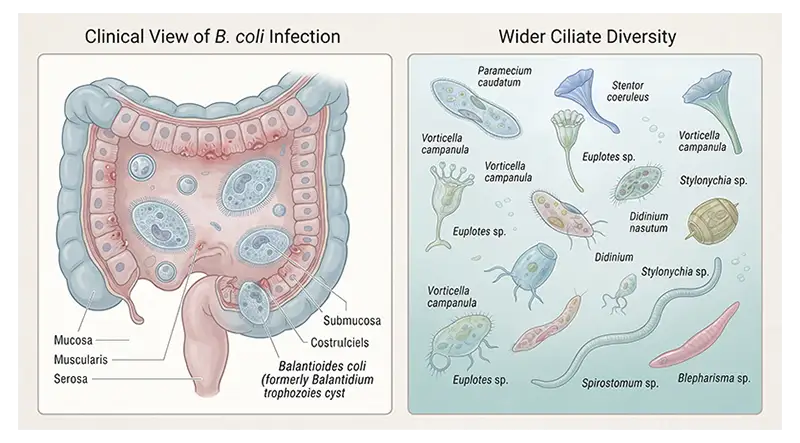
Most ciliates encountered in ordinary freshwater and marine environments are not known to cause disease in humans. Many are free-living organisms that feed on bacteria, algae, and other microscopic life. However, a small number of ciliates can affect animals or humans under particular circumstances.
The best-known human example is Balantioides coli, formerly called Balantidium coli. This ciliate can infect the large intestine and cause balantidiasis, an illness that may produce diarrhoea, abdominal discomfort, and, in severe cases, intestinal damage. Infection is associated with exposure to contaminated food or water containing infectious cysts, and pigs are an important reservoir.
Other ciliates live in association with animals without necessarily causing disease. For example, some ciliates occur in the digestive systems of cattle and other ruminants, where they participate in complex microbial communities. Their effects depend on the host, the ciliate species, and the conditions within the digestive tract.
It is important not to assume that all ciliates are parasites or pathogens. Most species have ecological roles that do not involve harming humans. Their presence in water does not automatically mean that the water is dangerous, although water safety must be assessed using appropriate microbiological and chemical tests.
What Are Some Interesting Facts About Ciliates?
Ciliates have several unusual features that make them especially interesting to biologists.
- One cell performs many functions: A ciliate can move, feed, regulate water balance, respond to its surroundings, and reproduce without organs or tissues.
- Many have two types of nuclei: The macronucleus supports everyday cellular activity, while micronuclei play key roles in sexual processes and genetic inheritance.
- Cilia are highly coordinated: Thousands of tiny structures can beat in organized patterns, enabling swimming and the movement of food particles.
- Some ciliates are surprisingly large: Although most are microscopic, certain species can be relatively large for single-celled organisms and may be visible without a microscope under suitable conditions.
- Conjugation does not simply make more cells: This process mainly involves genetic exchange and nuclear reorganization rather than an immediate increase in cell number.
- Some ciliates live in partnership with animals: Their relationships range from relatively harmless associations to interactions that can affect host health.
- They are valuable research organisms: Species such as Paramecium and Tetrahymena have helped scientists investigate cell movement, genetics, membrane function, and the organization of eukaryotic cells.
These features show that cellular complexity does not always require a multicellular body. Ciliates demonstrate how a single cell can develop specialized structures and coordinate many biological processes.
Conclusion
Ciliates are a diverse group of single-celled eukaryotes distinguished by their cilia and sophisticated cellular organization. Despite having no organs or nervous system, they can move, feed, regulate water balance, respond to environmental signals, and reproduce through specialized cellular processes.
Their diversity is reflected in organisms such as Paramecium, Vorticella, and Stentor, which differ in shape, feeding behaviour, and habitat. Ciliates occupy freshwater and marine ecosystems, moist soils, and host-associated environments. Through their interactions with bacteria, algae, and other organisms, they help sustain microbial food webs and recycle nutrients.
Studying ciliates also provides insight into fundamental biological processes, including cell movement, genetic exchange, and the evolution of complex eukaryotic cells. These microscopic organisms may be small, but their contributions to science and the natural world are significant.
No. Ciliates are eukaryotes, meaning their cells contain a nucleus and membrane-bound organelles. Bacteria are prokaryotes and do not possess a true nucleus.
Ciliates have traditionally been described as protozoa, particularly in introductory biology. However, protozoa is a broad historical term rather than a single, universally accepted evolutionary group. Ciliates are more precisely identified as members of Ciliophora.
Cilia are the defining feature of the group and occur during at least one stage of the life cycle. Their arrangement and function vary, and not every species uses cilia primarily for swimming. Some use them mainly for feeding or other interactions with their surroundings.
No. Ciliates do not have a brain or nervous system. Their movement and responses to environmental signals result from cellular structures, chemical signals, and coordinated biochemical processes.
Many ciliates reproduce asexually through binary fission. Numerous species also undergo conjugation, a process involving genetic exchange and nuclear reorganization. Reproductive details vary among lineages.