
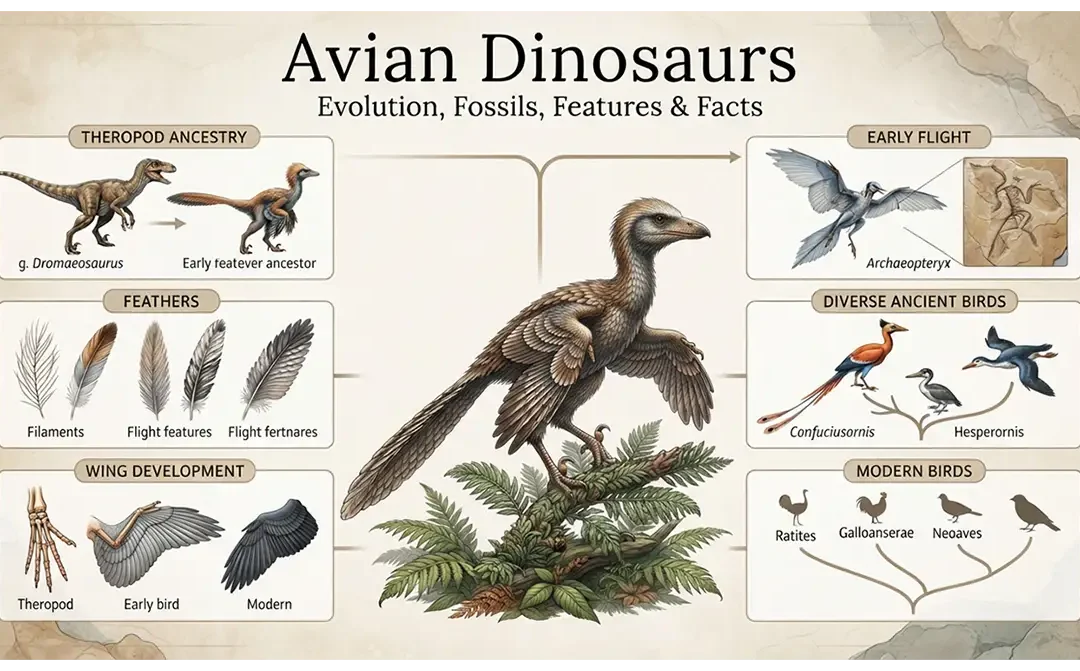
Avian dinosaurs are the group of dinosaurs that includes modern birds and their extinct bird-line relatives. They evolved from small theropod dinosaurs and developed a combination of features that helped them become increasingly suited to life in the air. Their history includes the evolution of feathers, changes in the skeleton, new ways of moving, and major shifts in feeding and ecology.
Birds are not separate from dinosaurs. Modern birds are living avian dinosaurs, while many extinct avian dinosaurs lived during the Jurassic and Cretaceous periods. Fossils from these animals provide important evidence for understanding how the bird body plan developed over millions of years.
What Are Avian Dinosaurs?
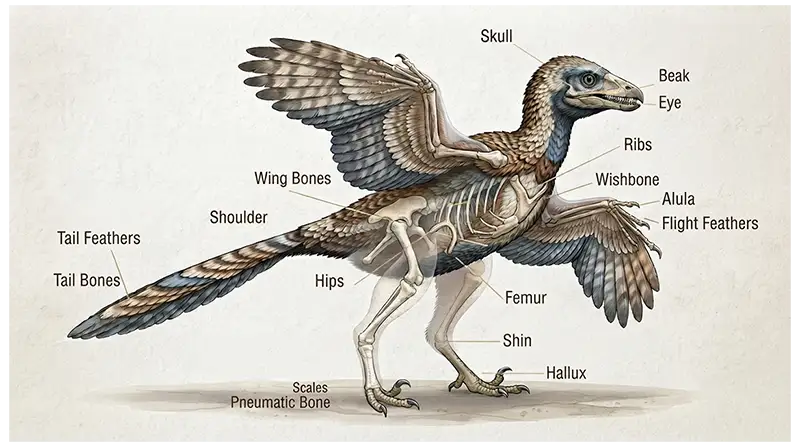
Avian dinosaurs are dinosaurs belonging to the bird lineage. In modern classification, birds are living theropod dinosaurs, so the term avian dinosaur can refer to birds and their extinct relatives within the avian branch. Theropods were a major group of dinosaurs that included animals with very different body sizes and lifestyles. Some were large predators, while others became much smaller and developed feathers and other features associated with the bird lineage.
Early avian dinosaurs did not all look like modern birds. Many had long bony tails, teeth, clawed fingers, and other features that are uncommon or absent in living birds. At the same time, they could possess feathers, lightweight skeletons, wishbones, and other traits associated with birds. This mixture of older dinosaur characteristics and newer bird-like features makes avian dinosaurs especially important in paleontology.
It is also important to distinguish avian dinosaurs from non-avian dinosaurs. Non-avian dinosaurs include dinosaur groups outside the bird lineage, while avian dinosaurs represent the branch that eventually produced modern birds. The evolutionary history of avian dinosaurs was not a simple straight line. Many different forms appeared, evolved specialized features, and eventually disappeared. Modern birds represent only one surviving branch of this much larger history.
How Did Avian Dinosaurs Evolve From Theropod Dinosaurs?
The origin of avian dinosaurs can be traced to small theropod dinosaurs. Over evolutionary time, members of this lineage developed combinations of skeletal, muscular, and feather-related features that increasingly resembled those of birds.
One important part of this history was the development of feathers. Feathers did not suddenly appear as fully formed flight structures. Fossils show that feather-like coverings evolved through different stages and served several functions before becoming specialized for powered flight.
Changes also occurred in the skeleton. The ancestors of birds developed lighter body structures, changes in the pelvis and limbs, and modifications to the forelimbs. The hands and fingers also changed over time. The tail provides another important example. Many early avian dinosaurs had long bony tails, while later birds evolved much shorter tails ending in a compact structure called a pygostyle.
The skull also changed. Some later birds lost many teeth and eventually developed toothless beaks. However, this transition happened gradually, and many early birds still had teeth. Evolution did not work toward a predetermined goal of producing modern birds. Instead, different avian dinosaurs experienced different environmental pressures and evolved different combinations of traits.
Some lineages became highly specialized for flight, while others developed adaptations for swimming, running, climbing, feeding on particular foods, or living in specific environments.
When Did Avian Dinosaurs First Appear?
The earliest history of avian dinosaurs is closely connected to the evolution of early birds during the Jurassic Period. One of the most famous early examples is Archaeopteryx, which lived roughly 150 million years ago in what is now Germany.
Archaeopteryx had feathers and several bird-like features, but it also retained characteristics associated with theropod dinosaurs. These included teeth, a long bony tail, and clawed fingers. However, Archaeopteryx should not be treated as the single ancestor of every modern bird. It represents an important early member of the bird lineage, but bird evolution involved many branches and experiments.
During the Early Cretaceous, avian dinosaurs became more diverse. Fossils from China and other parts of the world show a wide range of early birds with different body forms and lifestyles. Some had long tails, while others had shorter tails. Some retained teeth, while others evolved toothless jaws. Differences also appeared in wings, feet, skulls, and body proportions.
The Cretaceous Period was therefore a major period of avian diversification. By the end of the Cretaceous, birds represented a varied group of dinosaurs occupying different ecological roles.
What Features Made Avian Dinosaurs Different?
Avian dinosaurs developed a combination of features that separated them from many other dinosaur groups. Not every species had all of these traits, and the characteristics appeared at different stages of evolution.
Feathers
Feathers are one of the most recognizable features of the bird lineage. Early feather-like structures probably served functions such as insulation, display, and communication before some became specialized for flight.
Wishbone
The furcula, commonly called the wishbone, is an important skeletal feature found in birds and many theropod dinosaurs. It formed from the fusion of the two collarbones and helped support the shoulder region.
Lightweight Skeleton
Many avian dinosaurs had relatively lightweight skeletons. Some bird-line dinosaurs also had air-filled spaces in parts of their bones, a feature associated with efficient breathing and reduced skeletal weight.
Modified Forelimbs
The forelimbs became increasingly important as wings evolved. Their shape, joints, feathers, and muscles changed through the bird lineage.
Shorter Tail
Early bird-line dinosaurs often had long bony tails. Later birds developed shorter tails with a compact terminal structure that supported tail feathers.
Beak and Tooth Changes
Some early birds had teeth, while later groups evolved toothless beaks. Beaks became specialized for different feeding strategies. These features did not appear together in a single evolutionary event. Their gradual combination helps scientists trace the long transition from early theropods to modern birds.
How Did Avian Dinosaurs Develop Flight?
The evolution of flight was a gradual process, and scientists continue to study exactly how different bird-line dinosaurs used their bodies and feathers.
Feathers probably had important functions before they became fully adapted for powered flight. They could provide insulation, help with visual displays, and potentially improve control during movement. As feathered theropods evolved, their forelimbs and feathers became increasingly suitable for aerodynamic movement. Changes in shoulder structure, wing shape, body balance, and muscle arrangement contributed to improved aerial abilities.
Different avian dinosaurs may also have used different forms of movement. Some could have glided, while others were capable of active flapping flight. Certain species may have spent considerable time on the ground despite having wings. The evolution of flight therefore should not be viewed as a single jump from non-flying dinosaur to modern bird.
Instead, it involved a series of anatomical and behavioral changes. Fossils allow scientists to compare these changes across species and determine how wing structures became increasingly specialized. Modern birds show the result of this long evolutionary history, but extinct avian dinosaurs demonstrate that there were many earlier forms of flight and aerial movement.
What Did Avian Dinosaurs Eat and How Did They Feed?
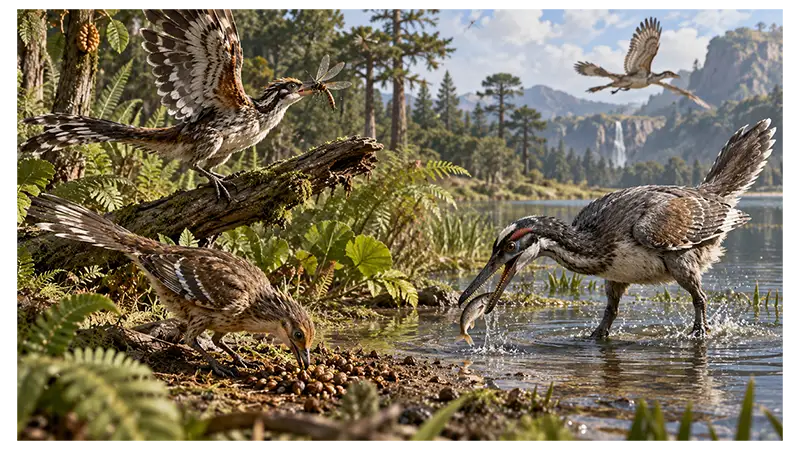
Avian dinosaurs had varied diets. Their food choices depended on their anatomy, habitat, body size, and evolutionary adaptations. Some early birds probably consumed insects and other small animals. Their sharp teeth could help them capture and process prey.
Other species developed feeding adaptations suited to seeds, plants, fish, or aquatic organisms. Changes in the skull and jaws allowed different lineages to exploit different food resources. The development of toothless beaks was particularly important. A beak could be shaped in many ways, allowing birds to pick up, crush, cut, or manipulate different foods.
Some Cretaceous birds had strong jaws that were suited to crushing hard foods. Others had narrow or pointed structures that may have helped them capture prey. Aquatic avian dinosaurs also evolved specialized feeding strategies. Fossils of groups such as hesperornithiform birds show that some early birds became strongly adapted to life in water.
Their diets were therefore not uniform. Avian dinosaurs occupied several feeding roles, demonstrating that the bird lineage had already developed ecological diversity long before modern birds appeared.
Where Did Avian Dinosaurs Live?
Avian dinosaurs lived in a wide range of environments during the Jurassic and Cretaceous periods. Their fossils have been found on several continents, showing that the bird lineage became geographically widespread. Some lived around lakes and rivers, where water and aquatic food sources were available. Others inhabited forests, coastal environments, islands, and open terrestrial habitats.
The famous Archaeopteryx fossils from Germany came from rocks deposited in an ancient tropical or subtropical island-and-lagoon environment associated with the Solnhofen region. Cretaceous fossils from China have revealed exceptionally diverse feathered dinosaurs and early birds. Many of these fossils were preserved in fine-grained sediments that captured delicate feathers and other soft structures.
Other avian dinosaur fossils have been found in North America, Europe, Asia, and other regions. Different environments encouraged different adaptations. Aquatic birds developed swimming-related features, while terrestrial forms could have had stronger legs or different feeding structures. Their geographic distribution also changed over time as continents, climates, coastlines, and ecosystems changed.
Which Avian Dinosaurs Are Known From Fossils?
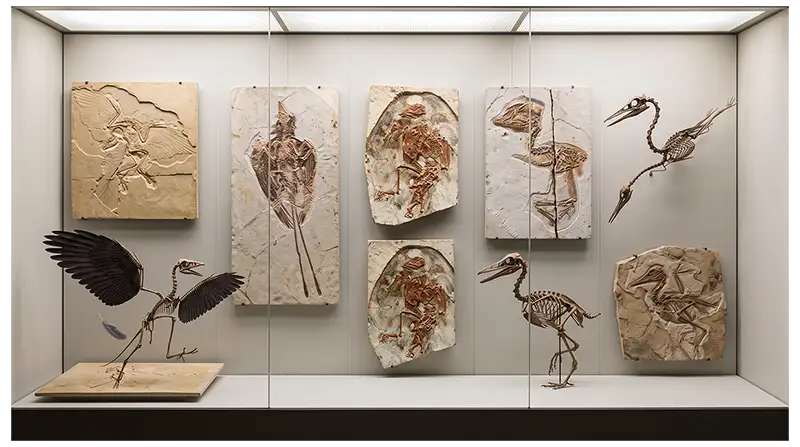
Fossils reveal many extinct members of the bird lineage. Some are especially important because they preserve unusual combinations of dinosaur and bird features.
Archaeopteryx
Archaeopteryx is one of the best-known early birds. It had feathers and wings but also retained teeth, clawed fingers, and a long bony tail.
Confuciusornis
Confuciusornis lived during the Early Cretaceous in what is now China. It had a toothless beak and well-developed wings, showing that early birds had already developed diverse body forms.
Enantiornithines
Enantiornithines were a large and diverse group of Cretaceous birds. They lived in many environments and had specialized feet, wings, and feeding structures. They were among the most diverse birds of the Cretaceous but disappeared at the end of the period.
Hesperornithiforms
Hesperornithiform birds were strongly adapted to aquatic environments. Some were excellent swimmers and had reduced wings, showing that bird-line dinosaurs evolved very different lifestyles.
Ichthyornis
Ichthyornis was a seabird-like Cretaceous bird with teeth in its jaws. Its fossils show that some advanced flying birds still retained teeth relatively late in bird evolution.
Microraptor
Microraptor was a small feathered theropod from China with feathers on both its forelimbs and hind limbs. It is important for understanding the evolution of feathers, aerial movement, and the diversity of feathered theropods.
These fossils demonstrate that avian evolution involved many different forms rather than a single straight progression.
How Did Avian Dinosaurs Become Modern Birds?
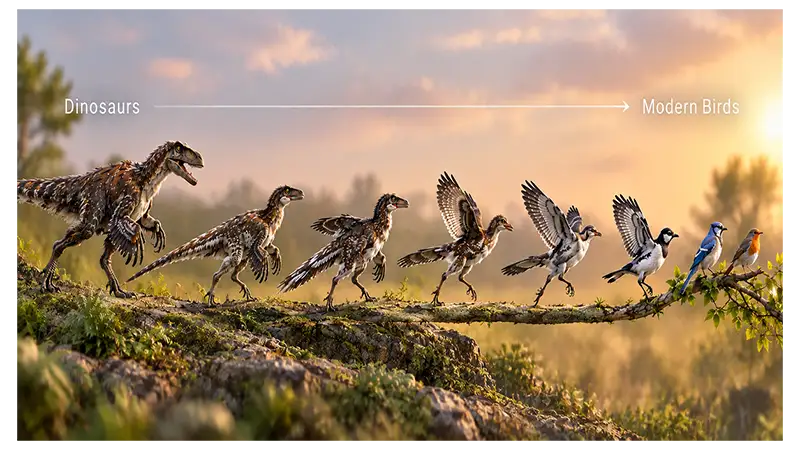
Modern birds developed through a long series of evolutionary changes within the theropod dinosaur lineage. Over time, many bird-line dinosaurs evolved shorter tails, modified wings, changes in the skeleton, tooth reduction or loss, and increasingly specialized beaks.
The respiratory system also became highly efficient. Birds today have a complex system of air sacs and lungs, and evidence suggests that parts of this breathing system evolved deep within the theropod lineage. Flight became more efficient as the shoulder, wing, feathers, muscles, and body balance changed.
At the same time, birds diversified into different ecological roles. Some became strong fliers, some adapted to aquatic environments, and others specialized in particular foods or habitats. The fossil record shows that many ancient bird groups became extinct. The modern bird lineage is therefore the surviving part of a much larger evolutionary history.
Importantly, modern birds did not evolve from Archaeopteryx alone. Archaeopteryx is one early branch within avian evolution, while the ancestors of living birds came through other lineages. The relationship is best understood as a branching evolutionary tree rather than a straight ladder from dinosaur to bird.
What Happened to Avian Dinosaurs at the End of the Cretaceous?
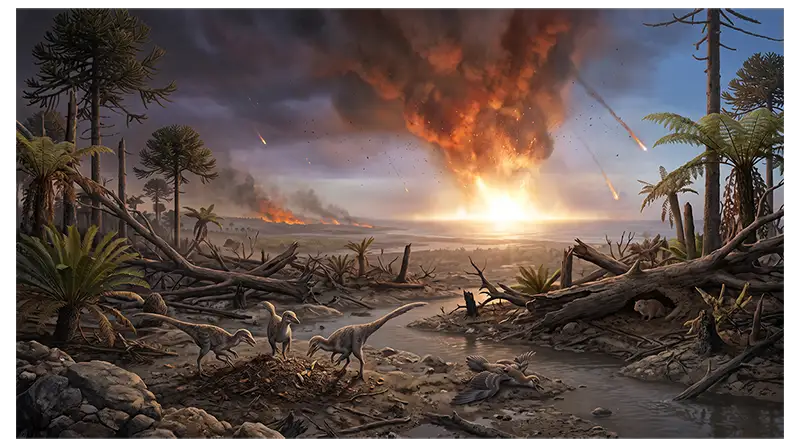
Avian dinosaurs survived for more than 100 million years and became diverse during the Cretaceous. However, most bird-line groups disappeared during the mass extinction at the end of the Cretaceous, about 66 million years ago.
This extinction is associated with the asteroid impact that formed the Chicxulub crater in present-day Mexico. The event caused major environmental changes, including darkness, cooling, fires, and disruption of food webs. The effects were severe for ecosystems on land and in the oceans. Many dinosaur groups disappeared, along with numerous marine organisms and other animals.
However, one branch of avian dinosaurs survived: the ancestors of modern birds. Scientists continue to investigate why some birds survived while other avian groups did not. Body size, diet, habitat, reproductive strategies, and access to different food sources may all have influenced survival.
The surviving birds then diversified during the Cenozoic Era, eventually producing the enormous variety of bird species living today. The end-Cretaceous extinction was therefore not the end of avian dinosaurs. Instead, it marked a major evolutionary turning point in which most ancient bird lineages disappeared while the lineage leading to modern birds continued.
Conclusion
Avian dinosaurs represent one of the most important evolutionary histories in the fossil record because they connect the dinosaur world with the living birds around us. They evolved from theropod dinosaurs and gradually developed feathers, modified skeletons, wings, specialized feet, beaks, and other features.
Their fossil record shows that this evolution was not a simple transformation from one animal into another. Many different avian dinosaurs appeared, lived in diverse environments, developed different feeding strategies, and experimented with different forms of aerial movement.
The Jurassic and Cretaceous periods produced a remarkable variety of bird-line dinosaurs, including Archaeopteryx, Confuciusornis, enantiornithines, Ichthyornis, and hesperornithiforms. Most disappeared during the end-Cretaceous mass extinction, but one surviving branch continued evolving.
That surviving lineage gave rise to the extraordinary diversity of modern birds. In this sense, every living bird carries part of the long evolutionary history of dinosaurs.
Yes. Modern birds are living members of the theropod dinosaur lineage and are therefore avian dinosaurs.
Feathers or feather-like structures were widespread among the bird lineage, but their exact form and distribution varied among different species.
Archaeopteryx is one of the oldest and most famous bird-line dinosaurs known from well-preserved fossils, but it should not be treated as the single first bird or the direct ancestor of all modern birds.
Yes. Several groups of avian dinosaurs lived during the Late Cretaceous, when Tyrannosaurus rex also existed.
The exact reasons remain an active area of research. Surviving bird lineages may have benefited from combinations of body size, diet, habitat use, reproductive traits, and access to food resources.