
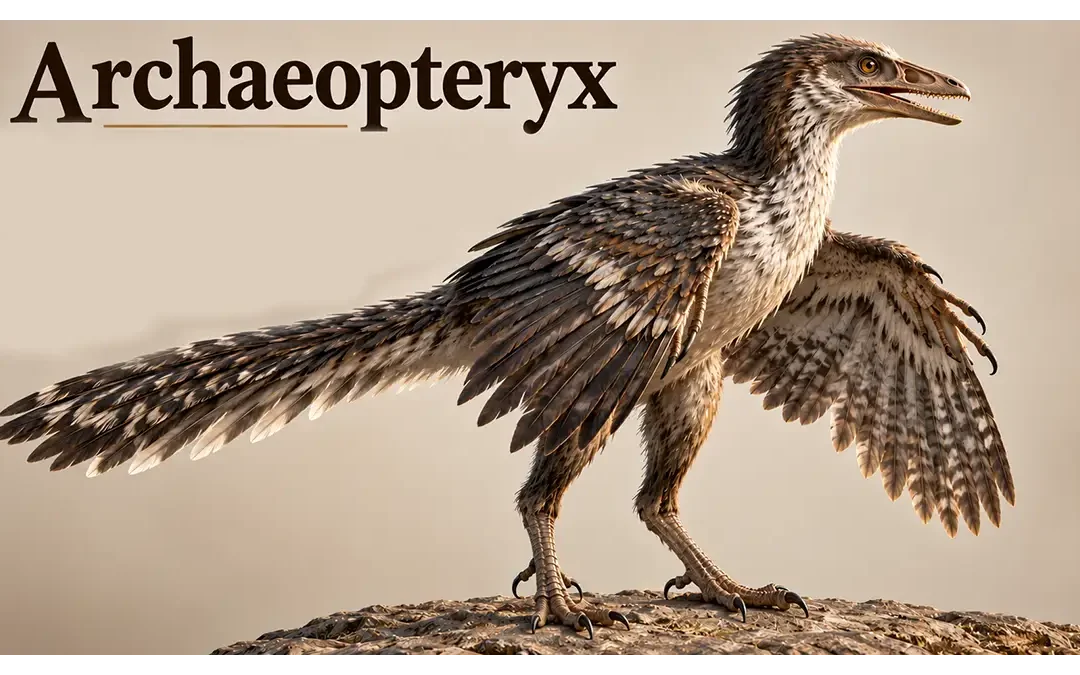
Archaeopteryx is one of the most famous prehistoric animals in paleontology because its fossils preserve a remarkable combination of dinosaur-like and bird-like characteristics. This small feathered theropod lived during the Late Jurassic, about 150 million years ago, in what is now southern Germany. Its wings and feathers show adaptations associated with aerial movement, while its teeth, clawed fingers, and long bony tail reveal features inherited from earlier theropod dinosaurs.
The discovery of Archaeopteryx fossils became especially important because they provided early evidence for the close evolutionary relationship between birds and dinosaurs. Later discoveries of other feathered dinosaurs have expanded this story, showing that bird evolution involved many species and gradual anatomical changes rather than a simple transformation from one animal into another.
The exceptionally preserved fossils from the Solnhofen limestone deposits allow scientists to investigate this animal in unusual detail. Its skeleton, feathers, teeth, wings, and surrounding geological evidence provide clues about its appearance, diet, possible flight abilities, environment, and place in the evolution of birds.
What Was Archaeopteryx?
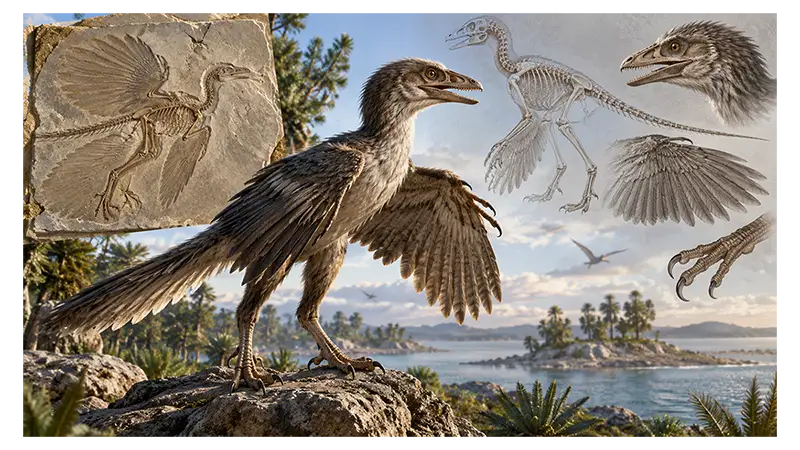
Archaeopteryx was a small feathered theropod dinosaur that lived during the Late Jurassic Period. Its name comes from Greek and is generally translated as “ancient wing.” The genus is known from fossils discovered in the Solnhofen region of Bavaria, Germany.
The animal was relatively small compared with many other Jurassic dinosaurs. Its body was lightly built, and its forelimbs had already developed into feathered wings. However, its skeleton still retained several characteristics that were common among non-avian theropods.
Archaeopteryx is part of the evolutionary history of birds, which originated within the theropod dinosaurs. Modern birds are living dinosaurs, specifically members of the avian branch of theropod evolution.
It is important to avoid describing Archaeopteryx as the direct ancestor of all modern birds. The fossil record shows that numerous feathered theropods existed around the same broad period, and bird evolution involved many branches.
Archaeopteryx is better understood as an early bird-like theropod that preserves a particularly informative combination of anatomical features.
What Did Archaeopteryx Look Like?
Archaeopteryx had a slender body, a long tail, feathered wings, and a relatively small head. Its appearance would have differed considerably from that of most modern birds.
Its jaws contained small, pointed teeth. These teeth were useful for gripping food and clearly separated Archaeopteryx from living birds, which lack functional teeth.
The forelimbs were transformed into wings but retained three separate fingers ending in claws. This arrangement gave the wings a more primitive construction than the highly specialized forelimbs of modern birds.
A long sequence of vertebrae formed the tail. Feathers extended along this structure and contributed to its overall aerodynamic shape.
The skeleton also contained a furcula, commonly called a wishbone. This structure is characteristic of modern birds but also occurs in various theropod dinosaurs.
A simplified comparison helps show its unusual combination of features:
| Feature | Archaeopteryx | Modern birds |
|---|---|---|
| Feathers | Present | Present |
| Wings | Present | Present |
| Teeth | Present | Absent |
| Fingers | Three clawed fingers | Highly modified digits |
| Tail | Long and bony | Shortened |
| Furcula | Present | Present |
| Body plan | Primitive theropod-bird form | Highly specialized avian form |
These characteristics created an animal that looked neither like a typical Jurassic theropod nor like a modern bird.
Did Archaeopteryx Have Feathers?
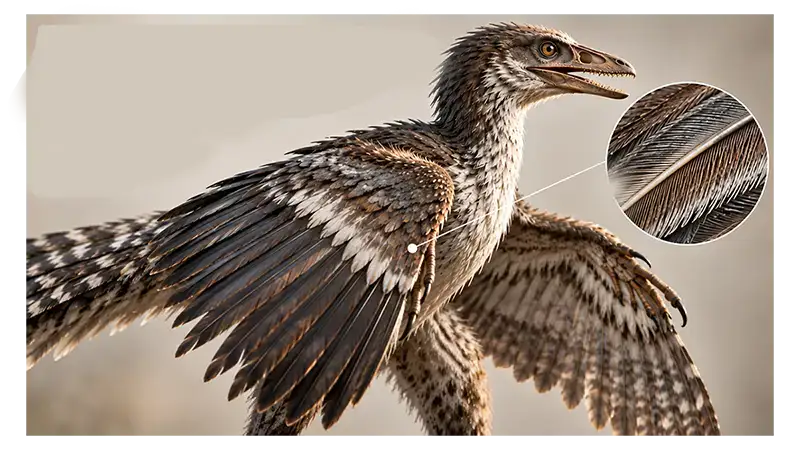
Yes. Archaeopteryx had feathers, and several fossils preserve their impressions around the wings and tail.
The preserved structures were complex feathers rather than simple hair-like filaments. Their arrangement provides important evidence about the development of feathered wings during the Jurassic.
Feathers themselves were not an invention specifically for flight. Feather-like coverings existed in dinosaurs that were not capable of powered flight. Early feathers may have helped with insulation, display, camouflage, or other functions before becoming increasingly important for aerial movement.
Archaeopteryx therefore represents an important stage in a much longer history of feather evolution. Its feathers show that sophisticated plumage had already developed among some theropods by the Late Jurassic.
Researchers have also investigated the possible colors of Archaeopteryx feathers. Microscopic structures preserved in an isolated feather have provided evidence for dark pigmentation, although scientists cannot confidently reconstruct the animal's complete color pattern.
The feather evidence is especially valuable because soft structures are rarely preserved in ordinary dinosaur fossils. The Solnhofen deposits created unusual conditions that allowed these delicate impressions to survive.
Could Archaeopteryx Fly?
Archaeopteryx had wings and feathers capable of interacting with moving air, but scientists continue to debate exactly how it used them.
Its long wing feathers formed an aerodynamic surface that could generate lift. The furcula and other parts of the skeleton also indicate adaptations associated with aerial movement.
However, its flight system was not identical to that of a modern eagle, swallow, or other specialized flying bird. The animal retained a long bony tail and clawed fingers, while some aspects of its shoulder and chest anatomy were relatively primitive.
Scientists have proposed several possibilities for its aerial behavior. It may have combined powered flapping with gliding, or it may have achieved stronger powered flight than some early interpretations suggested.
The evolution of flight was probably a gradual process. Different theropods developed feathers, modified forelimbs, changes in body proportions, and aerodynamic abilities at different times.
This means Archaeopteryx should not be treated as a simple halfway point between a ground-running dinosaur and a modern flying bird. Its anatomy represents one stage in a broader evolutionary history of aerial adaptation.
What Made Archaeopteryx Different From Modern Birds?
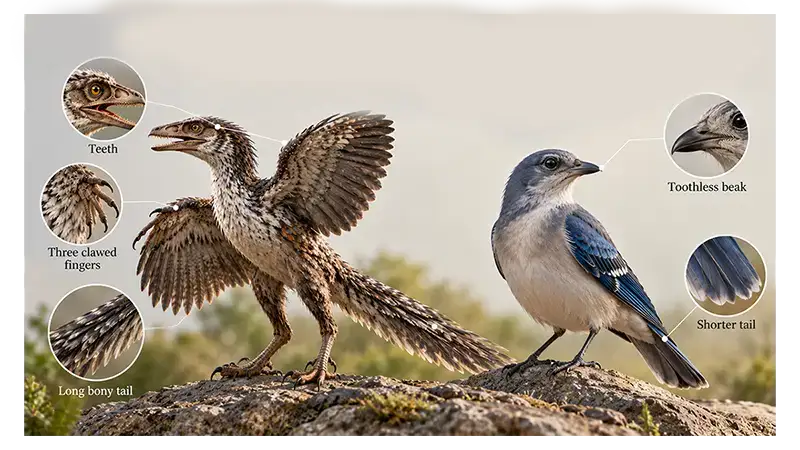
The differences between Archaeopteryx and living birds reveal how much the avian body has changed through evolution. Its jaws still carried teeth, whereas modern birds use toothless beaks. The presence of teeth shows that the loss of this ancestral feature had not yet occurred in Archaeopteryx.
Its hands were also more primitive. Three fingers remained distinct and carried claws, while modern birds have greatly modified digits incorporated into their wings.
The long bony tail provides another obvious distinction. Living birds have a much shorter tail structure with specialized bones that support their tail feathers.
Archaeopteryx also retained a body plan that was less specialized for efficient flight than that of most modern birds. Its anatomy reflects an earlier stage in the development of the highly integrated avian skeleton.
These differences are important because they demonstrate that bird evolution involved gradual modification of existing dinosaur structures. New adaptations appeared while older features continued to exist elsewhere in the body.
What Did Archaeopteryx Eat?
Archaeopteryx was probably a carnivorous or insect-eating animal. Its sharp teeth were suited to catching and holding small prey.
Its relatively small body suggests that it would have targeted animals that it could capture and handle without difficulty. Insects, small reptiles, and other small vertebrates are reasonable candidates based on its anatomy and the surrounding fossil ecosystem.
The Solnhofen region contained a diverse collection of Jurassic organisms. Fossils from the deposits include insects, lizards, pterosaurs, and other small animals that could have formed part of the available food web.
Its teeth provide the clearest anatomical evidence for its feeding habits. Pointed teeth are useful for gripping animal material and are not typical of animals specialized for grinding plant foods.
The claws on its fingers may also have played a role in interacting with prey, although their precise function cannot be established with certainty from fossils alone.
Because direct evidence of individual meals is extremely limited, scientists cannot provide a complete diet for Archaeopteryx. Instead, they combine dental anatomy, body size, and the known Jurassic ecosystem to estimate what it probably consumed.
Where and When Did Archaeopteryx Live?
Archaeopteryx lived during the Late Jurassic Period, roughly 150 million years ago. Its known fossils come from the Solnhofen limestone deposits of Bavaria in southern Germany.
The region looked very different from modern Germany. During the Jurassic, southern Germany was part of a warm island-and-lagoon environment surrounded by shallow marine waters.
Numerous islands stood above the surrounding sea, while restricted lagoons developed between them. Fine sediments accumulated in these quiet waters and eventually formed the limestone that preserved Archaeopteryx.
The surrounding ecosystem contained animals adapted to both land and water. Pterosaurs occupied the skies, small dinosaurs moved across the islands, and marine organisms inhabited the nearby lagoons.
The exact lifestyle of Archaeopteryx within this environment remains uncertain. Its anatomy indicates aerial capability, but fossils alone cannot reveal how frequently it flew or whether it spent most of its time on the ground.
The geological environment is particularly important because it explains why Archaeopteryx fossils are so exceptionally preserved. Fine sediment and low-oxygen conditions helped protect delicate remains from rapid destruction.
Archaeopteryx Fossils and Famous Specimens
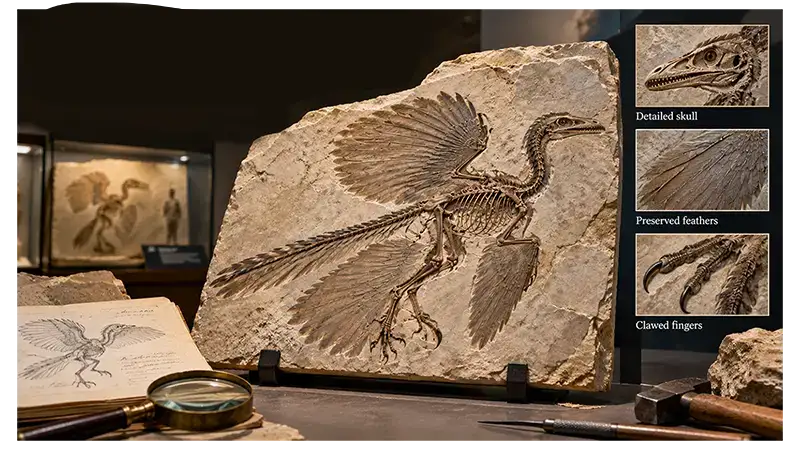
Archaeopteryx became famous largely because its fossils preserve details that are rarely found in Jurassic animals.
The first known Archaeopteryx fossil was an isolated feather discovered in 1861. Later that year, a more complete skeleton was found, revealing the unusual combination of bird-like and dinosaur-like characteristics.
The London specimen was one of the first major skeletons studied. It provided important evidence about the animal's body structure and helped establish its scientific significance.
The Berlin specimen is among the most complete Archaeopteryx fossils. It preserves a detailed skeleton together with impressions of feathers, making it one of the most valuable specimens for studying the animal's anatomy.
The Munich specimen and Thermopolis specimen provide additional information. Comparing several individuals allows researchers to identify features that might otherwise be misunderstood from a single fossil.
The Solnhofen limestone is particularly important because it can preserve extremely delicate structures. Under favorable conditions, feathers and other soft tissues left impressions in the fine sediment before becoming part of the fossil record.
Modern scientific techniques have also changed how these fossils are studied. High-resolution imaging can reveal structures that are difficult to see on the surface, allowing researchers to investigate specimens without physically damaging them.
The Archaeopteryx fossil record therefore contains much more than isolated bones. It preserves evidence about feathers, skeletal anatomy, geological conditions, and the biological characteristics of an important Jurassic animal.
Why Is Archaeopteryx Important to Bird Evolution?
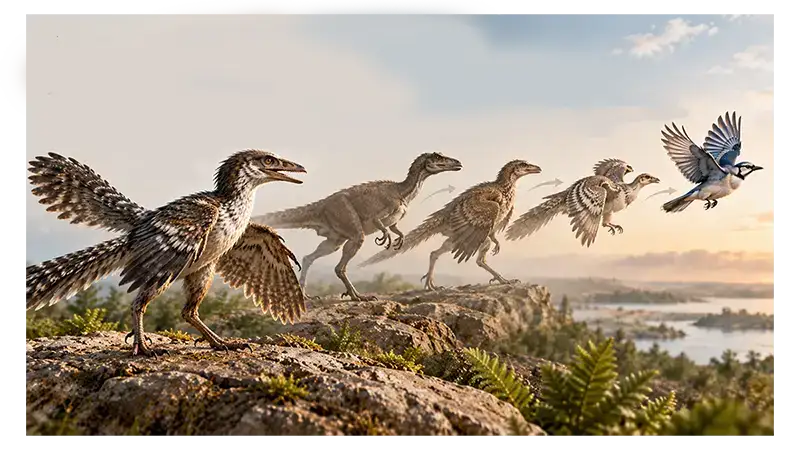
Archaeopteryx is important because it provides a detailed example of how bird-like characteristics existed within theropod dinosaurs.
Its feathers and wings demonstrate that aerial adaptations had already developed among small theropods by the Late Jurassic. At the same time, its teeth, clawed fingers, and long tail show that these animals could retain older anatomical characteristics.
This combination illustrates mosaic evolution, where different traits change at different rates within the same organism. An animal can develop a highly specialized structure while preserving ancestral features elsewhere in its body.
The discovery of Archaeopteryx was especially significant in the nineteenth century. It appeared soon after Charles Darwin published On the Origin of Species, at a time when scientists had far fewer fossils showing combinations of major anatomical characteristics.
Later discoveries have provided an even broader picture. Numerous feathered theropods have now been identified, demonstrating that feathers and other bird-like traits evolved across many dinosaur groups.
For this reason, Archaeopteryx should not be described simply as a “missing link.” It was a distinct animal with its own evolutionary history.
Its real importance lies in the evidence it provides for the gradual development of avian characteristics within theropod dinosaurs. The fossils help scientists understand how feathers, wings, modified limbs, and other features became part of the evolutionary history that eventually produced modern birds.
Conclusion
Archaeopteryx remains one of the most informative fossils from the Late Jurassic because its remains preserve an unusual combination of anatomical characteristics. Its feathers and wings existed alongside teeth, clawed fingers, and a long bony tail.
The exceptional Solnhofen fossils have allowed scientists to study these features in far greater detail than is possible for most Jurassic animals. Feather impressions are particularly valuable because they provide direct evidence of complex plumage in an early theropod.
Its evolutionary importance extends beyond the question of whether it should be called a bird or a dinosaur. Archaeopteryx helps explain how different characteristics associated with modern birds developed within theropod dinosaurs over long periods of evolutionary change.
The discovery of many other feathered dinosaurs has made the history of bird evolution more detailed and complex, but Archaeopteryx remains an important part of that story. Its fossils continue to help paleontologists investigate the origin of feathers, the development of flight, and the evolutionary history of birds.
Archaeopteryx was a theropod dinosaur closely related to the early evolutionary history of birds. Its exact classification can depend on how scientists define early birds and their closest relatives.
Yes. Its fossils preserve impressions of feathers, especially around the wings and tail.
Yes. Unlike modern birds, Archaeopteryx had small pointed teeth in its jaws.
Its fossils provide important evidence for understanding the development of bird-like characteristics within theropod dinosaurs.
The known fossils were discovered in the Solnhofen limestone deposits of Bavaria, Germany.