
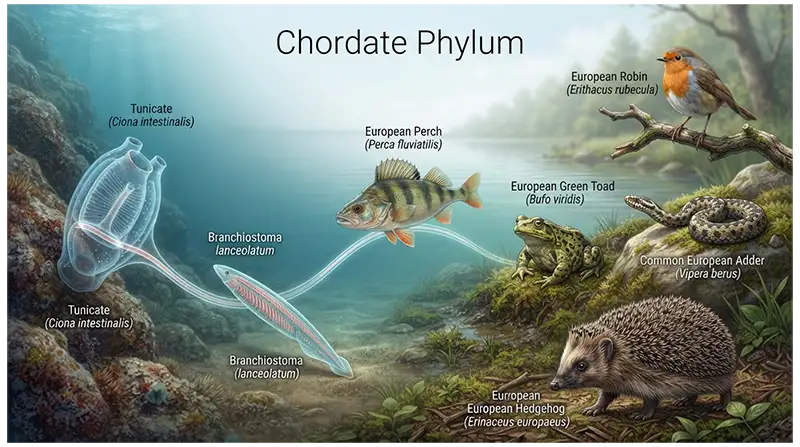
Chordate Phylum includes a diverse group of animals that share a distinctive set of features during at least one stage of their development. These features include the notochord, dorsal hollow nerve cord, pharyngeal slits, endostyle or thyroid-related structure, and post-anal tail. The group includes marine tunicates and lancelets as well as vertebrates such as fish, amphibians, reptiles, birds, and mammals.
Chordata is important in biology and paleontology because it provides a framework for understanding the evolution of vertebrates and the development of increasingly complex animal body plans. Fossils, anatomy, embryology, and molecular evidence together reveal how chordates diversified through geological time.
What Is the Chordate Phylum?
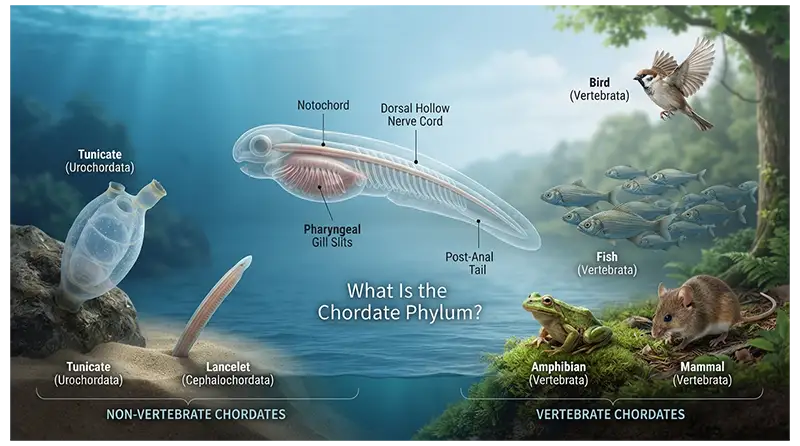
Chordata is a phylum within the animal kingdom. Animals belonging to this phylum are called chordates. The defining feature of the phylum is a particular developmental body plan rather than one permanent structure found in every adult animal. Chordates develop a notochord, dorsal hollow nerve cord, pharyngeal slits, an endostyle or thyroid-related structure, and a post-anal tail during at least one stage of their life.
These characteristics are especially clear in some simple marine chordates. In other members, particularly vertebrates, they become modified as the animal develops.
Chordates are commonly divided into three major living groups:
- Tunicata, including tunicates
- Cephalochordata, including lancelets
- Vertebrata, including animals with vertebral columns
This classification shows an important point: Chordata is broader than Vertebrata. A tunicate or lancelet is a chordate without being a vertebrate.
What Are the Main Characteristics of Chordates?
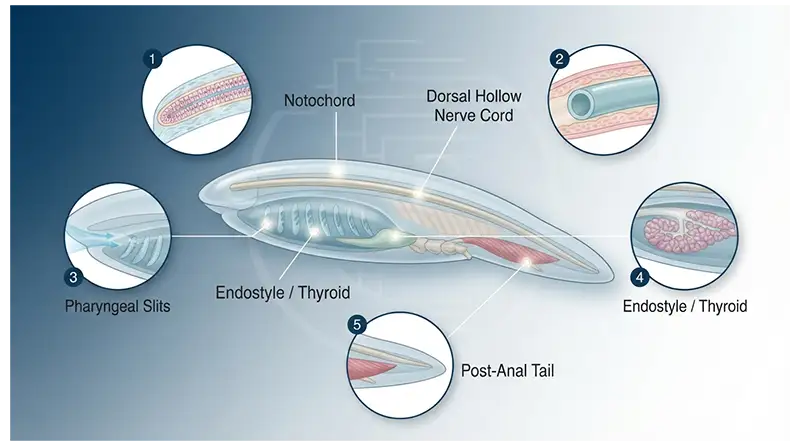
The chordate body plan is recognized by several defining developmental features.
Notochord
The notochord is a flexible, rod-like structure that extends along the main body axis. It provides support and helps organize development. In lancelets, the notochord remains prominent throughout life. In vertebrates, it is largely replaced or surrounded by the developing vertebral column.
Dorsal Hollow Nerve Cord
The dorsal hollow nerve cord develops along the back of the animal, above the notochord. In vertebrates, its anterior region develops into the brain and the rest forms the spinal cord. This structure is therefore closely connected with the complex nervous systems found in vertebrates.
Pharyngeal Slits
Pharyngeal slits occur in the pharyngeal region behind the mouth. In aquatic chordates, they can participate in filter feeding and water movement. In vertebrates, embryonic pharyngeal structures develop into different anatomical structures depending on the species.
Endostyle or Thyroid-Related Structure
The endostyle is a structure found in tunicates and lancelets that produces mucus involved in filter feeding. Vertebrates possess the thyroid gland, which is considered evolutionarily related to the endostyle. This connection provides an example of how a shared ancestral feature can become modified in different chordate lineages.
Post-Anal Tail
A post-anal tail extends beyond the anus during at least one stage of chordate development. In aquatic species, it often contributes to swimming. In other chordates, it may become reduced or undergo major structural changes.
Bilateral Symmetry
Chordates have bilateral symmetry, meaning their bodies have corresponding left and right sides. This arrangement is associated with directional movement and the development of distinct front and rear regions.
What Is the Chordate Body Structure?
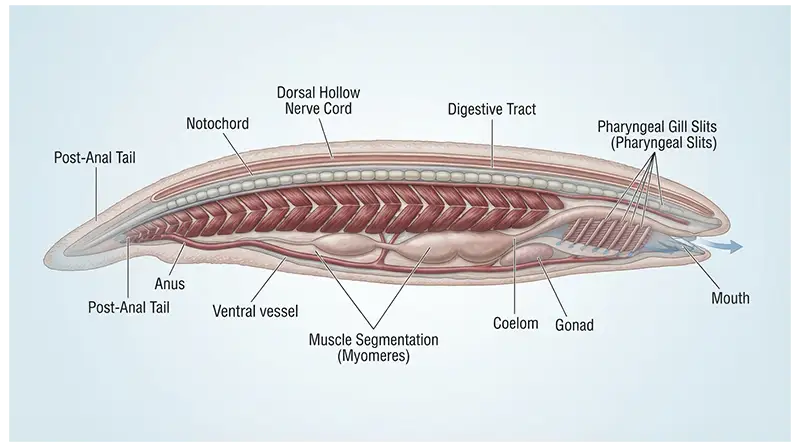
Although chordates differ greatly in appearance, their bodies share a basic structural organization. The notochord provides axial support, while the dorsal nerve cord lies above it. Muscles are arranged along the body, and many aquatic chordates have repeated muscle blocks called myomeres.
The pharynx is another important region. Depending on the chordate, it can contribute to feeding, respiration, or other biological functions. In vertebrates, this basic arrangement became much more elaborate.
A skull protects the brain, while the vertebral column provides support around the spinal cord. Fins, limbs, jaws, teeth, and specialized sensory organs developed in different vertebrate lineages. The result is a remarkable variety of body forms built from a common evolutionary foundation.
What Are the Three Main Groups of Chordates?
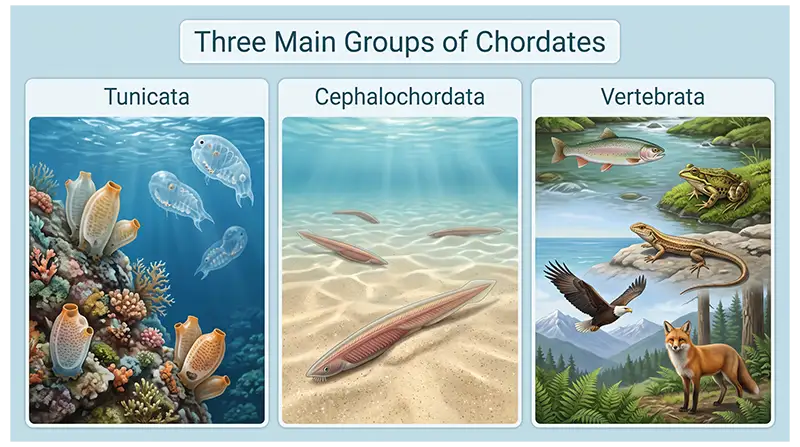
The three major living chordate groups are Tunicata, Cephalochordata, and Vertebrata.
Tunicata
Tunicata, commonly called tunicates, are primarily marine animals. Many adult tunicates are attached to rocks or other surfaces, while some forms are free-floating. Their larvae display several classic chordate features, including a notochord, dorsal nerve cord, and post-anal tail. Many of these structures become greatly reduced as the animal develops into an adult.
Examples include sea squirts, salps, and appendicularians.
Cephalochordata
Cephalochordata includes the small marine animals known as lancelets. Lancelets have elongated bodies and retain the notochord throughout their lives. They also retain several other features of the basic chordate body plan. They usually live partly buried in shallow marine sediments and filter small food particles from the surrounding water.
Vertebrata
Vertebrata contains the most familiar chordates. Members have a well-developed internal skeleton and vertebral structures, together with complex nervous and sensory systems.
Major vertebrate groups include:
- Jawless vertebrates
- Fishes
- Amphibians
- Reptiles
- Birds
- Mammals
Humans belong to Vertebrata and are therefore also members of Chordata.
Where Do Chordates Live?
Chordates occupy an enormous range of habitats, from marine environments to terrestrial ecosystems.
Marine Habitats
Tunicates and lancelets are marine animals, while many vertebrates also depend on ocean environments. Marine chordates can live in coastal waters, coral-associated habitats, the open ocean, deep water, and near the seafloor.
Freshwater Habitats
Freshwater chordates include numerous fishes and amphibians. They inhabit rivers, streams, lakes, ponds, and wetlands. Each environment presents different conditions involving temperature, water movement, oxygen, food, and shelter.
Terrestrial Habitats
Vertebrates successfully colonized land and now live in forests, grasslands, deserts, mountains, and polar regions. Birds and mammals occupy particularly diverse terrestrial habitats, while many reptiles and amphibians have also developed specialized adaptations for life on land.
Specialized Habitats
Some chordates live in caves, underground environments, deep marine habitats, or very cold regions. Their wide distribution demonstrates how different chordate lineages have adapted their bodies and behaviors to local environmental conditions.
How Do Chordates Feed and Move?
Chordates use a wide variety of feeding and locomotion strategies.
Feeding Strategies
Tunicates and lancelets can obtain food by filtering small particles from water through their pharyngeal regions. Vertebrates evolved more specialized feeding systems. Fish may use jaws and teeth to capture prey, birds have specialized beaks, and mammals have diverse teeth and jaws suited to different diets.
Chordates may function as:
- Filter feeders
- Herbivores
- Carnivores
- Omnivores
- Scavengers
- Predators
Movement
Aquatic chordates commonly use muscular body movements, tails, or fins for swimming. On land, vertebrates developed limbs with different functions. Some are adapted for walking, others for running, climbing, digging, or swimming. Birds modified their forelimbs into wings for powered flight, while some mammals independently evolved the ability to fly.
These differences demonstrate how the chordate body plan can be modified for specialized forms of movement.
How Do Chordates Reproduce and Develop?
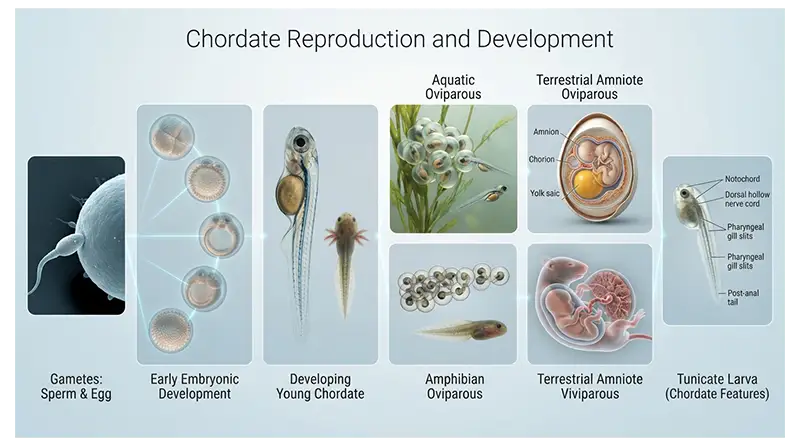
Chordate reproduction varies considerably among the three major groups and among individual species. Sexual reproduction is widespread, with sperm and eggs combining to form a fertilized egg. Development may occur in water, inside protective eggs, or within the parent's body.
Many fishes release eggs and sperm into water, although reproductive strategies vary widely. Amphibians often have aquatic eggs or larvae. Reptiles and birds generally produce eggs with protective coverings. Most mammals develop their embryos internally and give birth to live young, while monotremes such as the platypus and echidnas lay eggs.
Development is particularly important in chordates because some defining characteristics are most visible during embryonic or larval stages. A tunicate larva, for example, displays several chordate features that become greatly reduced in the adult.
How Did Chordates Evolve?
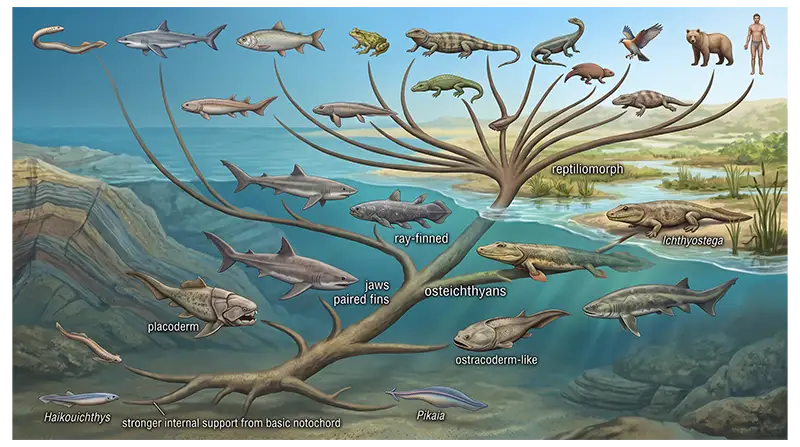
Chordate evolution began in ancient marine ecosystems. Early members were generally small and soft-bodied, which means their fossil record is incomplete. Cambrian fossil deposits provide some of the most important evidence for early chordate history. Fossils such as Pikaia from the Burgess Shale and early vertebrate-like forms such as Haikouichthys provide clues about the anatomy of ancient chordates.
As chordate lineages diversified, major innovations appeared.
These included:
- More complex heads and sensory systems
- Stronger internal support
- Jaws
- Paired fins
- More specialized feeding structures
- More efficient swimming
- Limbs
- Adaptations for terrestrial life
Chordate evolution was not a simple progression from one animal into another. Instead, it produced a branching network of lineages. Some groups survived and diversified, while others became extinct.
What Do Chordate Fossils Reveal About Early Vertebrates?
Fossils provide some of the strongest evidence for reconstructing the early history of chordates and vertebrates. Soft-bodied early chordates are difficult to preserve, but exceptional fossil deposits can capture delicate anatomical details. These fossils can reveal evidence of body structures associated with early chordates, including:
- Notochord-like structures
- Segmented muscles
- Pharyngeal regions
- Early nervous-system organization
- Feeding structures
- Swimming adaptations
Later vertebrate fossils show the development and modification of jaws, fins, skeletal structures, and eventually limbs. Trace fossils may also provide information about movement and interactions with ancient environments.
Because the fossil record is incomplete, paleontologists compare fossils with living chordates and use developmental, anatomical, genetic, and molecular evidence to reconstruct relationships. This combined approach is especially important for understanding the earliest stages of vertebrate evolution.
Why Are Chordates Important to Evolution and Earth Science?
Chordates are important because their history records major changes in animal life through geological time. Their fossils occur in rocks from many different periods, allowing scientists to examine how animal communities changed alongside shifting environments, climates, oceans, and ecosystems.
Chordate evolution also includes some of the most significant developments in vertebrate history, including the appearance of jaws, paired appendages, limbs, specialized teeth, feathers, and other complex structures. The group has major ecological importance as well. Fish occupy important positions in aquatic food webs, while amphibians, reptiles, birds, and mammals contribute to terrestrial and freshwater ecosystems.
Chordates are also directly relevant to human biology. Because humans are vertebrates, research on chordate development, anatomy, genetics, and evolution provides important information about our own biological history. For paleontology and Earth science, Chordata therefore offers a long-term record connecting animal evolution, fossils, environments, and geological change.
Conclusion
The Chordate Phylum, or Chordata, includes animals that share a distinctive developmental body plan. Its defining features include the notochord, dorsal hollow nerve cord, pharyngeal slits, endostyle or thyroid-related structure, and post-anal tail. The three major living chordate groups are Tunicata, Cephalochordata, and Vertebrata.
This classification also explains an important biological relationship: vertebrates are chordates, but chordates also include animals without vertebral columns. From ancient marine chordates to modern vertebrates, the history of Chordata shows how evolutionary changes can produce enormous biological diversity.
Fossils, anatomy, development, genetics, and molecular evidence together reveal how these animals changed through geological time. For biology and paleontology, chordates provide an important link between animal structure, vertebrate evolution, fossil evidence, ecology, and the geological history of life on Earth.
The defining characteristics are the notochord, dorsal hollow nerve cord, pharyngeal slits, endostyle or thyroid-related structure, and post-anal tail.
Yes. Humans are mammals and vertebrates, so they belong to the phylum Chordata.
No. Tunicates and lancelets are chordates but are not vertebrates.
Yes. Fish are vertebrates and therefore belong to Chordata.
Lancelets are small marine chordates in Cephalochordata. They retain the notochord and other basic chordate features throughout their lives.