
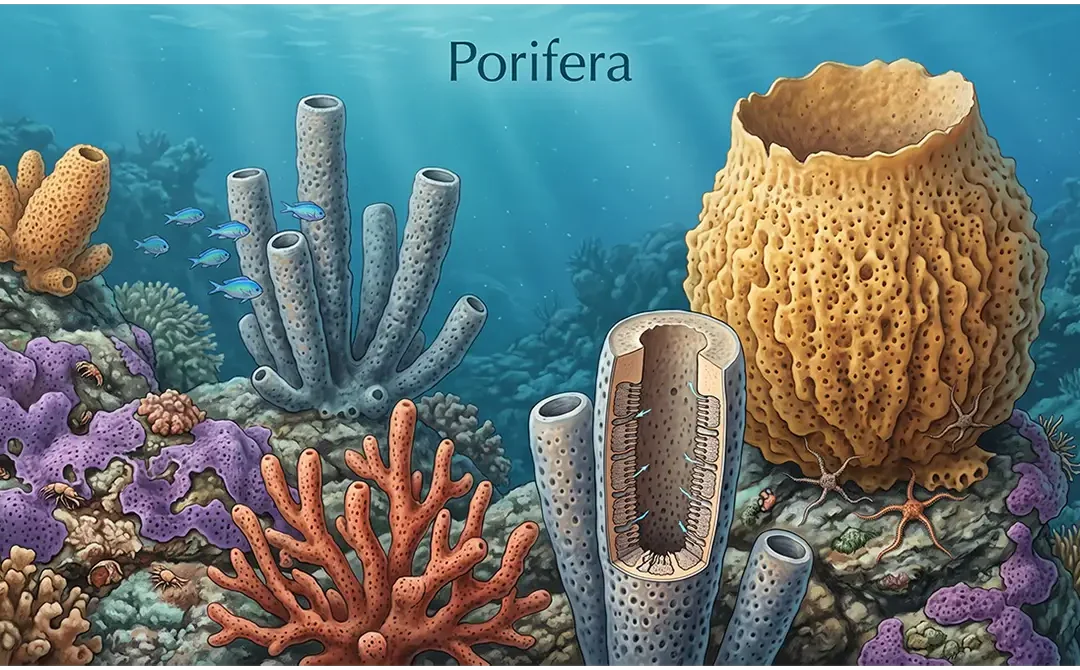
Porifera is a phylum of aquatic animals commonly known as sponges. They are among the simplest groups of living animals, but their biology is more complex than their appearance suggests. Sponges have specialized cells, organized water-flow systems, skeletal structures, and several ways of reproducing and repairing damaged parts.
Most Porifera live in marine environments, where they attach themselves to rocks, reefs, sediments, shells, and other surfaces. A smaller number live in freshwater habitats such as lakes, ponds, and streams. Instead of hunting for food, sponges usually filter tiny particles from water as it passes through their bodies.
Porifera also have an important place in Earth's history. Fossil spicules, mineralized skeletons, and sponge-like structures provide evidence about ancient aquatic environments and the early evolution of animals. Their long history makes them important subjects in biology, ecology, paleontology, and evolutionary science.
What Is Porifera?
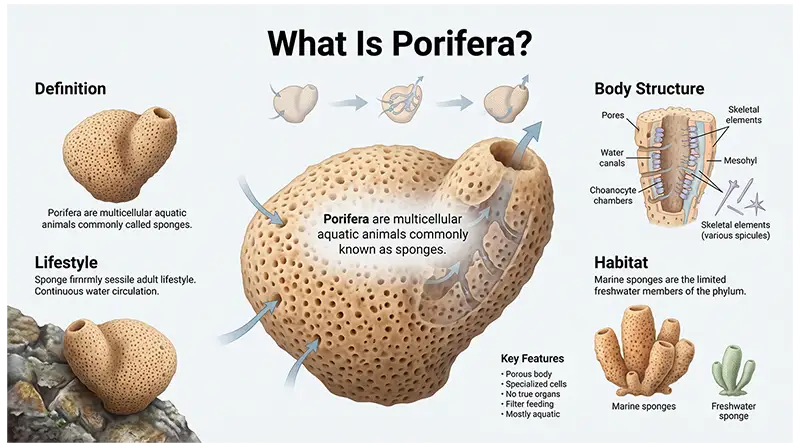
Porifera is the scientific name of the animal phylum that includes sponges. The name comes from the pore-bearing nature of their bodies. Numerous openings allow water to enter the sponge, while larger openings allow water to leave.
Sponges are multicellular animals, which means their bodies are made of many cells that perform different functions. However, they do not have the complex organ systems found in animals such as fish, insects, birds, or mammals. A sponge does not have a heart to pump blood, lungs to exchange gases, or a stomach to digest food. Instead, specialized cells carry out these functions directly or work together through the movement of water.
Water is central to almost every aspect of sponge life. It brings food particles and dissolved oxygen into the body and carries carbon dioxide and other waste products away. The sponge's internal canal system is therefore an essential part of its biology. Most adult sponges are sessile, meaning they remain attached to one place rather than moving freely through their environment. Their larvae,
however, are usually capable of swimming for a period of time before settling on a suitable surface. Porifera are primarily aquatic. Most species are marine, but freshwater sponges are also known. They can occupy environments ranging from shallow coastal waters to deep ocean habitats.
Although sponges may appear to be simple organisms, their cells are specialized for feeding, water circulation, reproduction, defense, skeletal formation, and repair. This makes Porifera important for understanding how multicellular animal life functions.
What Are the Main Characteristics of Porifera?
Porifera have a distinctive combination of biological features. These characteristics allow them to survive without the organs and nervous systems found in more complex animals.
Porous Body
The most recognizable feature of a sponge is its porous body. Numerous small openings allow water to enter. These pores connect to canals and chambers inside the body. The exact arrangement varies among different sponge groups, but the basic purpose is the same: move water through the animal.
Cellular Organization
Sponges are made of specialized cells, but they do not have true tissues and organs in the same way as most other animals. Different cell types perform different tasks. Some create water currents, some transport nutrients, some produce skeletal structures, and others participate in reproduction and regeneration.
No True Nervous System
Porifera do not have a brain or conventional nervous system. They also lack nerve cells organized into a nervous network. Nevertheless, sponge cells can communicate through chemical and physical signals. These interactions allow the animal to coordinate processes such as water movement and responses to environmental changes.
Filter Feeding
Most sponges are filter feeders. They obtain food by removing small particles from the water that passes through their bodies. Common food sources include bacteria, microscopic algae, organic particles, and other tiny organisms.
Specialized Choanocytes
Choanocytes, or collar cells, are particularly important to sponge biology. Their flagella generate water currents, while their collar-like structures help capture food particles. These cells are one of the main reasons sponges can maintain continuous water flow without a pumping organ.
Internal Skeleton
Many sponges have a skeleton that supports their bodies. Depending on the group, this skeleton may contain silica spicules, calcium carbonate spicules, flexible spongin fibers, or combinations of these materials.
Mostly Sessile Adults
Adult sponges normally remain attached to a surface. They do not walk or swim from one location to another. Their ability to obtain food from moving water allows them to maintain a stationary lifestyle.
Strong Regenerative Ability
Many sponges can repair damaged body parts and reorganize their cells after injury. Some can even regenerate after being separated into pieces or having their cells disrupted.
Mostly Marine
The majority of Porifera live in oceans and seas. Freshwater species occur in several environments but make up a much smaller portion of overall sponge diversity.
What Is the Anatomy of a Sponge?
A sponge may look like a simple mass from the outside, but its body contains a complex arrangement of pores, canals, chambers, cells, and supporting structures.
The exact anatomy differs among sponge groups, but several structures are commonly important.
Ostia
Ostia are small openings through which water enters the sponge. In some sponges, these openings are connected to an extensive network of canals. Water entering through many ostia eventually reaches areas containing choanocytes.
Canals and Chambers
The internal canal system distributes water throughout the sponge. Simple sponges have relatively uncomplicated pathways, while more complex forms contain numerous chambers and branching canals. These differences are related to body size, feeding efficiency, and the amount of water the sponge can process.
Osculum
The osculum is a larger opening through which water leaves the sponge. After passing through the internal canal and chamber system, water is directed toward the osculum and released back into the surrounding environment.
Choanocytes
Choanocytes are specialized cells that help generate water currents. Each choanocyte has a flagellum surrounded by a collar of fine projections. The movement of the flagellum draws water through the sponge, while food particles can become trapped around the collar. Choanocytes therefore play an important role in both water circulation and feeding.
Mesohyl
The mesohyl is a gelatinous material located between the sponge's outer and inner cellular regions. It contains various cells, fibers, skeletal elements, and other substances. The mesohyl acts as an important internal framework and provides space where different cellular activities occur.
Amoeboid Cells
Several types of mobile cells occur within the mesohyl. These cells can transport nutrients, produce skeletal materials, participate in reproduction, and help repair damaged areas.Their ability to move through the internal body environment is particularly important because sponges do not have blood vessels for transporting materials.
Spicules
Spicules are tiny skeletal structures found in many sponges. They may be made of silica or calcium carbonate, depending on the sponge group. Their shapes vary considerably. Some are needle-like, while others have multiple rays or more complex forms. Spicules strengthen the body and can also provide protection from predators.
Spongin
Many demosponges contain spongin, a flexible protein-based fiber that helps support the body. The combination of spongin and spicules gives many sponges a flexible but stable structure.
How Do Porifera Feed and Circulate Water?
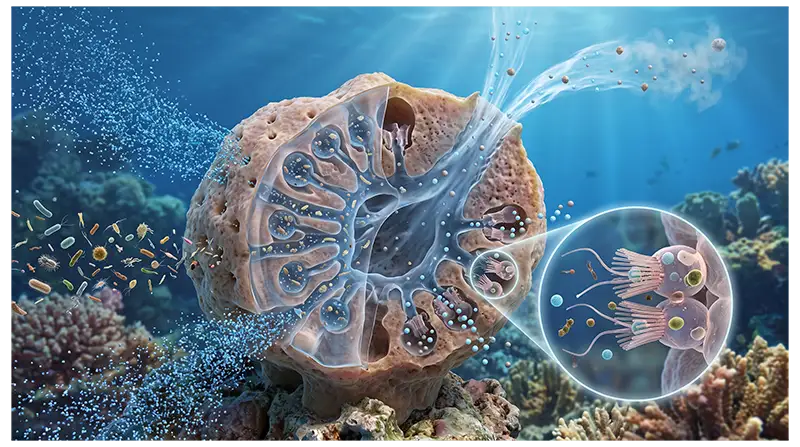
Water circulation is one of the most important processes in Porifera. A sponge depends on water movement for food, oxygen, and waste removal. Unlike animals that actively search for food, most sponges allow the surrounding water to bring food particles to them.
The process begins when water enters through numerous ostia. It then travels through canals and reaches chambers containing choanocytes. The flagella of choanocytes beat continuously and create currents through the sponge. As water passes the choanocytes, small food particles can become trapped by their collars.
The cells then take in and process these particles. Food is not transported through a traditional digestive tract. Instead, digestion occurs within cells, and nutrients can be transferred to other parts of the sponge by specialized cells in the mesohyl.
What Does Sponge Water Flow Provide?
Water movement serves several functions:
- Food: suspended particles are brought into the sponge.
- Oxygen: dissolved oxygen enters with the water.
- Waste removal: carbon dioxide and metabolic wastes are carried away.
- Chemical exchange: dissolved substances move between the sponge and its surroundings.
- Internal circulation: nutrients and other materials can be distributed through the body.
Different sponge groups have different internal canal systems. More complex canal arrangements can support efficient water processing in larger or more structurally developed bodies.
The rate of filtration can also change with environmental conditions. Some sponges can regulate their water flow when conditions become unfavorable, helping them cope with changes in sediment, temperature, or water quality.
Where Do Porifera Live?
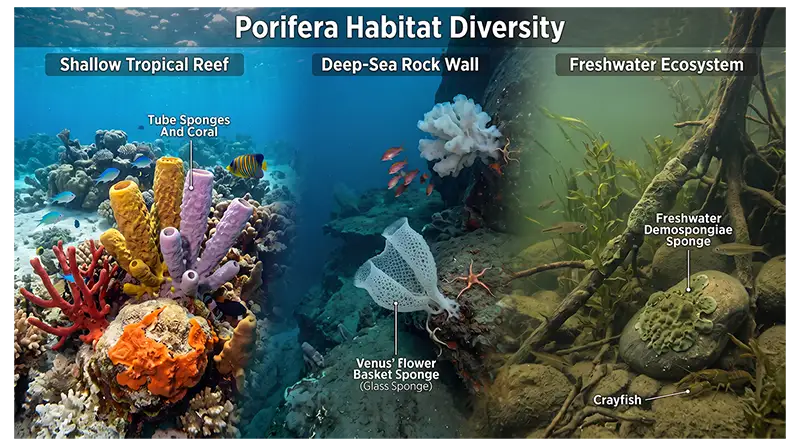
Porifera occupy a remarkably wide range of aquatic habitats. Although marine environments contain most sponge species, freshwater sponges have adapted to inland waters.
Shallow Marine Habitats
Many marine sponges grow in shallow coastal areas where sunlight, currents, and nutrients support diverse communities. They may attach to rocks, shells, reef surfaces, sediments, or other hard structures.
Coral Reef Environments
Sponges are important members of many reef ecosystems. They can occupy spaces between corals and other organisms and provide surfaces or shelter for smaller animals. Some reef sponges also participate in complex relationships with microorganisms living inside their tissues.
Deep-Sea Habitats
Sponges are not limited to shallow water. Many species live at considerable depths where temperatures are low and sunlight does not reach. Glass sponges, particularly members of Hexactinellida, are well known from deep marine environments. In some areas, they form extensive communities on the seafloor.
Caves and Low-Light Environments
Some sponges live inside underwater caves or other areas with little or no sunlight. Because most sponges do not depend directly on sunlight for energy, they can survive in environments that would be unsuitable for photosynthetic organisms.
Freshwater Habitats
Freshwater sponges occur in lakes, ponds, rivers, streams, and other inland environments. They may grow on submerged rocks, branches, plants, and other solid surfaces. Some freshwater species experience seasonal changes in water temperature, flow, and availability. Certain freshwater sponges produce gemmules, resistant structures that help them survive unfavorable conditions.
Polar and Cold Environments
Some marine sponges are adapted to cold waters, including high-latitude environments. Their ability to live under very different temperatures demonstrates the ecological flexibility of the phylum.
What Are the Main Groups of Porifera?
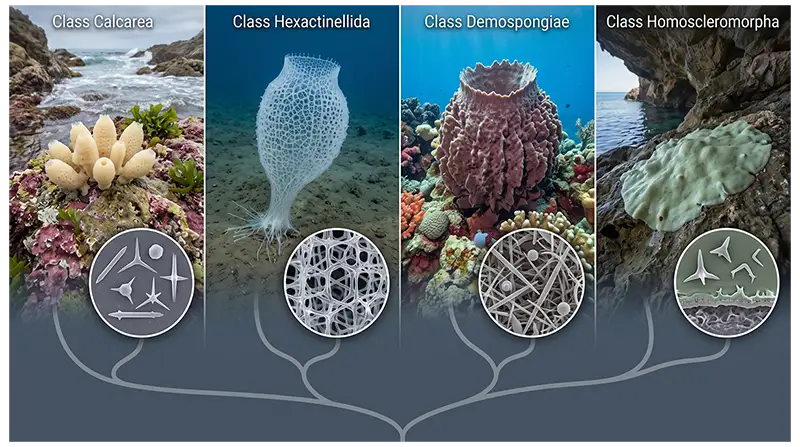
Modern sponge classification is based on anatomical, skeletal, developmental, and molecular evidence. Several major living groups are recognized.
Calcarea
Calcarea, or calcareous sponges, have skeletons made mainly from calcium carbonate spicules. They are exclusively marine and are commonly associated with relatively shallow environments, although their distribution is broader than a single habitat type. Calcareous sponges are generally small, and their body forms can vary considerably.
Hexactinellida
Hexactinellida are commonly called glass sponges. Their skeletons are made primarily of silica and contain distinctive spicules, many of which have six-rayed forms. Many glass sponges occur in deep marine environments. Their delicate skeletal structures can form large and visually complex frameworks.
Demospongiae
Demospongiae is the largest living class of sponges and includes most known sponge species. Members of this group occur in both marine and freshwater environments. Their skeletons may contain siliceous spicules, spongin fibers, or both. Their diversity includes small encrusting forms, branching sponges, massive forms, and many other body shapes.
Homoscleromorpha
Homoscleromorpha is a smaller group of living sponges with distinctive cellular and structural characteristics. Although it contains relatively few species, it is important in studies of sponge evolution because some of its features provide useful information about the early history of animal tissues and body organization.
Why Classification Matters
Sponge classification is not based simply on appearance. Two sponges may look similar externally while belonging to different evolutionary groups. Scientists therefore examine skeletal materials, cell structures, development, anatomy, and DNA to understand their relationships.
How Do Porifera Reproduce and Regenerate?
Porifera have several reproductive strategies. They can reproduce sexually, and many species can also reproduce asexually. This flexibility allows sponges to establish new populations and survive damage or changing environmental conditions.
Sexual Reproduction
Many sponges are hermaphroditic, meaning one individual can produce both sperm and eggs. However, reproductive timing can reduce the chance of self-fertilization in some species. Sperm are generally released into the surrounding water. Water currents can carry them into another sponge.
Specialized cells capture the sperm and transport them to eggs within the sponge. After fertilization, the developing embryo eventually becomes a larva.
Sponge Larvae
Sponge larvae are generally free-swimming for a limited period. This stage is important because adult sponges usually remain attached to a surface. The larva allows the organism to move away from its parent's location and search for a suitable place to settle. After settlement, the larva undergoes changes that produce the juvenile sponge.
Asexual Reproduction
Sponges can also reproduce without sexual fertilization.
Common methods include:
- Budding
- Fragmentation
- Gemmule formation in some freshwater sponges
In fragmentation, a piece of a sponge can separate from the main body and develop into another individual under suitable conditions.
Gemmules
Some freshwater sponges produce small resistant structures called gemmules. Gemmules contain specialized cells protected by a resistant covering. They can help the sponge survive periods when normal growth is difficult, such as cold seasons or drying conditions. When favorable conditions return, cells from the gemmule can develop into a new sponge.
Regeneration
Regeneration is another remarkable feature of Porifera. Sponge cells can reorganize after injury and rebuild functional structures. Some species can recover after major physical damage. This ability is connected to the flexibility of sponge cells and their relatively simple body organization.
Scientists study sponge regeneration to better understand cell differentiation, communication, development, and the evolution of multicellular organisms.
What Role Do Porifera Play in Aquatic Ecosystems?
Sponges are important components of many aquatic ecosystems. Their influence comes from their feeding activity, relationships with microorganisms, physical structures, and interactions with other organisms.
Water Filtration
A sponge can process large quantities of water relative to its body size. During filtration, it removes bacteria, organic particles, and other suspended material. This activity can influence the amount and distribution of nutrients in surrounding waters.
Nutrient Cycling
Sponges process organic material and release dissolved compounds back into the environment. These substances can become available to other organisms, linking sponge activity with broader nutrient cycles. Some sponge-associated microorganisms also transform nitrogen and other chemical compounds, adding another layer to their ecological role.
Habitat for Small Organisms
The structure of a sponge can provide shelter for small marine animals. Tiny crustaceans, worms, mollusks, and microorganisms may live on the surface or inside the sponge body. In this way, a sponge can function as a small habitat within a larger ecosystem.
Microbial Partnerships
Many sponges contain diverse communities of microorganisms. These microbes may help process nutrients or produce chemical compounds that affect interactions between the sponge and its environment. The relationship between sponges and their microbial communities is an active area of marine biological research.
Food-Web Connections
Sponges can also serve as food for specialized predators. Some sea slugs, fish, turtles, and other marine animals consume sponges. Chemical defenses and skeletal structures may reduce predation, but sponges remain part of aquatic food webs.
Contribution to Reef Ecosystems
In some reef systems, sponges help occupy open spaces and contribute to the cycling of organic material. Their effects vary by species and environment, but they can be important members of reef communities alongside corals, algae, microorganisms, and other animals.
What Do Porifera Fossils Reveal About Early Animal Life?
The fossil record of Porifera is important because sponges have a long evolutionary history. However, their fossils are not always easy to identify. The main problem is that much of a sponge's body is soft tissue. Soft tissues normally decay after death unless exceptional conditions preserve them. Mineralized structures have a better chance of becoming fossils.
Fossil Spicules
Sponge spicules are particularly useful fossil evidence. Silica and calcium carbonate spicules can survive burial and become preserved in sedimentary rocks. Their shape and composition can provide clues about the types of sponges that lived in ancient environments.
Fossil Sponge Skeletons
Some sponges produce larger skeletal frameworks that can also be preserved. These structures can reveal information about the body form, habitat, and ecological role of ancient sponge communities.
Cambrian Sponge Fossils
The Cambrian Period contains important evidence of early sponge diversity. Fossil sponge remains occur in several Cambrian deposits, demonstrating that sponge-like animals were already established in marine ecosystems during this early part of the Paleozoic Era. Their presence also contributes to research into the broader diversification of early animals.
Precambrian Evidence
Some structures from rocks older than the Cambrian have been interpreted as sponge-like or sponge-related. However, extremely old fossil evidence can be difficult to interpret. A simple layered or porous structure may have several possible biological or non-biological explanations. For this reason, scientists examine multiple lines of evidence rather than relying on appearance alone.
Fossils and Ancient Environments
Sponge fossils can also help reconstruct ancient marine environments.
Their skeletal remains may occur with other fossils such as:
- Trilobites
- Brachiopods
- Mollusks
- Microbial structures
- Other early marine animals
Together, these fossils provide information about ancient seafloors, water conditions, biodiversity, and ecological relationships.
How Did Porifera Evolve?
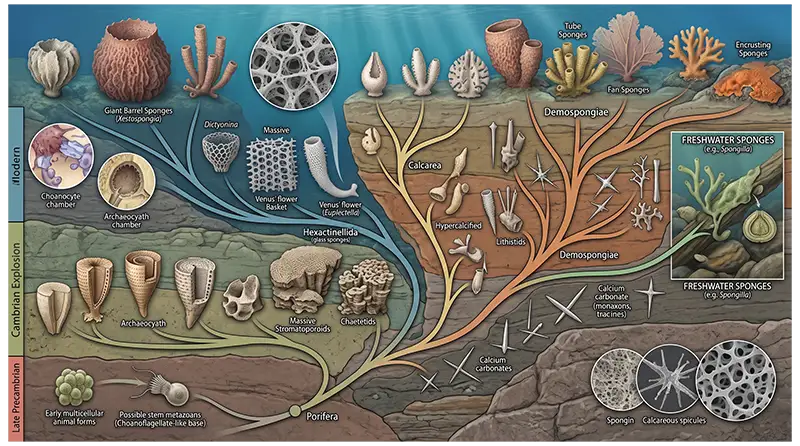
Porifera have a very deep evolutionary history and are important for understanding the early diversification of animals. Sponges represent one of the major lineages used to investigate how multicellular animal life developed from simpler ancestors.
Their bodies are relatively simple compared with those of animals with organs, yet they contain many specialized cell types. This makes them valuable for studying how cells became organized into increasingly complex biological systems.
Early Animal Evolution
The earliest stages of animal evolution are difficult to reconstruct because ancient soft-bodied organisms were poorly preserved.
Scientists therefore combine several types of evidence, including:
- Fossils
- Comparative anatomy
- Developmental biology
- Molecular genetics
- Molecular clocks
- Geochemical evidence
These approaches help researchers investigate when major animal lineages appeared and how they became diversified.
Sponge Diversification
Over geological time, different sponge lineages developed different skeletal materials, body forms, feeding systems, and environmental adaptations. Some became specialized for shallow reefs, while others evolved successfully in deep-sea environments. Freshwater sponges also developed adaptations for life away from the ocean.
Molecular Evidence
DNA and other molecular evidence provide important information about relationships among living sponge groups and other animals. The earliest branches of the animal evolutionary tree remain an active area of scientific research. Different datasets and analytical methods can produce different interpretations of relationships among the earliest animal lineages.
For this reason, sponge evolution is better understood as an ongoing scientific investigation rather than a completely settled story.
Why Sponges Matter in Evolutionary Studies
Porifera demonstrate that an animal can have specialized cells and coordinated biological functions without having a brain, muscles, or complex organs. Studying these organisms helps scientists investigate how cellular cooperation, communication, development, and body organization changed during early animal evolution.
Their fossils add another layer of evidence by showing how sponge communities and skeletal forms changed through geological time.
Why Are Porifera Important?
Porifera are important in several areas of science because they connect biology, ecology, evolution, paleontology, and marine science. Their ecological importance comes from their ability to filter water, process organic material, interact with microorganisms, and provide habitat for small organisms.
Their biological importance comes from their unusual cellular organization. Sponges show that multicellular animals can perform complex life processes without organs, muscles, or a nervous system.
Their regenerative abilities also make them useful for research into cell behavior and biological development.
Importance to Paleontology
Fossil spicules and skeletal structures help scientists reconstruct ancient aquatic environments. Sponge fossils can also contribute to studies of early animal diversification, especially when they occur in well-preserved fossil deposits.
Importance to Evolutionary Biology
Porifera provide living examples of an early type of animal body organization. Comparing sponge biology with that of more complex animals helps researchers investigate how specialized cells, tissues, organs, and nervous systems evolved.
Importance to Marine Ecosystems
Modern sponges contribute to filtration, nutrient cycling, habitat formation, and interactions among aquatic organisms. Their presence can therefore influence the structure and function of marine communities.
Importance to Biotechnology
Some sponges produce unusual chemical compounds that are being investigated for their biological properties. These compounds may have potential applications in pharmaceutical and biotechnology research, although studying a natural compound does not automatically mean that it will become a useful medicine.
Overall, Porifera demonstrate how organisms with relatively simple body structures can have major ecological and evolutionary importance.
Conclusion
Porifera are aquatic animals with a simple but highly specialized body organization. Their porous bodies and internal canal systems allow water to move continuously through them, providing food and oxygen while removing waste.
Sponges include several major groups with different skeletal structures, habitats, and body forms. Most live in marine environments, while some have adapted to freshwater. They reproduce through both sexual and asexual processes and are particularly well known for their ability to regenerate.
Porifera also play important roles in aquatic ecosystems through filtration, nutrient cycling, microbial relationships, and habitat creation. Their fossilized spicules and skeletal structures provide valuable evidence about ancient marine environments and the early diversification of animals.
Because of their unusual cells, simple body organization, regenerative abilities, ecological functions, and deep fossil history, Porifera remain important to the study of animal evolution, marine biology, paleontology, and Earth's history.
Yes. Sponges are multicellular animals and belong to the animal kingdom.
No. Sponges do not have true organs such as hearts, lungs, stomachs, or brains.
Most Porifera filter small particles from water. Choanocytes help create water currents and capture food particles.
No. Most are marine, but some Porifera live in freshwater environments such as lakes, ponds, and streams.
The major living groups commonly recognized include Calcarea, Hexactinellida, Demospongiae, and Homoscleromorpha.