
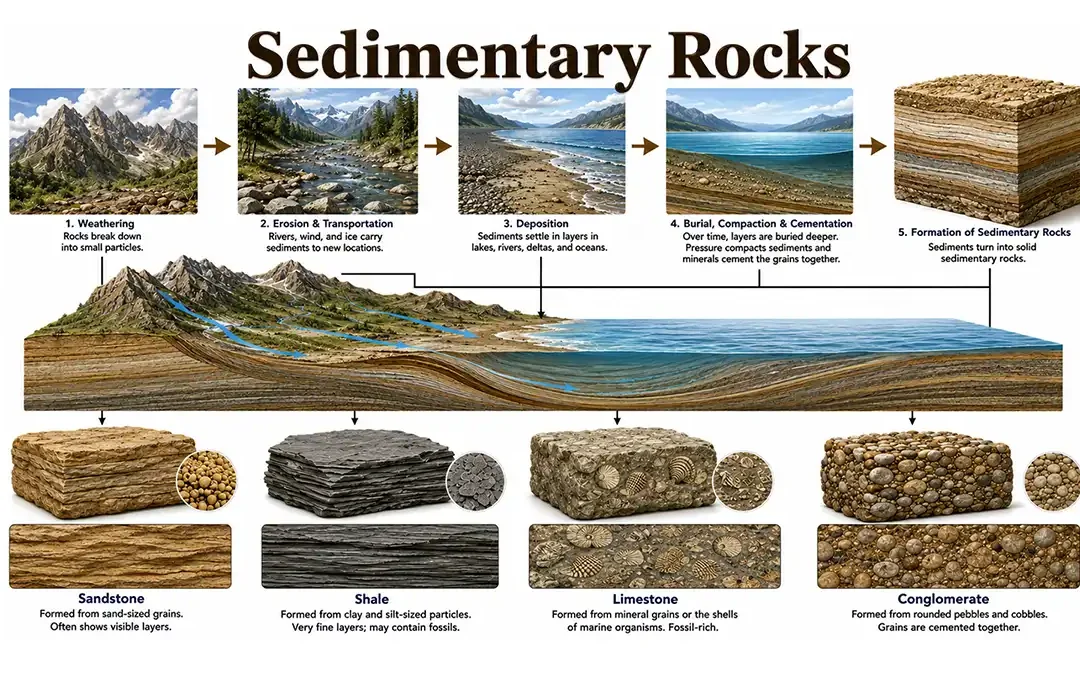
Every mountain, canyon, river valley, and coastline tells a geological story written over millions of years. Among the three major rock groups found on Earth, sedimentary rocks provide the clearest record of that history. These rocks preserve evidence of ancient rivers, deserts, tropical seas, glaciers, volcanic eruptions, and even the plants and animals that lived long before humans existed.
The term rocks of sedimentary origin refers to rocks that develop from accumulated sediments rather than molten magma or intense heat and pressure. Tiny grains of sand, mud, gravel, dissolved minerals, and organic remains gradually build up in layers. Over time, the weight of newer sediments compresses the older ones, while naturally occurring minerals cement the particles together, forming solid rock.
Today, sedimentary rocks cover nearly 75% of Earth's continental surface, making them the most widespread rocks visible at the surface. Although they account for only a small percentage of the Earth's crust by volume, they are incredibly important because they preserve fossils, store groundwater, contain petroleum and natural gas reservoirs, and supply raw materials for construction and industry.
In this complete guide, you'll discover what sedimentary rocks are, how sedimentary rocks form, their defining characteristics, major classifications, fossil preservation, common examples, and why they remain one of the most valuable resources for understanding Earth's geological past.
What Are Sedimentary Rocks?
Sedimentary rocks are rocks that form through the accumulation, deposition, compaction, and cementation of sediments over thousands to millions of years. Unlike igneous rocks, which solidify from molten magma, or metamorphic rocks, which are transformed by heat and pressure, sedimentary rocks develop at or near Earth's surface under relatively low temperatures and pressures.
These sediments originate from many different sources. Some are fragments of older rocks that have been broken down by weathering, while others consist of dissolved minerals that crystallize from water or the remains of living organisms such as shells, coral, algae, and plant material. As layer upon layer of sediment accumulates, natural geological processes gradually convert these loose particles into solid rock through a process known as lithification.
Because sedimentary rocks preserve information about the environments in which they formed, geologists often describe them as the history books of the Earth. Their layers record changes in climate, sea level, volcanic activity, and biological evolution over vast periods of geological time.
How Sedimentary Rocks Form
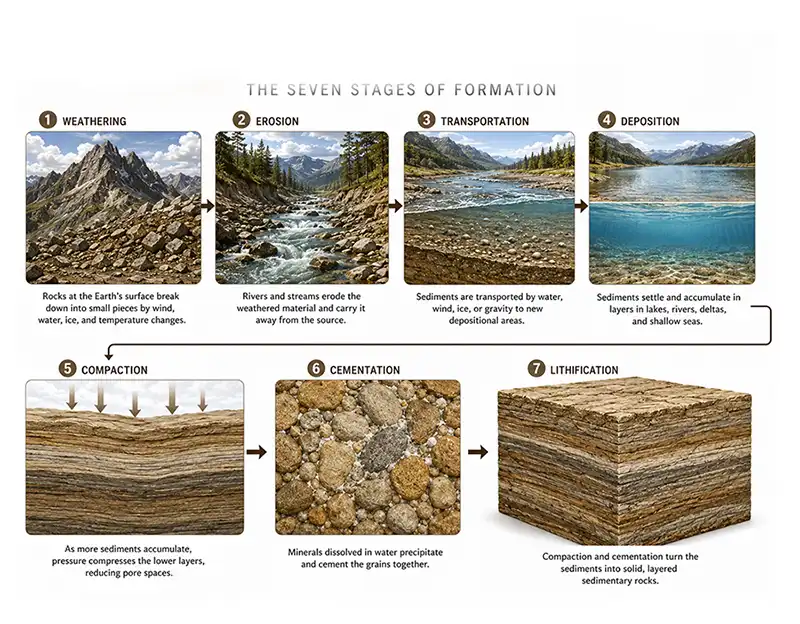
The formation of sedimentary rocks is a slow but continuous geological process that transforms loose sediments into solid rock. Depending on environmental conditions, this transformation may take thousands or even millions of years. Although the process appears simple, it involves several interconnected stages that operate continuously across Earth's surface.
Understanding how sedimentary rocks form is fundamental to geology because each stage leaves evidence preserved within the finished rock.
1. Weathering
The journey begins with weathering, the breakdown of existing rocks into smaller particles.
Weathering occurs in two primary forms.
Physical Weathering
Physical or mechanical weathering breaks rocks apart without changing their chemical composition.
Common causes include:
- Freeze-thaw action
- Temperature expansion and contraction
- Root growth
- Wind abrasion
- Wave action
- Salt crystal growth
For example, rainwater enters small cracks in rocks. When temperatures fall below freezing, the water expands into ice, widening the cracks until pieces eventually break away.
Chemical Weathering
Chemical weathering changes the mineral composition of rocks through reactions with water, oxygen, and naturally occurring acids.
Major chemical weathering processes include:
- Dissolution
- Carbonation
- Hydrolysis
- Oxidation
Rainwater containing dissolved carbon dioxide forms weak carbonic acid, which slowly dissolves limestone and other carbonate rocks. These dissolved minerals may later precipitate to form new sedimentary rocks.
Weathering continuously supplies the sediments needed to create future sedimentary rocks.
2. Erosion
Once weathering has produced loose sediment, erosion transports it away from its original location.
The main natural agents of erosion include:
- Rivers
- Wind
- Ocean waves
- Glaciers
- Gravity
Fast-flowing rivers carry large rocks, gravel, sand, and mud downstream, while glaciers can transport enormous boulders across continents.
As sediments move, repeated collisions gradually reduce their size and round their edges.
3. Transportation
Transportation refers to the movement of sediment from one location to another.
Different agents carry different sediment sizes:
| Transport Agent | Common Sediment Carried |
|---|---|
| Rivers | Gravel, sand, silt, clay |
| Wind | Sand and dust |
| Glaciers | Clay to giant boulders |
| Ocean Currents | Sand and marine sediments |
The farther sediments travel, the more rounded and better sorted they become. These characteristics help geologists determine how far sediments have moved before deposition.
4. Deposition
When rivers slow down, glaciers melt, or wind loses strength, sediments settle out and accumulate.
This process is known as deposition.
Deposition commonly occurs in:
- River floodplains
- Lakes
- Deltas
- Beaches
- Deserts
- Continental shelves
- Deep oceans
Over long periods, countless layers of sediment build upon one another, forming the distinctive layered appearance characteristic of sedimentary rocks.
Each layer represents a different chapter in Earth's geological history.
5. Compaction
As new sediments continue accumulating, the weight of overlying layers compresses the older sediments beneath them.
During compaction:
- Water is squeezed from pore spaces.
- Sediment grains become tightly packed.
- Density increases.
- Overall sediment thickness decreases.
Fine-grained clay experiences much greater compaction than coarse gravel because its tiny particles contain larger amounts of pore water.
6. Cementation
Compaction alone cannot produce solid rock.
Groundwater moving through buried sediments contains dissolved minerals such as:
- Calcite
- Silica
- Iron oxides
These minerals gradually crystallize between sediment grains, acting as natural cement that binds the particles together.
Different cements influence the rock's hardness, color, and resistance to weathering.
7. Lithification
The final stage is lithification, the process that converts loose sediments into solid sedimentary rock through compaction and cementation.
Examples include:
- Sand → Sandstone
- Clay → Shale
- Gravel → Conglomerate
- Shell fragments → Limestone
Depending on burial conditions, lithification may require thousands or millions of years.
The Complete Formation Process
The entire process follows a logical geological sequence:
Weathering → Erosion → Transportation → Deposition → Compaction → Cementation → Lithification
This continuous cycle has been operating throughout Earth's history, constantly producing new sedimentary rocks while preserving invaluable records of ancient environments and life.
Characteristics of Sedimentary Rocks
Sedimentary rocks are easily recognized because they possess a unique combination of physical, chemical, and structural features that distinguish them from igneous and metamorphic rocks. These characteristics develop during the long process of weathering, transportation, deposition, compaction, and cementation. By studying these features, geologists can determine how a rock formed, the environment in which it was deposited, and even reconstruct ancient landscapes and climates.
Unlike many other rocks, sedimentary rocks often preserve delicate structures such as fossils, ripple marks, mud cracks, and layered bedding, making them invaluable for understanding Earth's geological history.
Layered Structure (Stratification)
One of the most recognizable characteristics of sedimentary rocks is their layered appearance. These layers, known as beds or strata, form as sediments accumulate over time.
Each layer represents a different period of deposition. Changes in grain size, color, mineral composition, or fossil content often indicate shifts in environmental conditions such as floods, droughts, sea-level changes, or volcanic activity.
In places like the Grand Canyon, hundreds of sedimentary layers reveal millions of years of Earth's geological history.
Types of Sedimentary Rocks
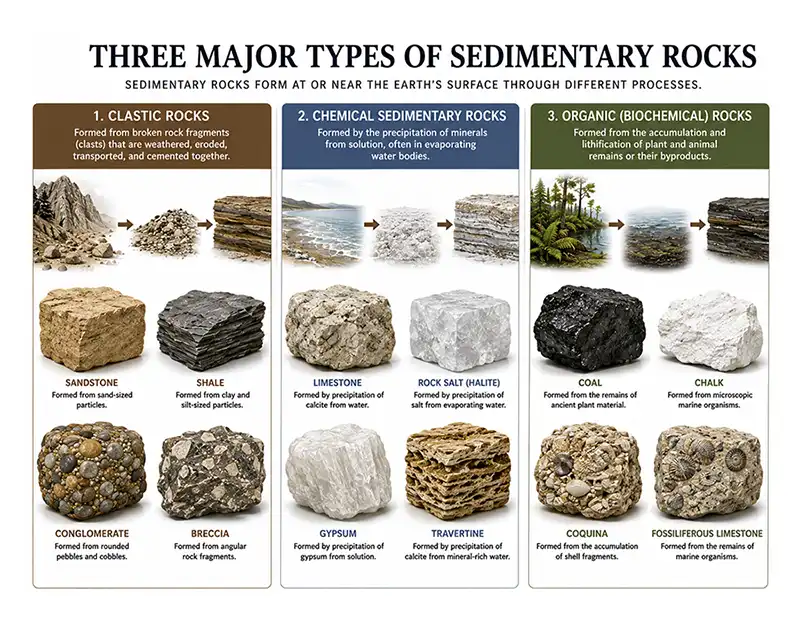
Geologists classify sedimentary rocks according to how they form, rather than simply by their appearance. Based on their origin, there are three main sedimentary rocks types: clastic, chemical, and organic (biochemical). Each type forms through different geological processes and contains distinctive minerals and textures.
Understanding these classifications helps geologists identify depositional environments, interpret Earth's history, and locate valuable natural resources.
1. Clastic Sedimentary Rocks
Clastic sedimentary rocks form from fragments of pre-existing rocks that have been weathered, eroded, transported, deposited, compacted, and cemented together.
These rock fragments, called clasts, vary in size from microscopic clay particles to large pebbles and boulders.
The size of the clasts determines the rock's classification.
Common Clastic Sedimentary Rocks
| Rock | Grain Size | Main Composition |
|---|---|---|
| Conglomerate | Pebbles and gravel | Rounded rock fragments |
| Breccia | Coarse gravel | Angular rock fragments |
| Sandstone | Sand | Mainly quartz and feldspar |
| Siltstone | Silt | Fine mineral particles |
| Shale | Clay | Clay minerals and silt |
Clastic rocks are the most abundant sedimentary rocks on Earth.
They commonly form in:
- Rivers
- Floodplains
- Beaches
- Deserts
- Deltas
- Continental shelves
2. Chemical Sedimentary Rocks
Chemical sedimentary rocks form when dissolved minerals precipitate directly from water.
This usually occurs when water evaporates or when chemical conditions change, causing minerals to crystallize.
Examples include:
- Limestone (chemical varieties)
- Rock Salt (Halite)
- Gypsum
- Dolostone
- Travertine
Many chemical sedimentary rocks develop in:
- Shallow seas
- Salt lakes
- Hot springs
- Evaporating lagoons
Evaporite deposits are particularly important because they supply valuable industrial minerals.
3. Organic (Biochemical) Sedimentary Rocks
Organic or biochemical sedimentary rocks form from the accumulated remains of living organisms.
Instead of forming from rock fragments, these rocks develop from shells, coral skeletons, microscopic marine organisms, algae, or plant material.
Common examples include:
- Fossiliferous limestone
- Chalk
- Coquina
- Coal
Coal forms from ancient swamp vegetation that accumulated in oxygen-poor environments before undergoing burial and compaction.
Similarly, chalk consists almost entirely of microscopic marine plankton shells deposited on the ocean floor.
Comparison of the Three Sedimentary Rock Types
| Type | Formation Process | Examples |
|---|---|---|
| Clastic | Compacted rock fragments | Sandstone, Shale, Conglomerate |
| Chemical | Minerals precipitated from water | Rock Salt, Gypsum, Travertine |
| Organic (Biochemical) | Plant and animal remains | Coal, Chalk, Fossiliferous Limestone |
Although each type forms differently, all become sedimentary rocks through lithification and play an essential role in recording Earth's geological history.
Types of Fossils Found in Sedimentary Rocks
Sedimentary rocks preserve several different fossil types, each providing unique information about ancient life.
Body Fossils
Body fossils are the preserved remains of an organism itself.
Examples include:
- Dinosaur bones
- Fish skeletons
- Shells
- Teeth
- Leaves
- Wood
- Coral skeletons
These fossils help scientists identify extinct species and understand evolutionary relationships.
Trace Fossils
Trace fossils record the activities of ancient organisms rather than their physical remains.
Common trace fossils include:
- Footprints
- Burrows
- Trails
- Feeding marks
- Nesting sites
- Coprolites (fossilized dung)
Trace fossils reveal how ancient animals moved, hunted, fed, and interacted with their environments.
Microfossils
Many sedimentary rocks contain microscopic fossils that can only be observed using microscopes.
Examples include:
- Foraminifera
- Diatoms
- Radiolarians
- Pollen grains
- Spores
Although tiny, microfossils are extremely valuable for dating sedimentary rocks and reconstructing ancient climates.
Importance of Sedimentary Rocks
Sedimentary rocks are among the most valuable geological resources on Earth. Beyond recording the planet's history, they support modern civilization by providing construction materials, groundwater reservoirs, fossil fuels, industrial minerals, and scientific evidence about ancient life.
Because sedimentary rocks cover most of Earth's continental surface, they influence landscapes, ecosystems, agriculture, engineering, and natural resource exploration.
Common Examples of Sedimentary Rocks
Sedimentary rocks occur in many forms, each formed under different geological conditions. Some consist of rock fragments transported by rivers and wind, while others form through chemical precipitation or the accumulation of biological materials.
Below are some of the most common examples found around the world.
Sandstone
Sandstone forms from compacted and cemented sand-sized particles, primarily composed of quartz.
It is one of the most abundant sedimentary rocks and is commonly used in building construction because of its strength and durability.
Common environments:
- Rivers
- Beaches
- Deserts
- Deltas
Shale
Shale forms from compacted clay and silt deposited in calm water environments.
It is the most abundant sedimentary rock and often acts as a source rock for petroleum and natural gas.
Common environments:
- Lakes
- Deep oceans
- Floodplains
Limestone
Limestone consists mainly of the mineral calcite.
It commonly forms from accumulated marine shells, coral reefs, or chemical precipitation in warm, shallow seas.
Major uses include:
- Cement production
- Building stone
- Agriculture
- Steel manufacturing
Conglomerate
Conglomerate is composed of rounded gravel and pebble-sized rock fragments cemented together. It indicates deposition by fast-moving rivers or high-energy environments.
Breccia
Breccia resembles conglomerate but contains angular rock fragments rather than rounded ones. Its angular shape indicates that the fragments were transported only a short distance before deposition.
Coal
Coal is an organic sedimentary rock formed from compressed ancient plant material that accumulated in swamp environments. It remains an important fuel source and industrial raw material.
Chalk
Chalk is a soft, white limestone composed primarily of microscopic marine organisms. It forms in deep marine environments where enormous numbers of plankton accumulate on the seafloor.
Rock Salt (Halite)
Rock salt forms when seawater or lake water evaporates, leaving behind salt crystals.
It is widely used for:
- Food seasoning
- Chemical production
- Road de-icing
Gypsum
Gypsum is another evaporite mineral that forms through the evaporation of mineral-rich water.
It is commonly used in:
- Plaster
- Drywall
- Cement
- Agriculture
Chert
Chert is a hard, fine-grained sedimentary rock composed mainly of microcrystalline silica. It often forms from microscopic marine organisms or through chemical replacement within limestone.
Limitations of Sedimentary Rocks
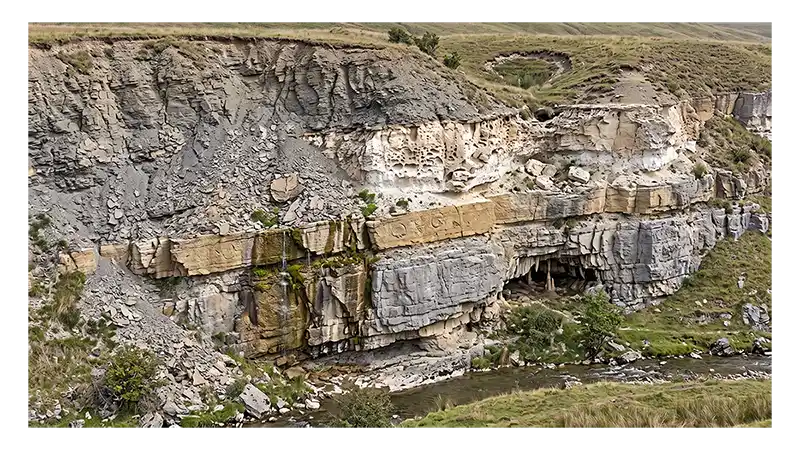
Although sedimentary rocks are valuable for preserving fossils, storing groundwater, and supplying important natural resources, they also have several limitations. Many sedimentary rocks are softer than igneous and metamorphic rocks, making them more vulnerable to weathering, erosion, and physical damage. Rocks such as shale and chalk can break apart easily, while limestone may dissolve gradually in slightly acidic water, creating caves and sinkholes.
Another limitation is that not all sedimentary rocks are suitable for heavy engineering projects. Their strength, durability, and permeability vary considerably depending on their composition and the degree of cementation. Some sedimentary rocks absorb water, which can reduce their stability over time. In addition, although these rocks preserve fossils exceptionally well, those fossils may be destroyed if the rocks are later subjected to intense heat and pressure during metamorphism.
Despite these limitations, sedimentary rocks remain one of the most important rock groups because of their scientific, environmental, and economic significance. Their widespread distribution and rich geological record continue to make them essential for studying Earth's history and supporting modern society.
Shale is the most abundant sedimentary rock, accounting for a significant portion of sedimentary rock formations worldwide.
Some of the best-known examples include sandstone, shale, limestone, conglomerate, breccia, coal, chalk, rock salt, gypsum, and chert.
Sedimentary rocks provide groundwater, petroleum, natural gas, coal, cement raw materials, construction stone, fertilizers, and many industrial minerals.
Yes. If sedimentary rocks experience intense heat and pressure, they can transform into metamorphic rocks. If they melt and later cool, they become igneous rocks as part of the rock cycle.
Sedimentary rocks form under relatively low temperatures and pressures, allowing buried organisms to be preserved instead of being destroyed by heat or melting.
Final Thoughts
Sedimentary rocks are much more than layers of sand, mud, or gravel turned into stone. They are natural archives that preserve Earth's geological and biological history across millions of years. From ancient marine environments and river systems to deserts, forests, and prehistoric ecosystems, these rocks provide evidence that helps scientists reconstruct the planet's past with remarkable accuracy.
Beyond their scientific importance, sedimentary rocks support modern society by supplying groundwater, fossil fuels, industrial minerals, and construction materials. They also preserve the world's richest fossil record, making them essential for understanding the evolution of life on Earth.
Whether you are a geology student, researcher, educator, or simply curious about the natural world, learning about sedimentary rocks offers valuable insight into the dynamic processes that continue to shape our planet today.