
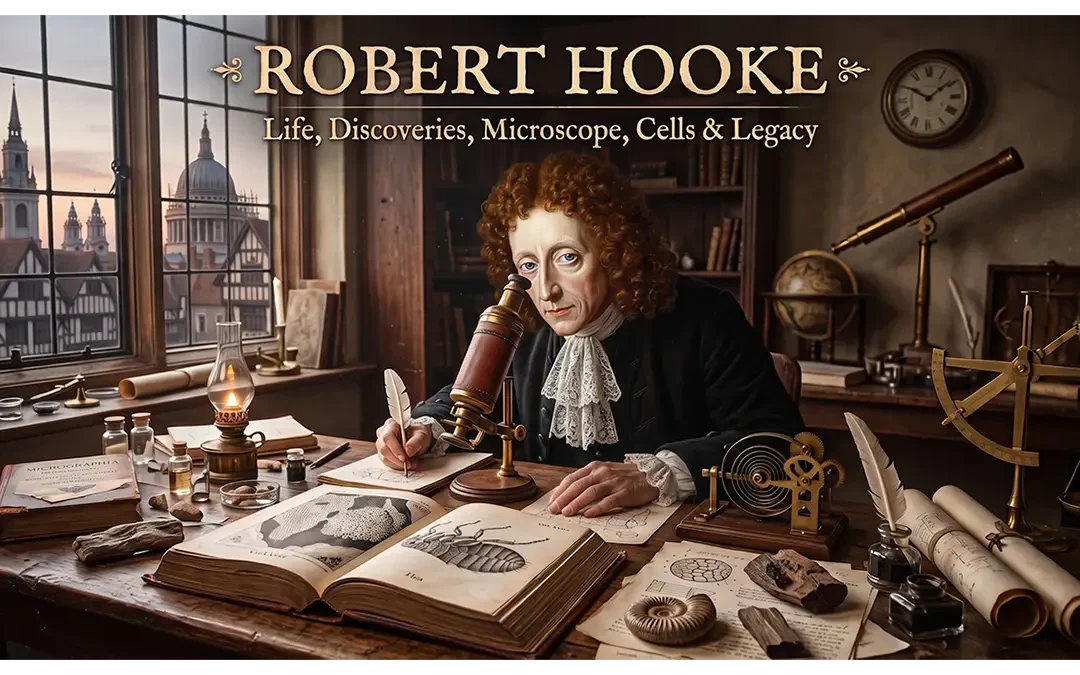
Robert Hooke was one of the most versatile scientists of the 17th century. He worked across microscopy, biology, physics, astronomy, geology, mechanics, architecture, and scientific instruments, making him an important figure in the development of modern experimental science. He is especially remembered for his 1665 book Micrographia, his observations of plant cells, and the law of elasticity now known as Hooke's law.
Who Was Robert Hooke?
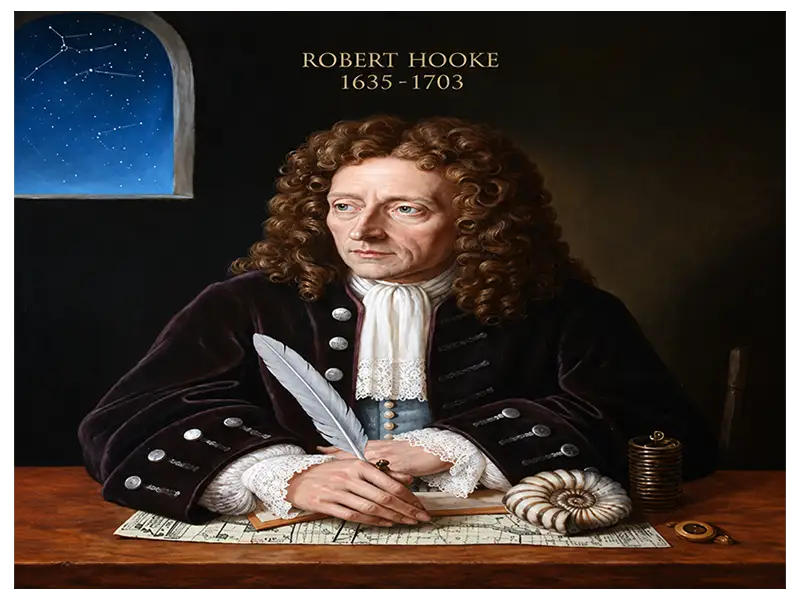
Robert Hooke was an English natural philosopher, inventor, architect, and experimental scientist who lived from 1635 to 1703. He was born on July 18, 1635, at Freshwater on the Isle of Wight and later studied at Westminster School and Christ Church, Oxford.
Hooke developed an early interest in mechanical devices and practical experimentation. At Oxford, he became associated with scientists including Robert Boyle, whose experiments on air and vacuum benefited from Hooke's mechanical skills and instrument-making abilities.
In 1662, Hooke became Curator of Experiments of the Royal Society, a demanding position in which he demonstrated experiments for the Society's meetings. He was elected a Fellow of the Royal Society in 1663 and later became Professor of Geometry at Gresham College.
His career was unusually broad. Instead of concentrating on one scientific subject, Hooke investigated whatever questions could be explored through observation, measurement, instruments, and experiments. He also became a surveyor and architect after the Great Fire of London in 1666, working alongside Christopher Wren during the rebuilding of the city.
This combination of scientific curiosity and practical engineering made Hooke an important representative of the experimental science of his period.
What Did Robert Hooke Discover?
Robert Hooke made discoveries and observations across several branches of science. Some of his best-known contributions include:
- Observing and naming microscopic cells in cork
- Publishing Micrographia
- Developing and improving scientific instruments
- Formulating the relationship between force and extension known as Hooke's law
- Investigating elasticity and springs
- Studying fossils, rocks, and geological processes
- Observing the Moon, planets, stars, and comets
- Investigating gravity and motion
- Contributing to microscopy and biological observation
- Designing and surveying buildings in London
- Developing mechanical devices and experimental equipment
His work with the microscope was particularly influential because it revealed structures that could not be seen with the unaided eye. Micrographia documented observations of plants, insects, rocks, minerals, and other specimens and helped demonstrate the scientific value of magnification.
It is important to remember that Hooke did not work in the modern scientific environment of specialized laboratories and highly developed instruments. His scientific practice depended heavily on craftsmanship, careful observation, drawing, measurement, and repeated experimentation.
How Did Robert Hooke Study Cells?
Robert Hooke studied cells using a compound microscope and examined thin sections of cork. When he looked at the cork under magnification, he saw many small, empty-looking compartments arranged closely together. He compared these compartments with the small rooms or chambers used by monks and called them “cells.” The term became one of the most enduring words in biological science.
Hooke's observation was published in Micrographia in 1665. He recognized that the small compartments helped explain some physical properties of cork, including its lightness and springiness.
However, Hooke's “cells” were not the living cells understood by modern biology. The cork tissue he observed consisted largely of dead cells whose walls remained after the living contents had disappeared. This distinction is important. Hooke did not establish modern cell theory, which developed much later through the work of scientists such as Matthias Schleiden, Theodor Schwann, and Rudolf Virchow.
Nevertheless, Hooke's observation gave biology a powerful new term and demonstrated that living and once-living structures contained an organization invisible to the naked eye. His work helped establish microscopy as an important method for investigating biological structure.
What Did Robert Hooke See Through His Microscope?
Hooke's microscope opened an unusual world of detail. His observations were not limited to cork. He examined insects, plants, seeds, feathers, hair, mold, fish scales, seaweed, stone, crystals, and other materials. His illustrations showed structures that ordinary vision could not reveal.
One of his most famous illustrations showed a flea. The detailed engraving revealed its body, legs, claws, and surface structures in a way that made the tiny insect appear enormous. Hooke also examined a louse and various other insects. His observations demonstrated that familiar organisms could look remarkably complex when magnified.
Microscopic Plants
Hooke examined plant tissues, including cork and other botanical specimens. Magnification allowed him to investigate structures and surfaces that were invisible at normal scale. His observations of plant material were especially important because they helped establish the idea that apparently solid biological tissues could contain repeated microscopic structures.
Microscopic Materials
Hooke also used magnification to examine nonliving materials. He studied the microscopic structure of stone, crystals, charcoal, and petrified wood, showing that microscopy could contribute to the study of materials as well as living organisms. The Royal Society's collection includes plates from Micrographia showing stone, sponge, seaweed, crystals, charcoal, and petrified wood.
This broad approach was characteristic of Hooke. He did not treat microscopy as a tool limited to biology; he used it to investigate the physical structure of the natural world.
What Was Micrographia and Why Was It Important?
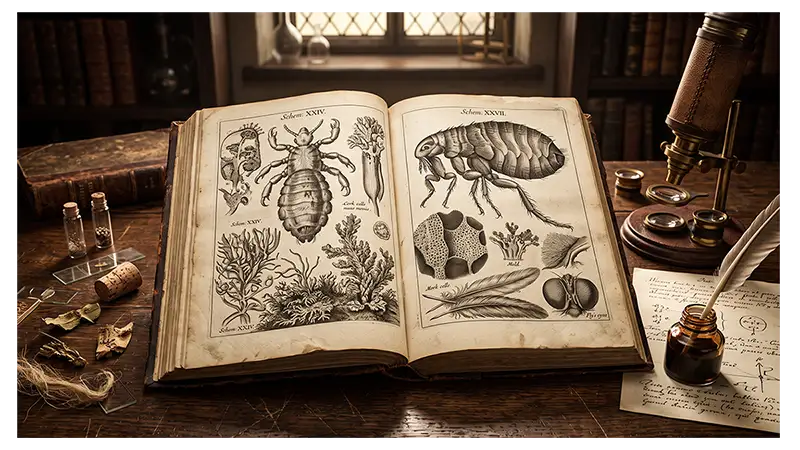
Micrographia was Robert Hooke's famous book published in 1665. Its full title was Micrographia: or Some Physiological Descriptions of Minute Bodies Made by Magnifying Glasses, with Observations and Inquiries Thereupon. It became a landmark in the history of microscopy and was the first fully illustrated book devoted to microscopy. The book contained 38 large copperplate engravings based on Hooke's observations and drawings.
The illustrations were one of the book's greatest strengths. Hooke had strong artistic skills, and the engravings communicated microscopic structures with remarkable detail for the 17th century.
A New Way of Seeing Nature
Before microscopes became useful scientific instruments, many structures were simply beyond human vision. Micrographia changed this by demonstrating that magnification could reveal a hidden level of nature.
Hooke described microscopic structures in objects that readers already knew, such as insects, plants, and manufactured materials. This created a powerful contrast between ordinary appearance and microscopic reality.
Scientific Communication
The book also demonstrated the importance of combining observation, illustration, description, and experiment. Hooke recorded magnification and specimen preparation details, reflecting the Royal Society's interest in reproducible experimentation.
Micrographia therefore became important not simply because of the discoveries it contained, but because it showed readers how scientific instruments could transform their understanding of the natural world.
What Did Robert Hooke Discover About Elasticity?
One of Hooke's most important contributions to physics was his work on elasticity. Hooke investigated springs and other materials that change shape when a force is applied. He found that, within the elastic limit, the extension of a spring is proportional to the applied force.
This relationship became known as Hooke's law:
F = kx
Here:
- F is the applied force
- k is the spring constant
- x is the extension or compression
The principle is useful because it connects measurable force with measurable deformation.
Hooke published his work on elasticity in De Potentia Restitutiva, or Of Spring, in 1678.
Why Hooke's Law Matters
Hooke's law became important in mechanics and engineering because elastic deformation occurs in many physical systems.
The basic principle is used in the study of:
- Springs
- Mechanical systems
- Structural materials
- Vibrations
- Elastic deformation
- Engineering design
Modern materials do not always behave according to Hooke's law at every level of force. Once a material passes its elastic range, permanent deformation or failure can occur. Hooke's work nevertheless provided a fundamental mathematical description of elastic behavior and remains an important part of introductory physics.
What Were Robert Hooke's Contributions to Astronomy and Geology?
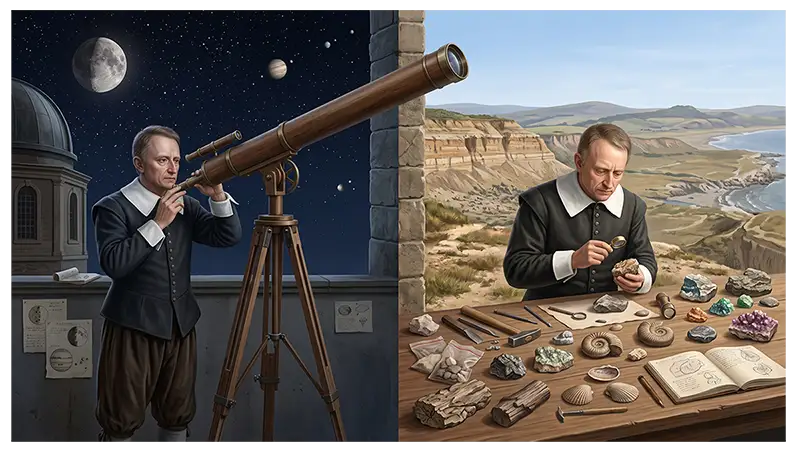
Hooke was deeply interested in the Earth and the universe. He used telescopes and other instruments to investigate astronomical objects and also studied geological materials and processes.
Astronomy
Hooke observed the Moon, planets, stars, and comets. He investigated the surface of the Moon and recognized that its appearance contained physical features such as elevations and depressions rather than being a perfectly smooth surface. His Micrographia also included astronomical material, and his surviving records show continued interest in telescopes and astronomical observations.
He also studied planetary motion and investigated ideas related to gravity. His work on gravity became part of the wider scientific discussion that eventually surrounded Newton's development of celestial mechanics.
Geology
Hooke's geological interests were equally remarkable for his time. He examined rocks, fossils, earthquakes, and the changing surface of Earth. His observations led him to question the idea that fossils were simply unusual objects formed inside rocks. He considered the possibility that fossils represented the remains of organisms that had lived in the past.
This was an important step toward understanding fossils as evidence of ancient life and Earth's changing history.
How Did Robert Hooke Study Fossils and Earth's History?
Hooke was one of the early scientists to treat fossils as evidence that could reveal the history of life and Earth. During the 17th century, the origin of fossils was still heavily debated. Many natural philosophers did not yet understand fossils as remains of organisms preserved through geological processes. Hooke examined fossilized shells, wood, and other materials and compared them with living organisms.
Fossils as Evidence of Ancient Life
Hooke recognized that some fossils had forms similar to organisms living in the present. This supported the idea that fossils could represent the remains of once-living organisms. He also noticed that some fossil organisms no longer existed in the same places or forms. These observations encouraged him to think about how Earth's environments had changed through time.
Earthquakes and Geological Change
Hooke also considered earthquakes and other geological processes. He explored the possibility that Earth's surface could change significantly through natural processes. This was an important departure from the idea of a completely static Earth.
Although Hooke did not develop modern geology, his willingness to connect fossils, rocks, earthquakes, and environmental change helped establish an approach that later became important in historical geology. His geological observations are one reason his scientific legacy extends beyond microscopy and biology.
What Other Scientific and Engineering Work Did Robert Hooke Do?
Hooke's scientific interests extended far beyond cells and fossils. He was also an inventor, instrument maker, architect, surveyor, and experimental physicist. His practical skills were particularly important because 17th-century scientists often had to design or modify their own instruments.
Scientific Instruments
Hooke worked on microscopes, telescopes, clocks, pumps, and other devices. He assisted Robert Boyle in constructing equipment for experiments involving air and vacuum. He also worked on timekeeping devices and mechanical systems.
Architecture and Surveying
After the Great Fire of London in 1666, Hooke became a City Surveyor and worked on rebuilding the city. He collaborated with Christopher Wren and was involved in surveying property boundaries, planning, and designing buildings.
His work included projects associated with the Monument and several important London buildings. His architectural work demonstrates how scientific measurement could be applied to practical problems.
Experimental Science
As Curator of Experiments at the Royal Society, Hooke was expected to conduct demonstrations regularly. Oxford's Cabinet project notes that his duties involved several major experiments each week, an extraordinary workload that helps explain the enormous range of subjects he investigated. This role placed Hooke at the center of the early Royal Society's experimental program.
Why Is Robert Hooke Important to Modern Science?
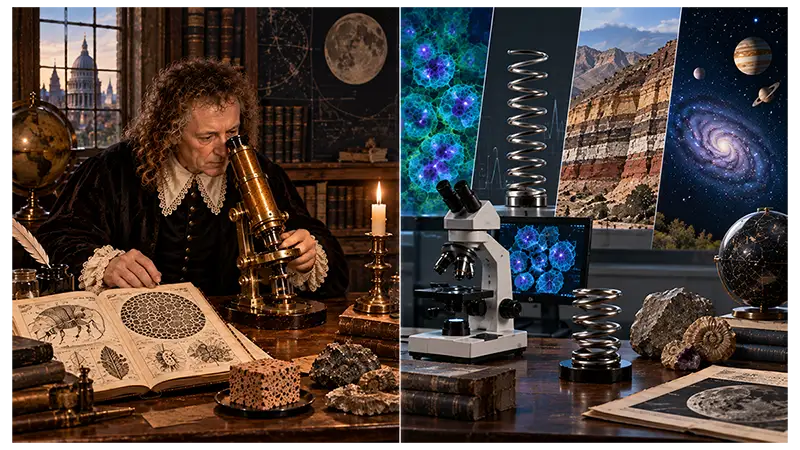
Robert Hooke remains important because his work helped change how scientists investigated nature. He demonstrated the power of observation supported by instruments, especially when those instruments allowed researchers to see or measure things beyond normal human senses. His legacy can be seen in several areas.
Cell Biology
The word cell became a foundation of biological terminology after Hooke used it to describe microscopic compartments in cork. Although modern cell theory came much later, Hooke's observation represents an important early step in microscopic biology.
Microscopy
Micrographia helped establish microscopy as a serious scientific method. Its detailed illustrations showed that magnification could reveal important structures in plants, animals, and materials.
Physics
Hooke's work on elasticity produced a principle still taught in physics and used in engineering.
Geology and Paleontology
His investigations of fossils and geological change helped encourage the interpretation of fossils as evidence for Earth's history.
Scientific Instruments
His ability to design and improve instruments demonstrated the close relationship between scientific discovery and engineering. For these reasons, Hooke is best understood not as the scientist who made only one famous discovery, but as a broad experimental thinker whose work crossed many scientific disciplines.
How Did Robert Hooke Influence Later Scientists?
Hooke influenced later science through his discoveries and scientific methods. He showed that scientists could expand scientific knowledge by building better instruments, observing carefully, recording results, creating detailed illustrations, and testing physical ideas through experiments.
His work with the microscope helped lay the foundation for later biological research. In the following centuries, scientists studied microscopic structures and developed increasingly sophisticated ideas about tissues, cells, microorganisms, and disease. His research on elasticity also became an important part of the mathematical and engineering study of materials.
Hooke's geological observations contributed to a broader intellectual movement that sought to understand Earth as a planet with a history that scientists could reconstruct from rocks and fossils. He also influenced scientific practice through his work with the Royal Society, where he conducted experiments and demonstrations that helped establish experimental investigation as a central part of the Society's activities.
Hooke sometimes had difficult relationships with other major scientists, particularly Isaac Newton. They disagreed over scientific priority and ideas concerning gravity. These disputes shaped Hooke's historical reputation, but they should not overshadow the substantial body of work he produced.
Today, scientists still use his name in terms such as Hooke's law, while his microscope observations remain an important milestone in the history of cell biology.
Conclusion
Robert Hooke became one of the most wide-ranging scientific thinkers of the 17th century. Through his microscope, he observed structures that remained invisible to the naked eye, and he introduced the word “cell,” which later became a fundamental term in biological science. In Micrographia, Hooke also demonstrated how detailed scientific observation and accurate illustration could transform the study of nature.
Hooke achieved far more than groundbreaking work in microscopy. He investigated elasticity, gravity, astronomy, fossils, rocks, earthquakes, mechanical devices, architecture, and scientific instruments. After the Great Fire of London, he applied scientific measurement and engineering principles to practical problems in rebuilding and urban planning.
Hooke’s extraordinary range of interests defines much of his lasting importance. He showed that careful observation, effective instruments, experimentation, precise measurement, and intellectual curiosity could uncover previously hidden aspects of nature. His legacy therefore extends far beyond biology, influencing physics, geology, astronomy, engineering, and the broader development of modern science.
Hooke is best known for publishing Micrographia, observing microscopic structures in cork, introducing the term cell, and formulating the law of elasticity known as Hooke's law.
Hooke observed the small compartments in cork and described them as “cells” while preparing Micrographia, which was published in 1665.
Hooke did not invent the microscope itself. He designed and improved compound microscopes and used them extensively for scientific observations. The Royal Society preserves an illustration of his microscope from Micrographia.
Yes. Hooke studied fossils and considered them evidence of organisms that had existed in the past. His geological interests also included earthquakes and changes in Earth's surface.
Robert Hooke died on 3 March 1703 in London.