
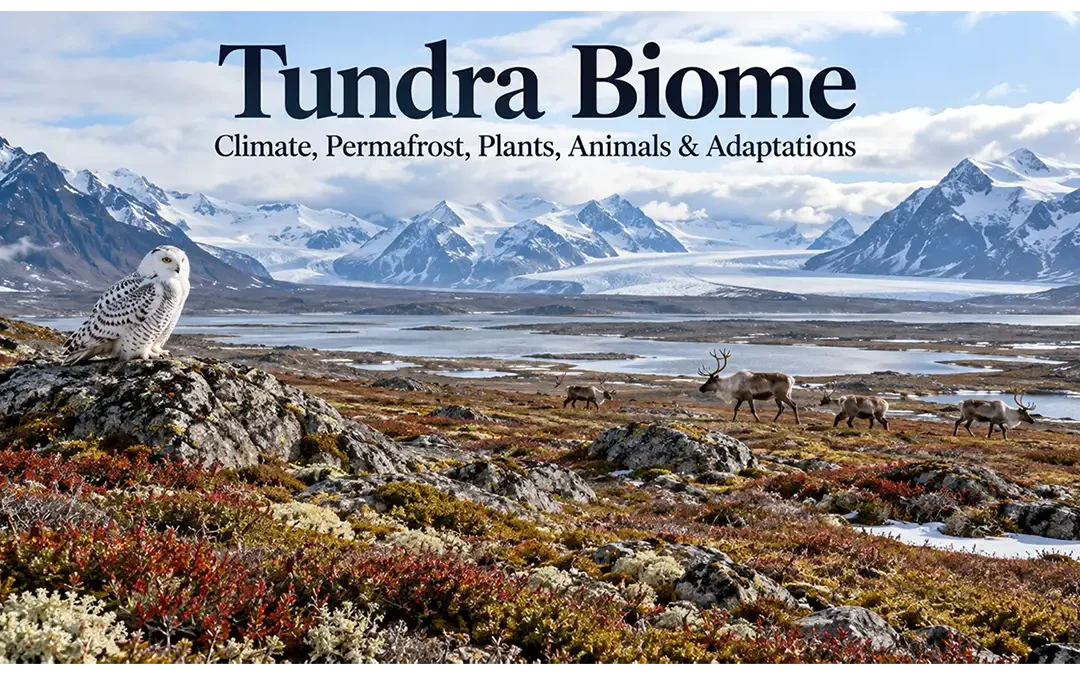
Tundra Biome is a cold terrestrial ecosystem where low temperatures, short growing seasons, limited precipitation, and frozen ground create challenging conditions for life. Unlike forests and grasslands, tundra landscapes are largely treeless and are dominated by mosses, lichens, grasses, sedges, and small shrubs. Despite its harsh environment, the tundra supports specially adapted plants, animals, and microorganisms.
The tundra occurs mainly in high northern latitudes and at high elevations. Its frozen soils, seasonal water, distinctive vegetation, and wildlife make it an important part of Earth's climate and ecological systems. Understanding the tundra also helps explain how ecosystems respond to extreme cold and environmental change.
What Is the Tundra Biome?
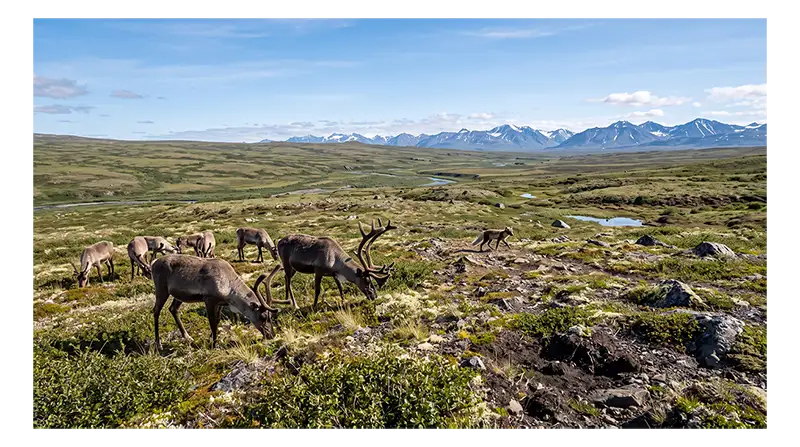
The tundra biome is a cold, mostly treeless ecosystem characterized by low temperatures, a short growing season, and vegetation adapted to difficult environmental conditions. The word tundra is associated with landscapes where trees are unable to grow tall and form a continuous forest.
Tundra environments can occur in very different geographic settings, but they share several important characteristics. Temperatures are generally low, precipitation is limited compared with many other biomes, and strong winds can increase the effects of cold. The ground may contain permafrost, while the upper soil layer can thaw during the warmer season.
Although tundra vegetation is relatively short, it is not biologically empty. Mosses, lichens, sedges, grasses, dwarf shrubs, and flowering plants grow during the brief favorable season. Herbivores feed on this vegetation, while predators and scavengers depend on the animals below them in the food web.
The tundra is therefore a complete ecosystem rather than simply a frozen landscape. Soil, water, plants, animals, microorganisms, sunlight, temperature, and seasonal processes all interact within it.
Where Is the Tundra Biome Located?
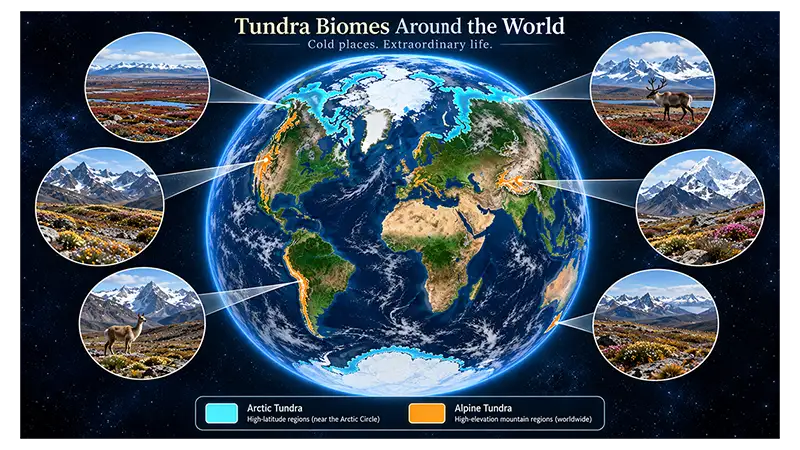
Tundra environments are mainly found in high-latitude regions near the Arctic and at high elevations on mountains. A smaller type of tundra-like environment occurs in parts of Antarctica and on some subantarctic islands.
Arctic Tundra
Arctic tundra forms a broad zone around the northern parts of North America, Greenland, northern Europe, and northern Asia. It generally lies north of the boreal forest and extends toward the Arctic Ocean. The landscape can include low hills, plains, wetlands, lakes, rocky areas, and river valleys. During summer, the upper ground layer can thaw, allowing plants to grow and creating temporary pools and wet areas.
Alpine Tundra
Alpine tundra occurs above the natural tree line on mountains. Unlike Arctic tundra, it is not restricted to polar regions. It can occur at high elevations in mountain ranges around the world. Cold temperatures, strong winds, snow, thin soils, and a short growing season limit tree growth. Plants are often low-growing and may form compact mats close to the ground.
Antarctic and Subantarctic Tundra
Parts of the Antarctic region and nearby islands support extremely limited vegetation adapted to cold conditions. These environments differ from the extensive Arctic tundra and generally contain much less plant and animal diversity. The distribution of tundra is controlled by temperature, elevation, moisture, wind, snow cover, and the length of the growing season.
Why Does the Tundra Have Almost No Trees?
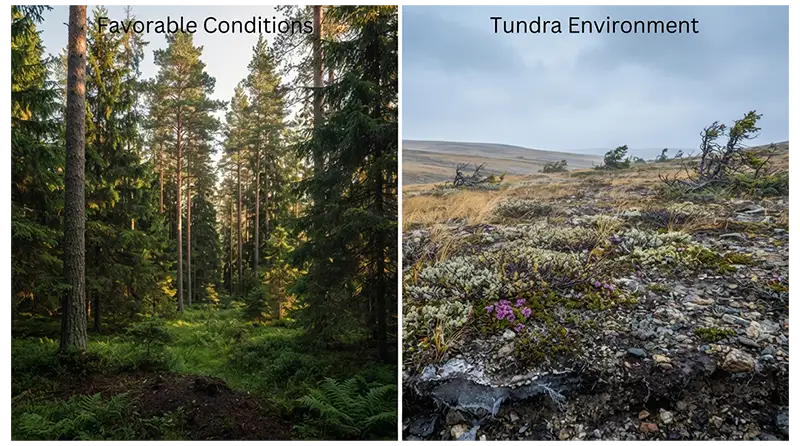
Trees require suitable temperatures, sufficient growing time, available water, stable soils, and conditions that allow roots and stems to develop. Tundra environments often fail to provide enough of these requirements for trees to establish large forests.
One major limitation is the short growing season. Plants have only a limited period each year when temperatures are warm enough for active growth. Trees need many years to develop large trunks and extensive root systems, making them particularly vulnerable to repeated cold and seasonal stress.
Frozen ground can also restrict root development. Where permafrost is present, roots are generally limited to the seasonally thawed active layer rather than penetrating deeply into permanently frozen material.
Strong winds create another challenge. Wind can remove heat from exposed vegetation and physically damage taller plants. Snow and ice can also bend or break branches. Low nutrient availability contributes to the difficult conditions. Cold temperatures slow decomposition, meaning nutrients can remain locked in organic material for long periods.
Instead of growing into tall trees, many tundra plants remain close to the ground. Their compact shapes reduce exposure to cold winds and help them take advantage of the warmer conditions near the surface.
What Is the Tundra Landscape Like?
Tundra landscapes vary considerably depending on latitude, elevation, geology, drainage, and climate. Some areas appear as broad flat plains, while others contain rocky ground, rolling hills, wetlands, ponds, or mountainous terrain. A characteristic feature of many Arctic tundra regions is the presence of permafrost. During the warm season, only the upper active layer may thaw, while deeper ground remains frozen.
Water can accumulate near the surface because frozen ground restricts downward drainage. This can produce shallow ponds, wetlands, and waterlogged areas during summer. Freeze-thaw processes can also reshape the ground. As water freezes and expands, it can move soil and rock particles. Repeated freezing and thawing may produce patterned ground, small ridges, cracks, and other surface features.
Vegetation adds another important layer to the landscape. Instead of tall trees, the surface is covered by low shrubs, grasses, sedges, mosses, lichens, and flowering plants. In some areas, exposed rocks and bare soil are also common. In alpine tundra, steep slopes and rocky terrain create additional environmental challenges. Snowfields, exposed ridges, shallow soils, and rapidly changing weather can all influence where plants grow.
What Happens to the Tundra During Winter?
Winter is the most challenging season for tundra organisms. Temperatures can remain far below freezing for extended periods, and daylight becomes extremely limited in high-latitude Arctic regions.
Snow forms an important part of the winter environment. Although it is extremely cold outside, a layer of snow can provide insulation between the atmosphere and the ground. This allows some organisms and plant structures beneath the snow to experience less extreme temperatures than the exposed surface.
Many animals change their behavior during winter. Some migrate to regions with more food, while others remain in the tundra and rely on stored body fat, winter food sources, or specialized insulation. Plants enter a period of greatly reduced activity. Most above-ground growth stops, although roots and other structures can remain alive beneath the soil or snow.
Microbial activity also decreases as temperatures fall. Decomposition continues at a much slower rate, contributing to the accumulation of organic material in cold soils. In the far north, the winter darkness can last for weeks or even months. The combination of darkness, extreme cold, frozen water, and limited food makes winter a major ecological filter.
What Happens to the Tundra During Summer?
Tundra summer is short, but it can be a period of remarkable biological activity. As temperatures rise, the upper soil layer thaws and plants quickly take advantage of the available sunlight and moisture.
In Arctic regions, summer days can be extremely long, and areas north of the Arctic Circle experience periods when the Sun remains above the horizon for 24 hours. This provides plants with an unusual combination of low temperatures and extended daylight. Flowers can appear rapidly during the short growing season. Grasses, sedges, mosses, lichens, and dwarf shrubs produce new growth, while insects become active.
The seasonal increase in insects provides an important food source for birds and other animals. Many migratory birds travel long distances to breed in the tundra during this brief period when food becomes abundant. Meltwater can create temporary ponds and wetlands. These habitats provide breeding and feeding areas for insects, birds, and other organisms.
Summer therefore transforms the tundra from a largely dormant winter environment into a highly active seasonal ecosystem. However, the warm period remains short compared with the growing seasons of temperate and tropical ecosystems.
What Is Permafrost and How Does It Form?
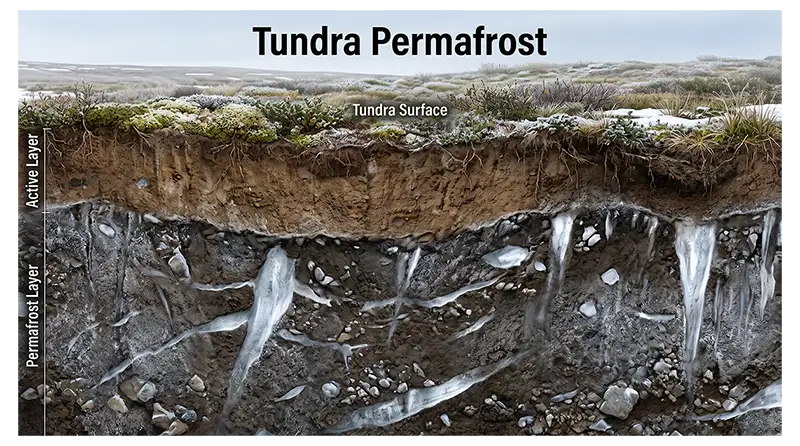
Permafrost is ground that remains at or below 0°C for at least two consecutive years. It can contain frozen soil, sediment, rock, and varying amounts of ground ice.
Permafrost develops when the ground remains cold enough for long periods that heat loss during winter is not completely offset by summer warming. Over many years, this allows permanently or persistently frozen ground to develop beneath the surface.
The uppermost layer is called the active layer. Unlike deeper permafrost, the active layer normally freezes during winter and thaws during summer. Its thickness varies according to climate, vegetation, snow cover, soil properties, and other environmental factors.
Permafrost does not necessarily mean that the entire landscape is covered by continuous frozen ground. It can occur continuously across large areas, or it can be discontinuous, sporadic, or isolated where warmer conditions allow unfrozen ground to occur between frozen areas.
Permafrost strongly influences tundra ecosystems. It affects drainage, soil development, vegetation, ground stability, and the storage of organic carbon.
Because decomposition is generally slow in cold, waterlogged environments, tundra soils can store substantial quantities of organic material. This makes frozen ground an important component of the global carbon cycle.
Which Plants Can Survive in the Tundra?
Tundra plants are adapted to cold temperatures, short growing seasons, strong winds, shallow soils, and limited nutrient availability. Most are relatively small and grow close to the ground.
Common tundra vegetation includes:
- Mosses
- Lichens
- Sedges
- Grasses
- Dwarf shrubs
- Small flowering plants
- Low-growing herbs
Many tundra plants have shallow root systems because permanently frozen ground can restrict deeper growth. Some develop extensive roots within the seasonally thawed soil to absorb available water and nutrients. Low growth provides several advantages. Plants close to the ground experience some protection from strong winds and can benefit from slightly warmer conditions near the surface.
Some species form dense cushions or mats. This growth form helps conserve heat and protects growing tissues from wind exposure. Dark-colored leaves can also help absorb solar energy, while hairy or waxy surfaces can reduce heat loss and protect tissues from harsh weather.
The short growing season encourages rapid reproduction. Plants may flower and produce seeds quickly when temperatures become favorable. Lichens are especially important because they can survive on exposed surfaces where soil development is limited. They contribute to the tundra food web and also play roles in nutrient cycling.
Which Animals Are Specially Adapted to the Tundra?
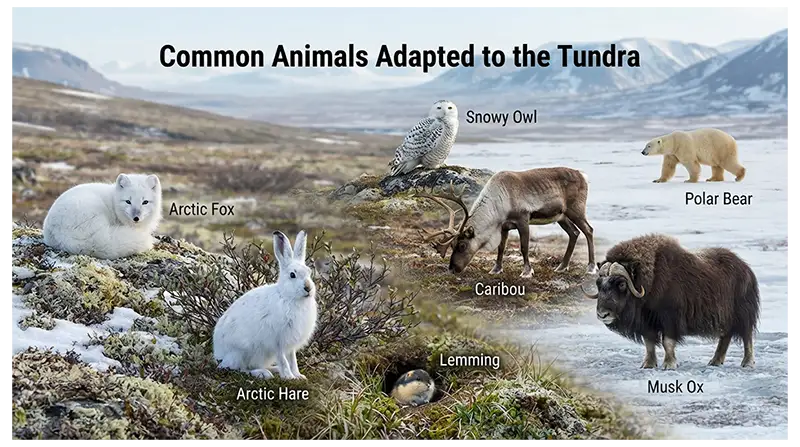
Tundra animals face extreme cold, seasonal food shortages, strong winds, and dramatic changes in daylight. Many species have specialized physical or behavioral adaptations that help them survive.
Examples include:
- Arctic foxes, which have dense fur and seasonal coat changes.
- Caribou and reindeer, which migrate and use specialized feeding strategies to exploit seasonal resources.
- Musk oxen, which have thick insulating coats and live in groups.
- Arctic hares, which have dense fur and compact body forms that reduce heat loss.
- Lemmings, which remain active beneath snow and form an important prey base.
- Polar bears, which depend heavily on marine environments but use Arctic coastal and sea-ice habitats.
- Snowy owls, which hunt across open northern landscapes.
- Migratory birds, which arrive during summer when insects and plants become more abundant.
Some animals develop thicker winter coats or accumulate body fat before the coldest period. Others migrate to warmer areas where food remains available. Seasonal coloration is another useful adaptation. Some species become lighter in winter, providing camouflage against snow, and change color again as snow disappears.
Body shape also matters. Compact bodies and smaller exposed extremities can reduce heat loss. Behavioral adaptations such as sheltering beneath snow, grouping together, or reducing activity can further conserve energy.
How Does the Tundra Food Web Work?
The tundra food web begins with organisms that capture energy from sunlight or, in aquatic environments, from other available energy sources. Plants such as grasses, sedges, dwarf shrubs, mosses, and other photosynthetic organisms form the foundation of many terrestrial tundra food webs.
Herbivores then consume this vegetation. Caribou, reindeer, musk oxen, hares, lemmings, and various insects are examples of animals that depend directly or indirectly on plant production. Predators occupy higher levels of the food web. Arctic foxes, wolves, birds of prey, and other carnivores feed on herbivores and smaller animals.
Scavengers also have an important role. When animals die, their remains provide food for organisms that consume dead material. Decomposers such as fungi and microorganisms break down organic matter and return nutrients to the soil. However, decomposition is generally slow in cold tundra conditions.
This creates a food web strongly influenced by seasonality. During summer, increased plant growth and insect activity can support large numbers of herbivores, birds, and predators. During winter, limited food availability makes survival much more difficult. Changes in one part of the food web can therefore affect other organisms. A reduction in plant productivity, for example, can influence herbivore populations and subsequently affect predators.
How Does Permafrost Thaw Change the Tundra?
When permafrost warms and thaws, the physical structure of the tundra can change significantly. Previously frozen ground may become unstable, allowing the surface to sink or collapse in some areas.
Thawing can also change how water moves through the landscape. Some areas may become wetter because ground subsidence creates ponds, while others can become drier when water gains new pathways through previously frozen soil.
Vegetation can respond to these changes. Warmer conditions may allow shrubs and other plants to expand into areas where they previously struggled to grow. At the same time, species adapted to existing cold conditions can face increased competition and habitat changes.
Permafrost contains large amounts of stored organic carbon. When frozen organic material becomes accessible to microorganisms after thawing, decomposition can accelerate. Depending on soil moisture and oxygen conditions, this process can release carbon dioxide and methane.
Thawing ground can also affect roads, buildings, pipelines, and other infrastructure constructed on frozen terrain. As the ground loses its stability, structures may become damaged or require additional engineering measures.
Permafrost thaw is therefore more than a temperature change. It can influence landscapes, water systems, vegetation, wildlife, carbon cycling, and human infrastructure.
Why Is the Tundra Important to Earth?
The tundra occupies a large area of Earth's northern land surface and supports ecosystems that are specially adapted to extreme conditions. One of its most important roles is carbon storage. Cold soils can preserve organic material for long periods, especially where decomposition is limited by low temperatures and frozen ground.
Tundra landscapes also provide important habitat for migratory birds and northern mammals. Many species depend on seasonal tundra resources for feeding, breeding, and raising young. The ecosystem also influences water movement. Seasonal snowmelt and thawing of the active layer contribute to streams, ponds, wetlands, and other freshwater environments.
Tundra environments are valuable for scientific research because they provide natural examples of how organisms respond to cold, seasonal darkness, short growing seasons, and frozen soils.
The tundra also has cultural and economic importance for Indigenous peoples living across northern regions. Communities have long developed knowledge and practices connected with local wildlife, plants, weather, ice, snow, and landscapes.
Because tundra environments are highly sensitive to warming, they can also provide important evidence of environmental change. Changes in vegetation, snow, permafrost, wildlife distribution, and surface water can reveal how northern ecosystems are responding to changing conditions.
Conclusion
The tundra biome is one of Earth's most distinctive ecosystems, shaped by extreme cold, short growing seasons, limited vegetation, and frozen ground. Although it appears relatively simple compared with tropical forests, the tundra contains complex interactions among plants, animals, soil, water, and microorganisms.
Its treeless landscapes support specialized vegetation and wildlife, while permafrost influences drainage, soil development, carbon storage, and landscape stability. Seasonal changes are especially important, with a long period of winter followed by a short but biologically active summer.
Today, warming temperatures are changing many tundra processes, particularly in regions where permafrost is thawing. Understanding these ecosystems is therefore important not only for studying cold-climate biology but also for understanding Earth's changing climate and carbon cycle.
No. Snow covers much of the tundra during winter, but large areas become snow-free during the short summer. Some alpine tundra may also have exposed rocky ground for much of the warmer season.
Yes. Tundra landscapes can contain rivers, lakes, ponds, streams, and wetlands. Snowmelt and summer thaw can create substantial seasonal water flow.
Trees may grow in sheltered areas near the boundaries of tundra, particularly where local conditions are warmer. However, the harsh conditions of true tundra generally prevent the development of tall, continuous forests.
Yes. Insects can become extremely abundant during the short summer. Mosquitoes, flies, beetles, butterflies, and other insects provide important food for birds and other animals.
No. Alpine tundra can occur on high mountains in many parts of the world. Its defining feature is elevation above the natural tree line rather than its distance from the poles.