
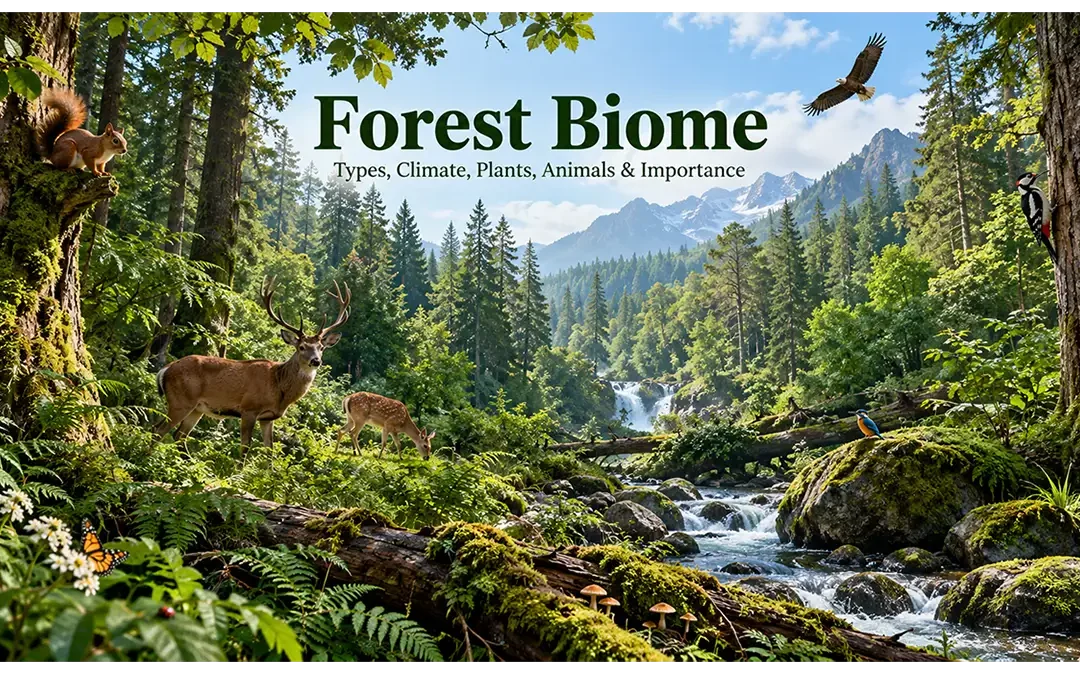
Forest Biome is one of the major terrestrial ecosystems on Earth, supporting a wide variety of plants, animals, fungi, and microorganisms. Forests occur across many climates, from warm tropical regions to cold northern landscapes, and each type has its own vegetation, wildlife, soil, and environmental conditions.
Forests also play an important role in the carbon cycle, water cycle, soil protection, and global biodiversity. Understanding the forest biome helps explain how living organisms interact with climate, land, water, and each other.
What Is a Forest Biome?
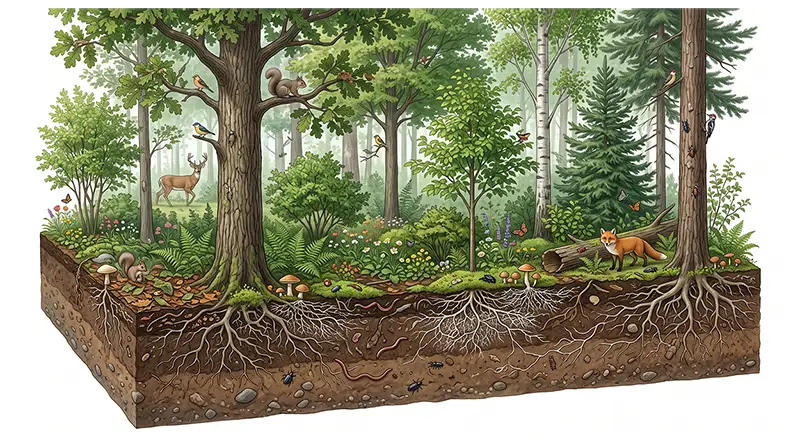
A forest biome is a large natural ecosystem dominated by trees and other woody plants. It includes not only trees but also shrubs, herbs, mosses, fungi, microorganisms, insects, birds, mammals, reptiles, amphibians, and other organisms.
A biome is generally defined by broad environmental conditions such as climate and characteristic vegetation. Forest biomes can therefore look very different depending on temperature, rainfall, elevation, soil, and seasonal patterns.
Unlike a single forest, the forest biome represents a much broader ecological category that includes forests found in different parts of the world.
Main Characteristics of Forest Biomes
Forest biomes commonly have:
- A large number of trees and woody plants
- Several layers of vegetation
- Diverse animal communities
- Active decomposition and nutrient cycling
- Organic-rich soils in many environments
- Significant carbon storage
- Complex relationships between plants, animals, fungi, and microorganisms
The amount and type of vegetation vary greatly between forest regions. A humid tropical forest may contain dense vegetation throughout several layers, while a boreal forest may have fewer tree species and a shorter growing season.
Forest ecosystems are also dynamic. Trees grow, compete for sunlight and water, reproduce, die, and become part of the nutrient cycle. Natural disturbances such as storms, insects, drought, and fire can also change forest structure over time.
Where Are Forest Biomes Found?
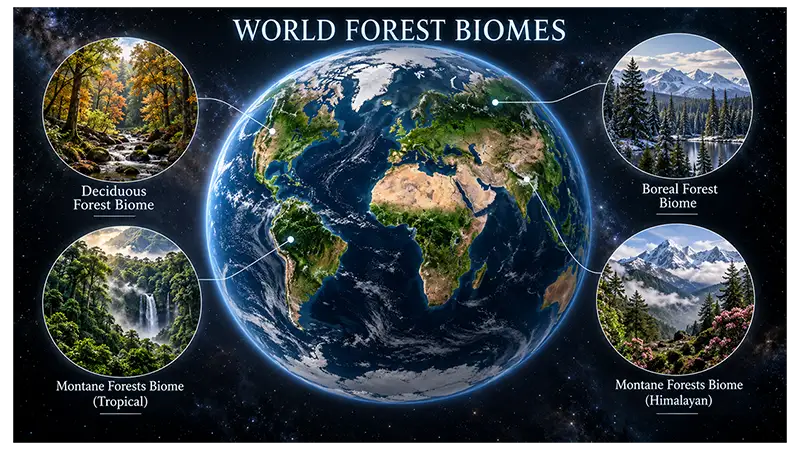
Forest biomes occur across much of the world wherever environmental conditions allow trees to grow. They are found from tropical regions near the equator to temperate areas at middle latitudes and boreal regions close to the Arctic.
Their distribution is strongly influenced by temperature and moisture. Warm, wet regions can support dense forests, while colder or drier regions usually support forests with different structures and fewer tree species.
Tropical Regions
Tropical forests occur mainly near the equator and in areas with warm temperatures throughout much of the year. Many receive substantial rainfall and can support dense, multilayered vegetation. The Amazon Basin, Congo Basin, and parts of Southeast Asia contain major tropical forest regions.
Temperate Regions
Temperate forests occur in areas with moderate temperatures and noticeable seasonal changes. These forests may contain broadleaf deciduous trees, evergreen trees, or mixtures of both. Large temperate forests occur in parts of North America, Europe, East Asia, and other regions.
Northern Regions
Boreal forests are concentrated across northern North America, Europe, and Asia. They are dominated mainly by coniferous trees such as spruce, fir, and pine. Cold temperatures and long winters strongly influence their vegetation and wildlife.
Mountain Regions
Forests can also occur at different elevations in mountain environments. As elevation increases, temperature generally decreases, and the types of trees and other plants change. At sufficiently high elevations, environmental conditions may become too cold or exposed for trees, creating a transition to alpine vegetation.
The worldwide distribution of forest biomes is therefore closely connected to temperature, precipitation, elevation, soil, and seasonal conditions.
What Are the Main Types of Forest Biomes?
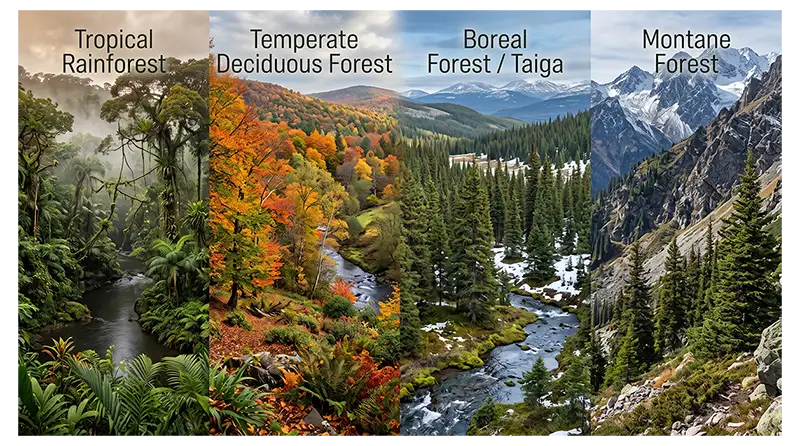
Forest biomes can be grouped into several broad types based mainly on climate, vegetation, and geographic location.
Tropical Forests
Tropical forests occur in warm regions with high rainfall. Many have extremely high biodiversity and complex vegetation layers. Tropical rainforests are especially rich in species and often contain tall trees forming a continuous canopy. Other tropical forests experience stronger seasonal changes in rainfall.
Temperate Forests
Temperate forests occur in regions with moderate climates and distinct seasons. They can contain deciduous trees that lose their leaves during colder or drier seasons, evergreen trees, or a mixture of both. These forests often experience significant changes in temperature and vegetation throughout the year.
Boreal Forests
Boreal forests, also called taiga, occur mainly across high northern latitudes. They have long, cold winters and relatively short growing seasons. Coniferous trees dominate many boreal forests because their needle-like leaves and other adaptations help them survive cold conditions.
Tropical Seasonal Forests
Some tropical forests experience a pronounced dry season. Trees in these forests may lose their leaves during periods of limited rainfall, reducing water loss. They generally have a different structure from evergreen tropical rainforests because seasonal water availability affects plant growth.
Montane Forests
Montane forests develop in mountainous areas where elevation strongly influences temperature, rainfall, and vegetation. The composition of a montane forest can change significantly over relatively short vertical distances as environmental conditions become colder with increasing elevation.
| Forest Type | Typical Climate | Common Vegetation |
|---|---|---|
| Tropical rainforest | Warm and very wet | Broadleaf evergreen trees, vines, epiphytes |
| Tropical seasonal forest | Warm with wet and dry seasons | Deciduous and evergreen trees |
| Temperate forest | Moderate with seasonal changes | Broadleaf trees, conifers, shrubs |
| Boreal forest | Cold with long winters | Spruce, fir, pine, larch |
| Montane forest | Cooler with increasing elevation | Conifers, broadleaf trees, shrubs |
These categories overlap in some regions, and real forests can contain characteristics of more than one broad type.
What Is the Climate Like in Forest Biomes?
Forest climates vary greatly because forests occur across different latitudes, elevations, and geographic regions. Temperature and precipitation are especially important because trees generally require sufficient water and a suitable growing period.
Temperature
Tropical forests remain warm for most of the year, while temperate forests experience stronger seasonal changes. Boreal forests have some of the coldest forest climates, with long winters and short summers. Temperature influences photosynthesis, plant growth, decomposition, reproduction, and animal activity.
Rainfall
Water availability is another major factor. Tropical rainforests can receive large amounts of rainfall throughout the year, while some tropical seasonal forests experience several months of relatively dry conditions. Temperate and boreal forests can also receive substantial precipitation, but much of it may occur as snow in colder regions.
Seasons
Seasonality affects when plants grow, flower, produce seeds, and lose leaves. Animals may respond by changing their feeding behavior, migration patterns, reproduction, or activity. In temperate forests, seasonal changes are particularly visible because many deciduous trees change leaf color and shed their leaves during autumn.
Climate and Forest Structure
Climate influences the height, density, and species composition of forests. Warm and wet conditions can support tall and dense vegetation, while cold or dry conditions generally limit plant growth. For this reason, climate is one of the main factors separating tropical, temperate, boreal, and other forest ecosystems.
What Plants Grow in Forest Biomes?
Forest biomes contain much more than trees. Plants occupy different levels of the ecosystem and compete for light, water, nutrients, and space. The vegetation can include trees, shrubs, herbs, grasses, ferns, mosses, vines, and other specialized plants.
Trees
Trees form the dominant vegetation in most forest biomes. Their height, leaf structure, bark, roots, and growth patterns vary according to climate. Tropical forests may contain many broadleaf evergreen species, while temperate forests can include deciduous trees such as oaks and maples as well as evergreen conifers. Boreal forests are commonly dominated by conifers adapted to cold conditions.
Shrubs and Herbs
Shrubs and herbaceous plants grow beneath or between trees. Their abundance depends strongly on how much sunlight reaches the lower layers. Some shade-tolerant plants can grow beneath dense canopies, while others require openings created by fallen trees or natural disturbances.
Ferns and Mosses
Ferns, mosses, and related plants are common in many moist forest environments. They can grow on soil, rocks, fallen logs, and tree surfaces. These plants contribute to habitat complexity and participate in nutrient and moisture cycles.
Vines and Epiphytes
Tropical forests often contain climbing plants and epiphytes. Vines use other plants for physical support, allowing them to reach greater heights. Epiphytes grow on other plants without necessarily taking nutrients directly from them. Orchids, bromeliads, and some ferns are examples found in tropical forests.
Fungi
Although fungi are not plants, they are essential parts of forest ecosystems. Many fungi break down dead organic material, while others form mycorrhizal relationships with plant roots. Through these relationships, fungi can help plants obtain nutrients and water while receiving carbohydrates produced by photosynthesis.
What Animals Live in Forest Biomes?
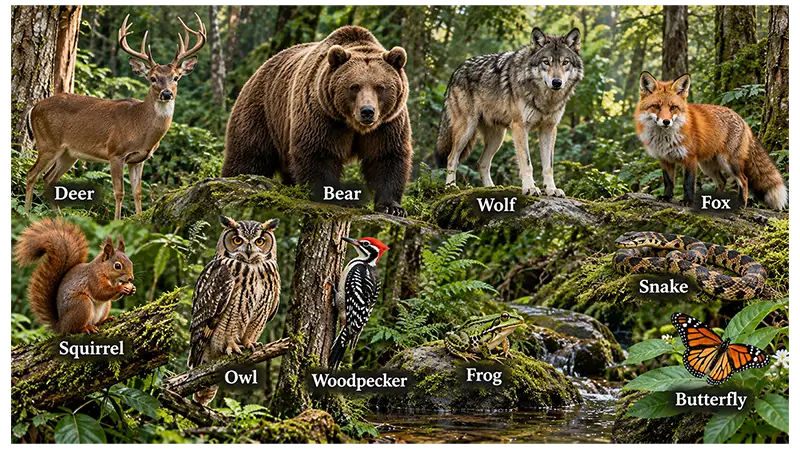
Forest biomes support an enormous range of animals. The exact species depend on the forest type, climate, vegetation, and geographic region. Animals can live in the canopy, understory, forest floor, soil, streams, tree cavities, or dead wood.
Mammals
Forests provide habitats for many mammals, including monkeys, deer, bears, elephants, rodents, bats, squirrels, and numerous small insect-eating species. Tropical forests are particularly diverse and contain many arboreal mammals adapted to life in trees.
Birds
Birds occupy almost every forest layer. Some feed in the canopy, others search for insects beneath leaves, while ground-dwelling species forage among fallen vegetation. Forests also provide nesting sites, shelter, and food resources for many bird species.
Reptiles and Amphibians
Warm and humid forests can support numerous reptiles and amphibians. Snakes, lizards, frogs, and salamanders use vegetation, leaf litter, tree cavities, streams, and other habitats. Moist forest environments are particularly important for amphibians because many species depend on water or humid conditions during reproduction.
Insects and Other Invertebrates
Insects are among the most abundant and ecologically important forest animals. Beetles, ants, butterflies, moths, termites, bees, and many other groups contribute to pollination, decomposition, herbivory, and food webs. Spiders, earthworms, millipedes, and other invertebrates also help process organic material and provide food for larger animals.
Forest biodiversity is therefore not limited to large and easily visible animals. A large proportion of forest life exists at small scales within soil, leaf litter, bark, and decaying wood.
How Do Forest Plants and Animals Adapt?
Forest organisms have evolved many adaptations that help them survive particular combinations of temperature, moisture, sunlight, predators, competitors, and food availability. Because forest environments differ greatly, adaptations vary between tropical, temperate, boreal, and mountain forests.
Plant Adaptations
Plants may adapt to limited sunlight by developing broad leaves, climbing toward the canopy, or completing their life cycles during periods when more light reaches the forest floor. Trees in dry environments may develop features that reduce water loss, while boreal conifers have narrow needles and other characteristics that help them withstand cold conditions. Deep or spreading root systems can improve access to water and nutrients and provide stability.
Animal Adaptations
Forest animals have also developed specialized traits. Arboreal animals may have grasping feet, strong limbs, claws, or balancing tails that help them move through trees. Some birds have specialized beaks suited to particular foods.
Many forest animals use camouflage to avoid predators or approach prey. Others have strong senses of smell, hearing, or vision that help them navigate dense vegetation.
Seasonal Adaptations
Animals in temperate and boreal forests may respond to seasonal changes through migration, hibernation, food storage, changes in coat thickness, or shifts in feeding behavior.
Plants can respond to seasonal conditions through leaf loss, dormancy, changes in growth, and timing of flowering or seed production. These adaptations allow organisms to use the resources available in their particular forest environment.
How Do Forests Affect Soil, Water and Climate?
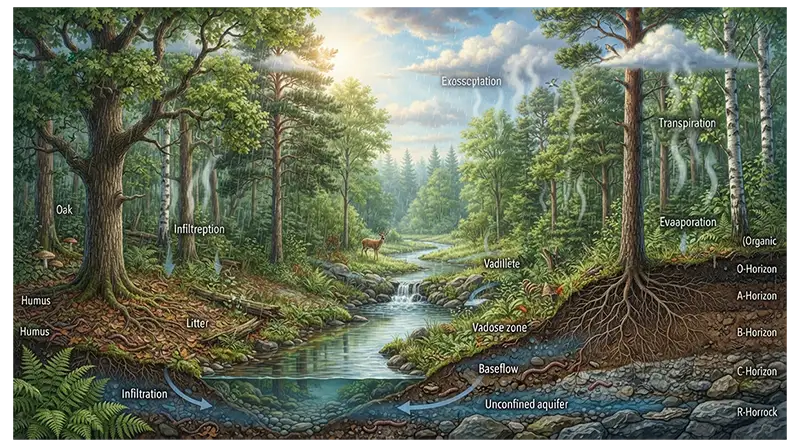
Forests influence important physical and chemical processes within ecosystems. Trees and other vegetation interact continuously with soil, water, and the atmosphere.
Forests and Soil
Fallen leaves, branches, roots, and dead organisms add organic material to the soil. Decomposers break down this material and release nutrients that can be reused by plants. Tree roots also help hold soil together. This can reduce erosion, especially on slopes and during heavy rainfall.
Forests and Water
Forest vegetation affects how rainfall reaches the ground. Leaves and branches can temporarily intercept precipitation before water moves through the vegetation and into the soil. Roots create pathways through the soil that can increase infiltration. Forested landscapes can therefore influence runoff, groundwater recharge, streamflow, and soil moisture. However, the exact effects vary with forest type, soil, climate, topography, and land management.
Forests and Carbon
Trees absorb carbon dioxide during photosynthesis and store carbon in their trunks, branches, roots, leaves, and surrounding soils. When forests grow, they can accumulate substantial amounts of carbon. When forests are burned, cleared, or severely degraded, some of the stored carbon can return to the atmosphere. Forests are therefore important components of the global carbon cycle.
Forests and Local Climate
Forest vegetation can influence temperature and humidity near the ground through shade and evapotranspiration. Water released by plants into the atmosphere can also contribute to regional moisture cycling. These effects vary among different forest environments, but they demonstrate that forests are closely connected to atmospheric and hydrological processes.
Why Are Forest Biomes Important?
Forest biomes are important for both natural ecosystems and human societies. Their value extends far beyond the trees themselves.
Biodiversity
Forests provide habitats for a large proportion of Earth's terrestrial species. Different vegetation layers create many opportunities for organisms with different lifestyles. A single forest can contain organisms living above the canopy, within tree trunks, beneath leaf litter, and deep inside the soil.
Soil Protection
Roots help stabilize soil, while fallen organic material protects the surface from direct rainfall and contributes to soil formation. Healthy forest ecosystems can therefore reduce erosion and support productive soils.
Water Regulation
Forests interact with rainfall, surface runoff, soil moisture, and groundwater. Forested watersheds can be important sources of freshwater for ecosystems and human communities.
Carbon Storage
Forests store carbon in living biomass and soils. Maintaining healthy forests therefore contributes to the long-term functioning of the global carbon cycle.
Natural Resources
Forests provide timber, fibers, fruits, nuts, medicines, fuel, and many other resources. Millions of people also depend directly or indirectly on forest ecosystems for livelihoods.
Cultural and Recreational Value
Forests provide places for recreation, education, research, cultural practices, and tourism. They also have important cultural and spiritual meanings for many communities.
The importance of forests comes from the combination of biodiversity, ecological processes, natural resources, and human benefits they provide.
What Threats Affect Forest Biomes?
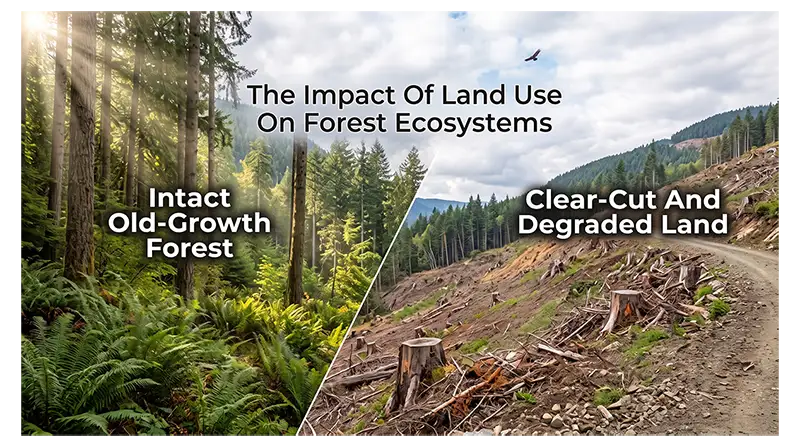
Forest biomes face many pressures caused by both human activities and environmental change. The severity of these threats differs among regions.
Deforestation
Deforestation occurs when forests are permanently cleared and converted to other land uses. Agriculture, infrastructure, mining, settlements, and resource extraction are among the major causes. Removing large areas of forest can destroy habitats and reduce biodiversity.
Habitat Fragmentation
Even when some forest remains, roads, farms, cities, and other developments can divide continuous forests into smaller patches. Fragmentation can isolate animal populations, reduce habitat quality, and make movement between suitable areas more difficult.
Wildfires
Fire is a natural part of some forest ecosystems, but unusually severe, frequent, or widespread fires can cause significant ecological damage. Changes in climate, land use, vegetation, and fire management can influence fire behavior and forest recovery.
Climate Change
Changing temperatures, precipitation patterns, drought conditions, and extreme weather can affect forest growth and survival. Some tree species may struggle when environmental conditions change faster than their populations can adapt or move to suitable habitats.
Invasive Species
Introduced plants, animals, insects, and pathogens can disrupt native forest communities. Some invasive species compete with native organisms, while others spread diseases or alter ecosystem processes.
Overexploitation
Unsustainable logging, hunting, collection of forest products, and other forms of resource use can reduce forest health and biodiversity. The combined effect of these pressures can be greater than the effect of any single threat.
How Can Forest Biomes Be Conserved?
Forest conservation involves protecting existing forests while also maintaining the ecological processes that allow damaged forests to recover.
Protected Areas
National parks, reserves, and other protected areas can conserve important forests and provide safe habitat for wildlife. Effective protection requires appropriate management, monitoring, and involvement of local communities.
Forest Restoration
Degraded forests can sometimes recover naturally if major pressures are removed. In other cases, restoration may involve planting native species, controlling invasive organisms, repairing soil, or reconnecting fragmented habitats. Restoration should consider the original ecological conditions rather than simply planting trees without regard to biodiversity.
Sustainable Forest Management
Forests can provide resources while remaining ecologically functional when harvesting and land use are carefully managed. Sustainable practices can reduce unnecessary habitat damage, protect soil and water, and maintain forest regeneration.
Wildlife Corridors
Wildlife corridors can connect isolated forest patches and allow animals to move between habitats. Connected landscapes can improve access to food, breeding areas, and seasonal resources while reducing the effects of fragmentation.
Community Conservation
Local and Indigenous communities often have extensive knowledge of forest environments. Conservation programs can be more effective when local people participate in planning, management, monitoring, and sustainable resource use.
Reducing Deforestation
Reducing unnecessary forest clearing is one of the most important conservation strategies. Better land-use planning, responsible agriculture, sustainable supply chains, law enforcement, and restoration can all contribute to forest protection. Long-term conservation works best when ecological protection is combined with sustainable human use and strong local participation.
Conclusion
The forest biome is one of Earth's most diverse and important terrestrial ecosystems. Forests occur across a wide range of climates, from warm tropical regions to cold boreal landscapes, and their vegetation and wildlife change according to temperature, rainfall, elevation, soil, and seasonal conditions.
Trees form the foundation of these ecosystems, but forests depend on much more than trees. Plants, fungi, animals, microorganisms, soil, water, and atmospheric processes interact to create complex ecological systems. Forests also influence carbon storage, nutrient cycling, water movement, soil stability, and biodiversity.
At the same time, forest biomes face serious pressures from deforestation, fragmentation, climate change, fires, invasive species, and unsustainable resource use. Protecting remaining forests and restoring degraded areas are therefore important for maintaining biodiversity and healthy Earth systems.
Understanding the Forest Biome provides a clearer view of how terrestrial ecosystems function and why forests remain essential to the natural environment and human societies.
Forests have existed for hundreds of millions of years. Early tree-like forests appeared during the Devonian Period, long before modern forests developed.
The boreal forest, also called the taiga, is the largest terrestrial forest biome. It forms a broad belt across northern North America, Europe, and Asia.
Evergreen trees retain their leaves or needles for several years. This adaptation helps many species continue photosynthesis during suitable conditions without producing a completely new canopy every year.
The distinction usually depends on tree density and canopy cover. Forests generally have a denser tree canopy, while woodlands tend to have more open spaces between trees.
Yes. Forests can grow at different elevations where temperature, moisture, and soil conditions are suitable. As elevation increases, forests often become shorter and more open before giving way to alpine vegetation.