
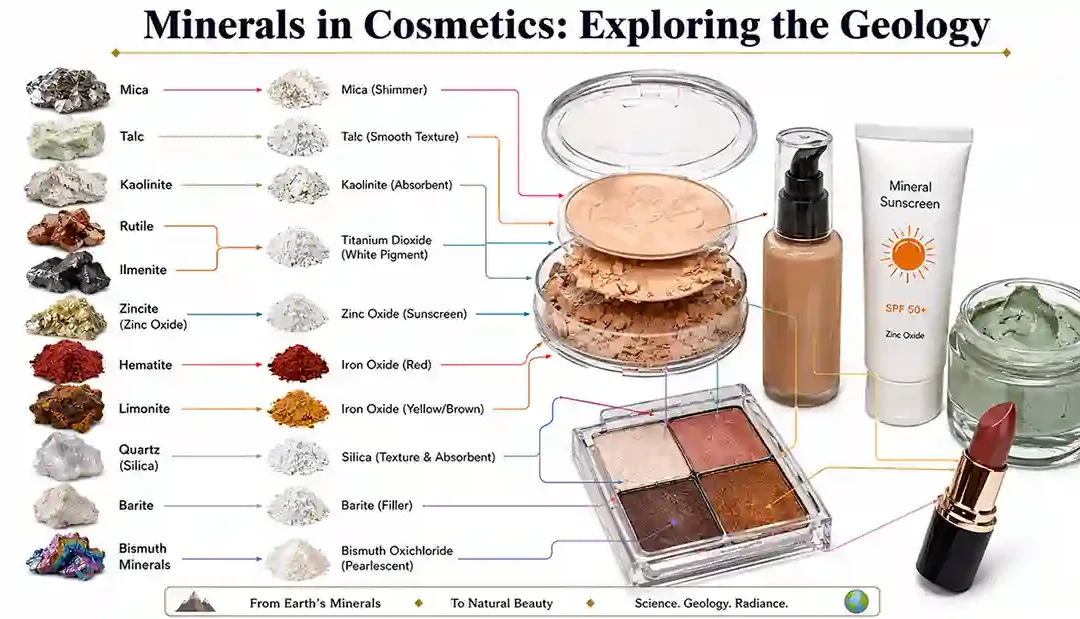
Cosmetics have been used for thousands of years to enhance appearance, protect the skin, and express personal style. Today, modern beauty products rely on carefully refined minerals extracted from the Earth's crust to provide color, texture, shine, sun protection, oil absorption, and long-lasting performance.
Minerals in cosmetics are found in products such as foundation, face powder, eyeshadow, lipstick, blush, sunscreen, facial masks, and skincare formulations. Minerals like mica, talc, kaolin, titanium dioxide, zinc oxide, silica, and iron oxides improve product performance while creating safe, durable, and visually appealing cosmetics.
Understanding these minerals highlights the close relationship between geology, chemistry, materials science, and the cosmetics industry.
This topic should be studied together with Industrial Minerals, Clay Mineralogy, and Mineralogy.
Why Cosmetics Depend on Minerals
Cosmetic products require minerals with specialized physical and chemical properties.
These minerals provide:
- Natural pigmentation
- Smooth texture
- Oil absorption
- UV protection
- Light reflection
- Skin coverage
- Product stability
- Long-lasting performance
Without these minerals, many modern cosmetics would lose their effectiveness and visual appeal.
Major Minerals Used in Cosmetics
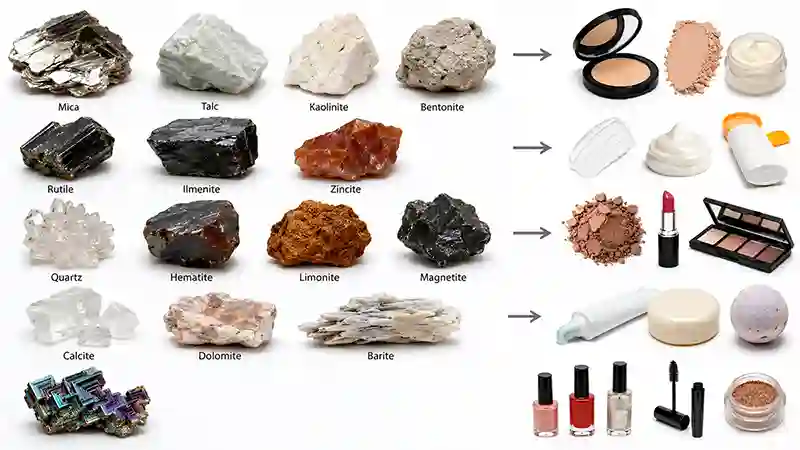
Mica
Uses:
- Eyeshadow
- Highlighter
- Foundation
- Lipstick
Importance:
Mica reflects light, creating shimmer, sparkle, and pearlescent effects in cosmetic products.
Talc
Uses:
- Face powder
- Foundation
- Baby powder
- Blush
Importance:
Talc provides a smooth texture, absorbs moisture, and improves the spreadability of cosmetic products.
Kaolinite
Uses:
- Facial masks
- Powder foundations
- Cleansers
Importance:
Kaolin clay absorbs excess oil while gently cleansing the skin.
Titanium Minerals
Common source minerals:
- Rutile
- Ilmenite
Uses:
- Titanium dioxide
- Sunscreen
- Foundation
- Face powder
Importance:
Titanium dioxide provides excellent opacity and protects the skin from ultraviolet (UV) radiation.
Zinc Minerals
Common source:
- Zincite
Uses:
- Zinc oxide sunscreen
- Skin creams
- Baby creams
Importance:
Zinc oxide protects against both UVA and UVB radiation while soothing sensitive skin.
Quartz
Uses:
- Silica powder
- Cosmetic fillers
- Skincare products
Importance:
Silica improves texture, reduces shine, and enhances product stability.
Iron Oxides
Common minerals:
- Hematite
- Limonite
- Magnetite
Uses:
- Foundation pigments
- Lipstick
- Blush
- Eyeshadow
Importance:
Iron oxides produce safe and stable red, yellow, brown, and black cosmetic pigments.
Barite
Uses:
- Cosmetic fillers
- Powder formulations
Importance:
Barite improves product density and smooth application.
Bismuth Minerals
Uses:
- Mineral makeup
- Highlighters
- Foundations
Importance:
Bismuth compounds create pearlescent finishes and improve skin coverage.
Bentonite
Uses:
- Clay masks
- Detoxifying skincare
- Cleansers
Importance:
Bentonite absorbs oils, impurities, and excess moisture from the skin.
Calcium Carbonate
Main mineral:
- Calcite
Uses:
- Cosmetic powders
- Toothpaste
- Skin products
Importance:
Provides gentle abrasion and acts as an inexpensive filler.
Dolomite
Uses:
- Cosmetic powders
- Facial products
Importance:
Improves texture and product consistency.
Minerals by Cosmetic Product
| Cosmetic Product | Main Minerals |
|---|---|
| Face Powder | Talc, Mica, Silica |
| Foundation | Titanium Dioxide, Iron Oxides, Mica |
| Eyeshadow | Mica, Iron Oxides |
| Lipstick | Iron Oxides, Mica |
| Sunscreen | Titanium Dioxide, Zinc Oxide |
| Facial Masks | Kaolinite, Bentonite |
| Highlighter | Mica, Bismuth Minerals |
| Blush | Iron Oxides, Talc |
Types of Cosmetics and Their Mineral Composition
Makeup
Main minerals:
- Mica
- Talc
- Iron oxides
- Titanium dioxide
Provides color, coverage, and shimmer.
Skincare Products
Main minerals:
- Kaolin
- Bentonite
- Zinc oxide
- Silica
Improves cleansing, oil absorption, and skin protection.
Sunscreens
Main minerals:
- Titanium dioxide
- Zinc oxide
Provide broad-spectrum UV protection.
Mineral Makeup
Main minerals:
- Mica
- Titanium dioxide
- Zinc oxide
- Iron oxides
Contains naturally derived mineral pigments with minimal synthetic ingredients.
Cosmetic Powders
Main minerals:
- Talc
- Silica
- Calcite
Improve texture, smoothness, and oil control.
From Mine to Cosmetic Product
Cosmetic minerals undergo several production stages.
- Geological exploration
- Mining and quarrying
- Mineral purification
- Fine grinding and micronization
- Cosmetic formulation
- Quality testing
- Packaging
- Consumer use
- Recycling and waste management
Each stage transforms raw minerals into safe cosmetic ingredients.
Environmental Challenges
Cosmetic mineral production presents several environmental challenges.
These include:
- Mining impacts
- Responsible sourcing
- Energy use
- Water consumption
- Packaging waste
Many companies now emphasize ethical sourcing and environmentally responsible mineral extraction.
Recycling Cosmetic Materials
Although cosmetics themselves are difficult to recycle, manufacturers increasingly recycle:
- Glass containers
- Plastic packaging
- Aluminum containers
- Cardboard packaging
Responsible packaging reduces environmental impacts.
Geological Importance
The cosmetics industry depends heavily on industrial minerals.
Geologists help:
- Discover high-purity mineral deposits
- Evaluate cosmetic-grade talc and kaolin
- Assess mica resources
- Support sustainable mining
- Ensure consistent mineral quality
Their work supports safe and reliable cosmetic manufacturing.
Laboratory Investigation
Cosmetic minerals are analyzed using:
- X-Ray Diffraction (XRD)
- X-Ray Fluorescence (XRF)
- Scanning Electron Microscopy (SEM)
- Particle Size Analysis
- ICP-MS
- Purity testing
These methods evaluate mineral composition, particle size, purity, and suitability for cosmetic applications.
Applications
Cosmetic minerals are essential in:
- Face powders
- Foundations
- Eyeshadows
- Lipsticks
- Sunscreens
- Facial masks
- Skincare products
- Personal care products
- Mineral makeup
Advantages of Studying Cosmetic Minerals
Understanding cosmetic minerals helps scientists and manufacturers:
- Develop safer cosmetics
- Improve UV protection
- Enhance product texture
- Increase color stability
- Support ethical mineral sourcing
- Improve sustainable manufacturing
Limitations
Despite their importance, cosmetic minerals present several challenges.
- Cosmetic-grade minerals require extremely high purity.
- Ethical sourcing of mica has become an important industry concern.
- Mining activities may affect local ecosystems.
- Strict quality control is essential for consumer safety.
- Manufacturers must balance product performance with sustainability.
For a broader understanding, study this topic together with:
- Industrial Minerals
- Economic Minerals
- Clay Mineralogy
- Materials Science
- Environmental Geology
- Surface Chemistry
- Sustainable Manufacturing
- Mineralogy
Comparison Table
| Mineral | Main Cosmetic Function | Example Product |
| Mica | Shimmer | Highlighter |
| Talc | Smooth Texture | Face Powder |
| Kaolinite | Oil Absorption | Clay Mask |
| Titanium Dioxide | UV Protection | Sunscreen |
| Zinc Oxide | Sun Protection | Mineral Sunscreen |
| Quartz (Silica) | Texture | Setting Powder |
| Iron Oxides | Pigments | Foundation |
| Bentonite | Cleansing | Facial Mask |
| Calcite | Filler | Cosmetic Powder |
| Barite | Density | Face Powder |
Summary Table
| Feature | Minerals in Cosmetics |
| Main Purpose | Cosmetic and Personal Care Products |
| Key Minerals | Mica, Talc, Kaolinite, Titanium Dioxide |
| Specialty Minerals | Zinc Oxide, Iron Oxides, Bentonite, Silica |
| Study Methods | XRD, XRF, SEM, Particle Size Analysis |
| Geological Importance | Industrial Mineral Resources and Cosmetic Manufacturing |
Mica is one of the most widely used cosmetic minerals because it creates shimmer and improves the appearance of makeup products.
Titanium dioxide provides bright white pigmentation, excellent coverage, and effective UV protection in sunscreens and foundations.
Iron oxides create red, yellow, brown, and black pigments, while mica produces shimmering effects and titanium dioxide provides brightness.
Cosmetic-grade minerals are highly purified and must meet strict safety standards before they are used in personal care products.
Kaolin gently absorbs excess oil, removes impurities, and improves skin texture without being overly harsh.
Final Thoughts
Modern cosmetics depend on a wide variety of naturally occurring minerals that provide color, texture, coverage, UV protection, and long-lasting performance. Mica creates shimmer, talc and silica improve smoothness, kaolin cleanses the skin, titanium dioxide and zinc oxide protect against ultraviolet radiation, while iron oxides produce stable natural pigments.
As consumers increasingly seek sustainable and ethically sourced beauty products, responsible mineral extraction, rigorous quality control, and environmentally friendly manufacturing practices will become even more important. Understanding the geology behind cosmetic ingredients highlights the essential role minerals play in the beauty and personal care industry.
Continue Learning
Continue exploring related topics: