
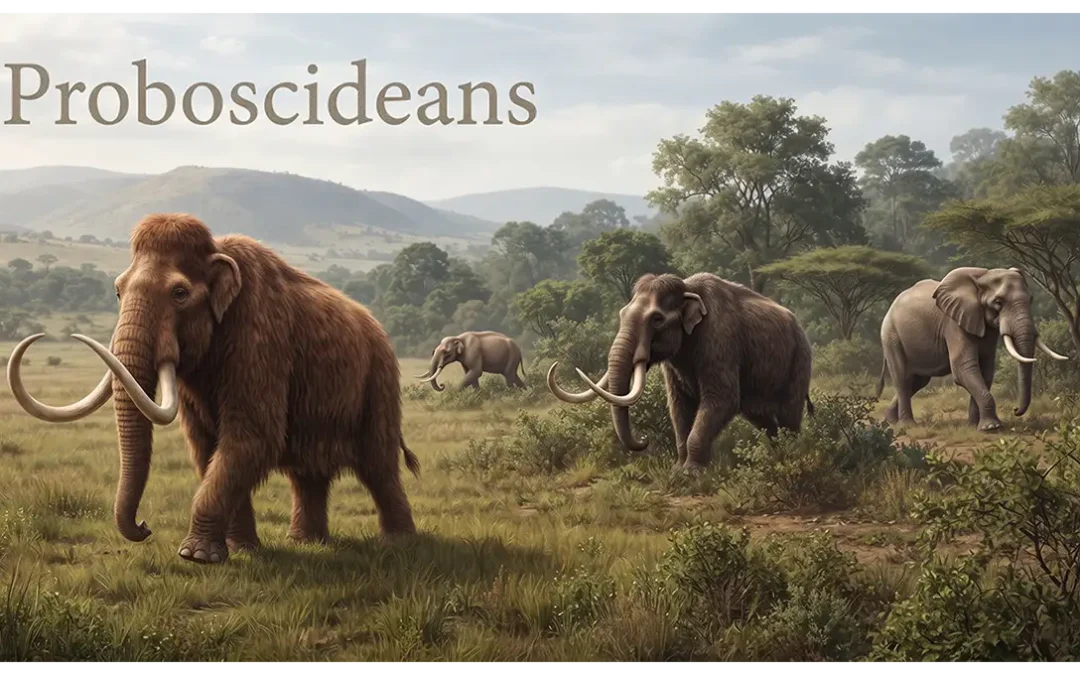
Proboscideans are a group of mammals best known for their distinctive trunks, tusks, and large bodies. This group includes living elephants and many extinct relatives, such as mammoths, mastodons, and gomphotheres. Over millions of years, proboscideans evolved a remarkable range of body shapes, feeding adaptations, and lifestyles, allowing them to inhabit environments across much of the world.
Although modern elephants are the only surviving members of this group, the fossil record reveals a much richer history. Some ancient proboscideans had short trunks, unusual tusks, or lower jaws unlike those of living elephants. Others developed specialized teeth for browsing leaves or grazing on grasses. Their remains provide important evidence about mammalian evolution, prehistoric ecosystems, and changes in Earth's climate.
Understanding proboscideans also helps explain why mammoths and mastodons were different animals, how elephants became the only surviving members of their order, and why many prehistoric species disappeared. This guide explores their origins, anatomy, evolution, major groups, diet, habitats, fossils, and extinction.
What Are Proboscideans?
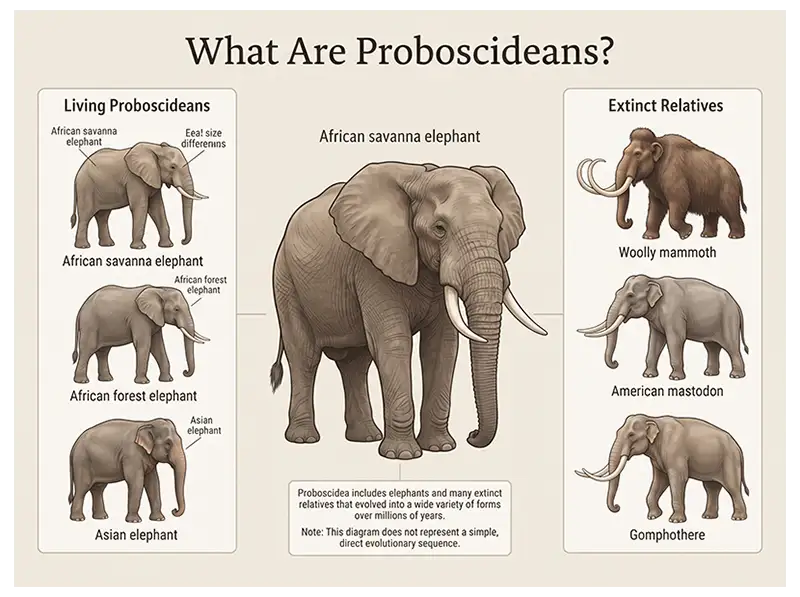
Proboscideans are mammals belonging to the order Proboscidea. The group includes modern elephants and numerous extinct relatives that lived during different periods of Earth's history. The name refers to the proboscis, or elongated nose, which is represented by the highly developed trunk of modern elephants.
Today, the only living proboscideans are African savanna elephants (Loxodonta africana), African forest elephants (Loxodonta cyclotis), and Asian elephants (Elephas maximus). Their extinct relatives were far more diverse, ranging from early forms with relatively small bodies to enormous animals with complex tusks and specialized teeth.
Proboscideans belong to a larger mammalian group called Afrotheria, which also includes animals such as hyraxes, sirenians, and aardvarks. Despite differences in appearance, genetic and fossil evidence supports their evolutionary relationships within this broader African-origin mammalian lineage.
One of the most recognizable features of living elephants is their trunk. This muscular structure combines the functions of the nose and upper lip, allowing an elephant to smell, breathe, gather food, manipulate objects, and draw up water. However, the anatomy of early proboscideans varied, and the trunk's development occurred over evolutionary time.
Tusks are another familiar feature, but they were not identical across all species. In many proboscideans, tusks were enlarged upper incisors, while some extinct forms also had enlarged lower tusks. Their shape and size varied according to species, age, sex, and evolutionary history.
Proboscideans are important to paleontology because they demonstrate how mammals adapted to changing environments over millions of years. Their fossils preserve evidence of anatomical change, migration, feeding behavior, and interactions with prehistoric ecosystems.
When Did Proboscideans First Appear?
Proboscideans first appeared during the Paleogene Period, roughly 60 million years ago, in the aftermath of the extinction that ended the age of non-avian dinosaurs. Their earliest known representatives lived in Africa, where early mammals were diversifying into many ecological roles.
Among the early proboscideans was Eritherium, a small, primitive mammal known from Paleocene deposits in Morocco. It lacked the imposing proportions of later elephants and is important because it helps researchers investigate the early stages of proboscidean evolution. Other early forms, including Phosphatherium and Numidotherium, provide additional evidence of the group's gradual diversification.
During the Eocene and Oligocene epochs, proboscideans developed a wider range of body forms and feeding adaptations. Some acquired more specialized teeth, while others evolved changes in their jaws, skulls, and tusks. These modifications helped them exploit different plants and habitats.
By the Miocene Epoch, proboscideans had diversified extensively. Several lineages spread beyond Africa into Eurasia and, later, other regions. Gomphotheres became widespread across multiple continents, while elephant relatives developed increasingly specialized features.
Mammoths appeared much later, during the Pliocene Epoch, approximately five million years ago. Their descendants eventually occupied parts of Africa, Eurasia, and North America. Mastodons belonged to a separate proboscidean lineage and became especially well known in North America.
The geological timeline of proboscideans therefore extends across tens of millions of years. Their history includes many evolutionary branches, regional migrations, and extinctions rather than a single uninterrupted progression from one early species to the modern elephant.
What Are the Main Characteristics of Proboscideans?
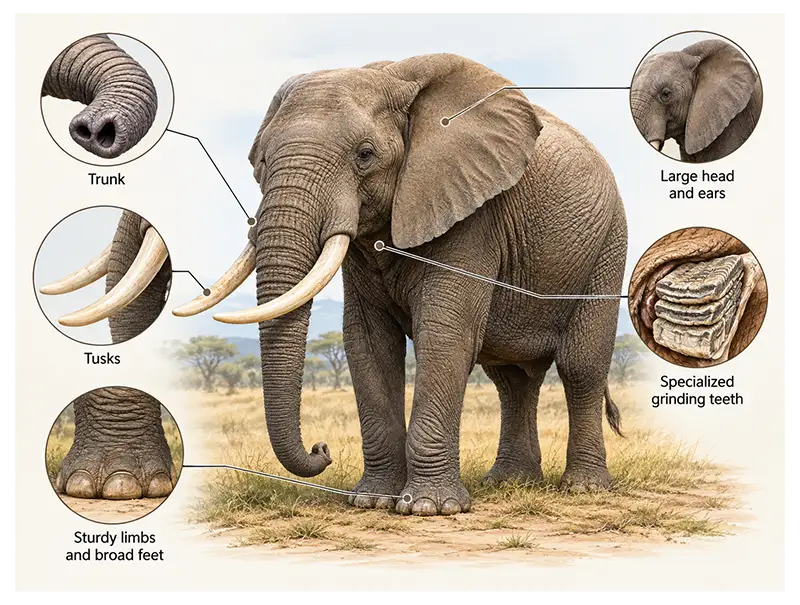
Proboscideans share a set of anatomical features, although extinct species differed considerably in size, proportions, and feeding structures. Modern elephants provide the best-known examples, but fossil discoveries reveal that these traits changed substantially throughout the group's history.
The trunk
The trunk is a highly flexible muscular structure used for breathing, smelling, gathering food, drinking, and manipulating objects. Modern elephants can perform delicate movements with their trunks despite their considerable strength.
The trunk contains no bones along its length. Instead, it is supported by complex arrangements of muscles and connective tissues. Early proboscideans probably had different degrees of nasal and upper-lip development, and the exact appearance of their soft tissues is difficult to establish from fossils alone.
Tusks
Tusks are enlarged teeth that grow continuously in many living elephants. In modern elephants, they are modified upper incisors. They may be used for digging, stripping bark, moving objects, defense, and competition.
Extinct proboscideans displayed much greater variation. Some had long, curved upper tusks; others possessed flattened or shovel-shaped lower tusks. Certain species had unusual combinations of upper and lower tusks, reflecting specialized feeding or other behaviors.
Teeth and jaws
Proboscideans developed distinctive molars adapted to processing large quantities of plant material. Their teeth often consisted of repeated ridges or plates of enamel and dentine, although the exact structure varied between lineages.
These teeth were particularly important for animals that consumed abrasive grasses or tough vegetation. In modern elephants, successive molars replace earlier ones as the animals age. Fossil species had their own patterns of tooth development and replacement.
Large bodies and strong limbs
Many later proboscideans became large-bodied animals with sturdy limbs that supported their weight. However, body size varied considerably throughout the order, and the earliest members were much smaller than living elephants.
Large size can help animals travel long distances and process substantial amounts of vegetation, but it also requires considerable food and water. The relationship between body size, climate, diet, and habitat is therefore an important subject in proboscidean research.
A specialized feeding system
The combination of a flexible trunk, mobile lips, tusks, and powerful grinding teeth allowed proboscideans to gather and process a wide range of plant foods. Different species developed different combinations of these features, demonstrating that there was no single proboscidean body plan throughout their evolutionary history.
How Did Proboscideans Evolve?
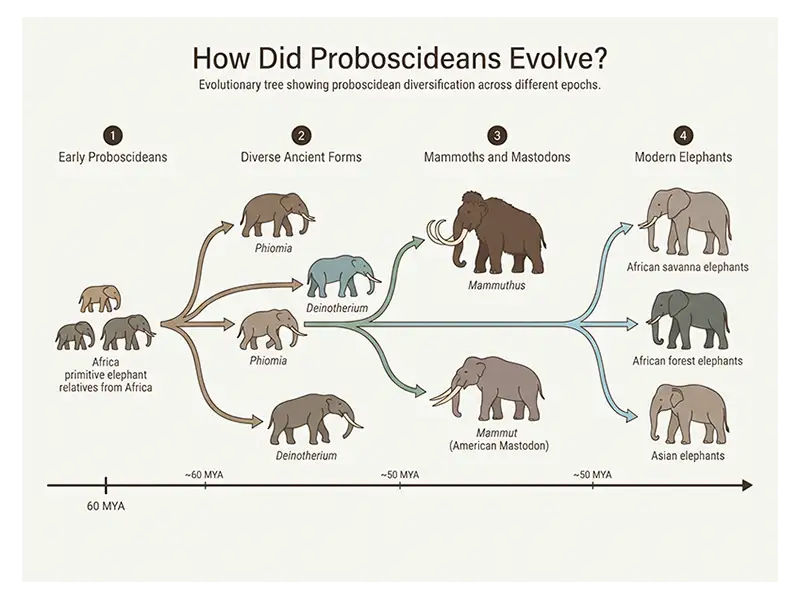
Proboscidean evolution involved gradual anatomical changes and the branching of numerous lineages. Fossils show that modern elephants did not emerge from a simple sequence of species in which every earlier form directly became the next.
The earliest proboscideans were relatively small compared with many later members of the group. As populations adapted to different environments, their skulls, jaws, teeth, tusks, and body proportions changed. These modifications allowed different species to exploit distinct food sources and habitats.
During the Paleogene, early proboscideans diversified primarily in Africa. Some forms retained relatively primitive anatomical features, while others developed more specialized chewing structures and increasingly prominent tusks. Fossils from this period help researchers identify which characteristics appeared early and which evolved later.
During the Miocene, several proboscidean lineages spread across Eurasia and other regions. Gomphotheres became particularly widespread and developed varied jaw and tusk arrangements. At the same time, the evolutionary branches leading toward modern elephants diversified.
Mammoths and modern elephants share a more recent common ancestry with each other than either does with the American mastodon. Mastodons belonged to the family Mammutidae, whereas mammoths belonged to the elephant family, Elephantidae. This distinction reflects branching evolutionary relationships rather than a simple progression from mastodon to mammoth to elephant.
Environmental changes influenced these developments. Shifts in vegetation, temperature, rainfall, and the distribution of grasslands and woodlands created new opportunities for some lineages while placing pressure on others. Migration also allowed proboscideans to occupy new regions and encounter unfamiliar ecosystems.
Scientists reconstruct these evolutionary patterns by comparing fossil anatomy, geological ages, and, when available, ancient DNA and proteins. These sources of evidence do not always produce a completely settled family tree, so some relationships continue to be revised as new discoveries are made.
The overall picture is one of extensive diversification followed by the extinction of many branches. Modern elephants represent only the surviving part of a once much larger evolutionary history.
What Were the Main Groups of Proboscideans?
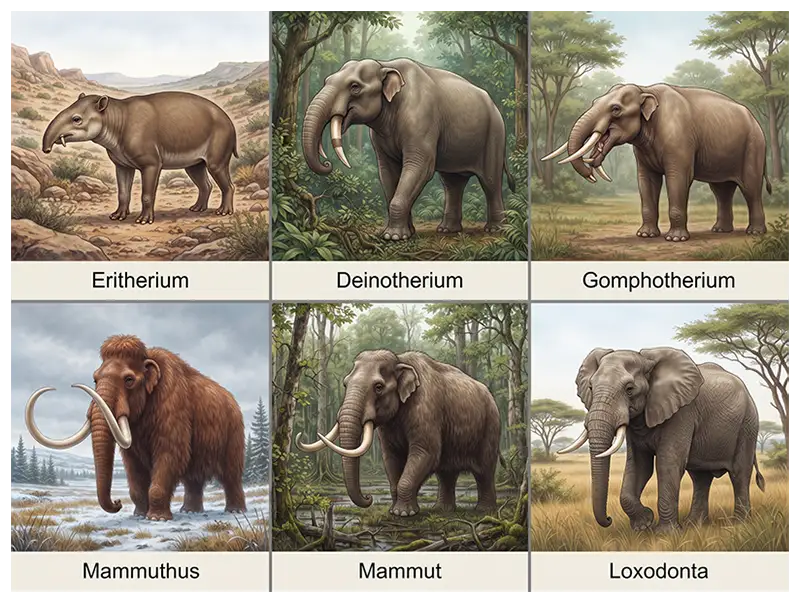
Proboscidea includes numerous extinct families and genera. The groups below illustrate major stages and branches of its history; they are not a simple ladder leading directly to modern elephants.
Early proboscideans
Early forms such as Eritherium, Phosphatherium, and Numidotherium help scientists understand the group's origins. They generally lacked the full combination of features associated with modern elephants, and their bodies and teeth varied from those of later members.
These fossils are particularly useful for studying the early development of proboscidean anatomy. They show that the characteristic features of elephants emerged through evolutionary changes rather than appearing all at once.
Deinotheres
Deinotheres, including Deinotherium, were large proboscideans with a striking arrangement of tusks. Unlike modern elephants, their most distinctive tusks curved downward from the lower jaw.
They lived across parts of Africa and Eurasia during the Neogene. Their unusual tusk arrangement has prompted several hypotheses about feeding behavior, although the exact functions remain uncertain.
Gomphotheres
Gomphotheres were a diverse group that included many species with elongated jaws and, in some forms, both upper and lower tusks. Their tooth structure and tusk arrangements differed widely, reflecting a range of feeding strategies.
Some gomphotheres spread across North America and South America, while others inhabited Africa and Eurasia. Their remains are important for studying proboscidean migration and the exchange of mammals between continents.
Mammoths
Mammoths belonged to the genus Mammuthus. They were members of Elephantidae and were related to living elephants. Different mammoth species lived in Africa, Eurasia, and North America at various times.
The woolly mammoth (Mammuthus primigenius) is especially famous for its long, curved tusks and adaptations to cold environments. Other mammoths lived in warmer regions and did not all possess the same coat or body features.
Mastodons
The American mastodon (Mammut americanum) belonged to a different family, Mammutidae. It lived in North America and is known for its robust build and distinctive molars, which had pronounced cusps rather than the plate-like ridges typical of mammoths.
Mastodons were often associated with woodland and forested environments, although their habitats and diets varied with region and time. They became extinct near the end of the Pleistocene.
Modern elephants
The surviving proboscideans are African savanna elephants, African forest elephants, and Asian elephants. They belong to Elephantidae and represent the only living branches of this once highly diverse order.
Their survival does not mean that proboscidean evolution has stopped. Living elephant populations continue to experience natural selection, while their future is strongly affected by habitat loss, poaching, and conflict with humans.
What Is the Difference Between Mammoths, Mastodons, and Elephants?
Mammoths, mastodons, and modern elephants all belong to Proboscidea, but they represent different evolutionary branches. Their similarities reflect shared ancestry, while differences in their teeth, bodies, and habitats help distinguish them.
| Feature | Mammoths | American mastodons | Modern elephants |
|---|---|---|---|
| Scientific group | Mammuthus | Mammut | Loxodonta and Elephas |
| Family | Elephantidae | Mammutidae | Elephantidae |
| Geological history | Pliocene to Holocene, depending on species | Mainly Miocene to Pleistocene, depending on species | Pleistocene to present for living species |
| Teeth | Plate-like molar ridges | Pronounced cusps on molars | Plate-like molar ridges |
| Tusks | Often long and curved, depending on species | Usually long and curved | Vary in size; some individuals have small or no visible tusks |
| Habitat | Varied; woolly mammoths occupied cold regions | Often woodland and forest habitats | African and Asian habitats, including savannas and forests |
Mammoths and elephants
Mammoths were closely related to living elephants. Their molars had multiple enamel ridges suited to grinding vegetation, and some species developed adaptations for cold environments. Woolly mammoths had dense fur and other features that helped them survive in cold, open landscapes.
However, not every mammoth lived in icy conditions. The genus included species that inhabited warmer regions, so woolly mammoth traits should not be applied to all mammoths.
Mastodons and mammoths
The clearest difference is in their teeth. Mastodon molars had prominent cusps that were well suited to processing leaves, twigs, and other vegetation. Mammoth molars generally had numerous ridges that could grind grasses and other plant material effectively.
These differences are consistent with broad dietary tendencies, not strict rules. Diets depended on the species, available vegetation, season, and habitat. Fossil evidence also shows that individual animals could consume a wider range of plants than a simple “browser versus grazer” division suggests.
Modern elephants
Modern elephants share important features with mammoths, including their general skull and molar structure. African and Asian elephants differ from each other in several anatomical characteristics, including ear shape and aspects of their tusks and skulls.
Unlike extinct mammoths and mastodons, living elephants continue to shape ecosystems today. They disperse seeds, modify vegetation, create pathways, and influence the availability of resources for other species.
These comparisons demonstrate that the three names do not describe interchangeable animals. Each represents a distinct evolutionary history within the wider proboscidean group.
What Did Proboscideans Eat?
Most proboscideans were herbivores, meaning they consumed plant material. Their diets included leaves, grasses, bark, twigs, fruits, and other vegetation, but the proportions varied among species and changed with environmental conditions.
The trunk helped these animals gather food from the ground, pull vegetation from shrubs, reach branches, and manipulate plant material. Tusks could assist with tasks such as stripping bark, moving obstacles, or digging, although their use varied and cannot always be determined from fossils.
Browsing and grazing
Browsers feed mainly on leaves, shoots, and woody plants, while grazers consume substantial amounts of grasses. Some proboscideans were adapted more strongly to one feeding strategy, whereas others had mixed diets.
Mammoths, particularly species associated with open and cold environments, often consumed grasses and other low-growing plants. American mastodons are commonly associated with browsing on woody vegetation in woodland habitats. However, neither group had a completely uniform diet across every population or time period.
How teeth reveal diet
Proboscidean teeth preserve valuable clues about feeding behavior. The shape and arrangement of enamel ridges, the height of tooth crowns, and patterns of wear can help researchers infer which foods an animal processed.
Microscopic wear on teeth may reveal whether an animal consumed relatively abrasive plants or other material. Chemical analyses of fossil teeth can also provide information about diet and the environments in which animals lived.
Why diet matters
Food availability influences where large herbivores can survive, how far they travel, and how they respond to seasonal changes. When climate alters vegetation, species adapted to one type of food may struggle if their preferred plants become scarce.
By studying proboscidean teeth, plant fossils, and other evidence together, scientists can reconstruct ancient ecosystems and investigate how changes in vegetation contributed to the expansion or decline of particular lineages.
Where Did Proboscideans Live?
Proboscideans once occupied a much wider geographic range than living elephants. Their fossils have been discovered in Africa, Europe, Asia, and the Americas, revealing a history of migration and adaptation across different climates.
Africa was central to the early evolution of proboscideans. Early members of the group appeared there, and several lineages later spread into Eurasia. During the Miocene and Pliocene, changes in geography and climate created opportunities for some species to move into new regions.
Gomphotheres became widespread across several continents. Some eventually reached South America after the formation of the Central American land connection allowed land mammals to move between North and South America. Mammoths also spread widely across Eurasia and North America, while different species occupied habitats ranging from relatively warm environments to cold steppe landscapes.
Forests and woodlands
Many proboscideans lived in wooded environments where leaves, branches, and other vegetation were readily available. Mastodons are often associated with woodland habitats, although evidence indicates variation across their range.
Grasslands and open landscapes
Expanding grasslands provided new feeding opportunities for species with teeth adapted to grazing. Mammoths are particularly well known from cold, open environments, where grasses and other low-growing plants formed a substantial part of the available vegetation.
Changing climates
Proboscidean distributions shifted as temperatures, rainfall, sea levels, and vegetation changed. Some species expanded into new regions, while others became isolated or lost suitable habitats.
Fossils from different geological settings help scientists track these movements. However, a fossil's location does not automatically establish its full habitat preferences; researchers also consider sedimentology, associated plant remains, and other evidence.
The modern distribution of elephants is much more restricted than the historical range of Proboscidea. Habitat loss, human activities, and past extinction events have contributed to this dramatic reduction.
Which Famous Proboscidean Fossils Have Been Discovered?
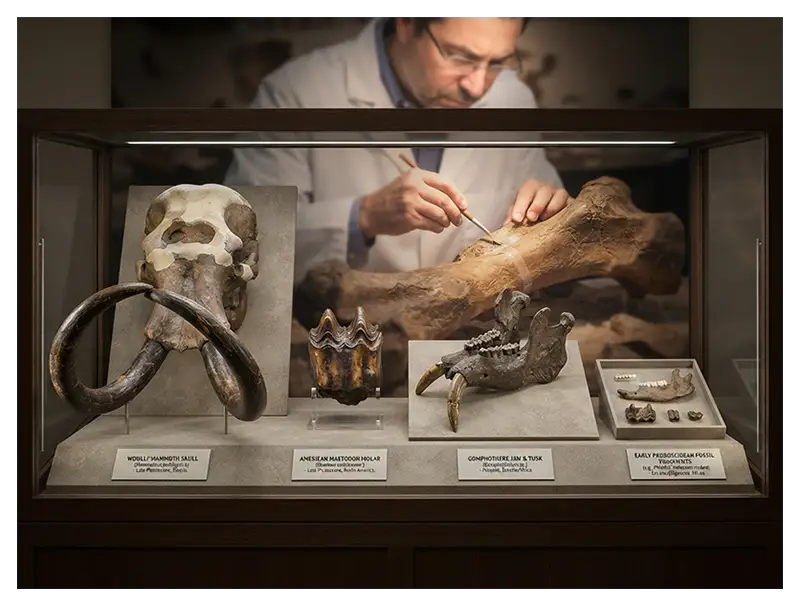
Proboscidean fossils include teeth, tusks, skulls, limb bones, and occasionally exceptionally preserved remains with soft tissues. These discoveries provide information about anatomy, growth, diet, migration, and the environments in which ancient animals lived.
Woolly mammoths preserved in permafrost
Frozen ground in parts of Siberia and other northern regions has preserved woolly mammoth remains with skin, hair, and other soft tissues. Such specimens are exceptionally valuable because most fossils preserve only hard structures.
These remains help researchers study the animals' bodies, adaptations to cold conditions, and, in some cases, genetic material. Ancient DNA has improved understanding of mammoth population history and relationships with living elephants.
American mastodon fossils
American mastodon remains have been found at numerous North American sites. Some localities preserve teeth and bones alongside plant material, allowing researchers to investigate feeding habits and habitats.
The mastodon's distinctive molars are especially useful for distinguishing it from mammoths. Associated evidence from sediments and vegetation can also help reconstruct the environments in which these animals lived.
Gomphothere fossils
Gomphothere fossils are important for studying the geographical spread of proboscideans. Their remains occur in several continents and include skulls, teeth, tusks, and other skeletal elements.
Some specimens preserve distinctive combinations of upper and lower tusks, while tooth structure helps scientists distinguish different lineages. These finds contribute to research on migration and the diversification of ancient herbivores.
Early proboscidean fossils
Fossils of early forms such as Eritherium and Phosphatherium are essential for studying the origins of Proboscidea. They provide evidence of anatomy from a time when the group looked very different from modern elephants.
Although early fossils are often less complete than spectacular mammoth specimens, they can be more important for understanding the evolutionary sequence of anatomical changes.
What fossils reveal
Proboscidean remains can reveal age, growth, diet, movement, and relationships between populations. Teeth record wear and chemical signals, while bones provide clues about body size and locomotion. Rare soft-tissue preservation and ancient DNA add further detail.
Every discovery has limitations. Fossilization is selective, and many species are known from incomplete remains. Paleontologists therefore compare multiple specimens and types of evidence before drawing conclusions about an extinct animal's biology.
Why Did Many Proboscideans Become Extinct?
Many proboscidean species disappeared over millions of years as climates changed, habitats shifted, and ecosystems were reorganized. Others survived until the late Pleistocene or early Holocene, when human expansion and environmental changes contributed to the decline of numerous large mammals.
There was no single extinction event that eliminated all proboscideans. Different lineages disappeared at different times and for different reasons. Some early groups vanished long before mammoths and mastodons appeared, while modern elephants survived into the present.
Climate and habitat change
Long-term climate changes altered the distribution of forests, woodlands, grasslands, and cold environments. Species adapted to particular habitats could lose access to suitable food or breeding areas as these environments changed.
For example, some mammoth populations depended on open landscapes that were transformed as climates warmed and vegetation patterns shifted. The effects varied by region, and not all mammoth populations disappeared at the same time.
Human hunting and land use
Humans hunted some proboscideans, and archaeological sites preserve evidence of interactions between people and these animals. Hunting may have contributed to the decline of certain populations, particularly when combined with environmental stress and slow reproductive rates.
The relative importance of human activity remains debated for individual species and regions. It is not scientifically accurate to attribute every proboscidean extinction to hunting alone.
Small populations and slow reproduction
Large mammals generally require substantial food resources and often reproduce more slowly than small mammals. When populations become fragmented or decline sharply, recovery can be difficult.
Reduced genetic diversity, limited access to mates, and increasing pressure from environmental changes can further threaten small populations. These factors may have compounded the difficulties faced by some late-surviving proboscideans.
Why some survived
Modern elephants survived because their lineages persisted through past environmental changes, but survival does not mean they are free from danger. Today, habitat destruction, poaching, conflict with people, and the fragmentation of populations threaten many elephant populations.
The extinction history of Proboscidea shows that evolutionary success is not permanent. Even animals that once occupied vast areas can disappear when environmental conditions and other pressures change faster than populations can adapt.
Conclusion
Proboscideans are an important group in mammalian evolution, encompassing modern elephants and many extinct relatives. From early forms such as Eritherium to mammoths, mastodons, and gomphotheres, their history reveals millions of years of anatomical change, migration, and ecological adaptation.
Their trunks, tusks, teeth, and large bodies developed in different ways across multiple evolutionary lineages. Fossils show how these animals fed, moved, and responded to changing environments, while comparisons between mammoths and mastodons demonstrate that similar-looking animals can have distinct evolutionary histories.
Many proboscidean lineages eventually disappeared as environments changed and, in some cases, human pressures increased. Modern elephants are the only surviving members of this once-diverse order, making their conservation important not only for living ecosystems but also for preserving the final branches of an ancient mammalian lineage.
Proboscideans belong to the mammalian order Proboscidea. Living members are African savanna elephants, African forest elephants, and Asian elephants. Extinct members include mammoths, mastodons, gomphotheres, and numerous earlier forms.
Proboscideans first appeared roughly 60 million years ago in Africa. Their early fossil record includes small, primitive forms, and the group diversified extensively during later geological periods.
Mammoth extinction varied by population and region. Climate and habitat changes, human hunting, and other pressures contributed to the disappearance of many populations. Some isolated mammoths survived until approximately 4,000 years ago.
Yes. The only living proboscideans are the two African elephant species and the Asian elephant. All other known members of the order are extinct.
No. Mammoths belonged to the genus Mammuthus in the family Elephantidae, while American mastodons belonged to the genus Mammut in the family Mammutidae. Their teeth and evolutionary relationships differ.