
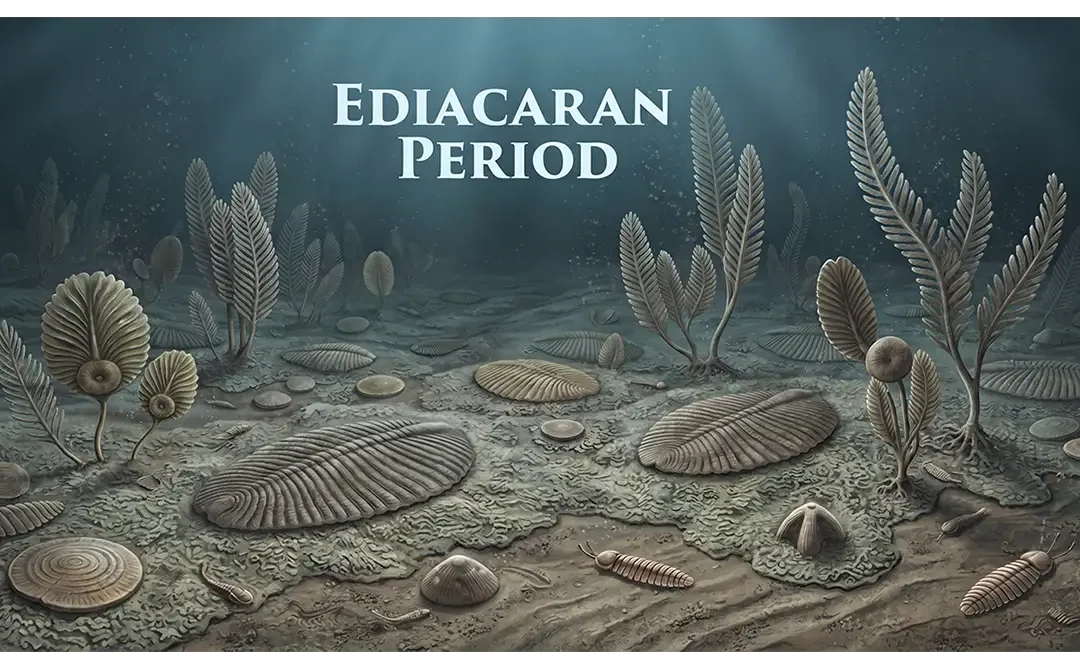
The Ediacaran Period represents one of the most fascinating chapters in Earth's history. During this time, ancient oceans supported a remarkable variety of large, soft-bodied organisms that differed greatly from most familiar animals living today. Their fossils preserve evidence of an important stage in the development of complex life before the Cambrian explosion.
Scientists study Ediacaran rocks to understand how early organisms developed, interacted with their environments, and responded to changing conditions in the oceans. Although the relationships between many Ediacaran organisms and modern animals remain uncertain, their discoveries have transformed our understanding of early life.
What Is the Ediacaran Period?
The Ediacaran Period is the final period of the Proterozoic Eon and the Neoproterozoic Era. It followed the Cryogenian Period and preceded the Cambrian Period, which began the Paleozoic Era. The Ediacaran is especially notable for the appearance and diversification of large, structurally complex organisms preserved in ancient marine sediments.
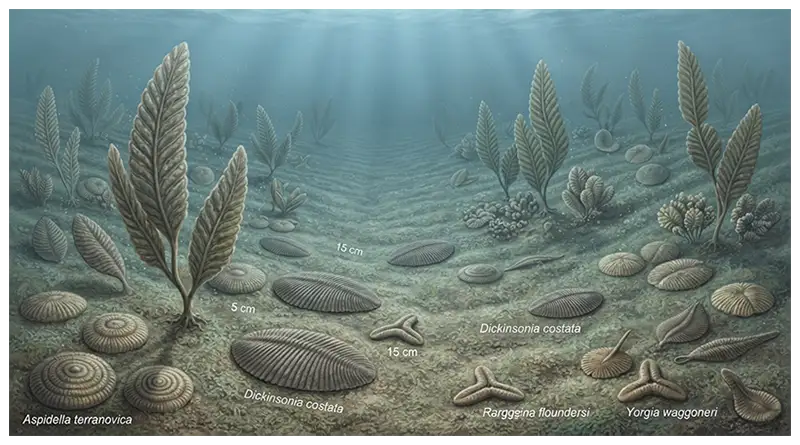
Unlike earlier records dominated by microscopic life, Ediacaran fossil deposits contain many organisms large enough to be seen without a microscope. Some had flattened, leaf-like bodies, while others displayed segmented, ribbed, circular, or irregular shapes. Many appear to have lived on or near the seafloor.
The name comes from the Ediacara Hills in South Australia, where important fossil discoveries helped establish the significance of this ancient biological community. Similar fossils have since been found in many other parts of the world, showing that these organisms were not restricted to one region.
The Ediacaran Period is important because it provides evidence of major changes in the size, organization, and ecological roles of organisms. Some fossils may represent early animals, while others could belong to extinct branches of life with no close living equivalents. Their exact relationships remain an active subject of scientific research.
When Did the Ediacaran Period Begin and End?
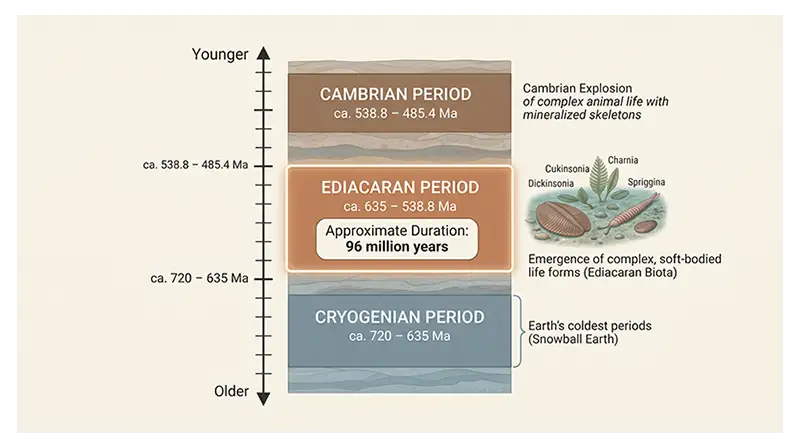
The Ediacaran Period lasted from approximately 635 million to 538.8 million years ago, spanning about 96 million years. These dates place it near the end of the Precambrian, the informal term for the vast stretch of Earth history before the Cambrian Period.
Its beginning is associated with the end of the Cryogenian Period and follows a time when Earth experienced major glaciations. The precise environmental history around this transition is complex, and the effects of earlier ice ages on later biological development continue to be investigated.
The end of the Ediacaran marks the boundary between the Ediacaran and Cambrian periods. This boundary is associated with changes in the fossil record, including the appearance of distinctive trace fossils and other evidence of increasingly complex animal activity.
The geological time scale divides Earth's history using evidence from rock layers, fossil assemblages, and radiometric dating. Scientists refine these divisions as new evidence becomes available, so numerical ages may be updated in future geological timescale revisions.
The Ediacaran is the youngest period of the Proterozoic Eon. It therefore occupies a critical position between the earlier history of mostly microscopic life and the later Cambrian diversification of animals with a richer fossil record.
What Was Earth Like During the Ediacaran Period?
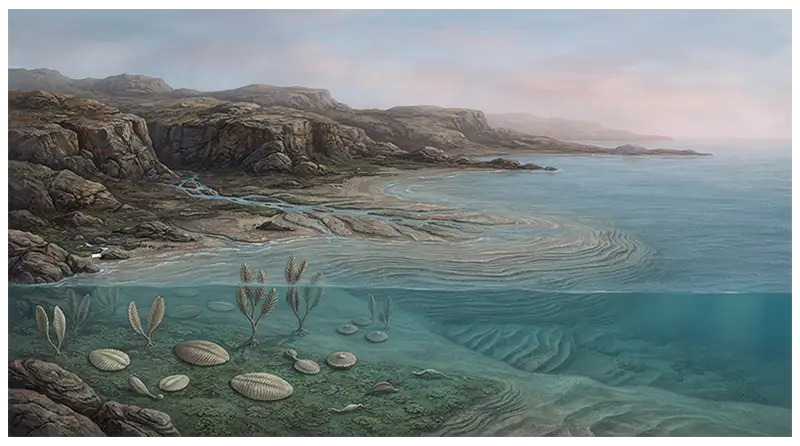
Earth underwent significant geological, climatic, and chemical changes during the Ediacaran Period. Continents were changing position, ocean basins were evolving, and seawater chemistry varied across different regions. These conditions influenced the environments available to early complex organisms.
Continents and oceans
The supercontinent Rodinia had broken apart before the Ediacaran began. During the period, continental fragments continued to move and reorganize, affecting coastlines, shallow seas, and sedimentary environments.
Many Ediacaran fossils are preserved in marine rocks formed in shallow-water settings. These environments included continental shelves and seafloors where fine sediment could accumulate around organisms. Some fossil deposits record deeper-water conditions as well, demonstrating that Ediacaran communities occupied varied marine environments.
Climate and glaciation
The Ediacaran followed the Cryogenian, a period known for extensive glaciations often called Snowball Earth events. Although major global glaciations had ended by the beginning of the Ediacaran, climatic and environmental conditions continued to change.
The postglacial world experienced changes in weathering, ocean circulation, and the delivery of nutrients to the sea. Scientists investigate whether these changes helped create conditions favorable for the development and spread of larger organisms. However, the relationship between climate shifts and biological diversification was not necessarily simple or uniform.
Oxygen and ocean chemistry
Oxygen availability was another important factor. Photosynthetic microorganisms had produced oxygen for billions of years, but oxygen concentrations varied across the oceans and through geological time. Some Ediacaran marine environments may have contained oxygenated bottom waters, while others remained oxygen-poor.
These differences could have influenced which organisms survived in particular habitats. Researchers use chemical signatures preserved in ancient rocks to reconstruct changes in oxygen levels and other aspects of seawater chemistry.
The Ediacaran environment was therefore not a single, unchanging setting. It consisted of diverse marine habitats shaped by shifting continents, climate, sedimentation, and ocean chemistry.
What Was the Ediacaran Biota?
The Ediacaran biota refers to the diverse assemblage of organisms known from Ediacaran fossil deposits, particularly those preserved before the widespread appearance of characteristic Cambrian animal fossils. Many members had soft bodies and unusual shapes that are rarely represented in the fossil record of modern ecosystems.
Some organisms resembled flattened discs, branching fronds, quilted cushions, or elongated segmented forms. Others had body plans that are difficult to compare directly with living animals. Many lacked obvious shells, bones, or other hard structures, making their preservation especially remarkable.
The term biota describes the organisms associated with a particular environment or time interval. It does not mean that all Ediacaran organisms belonged to one biological group. The assemblage probably included several unrelated lineages with different evolutionary histories.
Scientists have proposed different interpretations of their relationships. Certain fossils may represent early members of animal groups, while others have been interpreted as algae, microbial structures, extinct eukaryotes, or organisms belonging to lineages that left no clear modern descendants. Some classifications remain controversial because fossil impressions often preserve external form without revealing internal anatomy.
The Ediacaran biota is also important for understanding ancient ecosystems. Some organisms lived attached to the seafloor, others rested on sediment, and some may have moved or interacted with microbial communities. Together, these fossils reveal marine communities more structurally diverse than those known from many older deposits.
Rather than representing a single evolutionary stage, the Ediacaran biota records a varied biological world whose members experimented with body forms and ecological strategies before and during the early evolution of animals.
What Types of Organisms Lived During the Ediacaran Period?
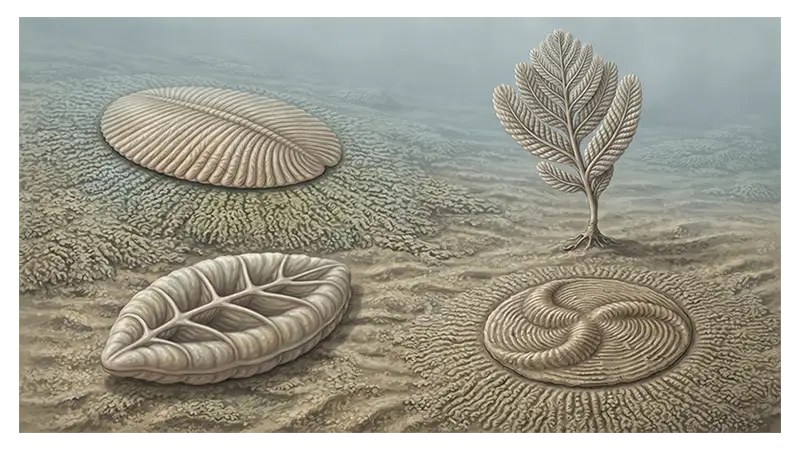
Ediacaran organisms varied greatly in size, shape, and possible lifestyle. Because many fossils preserve only soft-bodied impressions, scientists often classify them according to their physical form and distinctive features before assigning them to particular biological groups.
Frond-like organisms
Some organisms had upright, branching or leaf-shaped bodies attached to the seafloor. Their structures increased the area exposed to surrounding seawater, although their precise feeding strategies remain debated.
Several frond-like fossils have been interpreted as suspension feeders, absorbing or capturing food particles from the water. Other explanations have been proposed for some forms, and not every branching fossil necessarily shared the same lifestyle.
Segmented and quilted forms
Other organisms had elongated or oval bodies divided into repeated units or covered with quilt-like patterns. These features can resemble segmentation in modern animals, but similar external patterns do not automatically prove close evolutionary relationships.
Some quilted organisms may have possessed a distinctive body construction unlike that of living animals. Their internal organization is difficult to reconstruct because the fossils usually preserve surface outlines rather than complete anatomy.
Disc-shaped organisms
Circular and oval impressions are common in some Ediacaran deposits. These fossils may represent organisms that attached to the seafloor, rested on sediment, or formed parts of larger structures. However, some circular fossils may also be holdfasts, body impressions, or other structures rather than complete individual organisms.
Possible early animals
A number of Ediacaran fossils show characteristics that have led researchers to consider them possible animals. Dickinsonia, for example, has been the subject of detailed investigations into its body structure and biological affinity.
Other fossils may represent early relatives of animal groups that became more prominent in the Cambrian. Nevertheless, it is not possible to assign every Ediacaran organism confidently to a modern animal phylum.
Microorganisms and microbial communities
Microscopic organisms remained essential parts of Ediacaran ecosystems. Microbes formed mats on some seafloors and contributed to nutrient cycling and sediment processes. These mats may also have influenced how soft-bodied organisms interacted with the substrate and how their remains were preserved.
The Ediacaran world therefore included much more than large, unusual fossils. It contained complex interactions among microorganisms, soft-bodied organisms, and changing marine environments.
Which Famous Fossils Are Found in Ediacaran Rocks?
Several Ediacaran fossils have become important examples in paleontology because they illustrate the unusual body forms and uncertain evolutionary relationships of early complex organisms.
Dickinsonia
Dickinsonia is among the best-known Ediacaran fossils. It commonly appears as a flattened oval impression with a series of repeated, rib-like segments arranged along its body.
Its size varied, and some specimens reached substantial lengths. Researchers have examined its body symmetry, growth patterns, and chemical evidence to understand its biological identity. Some studies support an animal affinity, but interpretations of Ediacaran organisms should be evaluated in light of continuing research.
Charnia
Charnia had a branching, frond-like form resembling a feather. Its fossils are especially important because they helped demonstrate that complex, large-bodied organisms existed long before the Cambrian Period.
The organism is generally interpreted as having lived attached to the seafloor. Its branching structure may have helped it interact with surrounding water, but the precise way it obtained nutrients remains uncertain.
Spriggina
Spriggina is an elongated fossil with a series of repeated body units and a distinctive front region. Its appearance has led to comparisons with several types of animals, including arthropods, but its exact classification remains debated.
It is an important example of why superficial resemblance does not always reveal evolutionary relationships. Without clear evidence of diagnostic anatomy, researchers must consider several possible interpretations.
Kimberella
Kimberella is often discussed in connection with the early evolution of animals. Its body shape and associated marks in sediment have led some researchers to suggest that it moved across microbial mats and may have grazed on them.
It is commonly interpreted as a possible bilaterian animal, although details of its anatomy and relationships continue to be studied. Its fossils provide valuable clues about how some organisms may have interacted with the seafloor.
Rangea
Rangea is a branching, frond-like organism known from Ediacaran fossil deposits. Its complex structure illustrates the diversity of body forms that developed during this period.
Like other frondose fossils, it is generally interpreted as a seafloor organism, but the details of its feeding method and biological classification remain uncertain.
These examples demonstrate why Ediacaran fossils are scientifically valuable. They preserve a wide range of body structures and provide evidence for biological experimentation during a critical interval in Earth's history.
How Did Ediacaran Organisms Live and Feed?
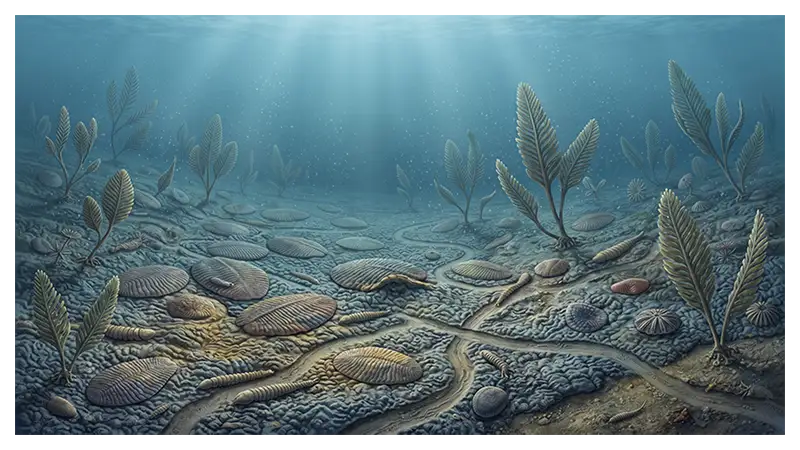
The lifestyles of Ediacaran organisms varied, and scientists reconstruct them by examining fossil shapes, the surrounding sediment, trace fossils, and the geological setting in which remains were preserved.
Many known forms lived on or near the seafloor. Some were attached to the substrate, while others rested directly on sediment. The orientation of fossils, their attachment structures, and the nature of surrounding rocks can help researchers infer whether organisms lived upright, lay flat, or occupied other positions.
Feeding strategies
Several feeding methods have been proposed for Ediacaran organisms. Some may have absorbed dissolved nutrients from seawater or obtained nourishment through associations with microorganisms. Others may have captured suspended particles or grazed on microbial mats.
The feeding habits of individual species are not always clear. An organism's external shape can suggest possible functions, but researchers must be cautious about assuming that an unfamiliar body operated like a modern animal with a similar appearance.
Movement and interaction
Evidence suggests that some Ediacaran organisms were capable of movement. Trace fossils, including surface trails and other marks in sediment, help scientists investigate how organisms traveled across ancient seafloors. Kimberella and associated feeding traces have been discussed as possible evidence of grazing behavior.
However, many Ediacaran organisms probably had limited movement or remained attached to the substrate for at least part of their lives. Different species would have occupied different ecological roles.
Early ecosystem structure
Ediacaran communities were not necessarily organized like modern marine ecosystems. Microbial mats were widespread in some environments, and the ecological influence of burrowing animals was generally less extensive than it became in many Cambrian settings.
By studying the arrangement of fossils and their relationships with sedimentary structures, paleontologists can investigate how organisms shared space and resources. These observations provide clues about the emergence of increasingly complex marine ecosystems.
How Are Ediacaran Fossils Preserved and Studied?
The preservation of Ediacaran fossils is remarkable because many of the organisms lacked shells, bones, or other durable hard parts. Their remains would normally decay quickly, leaving little evidence in the geological record.
Preservation of soft-bodied organisms
Some Ediacaran fossils were preserved as impressions on the surfaces of sandstone or other sedimentary rocks. When an organism rested on or became buried beneath sediment, its body outline could leave a recognizable impression.
Rapid burial, sediment characteristics, and microbial processes may have contributed to preservation in certain deposits. In some settings, microbial mats helped stabilize sediment surfaces or influenced the interaction between decaying tissues and minerals. The exact mechanisms differed among fossil sites.
Soft-bodied preservation does not mean that every fossil retained its original tissues. Many specimens preserve external outlines, surface textures, or casts rather than the original biological material.
Fossil discovery and excavation
Paleontologists locate Ediacaran fossils by examining exposed rock layers, geological maps, and previously documented fossil sites. Fieldwork involves recording the position and orientation of specimens, photographing rock surfaces, and collecting samples where permitted.
Researchers must document the geological context because the surrounding rocks provide information about the environment in which organisms lived and were buried. Removing a fossil without recording its location can destroy important scientific evidence.
Modern research methods
Scientists use several approaches to study Ediacaran fossils, including high-resolution photography, microscopy, three-dimensional surface scanning, chemical analysis, and comparisons with other fossils.
Radiometric dating of suitable rocks can help establish the ages of fossil-bearing layers. Researchers also analyze sedimentary structures and chemical signatures to reconstruct environmental conditions.
New discoveries and analytical techniques can change interpretations of individual species. This is especially important for fossils whose anatomy does not clearly match living organisms. Scientific classifications are therefore refined as new evidence becomes available.
Why Did the Ediacaran Biota Decline or Disappear?
one of the major questions in early animal evolution. The evidence does not support a simple explanation in which every Ediacaran organism vanished during one clearly defined global extinction event.
Several environmental and biological changes may have contributed to the transition.
Environmental change
Changes in ocean oxygenation, seawater chemistry, sedimentation, and climate could have affected the habitats occupied by Ediacaran organisms. Conditions varied among marine regions, so environmental pressures would not necessarily have affected every community in the same way.
Some organisms may have been particularly sensitive to changes in oxygen availability or the stability of seafloor environments. However, linking a particular environmental event to the disappearance of a specific group requires evidence from the relevant fossil deposits.
Ecological changes
The spread of animals that moved through sediment, grazed on microbial mats, or interacted with other organisms may have altered Ediacaran ecosystems. Increased disturbance of the seafloor could have affected organisms that depended on relatively stable surfaces.
Predation has also been proposed as a possible factor in the transition to Cambrian ecosystems. Yet the extent to which predation caused the decline of Ediacaran forms remains uncertain, and it should not be treated as a complete explanation.
Evolutionary turnover
The end of the Ediacaran was followed by the Cambrian Period, when the fossil record shows increasing diversity among animals with recognizable hard parts and more complex trace fossils. Some biological lineages may have survived across the boundary, while others declined or disappeared.
The transition probably involved a combination of environmental change, ecological reorganization, evolutionary innovation, and differences in fossil preservation. Continued discoveries may clarify how these processes interacted.
How Did the Ediacaran Period Lead Into the Cambrian Explosion?
The Ediacaran Period preceded the Cambrian Period, when many major animal groups became more visible and diverse in the fossil record. This interval is often associated with the Cambrian explosion, a period of substantial evolutionary diversification that began around 539 million years ago.
The term does not mean that complex animals appeared suddenly without earlier history. Instead, it describes a comparatively rapid expansion in the diversity of animal forms, including organisms with mineralized skeletons and a wider range of body structures.
Changes in animal diversity
During the Ediacaran, many large organisms had soft bodies and unusual forms. In the Cambrian, fossils increasingly record animals with hard parts such as shells, along with diverse body plans and evidence of active movement.
Hard tissues are more likely to survive fossilization than soft tissues, so part of the apparent change reflects preservation. Nevertheless, fossil and geological evidence indicates that important biological diversification also occurred.
Changes in seafloor ecosystems
The Cambrian fossil record includes evidence of more extensive burrowing and sediment disturbance by animals. Such activity altered the structure of marine environments and the relationships among organisms living on or within the seafloor.
These changes differed from the microbial-mat-dominated surfaces found in many Ediacaran settings. The shift helped establish new ecological conditions in which organisms interacted with sediment and one another in increasingly varied ways.
Did Ediacaran organisms become Cambrian animals?
Some Ediacaran organisms may be related to lineages that continued into the Cambrian, but the evolutionary relationships of many forms remain unresolved. It is therefore inaccurate to claim that all Ediacaran organisms directly evolved into modern animal groups.
The relationship between the two periods is best understood as a transition involving both continuity and change. The Ediacaran preserves evidence of early complex communities, while the Cambrian records a major expansion in recognizable animal diversity and ecological complexity.
Why Is the Ediacaran Period Important to Earth's History?
The Ediacaran Period is essential to understanding how life developed from earlier microbial ecosystems into communities containing large, complex organisms. Its fossils reveal that substantial biological diversity existed before the Cambrian explosion.
One major contribution is the evidence for early large-bodied life. Ediacaran fossils demonstrate that organisms could develop distinctive shapes and occupy a range of marine habitats long before many familiar animal groups became common in the fossil record.
The period also helps scientists investigate the evolution of animal body plans. Some fossils may represent early animals or relatives of later groups, while others belong to lineages whose relationships remain uncertain. Comparing these forms allows researchers to test hypotheses about the origins of major evolutionary innovations.
Ediacaran rocks also preserve clues about environmental change. Their sediments and chemical signatures help researchers reconstruct ancient oceans, oxygen availability, and the interactions between living organisms and their surroundings.
Finally, the Ediacaran Period illustrates an important principle of paleontology: the history of life cannot be understood from living organisms alone. Extinct forms may have possessed combinations of features that no longer exist today. Studying them reveals that evolution has produced a much wider variety of biological structures and ecological strategies than the modern world alone might suggest.
Conclusion
The Ediacaran Period, lasting from approximately 635 to 538.8 million years ago, records a remarkable stage in Earth's biological history. Its oceans supported diverse organisms with unusual body forms, including frond-like, segmented, and disc-shaped varieties. Many were soft-bodied, allowing them to be preserved only under particular geological conditions.
Fossils such as Dickinsonia, Charnia, Spriggina, Kimberella, and Rangea provide valuable evidence of this ancient world, although the evolutionary relationships of several forms remain debated. Environmental changes, biological interactions, and evolutionary diversification shaped the transition into the Cambrian Period.
By examining Ediacaran fossils and the rocks that preserve them, scientists continue to investigate the emergence of complex life and the origins of the ecosystems that would develop in later geological periods.
Frequently Asked Questions (FAQs)
The Ediacaran Period is best known for its diverse assemblages of large, mostly soft-bodied organisms preserved in rocks dating from approximately 635 to 538.8 million years ago. These fossils provide important evidence of complex life before the Cambrian explosion.
Some Ediacaran organisms are considered possible animals, but the classification of many remains uncertain. Their fossils often preserve external shapes without enough anatomical detail to establish clear relationships with modern animal groups.
Dickinsonia is one of the most famous Ediacaran fossils. It has a flattened, oval body with repeated rib-like segments and has been extensively studied to determine its biological identity.
No. Dinosaurs appeared hundreds of millions of years later, during the Mesozoic Era. The Ediacaran Period ended about 539 million years ago, long before the first dinosaurs evolved.
The Ediacaran Period was the final period of the Proterozoic Eon and is known for diverse early complex organisms, many of them soft-bodied. The Cambrian Period followed it and records a major diversification of animals, including many with mineralized skeletons and increasingly varied body plans.