
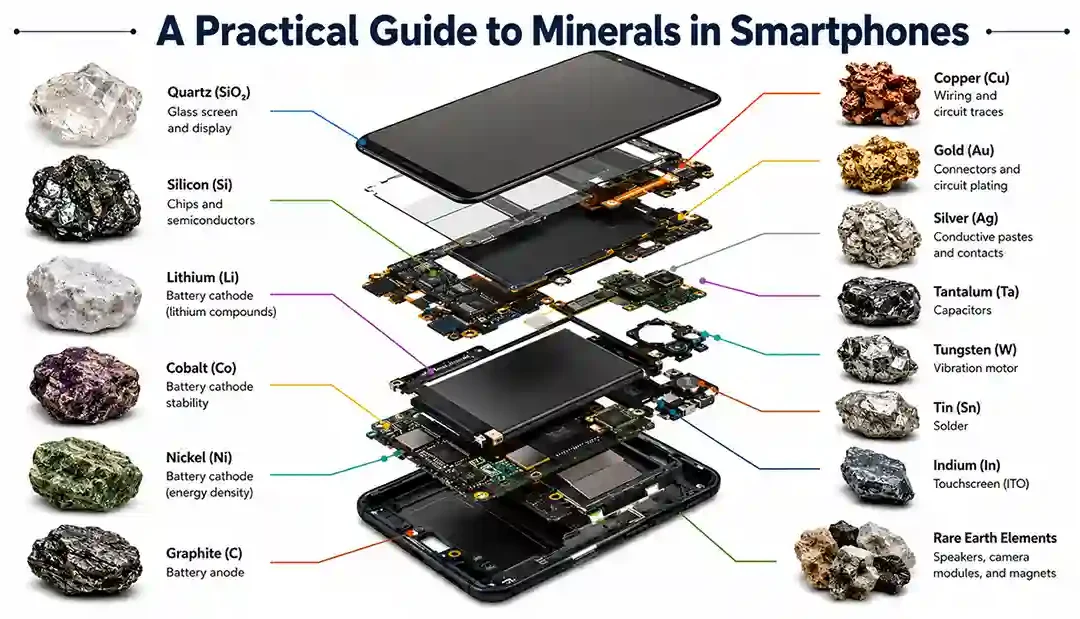
A modern smartphone is much more than glass, plastic, and metal. Hidden inside every device are dozens of minerals and chemical elements that make communication, photography, navigation, and computing possible. From the battery and touchscreen to the processor and speakers, nearly every component depends on minerals extracted from Earth's crust.
The average smartphone contains more than 60 different chemical elements, many of which originate from economically important minerals. Some are abundant, while others—such as rare earth elements and tantalum—are considered critical minerals because of their limited supply and growing demand.
Understanding the minerals used in smartphones highlights the connection between geology, mining, materials science, and modern technology.
This topic should be studied together with Rare Earth Minerals, Critical Minerals, and Mineralogy.
Why Smartphones Depend on Minerals
Each smartphone component requires materials with unique physical and chemical properties.
Minerals provide:
- Electrical conductivity
- Heat resistance
- Magnetic properties
- Energy storage
- Optical transparency
- Mechanical strength
- Corrosion resistance
Without these materials, smartphones would not function.
Major Minerals Used in Smartphones
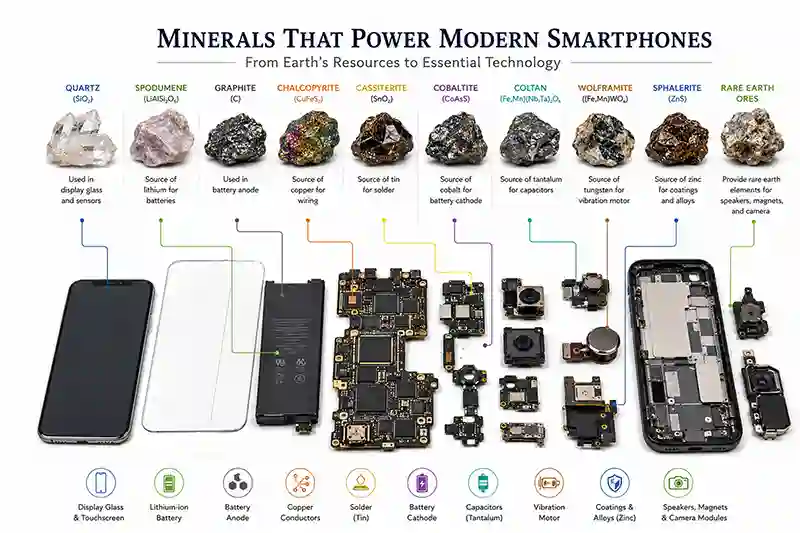
Quartz
Quartz is the primary source of silicon.
Uses:
- Semiconductor chips
- Glass manufacturing
- Timing crystals
Importance:
Silicon chips are the brain of every smartphone.
Lithium Minerals
Common sources:
- Spodumene
- Lepidolite
Uses:
- Rechargeable lithium-ion batteries
Importance:
Lithium provides lightweight, high-energy storage.
Cobalt Minerals
Common sources:
- Cobaltite
- Heterogenite
Uses:
- Battery cathodes
Importance:
Improves battery stability and lifespan.
Graphite
Uses:
- Battery anodes
Importance:
Stores and releases electrical energy during charging.
Nickel Minerals
Uses:
- Battery chemistry
- Stainless steel components
Importance:
Increases battery energy density.
Copper Minerals
Common sources:
- Chalcopyrite
- Bornite
Uses:
- Electrical wiring
- Printed circuit boards
- Charging systems
Importance:
Excellent electrical conductor.
Gold
Uses:
- Electrical contacts
- Connectors
- Circuit boards
Importance:
Highly conductive and corrosion-resistant.
Silver
Uses:
- Electrical circuits
- Contacts
Importance:
Highest electrical conductivity among metals.
Tin
Common source:
- Cassiterite
Uses:
- Solder for electronic components
Importance:
Joins electronic circuits securely.
Tantalum
Common source:
- Columbite-Tantalite (Coltan)
Uses:
- Capacitors
Importance:
Stores electrical charge in compact spaces.
Tungsten
Common source:
- Wolframite
- Scheelite
Uses:
- Vibration motor weights
Importance:
Very high density.
Indium
Common source:
- Sphalerite (as a by-product)
Uses:
- Indium Tin Oxide (ITO)
- Touchscreens
Importance:
Transparent electrical conductor.
Rare Earth Minerals
Important elements:
- Neodymium
- Dysprosium
- Praseodymium
- Terbium
Uses:
- Speakers
- Microphones
- Camera autofocus
- Vibration motors
Importance:
Produce powerful permanent magnets.
Other Important Minerals
Additional minerals include:
- Feldspar (glass production)
- Calcite (glass manufacturing)
- Fluorite (chemical processing)
- Barite (industrial applications)
- Rutile (titanium source)
Minerals by Smartphone Component
| Smartphone Component | Main Minerals |
|---|---|
| Screen | Quartz, Feldspar, Indium |
| Processor | Quartz (Silicon) |
| Battery | Lithium, Cobalt, Nickel, Graphite |
| Wiring | Copper |
| Circuit Board | Gold, Silver, Copper, Tin |
| Capacitors | Tantalum |
| Speakers | Rare Earth Elements |
| Vibration Motor | Tungsten |
| Camera Module | Rare Earth Elements, Silicon |
From Mine to Smartphone
The journey of smartphone minerals involves several stages:
- Mineral exploration
- Mining
- Ore processing
- Metal refining
- Component manufacturing
- Smartphone assembly
- Consumer use
- Recycling
Each stage adds value before the finished device reaches consumers.
Environmental Challenges
Mining minerals for smartphones presents several challenges.
These include:
- Habitat disturbance
- Energy consumption
- Water use
- Tailings management
- Carbon emissions
- Electronic waste (e-waste)
Responsible mining and recycling help reduce these impacts.
Recycling Smartphone Minerals
Many valuable materials can be recovered from discarded phones.
Recovered materials include:
- Gold
- Silver
- Copper
- Cobalt
- Nickel
- Rare earth elements
Urban mining reduces pressure on natural mineral resources.
Geological Importance
Understanding smartphone minerals helps geologists:
- Locate critical mineral deposits
- Improve resource management
- Support sustainable mining
- Develop recycling technologies
- Meet growing demand for clean technologies
Critical mineral exploration has become one of the fastest-growing fields in economic geology.
Laboratory Investigation
Scientists study smartphone minerals using:
- X-Ray Diffraction (XRD)
- X-Ray Fluorescence (XRF)
- Scanning Electron Microscopy (SEM)
- Electron Probe Microanalysis (EPMA)
- Inductively Coupled Plasma Mass Spectrometry (ICP-MS)
- Raman Spectroscopy
These techniques identify mineral composition, purity, and trace elements.
Applications
Understanding smartphone minerals is important in:
- Economic Geology
- Mineral Exploration
- Mining Engineering
- Materials Science
- Electronics Manufacturing
- Environmental Science
- Recycling Technology
- Sustainable Development
Advantages of Studying Smartphone Minerals
Studying smartphone minerals helps scientists and engineers:
- Develop better batteries
- Discover new mineral resources
- Improve recycling efficiency
- Reduce environmental impacts
- Support critical mineral supply chains
- Advance future electronics
Limitations
Despite their importance, smartphone minerals present several challenges:
- Many critical minerals are concentrated in a few countries.
- Some minerals face supply-chain risks.
- Recycling rates remain relatively low for several valuable elements.
- Growing demand for electronic devices increases pressure on mining operations.
For a broader understanding, study this topic together with:
- Economic Minerals
- Critical Minerals
- Rare Earth Minerals
- Mineral Resources
- Sustainable Mining
- Mineral Recycling
- Environmental Geology
- Mineralogy
Comparison Table
| Mineral | Smartphone Use | Example Source Mineral |
| Quartz | Silicon chips, Glass | Quartz |
| Lithium | Battery | Spodumene |
| Graphite | Battery anode | Graphite |
| Cobalt | Battery cathode | Cobaltite |
| Copper | Wiring | Chalcopyrite |
| Gold | Electrical contacts | Native Gold |
| Tin | Solder | Cassiterite |
| Tantalum | Capacitors | Columbite-Tantalite |
| Tungsten | Vibration motor | Wolframite |
| Indium | Touchscreen | Sphalerite |
Summary Table
| Feature | Minerals in Smartphones |
| Main Purpose | Build Electronic Components |
| Key Minerals | Quartz, Lithium, Copper, Gold, Tantalum, Graphite |
| Critical Materials | Rare Earth Elements, Cobalt, Lithium |
| Study Methods | XRD, XRF, SEM, ICP-MS |
| Geological Importance | Critical Mineral Exploration and Sustainable Mining |
A typical smartphone contains materials derived from more than 60 chemical elements, sourced from numerous minerals such as quartz, spodumene, graphite, chalcopyrite, cassiterite, and columbite-tantalite.
Lithium-bearing minerals such as spodumene supply lithium, while graphite, cobalt, and nickel are also essential battery materials.
Gold is highly conductive and resists corrosion, making it ideal for electrical contacts and connectors.
Rare earth elements are used to manufacture powerful magnets found in speakers, microphones, vibration motors, and camera autofocus systems.
Yes. Valuable materials such as gold, copper, silver, cobalt, nickel, and some rare earth elements can be recovered from discarded smartphones through recycling.
Final Thoughts
Smartphones are remarkable examples of how geology supports modern technology. Every device depends on a wide range of minerals that provide conductivity, energy storage, strength, and precision. From quartz-derived silicon chips and lithium-ion batteries to gold connectors and rare earth magnets, these natural resources make today's mobile devices possible.
As demand for smartphones and other electronic devices continues to grow, responsible mining, efficient recycling, and sustainable management of critical minerals will become increasingly important. Understanding the geology behind smartphones helps connect everyday technology with the Earth's mineral wealth.
Continue Learning
Continue exploring related topics: