
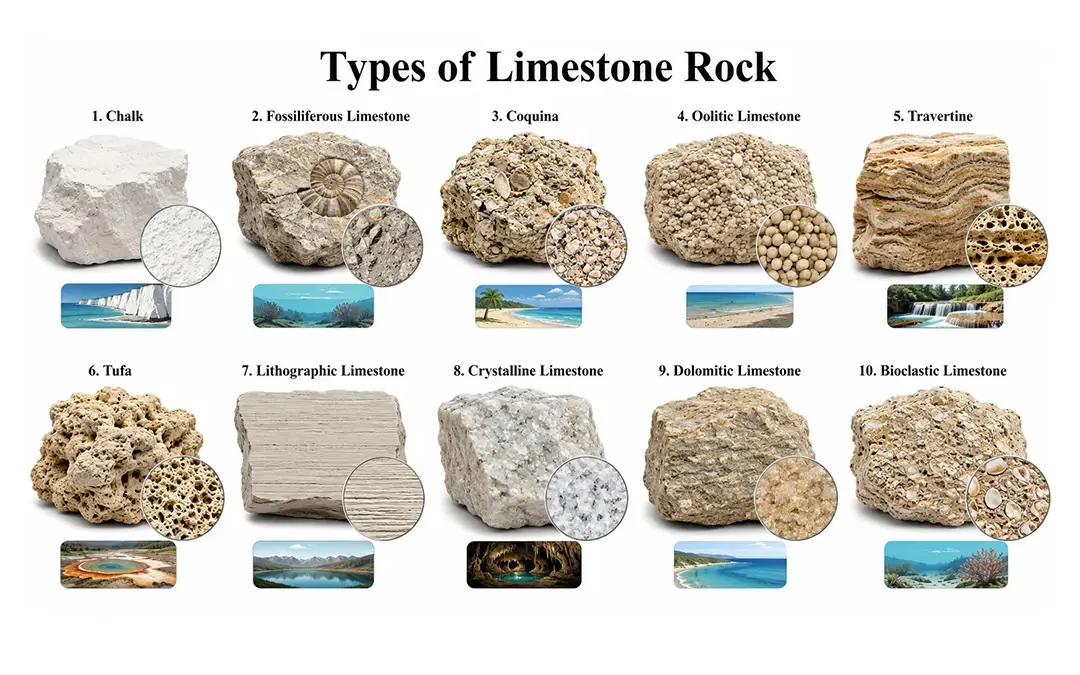
Limestone is one of the most common sedimentary rocks on Earth, yet many people are surprised to learn that it comes in many different varieties. Some limestones are made almost entirely of ancient marine fossils, while others form from mineral-rich spring water or tiny spherical grains deposited in shallow seas.
Understanding the types of limestone rock helps geologists reconstruct ancient environments, identify valuable building materials, and even locate groundwater and petroleum reservoirs. In this guide, you'll learn how limestone is classified, what makes each type unique, and where each variety is commonly found.
What Is Limestone?
Limestone is a sedimentary rock composed primarily of calcite (CaCO₃). It usually forms in warm, shallow marine environments where shells, corals, algae, and microscopic organisms accumulate over millions of years.
Read our full article about Limestone
Major Types of Limestone Rock
1. Chalk
Chalk is a soft, white limestone made from microscopic marine organisms called coccolithophores.
Characteristics
- Fine-grained
- Bright white
- Soft and porous
- Easily scratched
Formation
Forms from millions of tiny plankton skeletons that settle on the ocean floor.
Common Uses
- Classroom chalk (historically)
- Cement production
- Agriculture
- Soil treatment
2. Fossiliferous Limestone
Fossiliferous limestone contains abundant visible fossils such as shells, corals, brachiopods, and crinoids.
Characteristics
- Rich fossil content
- Medium to coarse texture
- Gray to cream color
- Excellent for studying ancient life
Formation
Develops where marine organisms accumulate rapidly in shallow seas.
Common Uses
- Decorative stone
- Museum displays
- Geological research
- Construction stone
3. Coquina
Coquina consists almost entirely of loosely cemented shell fragments.
Characteristics
- Highly porous
- Coarse texture
- Visible shell pieces
- Lightweight
Formation
Forms on beaches with high wave energy where shells accumulate.
Uses
- Historic building stone
- Landscaping
- Decorative rock
4. Oolitic Limestone
Oolitic limestone is composed of tiny rounded grains called ooids.
Characteristics
- Uniform spherical grains
- Fine to medium texture
- Cream or light gray
- Attractive appearance
Formation
Forms in warm, shallow tropical seas where calcium carbonate coats tiny particles.
Uses
- Building stone
- Architecture
- Dimension stone
5. Travertine
Travertine forms when calcium-rich groundwater deposits calcite around springs and waterfalls.
Characteristics
- Layered structure
- Natural cavities
- Cream, tan, or brown colors
- Decorative appearance
Formation
Precipitated from mineral-rich freshwater.
Uses
- Floor tiles
- Countertops
- Wall cladding
- Landscaping
6. Tufa
Tufa is a lightweight, porous limestone that forms in freshwater lakes and streams.
Characteristics
- Highly porous
- Soft
- Irregular texture
- Light-colored
Formation
Created when dissolved calcium carbonate precipitates around aquatic plants and algae.
Uses
- Garden landscaping
- Decorative stone
7. Lithographic Limestone
Lithographic limestone is an extremely fine-grained limestone with a smooth, uniform texture.
Characteristics
- Dense
- Fine-grained
- Homogeneous
- High-quality surface
Formation
Deposited in calm, low-energy environments.
Uses
- Historic printing plates
- Precision carving
- Decorative stone
8. Crystalline Limestone
Crystalline limestone has undergone partial recrystallization without becoming true marble.
Characteristics
- Interlocking calcite crystals
- Dense texture
- Low fossil visibility
- Sparkling appearance
Formation
Develops through diagenesis or mild metamorphic alteration.
Uses
- Construction
- Decorative stone
9. Dolomitic Limestone
Dolomitic limestone contains significant amounts of the mineral dolomite.
Characteristics
- Harder than pure limestone
- Less reactive with weak acid
- Gray or tan color
- More resistant to weathering
Formation
Forms when magnesium-rich fluids replace part of the calcite.
Uses
- Road aggregate
- Cement
- Construction
- Industrial minerals
10. Bioclastic Limestone
Bioclastic limestone is made from broken fragments of marine organisms.
Characteristics
- Fossil fragments
- Variable grain size
- Marine origin
- Often well cemented
Formation
Produced by waves and currents breaking shells and skeletal material.
Uses
- Building stone
- Geological studies
Where Are Different Limestone Types Found?
Different varieties occur in different geological settings:
- Chalk — England, France, Denmark
- Travertine — Italy, Turkey, Yellowstone National Park
- Oolitic limestone — Bahamas, Florida, England
- Coquina — Florida, Caribbean coastlines
- Fossiliferous limestone — Found worldwide in ancient shallow marine deposits
- Tufa — Freshwater lakes and springs across many regions
Final Thoughts
The types of limestone rock reveal the remarkable diversity of Earth's sedimentary environments. From fossil-rich marine deposits and tropical ooid shoals to freshwater travertine terraces and porous coquina beaches, each variety records a different chapter of geological history. Recognizing these limestone types helps geologists interpret past environments, supports resource exploration, and guides the selection of suitable construction materials.