

Metasomatism is the process by which the chemical composition of a rock changes due to the addition or removal of elements by chemically active fluids. Unlike ordinary metamorphism, which mainly changes a rock's mineralogy through heat and pressure, metasomatism involves the movement of fluids that transport dissolved ions into or out of rocks, producing entirely new mineral assemblages.
Metasomatism commonly occurs near igneous intrusions, hydrothermal systems, subduction zones, and metamorphic terrains. It plays a major role in forming skarn deposits, serpentinized ultramafic rocks, greisen deposits, and many economically important ore deposits containing copper, tungsten, tin, gold, iron, and rare metals.
Understanding metasomatism is fundamental to mineralogy, metamorphic petrology, economic geology, hydrothermal geology, and geochemistry.
This topic should be studied together with Hydrothermal Alteration, Mineral Alteration Processes, Hydrothermal Minerals, and Mineral Veins Explained.
What Is Metasomatism?
Metasomatism is the chemical alteration of a rock caused by fluid-rock interaction.
During metasomatism:
- Fluids move through fractures and pores.
- Chemical elements dissolve and migrate.
- New minerals crystallize.
- Original minerals are replaced.
- The rock's chemical composition changes.
Unlike simple recrystallization, metasomatism involves a gain or loss of chemical components.
How Metasomatism Occurs
The general process includes:
- Hot fluids are generated by magma, metamorphism, or groundwater circulation.
- Fluids migrate through fractures, faults, and permeable rocks.
- Dissolved ions react with existing minerals.
- Some elements are removed while others are added.
- New mineral assemblages develop.
- Altered rocks record the chemical changes.
This process may continue through multiple episodes of fluid flow.
Sources of Metasomatic Fluids
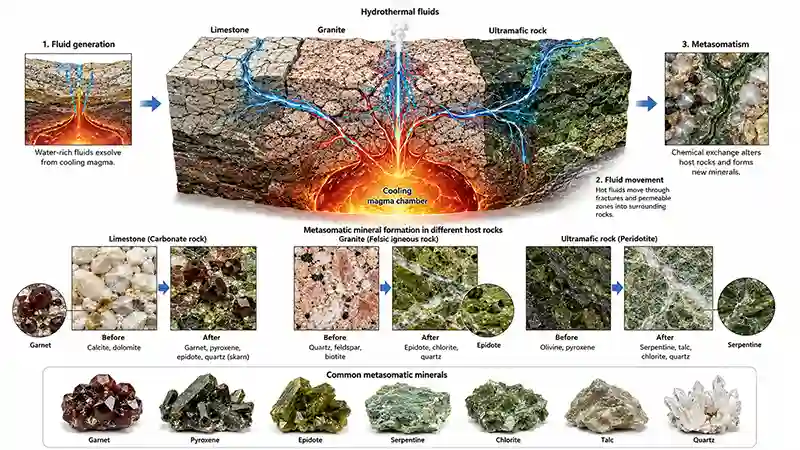
Metasomatic fluids may originate from:
- Cooling magma
- Metamorphic dehydration
- Deep groundwater
- Seawater circulation
- Basin brines
These fluids commonly carry:
- Silica
- Calcium
- Potassium
- Sodium
- Magnesium
- Iron
- Boron
- Fluorine
- Carbon dioxide
Types of Metasomatism
Contact Metasomatism
Occurs near igneous intrusions.
Characteristics:
- High temperatures
- Intense fluid circulation
- Formation of skarn deposits
Hydrothermal Metasomatism
Produced by hot hydrothermal fluids.
Common alteration types include:
- Silicification
- Sericitization
- Chloritization
- Carbonatization
- Albitization
Regional Metasomatism
Occurs over large areas during regional metamorphism. Often associated with deep crustal fluid movement.
Ocean-Floor Metasomatism
Occurs where seawater circulates through oceanic crust.
Produces:
- Chlorite
- Epidote
- Actinolite
Mantle Metasomatism
Occurs in Earth's mantle.
Fluids or melts enrich mantle rocks with:
- Potassium
- Water
- Carbon dioxide
- Rare elements
Mantle metasomatism influences later magma generation.
Common Metasomatic Minerals
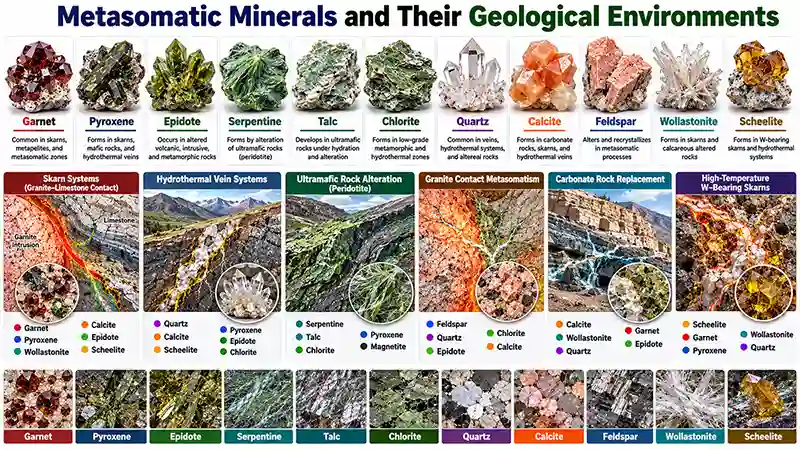
Garnet
Common in skarn deposits.
Forms where calcium-rich rocks react with silica-rich fluids.
Pyroxene
Often develops alongside garnet in skarns.
Epidote
Forms during hydrothermal alteration and regional metamorphism.
Serpentine
Produced by hydration of ultramafic rocks. Common during serpentinization.
Talc
Forms when magnesium-rich rocks react with silica-rich fluids.
Chlorite
One of the most widespread hydrothermal alteration minerals.
Quartz
Silica-rich fluids commonly deposit quartz during metasomatism.
Calcite
Carbon dioxide-rich fluids frequently produce calcite alteration.
Feldspar
Sodium-rich fluids may replace original minerals with albite (albitization). Potassium-rich fluids may produce potassium feldspar (potassic alteration).
Accessory Metasomatic Minerals
Other important metasomatic minerals include:
- Wollastonite
- Vesuvianite
- Tremolite
- Actinolite
- Magnetite
- Tourmaline
- Fluorite
- Scheelite
- Cassiterite
These minerals commonly occur in skarns and hydrothermal ore systems.
Major Types of Metasomatic Alteration
Several characteristic alteration styles occur in hydrothermal systems.
| Alteration Type | Dominant Minerals |
|---|---|
| Silicification | Quartz |
| Potassic Alteration | K-Feldspar, Biotite |
| Sericitization | Sericite |
| Chloritization | Chlorite |
| Carbonatization | Calcite, Dolomite |
| Albitization | Albite |
| Serpentinization | Serpentine |
| Greisenization | Quartz, Muscovite, Topaz |
These alteration styles help geologists identify ore-forming systems.
Metasomatism and Ore Deposits
Metasomatism plays a major role in forming many mineral deposits.
Common deposit types include:
- Skarn deposits
- Porphyry copper deposits
- Greisen deposits
- Iron oxide deposits
- Gold-bearing hydrothermal systems
- Tungsten deposits
- Tin deposits
Many valuable ore minerals crystallize during metasomatic alteration.
Geological Importance
Metasomatism helps geologists:
- Understand fluid-rock interaction
- Reconstruct hydrothermal systems
- Interpret metamorphic evolution
- Identify mineral exploration targets
- Study crustal chemical evolution
- Explain mineral replacement processes
It links metamorphism, hydrothermal activity, and ore formation.
Laboratory Identification
Metasomatic rocks are studied using:
- Petrographic Microscopy
- X-Ray Diffraction (XRD)
- Electron Microprobe Analysis (EPMA)
- Scanning Electron Microscopy (SEM)
- Fluid inclusion analysis
- Stable isotope geochemistry
- X-Ray Fluorescence (XRF)
- Whole-rock geochemistry
These techniques identify mineral replacement, fluid chemistry, and alteration history.
Applications
Metasomatism studies are important in:
- Mineralogy
- Metamorphic Petrology
- Economic Geology
- Hydrothermal Geology
- Geochemistry
- Mining Exploration
- Structural Geology
- Environmental Geology
Advantages of Studying Metasomatism
Studying metasomatism helps scientists:
- Discover ore deposits
- Understand hydrothermal systems
- Interpret fluid evolution
- Reconstruct metamorphic histories
- Improve mineral exploration
- Explain large-scale chemical changes in Earth's crust
Limitations
Studying metasomatism may be challenging because:
- Multiple fluid events can overprint earlier alteration.
- Original rock textures may be partially destroyed.
- Similar alteration minerals may form under different conditions.
- Accurate interpretation often requires petrographic, geochemical, and isotopic analyses.
For comprehensive interpretation, combine metasomatism studies with:
- Hydrothermal Alteration
- Mineral Alteration Processes
- Hydrothermal Minerals
- Mineral Veins Explained
- Metamorphism and Minerals
- Petrographic Microscopy
- Mineral Chemistry Analysis
- X-Ray Diffraction in Mineralogy
Comparison Table
| Metasomatic Process | Dominant Fluids | Common Minerals | Typical Environment |
| Contact Metasomatism | Magmatic Fluids | Garnet, Pyroxene | Igneous Intrusions |
| Hydrothermal Metasomatism | Hot Aqueous Fluids | Quartz, Chlorite, Sericite | Hydrothermal Systems |
| Serpentinization | Water-Rich Fluids | Serpentine | Ultramafic Rocks |
| Carbonatization | CO₂-Rich Fluids | Calcite, Dolomite | Hydrothermal Veins |
| Greisenization | F- and B-Rich Fluids | Quartz, Muscovite, Topaz | Granitic Systems |
Summary Table
| Feature | Metasomatism |
| Main Process | Chemical Alteration by Fluids |
| Main Driving Force | Fluid-Rock Interaction |
| Common Minerals | Garnet, Quartz, Chlorite, Serpentine |
| Major Study Methods | Petrography, XRD, EPMA, Fluid Inclusion Analysis |
| Geological Importance | Ore Formation and Chemical Rock Alteration |
Metasomatism is the process in which chemically active fluids alter the composition of rocks by adding, removing, or exchanging chemical elements, resulting in the formation of new minerals.
Metamorphism mainly changes mineral textures and mineral assemblages through heat and pressure with relatively little chemical change. Metasomatism involves significant chemical exchange between fluids and rocks, producing measurable changes in rock composition.
Metasomatism commonly occurs near igneous intrusions, hydrothermal systems, subduction zones, metamorphic terrains, and oceanic crust where fluid circulation is active.
Common metasomatic minerals include garnet, pyroxene, epidote, serpentine, talc, chlorite, quartz, calcite, feldspar, wollastonite, and scheelite.
Geologists investigate metasomatism using petrographic microscopy, X-ray diffraction (XRD), electron microprobe analysis (EPMA), scanning electron microscopy (SEM), fluid inclusion studies, stable isotope geochemistry, and whole-rock chemical analysis.
Final Thoughts
Metasomatism is one of the most important fluid-driven geological processes, transforming rocks by altering their chemical composition and creating entirely new mineral assemblages. Through the movement of hydrothermal and metamorphic fluids, metasomatism forms skarns, serpentinized ultramafic rocks, greisens, and many of the world's richest ore deposits containing copper, tungsten, tin, gold, and other valuable metals.
By integrating field observations with petrographic microscopy, mineral chemistry, fluid inclusion studies, X-ray diffraction, and isotopic analyses, geologists can reconstruct fluid pathways, understand rock alteration, and identify promising exploration targets. Metasomatism remains a cornerstone of economic geology, metamorphic petrology, hydrothermal geology, and mineral exploration.
Continue Learning
Continue exploring fluid-rock interaction and mineral formation with these related guides: