
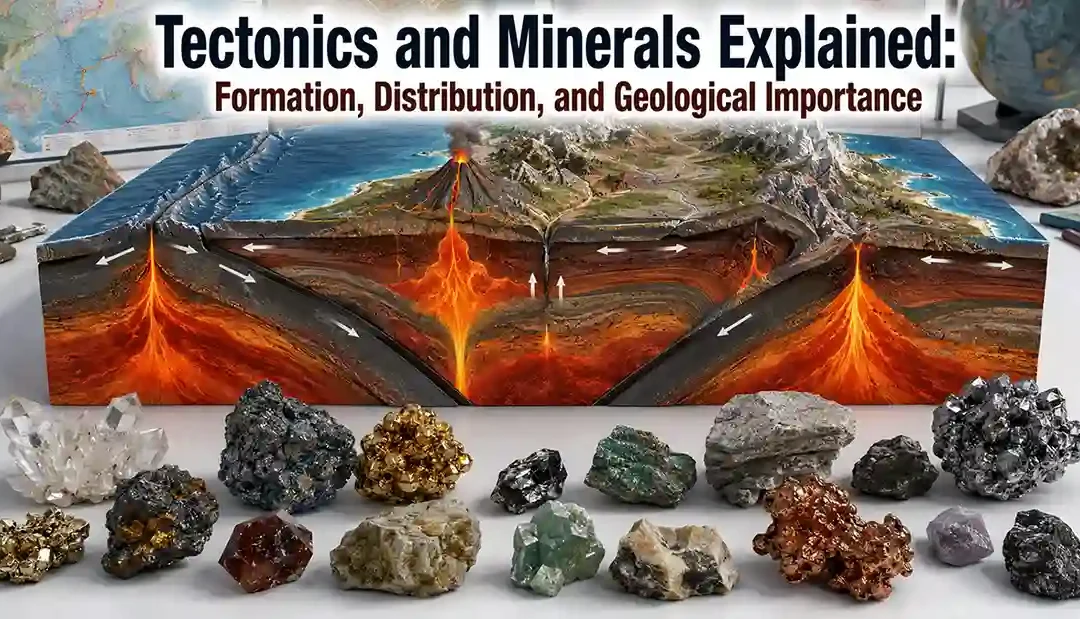
Plate tectonics is the fundamental geological theory explaining the movement of Earth's lithospheric plates and the formation of continents, oceans, mountains, volcanoes, and earthquakes. These tectonic processes also control where minerals form, how they evolve, and why valuable mineral deposits occur in specific regions around the world.
As tectonic plates move, collide, separate, or slide past one another, they generate magma, heat, pressure, and hydrothermal fluids. These geological processes create ideal conditions for forming new minerals, altering existing ones, and concentrating economically valuable metals such as copper, gold, iron, nickel, chromium, platinum, and rare earth elements.
Nearly every major mineral deposit on Earth is directly or indirectly linked to plate tectonics. Understanding these relationships helps geologists locate mineral resources, reconstruct Earth's history, and explain the formation of rocks and ore deposits.
This topic should be studied together with Plate Tectonics Explained, Economic Geology,and Hydrothermal Alteration.
What Is Plate Tectonics?
Plate tectonics describes the movement of rigid lithospheric plates over Earth's semi-molten asthenosphere.
These plates move at rates of a few centimeters per year and interact along three main boundary types:
- Divergent boundaries
- Convergent boundaries
- Transform boundaries
Each boundary produces distinct geological environments and characteristic mineral assemblages.
Why Does Plate Tectonics Influence Minerals?
Plate movement controls:
- Magma generation
- Volcanic activity
- Mountain building
- Metamorphism
- Hydrothermal circulation
- Rock recycling
These processes create the temperature, pressure, and chemical conditions required for mineral formation.
Plate Boundaries and Mineral Formation
Divergent Plate Boundaries
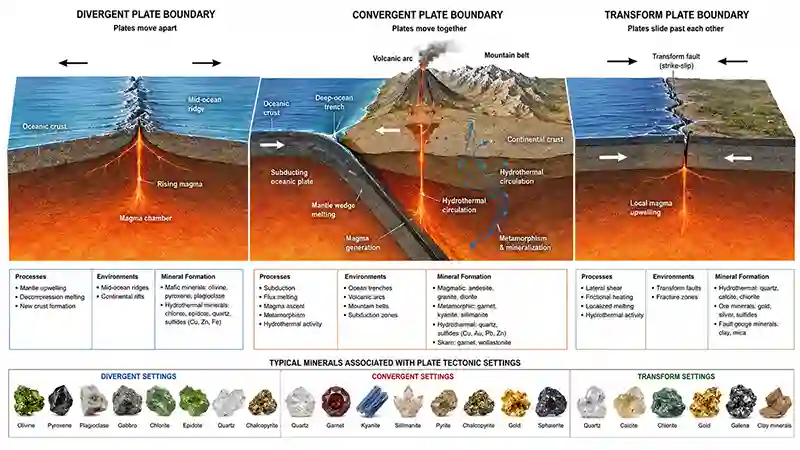
Divergent boundaries occur where tectonic plates move apart.
Examples:
- Mid-ocean ridges
- Continental rifts
Processes include:
- Mantle melting
- Basaltic volcanism
- Hydrothermal vent activity
Common minerals:
- Olivine
- Pyroxene
- Plagioclase Feldspar
- Magnetite
- Sulfide minerals
These environments often host volcanogenic massive sulfide (VMS) deposits.
Convergent Plate Boundaries
Convergent boundaries form where plates collide.
Processes include:
- Subduction
- Mountain building
- Arc volcanism
- Regional metamorphism
- Hydrothermal alteration
Common minerals:
- Quartz
- Feldspar
- Amphibole
- Biotite
- Garnet
- Kyanite
- Sillimanite
Major ore deposits include:
- Porphyry copper
- Epithermal gold
- Skarn deposits
Transform Plate Boundaries
Transform boundaries involve horizontal movement between plates.
Although they produce fewer igneous rocks, they influence:
- Fault-controlled hydrothermal systems
- Quartz veins
- Gold mineralization
- Fracture-controlled ore deposits
Plate Tectonics and Igneous Minerals
Plate tectonics directly controls magma composition.
Typical minerals include:
- Quartz
- Feldspar
- Olivine
- Pyroxene
- Amphibole
- Biotite
- Magnetite
Different tectonic settings produce different magma types and mineral assemblages.
Plate Tectonics and Metamorphic Minerals
Mountain-building events create high pressures and temperatures that produce metamorphic minerals.
Common examples include:
- Garnet
- Staurolite
- Kyanite
- Andalusite
- Sillimanite
- Chlorite
These minerals help geologists reconstruct tectonic history.
Plate Tectonics and Sedimentary Minerals
Tectonic uplift increases erosion, supplying sediments to rivers, lakes, and oceans.
Common sedimentary minerals include:
- Quartz
- Feldspar
- Clay minerals
- Calcite
- Dolomite
Basin development also controls the formation of evaporites such as gypsum and halite.
Hydrothermal Mineral Formation
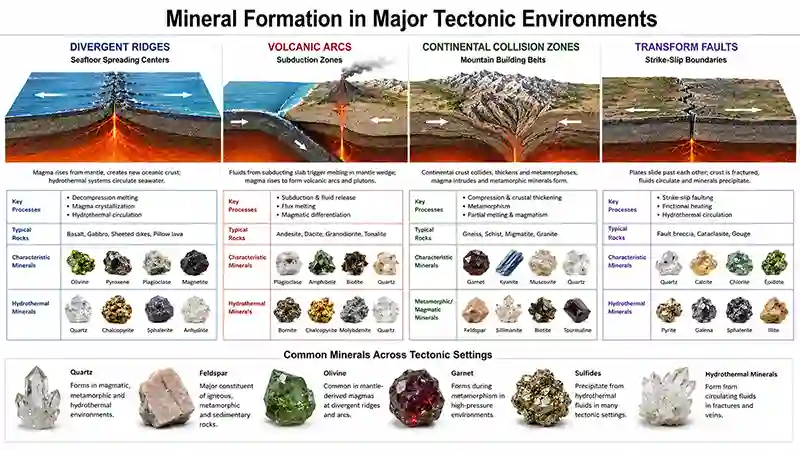
Hydrothermal fluids generated near magma chambers transport dissolved metals through fractures.
Common hydrothermal minerals include:
- Quartz
- Calcite
- Sericite
- Chlorite
- Epidote
- Pyrite
- Chalcopyrite
- Bornite
Hydrothermal systems are responsible for many of the world's largest ore deposits.
Plate Tectonics and Ore Deposits
Different tectonic environments host distinctive mineral deposits.
| Tectonic Setting | Major Ore Deposits |
|---|---|
| Mid-Ocean Ridge | Massive Sulfide (VMS) |
| Island Arc | Porphyry Copper, Epithermal Gold |
| Continental Collision | Gold, Graphite, Gemstones |
| Rift Zones | Nickel, Copper, Platinum |
| Cratons | Diamonds, Gold |
| Layered Intrusions | Chromite, Platinum Group Elements |
Understanding tectonic setting greatly improves mineral exploration.
Minerals Associated with Plate Boundaries
| Plate Boundary | Typical Minerals |
| Divergent | Olivine, Pyroxene, Plagioclase, Magnetite |
| Convergent | Quartz, Feldspar, Amphibole, Garnet |
| Transform | Quartz, Calcite, Sulfides |
| Continental Collision | Kyanite, Sillimanite, Garnet |
| Oceanic Crust | Olivine, Serpentine, Chromite |
Laboratory Methods
Scientists study tectonically controlled minerals using:
- Petrographic Microscopy
- X-Ray Diffraction (XRD)
- Electron Microprobe Analysis (EPMA)
- ICP-MS
- Scanning Electron Microscopy (SEM)
- Isotope Geochemistry
- Geochronology
These methods reveal mineral chemistry, crystal structure, and formation history.
Applications
Understanding plate tectonics and minerals is essential in:
- Mineral exploration
- Economic geology
- Petrology
- Structural geology
- Volcanology
- Geochemistry
- Engineering geology
- Environmental geology
Advantages of Studying Plate Tectonics and Minerals
Studying tectonic controls on mineral formation helps scientists:
- Predict mineral deposits
- Understand Earth's evolution
- Reconstruct ancient plate movements
- Improve exploration success
- Interpret rock histories
- Assess natural resources
Limitations
Geological systems are complex because:
- Multiple tectonic events may affect the same region.
- Later alteration can modify original minerals.
- Erosion may remove evidence of ancient tectonic settings.
- Laboratory analyses are often required to confirm mineral origins.
For the most reliable interpretation, combine tectonic studies with:
- Plate Tectonics Explained
- Hydrothermal Alteration
- Mineral Formation
- Economic Geology
- Petrographic Microscopy
- X-Ray Diffraction in Mineralogy
- Mineral Chemistry Analysis
Comparison Table
| Tectonic Environment | Dominant Process | Common Minerals |
| Divergent Boundary | Mantle Melting | Olivine, Pyroxene |
| Convergent Boundary | Subduction | Quartz, Amphibole, Garnet |
| Continental Collision | Regional Metamorphism | Kyanite, Sillimanite |
| Rift Basin | Mafic Magmatism | Olivine, Magnetite |
| Hydrothermal System | Fluid-Rock Interaction | Quartz, Pyrite, Chalcopyrite |
Summary Table
| Feature | Plate Tectonics and Minerals |
| Main Concept | Plate Movement Controls Mineral Formation |
| Major Processes | Magmatism, Metamorphism, Hydrothermal Activity |
| Key Mineral Groups | Igneous, Metamorphic, Hydrothermal, Ore Minerals |
| Common Study Methods | Petrography, XRD, EPMA, SEM, Geochemistry |
| Geological Importance | Mineral Resources and Earth's Evolution |
Plate tectonics controls magma generation, mountain building, metamorphism, and hydrothermal fluid circulation, creating the conditions needed for mineral formation and concentration.
Convergent plate boundaries, especially subduction zones, host many of the world's largest porphyry copper, epithermal gold, and skarn deposits. Divergent boundaries are also important for volcanogenic massive sulfide (VMS) deposits.
Magma generated at active plate boundaries heats groundwater, creating hydrothermal fluids that transport and deposit minerals in fractures and surrounding rocks.
Quartz, feldspar, amphibole, biotite, garnet, pyrite, chalcopyrite, and many hydrothermal alteration minerals are common in subduction-related environments.
Understanding tectonic settings helps geologists predict where valuable mineral deposits are most likely to occur, making exploration more efficient and cost-effective.
Final Thoughts
Plate tectonics is the driving force behind the formation, transformation, and distribution of minerals across Earth. From the crystallization of igneous minerals at divergent boundaries to the development of metamorphic index minerals during continental collisions and the concentration of valuable metals by hydrothermal systems, tectonic processes shape nearly every aspect of mineral formation.
By integrating plate tectonic theory with petrology, mineral chemistry, geophysics, and laboratory techniques such as petrographic microscopy, X-ray diffraction, and electron microprobe analysis, geologists can reconstruct Earth's geological history and discover new mineral resources. Understanding the relationship between plate tectonics and minerals is essential for modern geology, mining, and resource exploration.
Continue Learning
Continue exploring Earth processes with these related guides: