
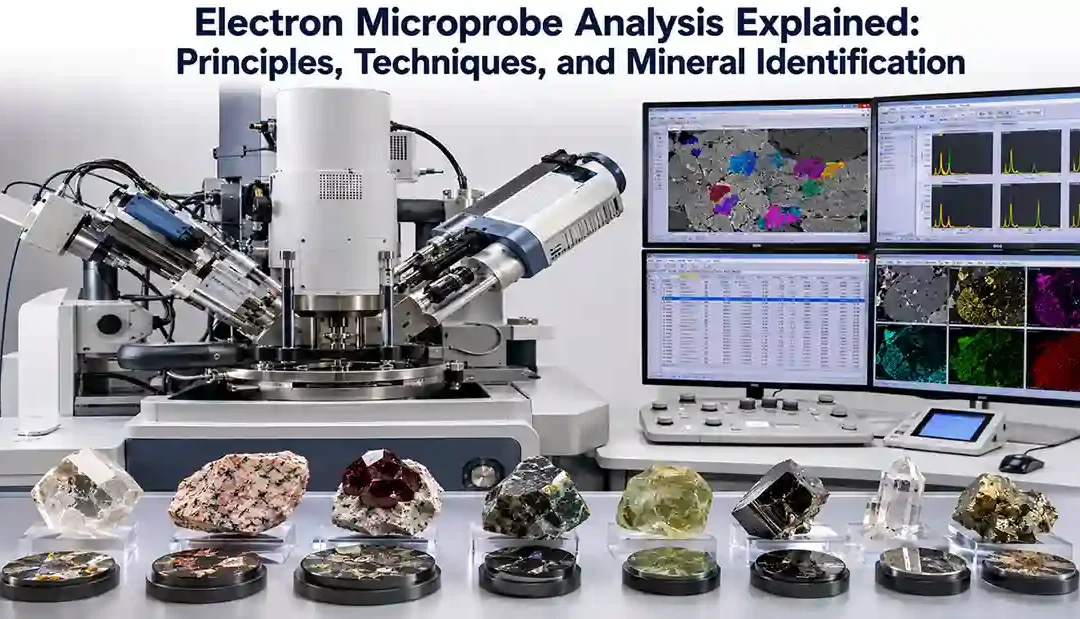
Electron Microprobe Analysis (EPMA) is one of the most accurate laboratory techniques used to determine the chemical composition of minerals. Unlike optical methods that identify minerals by their physical or optical properties, EPMA measures the concentrations of chemical elements within microscopic areas of a mineral using a focused electron beam.
Because many minerals have similar appearances but different chemical compositions, EPMA is an essential tool in mineralogy, petrology, economic geology, geochemistry, and materials science. It allows scientists to analyze individual mineral grains, determine chemical zoning, identify trace substitutions, and produce detailed elemental maps.
Electron microprobe analysis is widely used in universities, geological surveys, mining companies, museums, and research laboratories around the world.
For a complete understanding of mineral analysis, EPMA should be studied together with X-Ray Diffraction in Mineralogy and Petrographic Microscopy
What Is Electron Microprobe Analysis (EPMA)?
Electron Microprobe Analysis (EPMA) is an analytical technique that determines the elemental composition of minerals by bombarding a polished sample with a focused beam of high-energy electrons.
When the electron beam strikes the sample:
- Atoms become excited.
- Characteristic X-rays are emitted.
- Spectrometers measure the X-rays.
- Software calculates the concentration of each element.
The result is a highly accurate quantitative chemical analysis.
Why Is EPMA Important?
EPMA helps geologists:
- Identify mineral chemistry
- Measure elemental concentrations
- Detect chemical zoning
- Study mineral evolution
- Distinguish similar minerals
- Investigate ore deposits
It is considered one of the most precise methods for quantitative mineral analysis.
Principle of Electron Microprobe Analysis
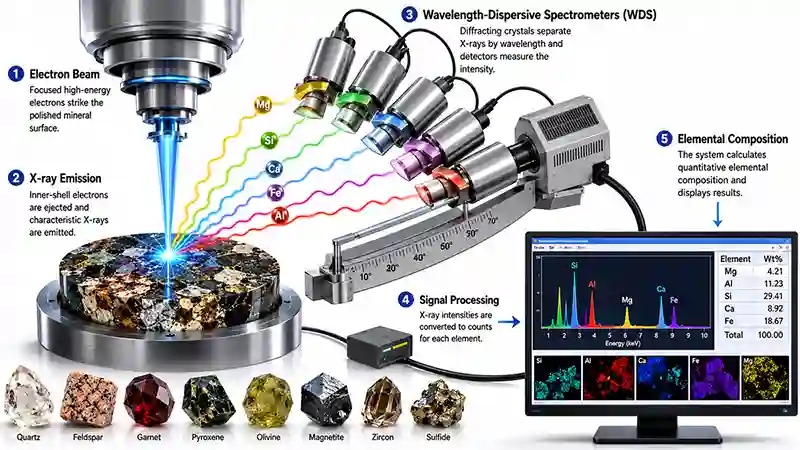
EPMA works by generating characteristic X-rays from a very small area of a mineral.
The basic process is:
- A focused electron beam strikes the sample.
- Inner-shell electrons are ejected from atoms.
- Higher-energy electrons fill the vacancies.
- Characteristic X-rays are released.
- Spectrometers measure X-ray wavelengths and intensities.
- Software converts the data into elemental concentrations.
Each chemical element emits a unique X-ray signature, allowing precise identification.
Major Components of an Electron Microprobe
A modern EPMA system consists of:
- Electron gun
- Electromagnetic lenses
- Vacuum chamber
- Sample stage
- Wavelength-dispersive spectrometers (WDS)
- Energy-dispersive spectrometer (EDS) (optional on many systems)
- X-ray detectors
- Computer and analytical software
Each component contributes to accurate elemental measurements.
How Does EPMA Work?
The analysis generally follows these steps.
Step 1
Prepare a polished mineral or rock sample.
Step 2
Coat the sample with a thin conductive layer (commonly carbon).
Step 3
Place the sample inside the vacuum chamber.
Step 4
Focus the electron beam onto the selected mineral grain.
Step 5
Measure the emitted characteristic X-rays.
Step 6
Calculate quantitative elemental concentrations using calibration standards.
Sample Preparation
High-quality sample preparation is essential.
Typical preparation includes:
- Cutting the rock sample
- Mounting in epoxy
- Grinding and polishing
- Carbon coating
- Cleaning before analysis
A smooth, flat surface improves analytical accuracy.
Information Obtained from EPMA
Electron microprobe analysis provides:
- Major element composition
- Minor element composition
- Chemical zoning
- Element distribution maps
- Mineral formulas
- Compositional variations
- Mineral identification support
Unlike XRD, EPMA measures chemical composition rather than crystal structure.
Minerals Commonly Analyzed
EPMA is widely used to analyze:
| Mineral | Common Elements Measured |
|---|---|
| Quartz | Si, O |
| Feldspar | Si, Al, Na, K, Ca |
| Garnet | Fe, Mg, Mn, Ca, Al |
| Olivine | Mg, Fe, Si |
| Pyroxene | Ca, Mg, Fe, Si |
| Amphibole | Ca, Na, Mg, Fe, Al |
| Biotite | K, Mg, Fe, Al, Ti |
| Magnetite | Fe, Ti |
| Zircon | Zr, Si, Hf |
| Sulfide Minerals | Fe, Cu, Pb, Zn, Ni, S |
These analyses help determine mineral composition and geological history.
Elemental Mapping
One of the strengths of EPMA is elemental mapping. The instrument scans the sample and produces maps showing the distribution of individual elements.
Common mapping applications include:
- Chemical zoning in garnet
- Feldspar compositional variation
- Ore mineral distribution
- Metamorphic reaction textures
- Alteration patterns
These maps reveal details that are impossible to observe with the naked eye.
EPMA vs X-Ray Diffraction
| Electron Microprobe (EPMA) | X-Ray Diffraction (XRD) |
| Measures chemical composition | Measures crystal structure |
| Micrometer-scale analysis | Bulk powdered sample |
| Quantitative elemental data | Mineral phase identification |
| Excellent for zoning | Excellent for clay identification |
| Individual mineral grains | Whole sample analysis |
The two techniques are complementary and are often used together.
EPMA vs SEM
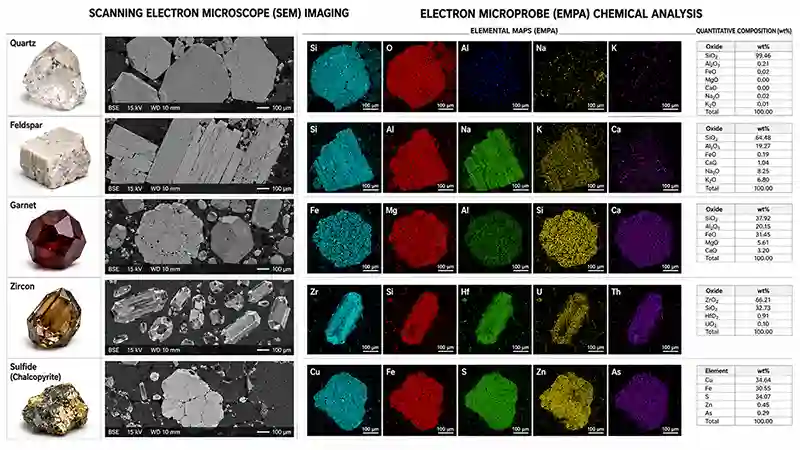
| Electron Microprobe | SEM |
| Quantitative chemistry | High-resolution imaging |
| WDS analysis | Surface morphology |
| Higher analytical accuracy | Faster imaging |
| Element mapping | Microstructural observation |
Many research laboratories use both instruments for comprehensive mineral analysis.
Applications in Geology
Electron microprobe analysis is widely used in:
- Mineral identification
- Petrology
- Metamorphic geology
- Igneous petrology
- Economic geology
- Ore deposit studies
- Geochemistry
- Planetary geology
It is one of the most important tools for studying mineral chemistry.
Applications in Industry
Industries use EPMA for:
- Mining exploration
- Metallurgy
- Ceramics
- Semiconductor materials
- Environmental analysis
- Advanced materials research
Its ability to measure elemental composition at microscopic scales makes it valuable across many scientific disciplines.
Advantages of Electron Microprobe Analysis
EPMA offers numerous advantages:
- Highly accurate quantitative analysis
- Micrometer-scale spatial resolution
- Excellent elemental mapping
- Non-destructive to polished samples
- High analytical precision
- Reliable mineral chemistry
It remains one of the gold-standard techniques for quantitative mineral analysis.
Limitations
Despite its strengths, EPMA has some limitations.
- Requires polished and conductive samples.
- Operates under high vacuum.
- Cannot directly determine crystal structure.
- Trace elements at very low concentrations may require other techniques, such as Laser Ablation ICP-MS.
For comprehensive mineral characterization, combine EPMA with:
- X-Ray Diffraction in Mineralogy
- Scanning Electron Microscopy (SEM)
- Petrographic Microscopy
- Thin Section Mineral Analysis
- Optical Properties of Minerals
- X-Ray Fluorescence (XRF)
- How to Identify Minerals
Comparison Table
| Technique | Main Information |
| Electron Microprobe (EPMA) | Quantitative Chemical Composition |
| X-Ray Diffraction (XRD) | Crystal Structure |
| Scanning Electron Microscopy (SEM) | Surface Morphology |
| X-Ray Fluorescence (XRF) | Bulk Chemical Composition |
| Petrographic Microscopy | Optical Properties |
Summary Table
| Feature | Electron Microprobe Analysis |
| Main Purpose | Quantitative Elemental Analysis |
| Sample Type | Polished Mineral Section |
| Main Instrument | Electron Microprobe Analyzer (EPMA) |
| Best For | Mineral Chemistry |
| Scientific Importance | Mineralogy, Geochemistry, Petrology |
Electron Microprobe Analysis (EPMA) is a laboratory technique that measures the chemical composition of minerals by detecting characteristic X-rays emitted when a focused electron beam strikes a polished sample.
EPMA determines elemental composition, while X-ray diffraction (XRD) identifies crystal structure and mineral phases. Both techniques are complementary.
EPMA is commonly used to analyze quartz, feldspar, garnet, olivine, pyroxene, amphibole, zircon, magnetite, sulfides, and many other minerals.
A thin carbon coating makes the sample electrically conductive, preventing charge buildup during electron beam analysis.
EPMA provides highly accurate quantitative chemical analyses of individual mineral grains, helping geologists interpret mineral formation, metamorphism, magma evolution, and ore deposit processes.
Final Thoughts
Electron Microprobe Analysis is one of the most precise techniques available for studying mineral chemistry. By combining a focused electron beam with high-resolution X-ray spectrometry, EPMA allows scientists to measure elemental concentrations, identify chemical zoning, and investigate microscopic mineral variations with exceptional accuracy.
Together with X-ray diffraction, petrographic microscopy, SEM, and other analytical methods, EPMA forms a cornerstone of modern mineralogical and geological research. Its ability to reveal the chemical composition of individual mineral grains makes it indispensable for understanding Earth's rocks, mineral deposits, and geological history.
Continue Learning
Expand your knowledge with these related guides: