
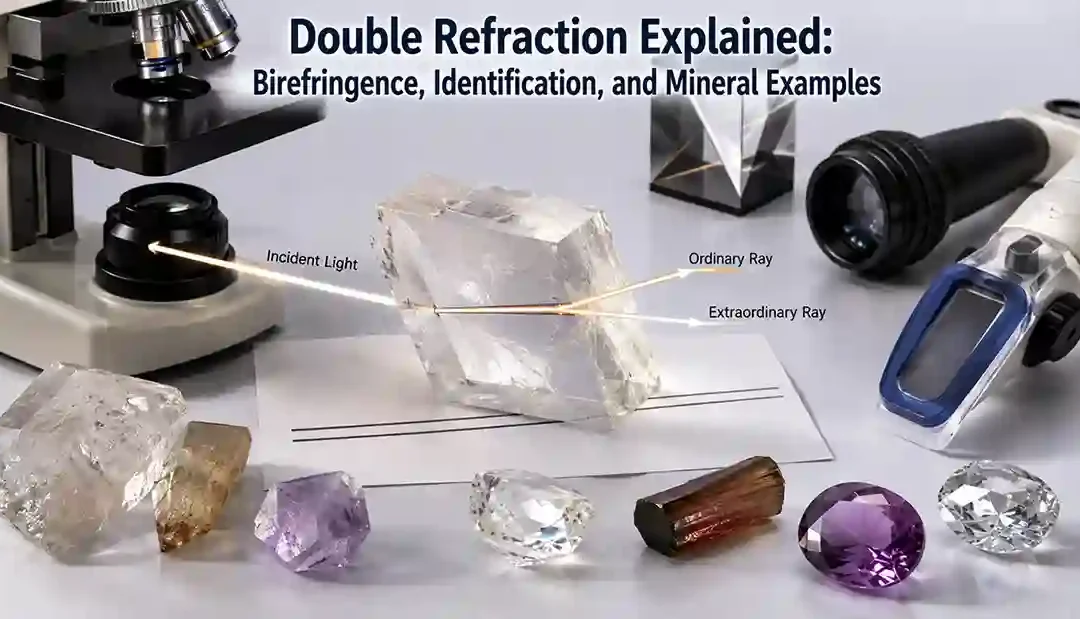
Double refraction, also known as birefringence, is one of the most important optical properties used in mineralogy and gemology. It occurs when light entering certain minerals splits into two separate rays that travel at different speeds and in different directions. As a result, objects viewed through these minerals may appear doubled.
Calcite is the classic example of a mineral showing strong double refraction, making it one of the easiest optical properties to observe. Minerals with birefringence provide valuable information about crystal structure, symmetry, and optical behavior, making this property essential for mineral identification and petrographic microscopy.
When combined with refractive index, pleochroism, fluorescence, hardness, density, and crystal habit, birefringence becomes a powerful diagnostic tool.
If you are learning optical mineralogy, study this topic together with Optical Properties of Minerals, Refractive Index in Minerals, and How to Identify Minerals.
What Is Double Refraction?
Double refraction is the phenomenon in which a single beam of light entering an anisotropic mineral splits into two separate rays.
These are called:
- Ordinary Ray (O-ray)
- Extraordinary Ray (E-ray)
Each ray travels through the crystal at a different speed, producing two separate images.
This optical phenomenon is known as birefringence.
Why Does Double Refraction Occur?
Double refraction occurs because many minerals have anisotropic crystal structures.
In these minerals:
- Light travels at different speeds in different crystallographic directions.
- The crystal has more than one refractive index.
- Incoming light separates into two polarized rays.
This behavior is controlled entirely by the mineral's internal crystal structure.
Isotropic vs Anisotropic Minerals
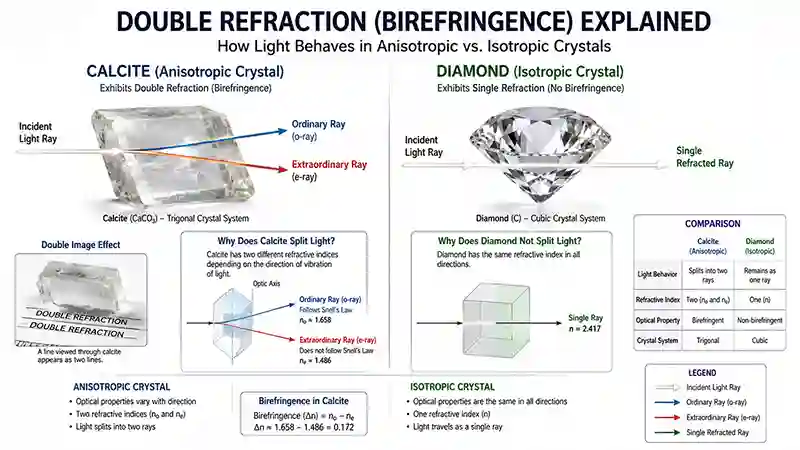
Minerals are divided into two optical groups.
| Isotropic Minerals | Anisotropic Minerals |
|---|---|
| One refractive index | Two or more refractive indices |
| No double refraction | Double refraction present |
| Light behaves equally in all directions | Light speed varies with direction |
| Cubic crystal system | All other crystal systems (except cubic) |
Examples of isotropic minerals:
- Diamond
- Garnet
- Spinel
Examples of anisotropic minerals:
- Calcite
- Quartz
- Tourmaline
- Sapphire
- Topaz
Ordinary and Extraordinary Rays
When light enters a birefringent mineral:
Ordinary Ray (O-ray)
- Travels according to Snell's Law
- Constant refractive index
Extraordinary Ray (E-ray)
- Travels at a different speed
- Variable refractive index
- Produces the second image
The separation between these rays determines the strength of birefringence.
What Is Birefringence?
Birefringence is the numerical difference between the highest and lowest refractive indices of a mineral.
Birefringence = Highest RI − Lowest RI
A higher birefringence value produces stronger double refraction.
For example:
- Quartz → Low birefringence
- Calcite → Very high birefringence
Learn more in Refractive Index in Minerals.
Minerals That Show Double Refraction
Many transparent minerals display birefringence.
| Mineral | Birefringence |
| Calcite | Very High |
| Quartz | Low |
| Topaz | Moderate |
| Tourmaline | Moderate |
| Zircon | Moderate to High |
| Sapphire | Moderate |
| Beryl | Low |
Calcite exhibits one of the strongest visible examples of double refraction.
Minerals That Do Not Show Double Refraction
Cubic minerals are optically isotropic.
Examples include:
- Diamond
- Garnet
- Spinel
- Fluorite (optically isotropic despite crystal imperfections in some specimens)
These minerals do not split light into two rays.
How to Observe Double Refraction
The phenomenon can be observed using several methods.
Naked-Eye Observation
Transparent calcite placed over printed text clearly produces doubled letters.
Polarized Light Microscope
Petrographers observe birefringence in thin rock sections.
Refractometer
Measures refractive indices that determine birefringence.
Polariscope
Separates isotropic and anisotropic gemstones.
Optical Significance
Double refraction helps determine:
- Crystal symmetry
- Mineral species
- Optical orientation
- Refractive index differences
- Thin-section mineral identification
It is one of the most valuable diagnostic optical properties.
Double Refraction in Petrography
Petrographic microscopes use crossed polarized light to study birefringent minerals.
Important observations include:
- Interference colors
- Extinction angles
- Crystal orientation
- Twinning
- Optical sign
These properties help identify minerals in thin sections of rocks.
Double Refraction vs Dispersion
These optical effects are often confused.
| Double Refraction | Dispersion |
| Splits one light ray into two | Splits white light into colors |
| Controlled by birefringence | Controlled by wavelength |
| Common in calcite | Strong in diamond |
Both contribute to gemstone appearance but arise from different optical principles.
Applications
Double refraction is widely used in:
- Mineral identification
- Gemstone identification
- Optical mineralogy
- Petrography
- Geological research
- University teaching
- Museum collections
It provides valuable information about crystal structure that cannot be obtained through visual inspection alone.
Advantages
Double refraction testing is:
- Non-destructive
- Highly accurate
- Repeatable
- Excellent for transparent minerals
- Essential in petrography
Limitations
Double refraction alone cannot identify every mineral because:
- Opaque minerals cannot be tested.
- Some minerals have very low birefringence.
- Surface quality affects observations.
For reliable identification, combine birefringence with:
- Refractive Index in Minerals
- Optical Properties of Minerals
- Pleochroism in Minerals
- Fluorescent Minerals
- Mineral Density Test
- Mineral Hardness Test
- Crystal Systems Explained
Comparison Table
| Optical Property | Measures |
| Double Refraction | Splitting of Light |
| Refractive Index | Light Bending |
| Pleochroism | Color Change |
| Fluorescence | UV Response |
| Dispersion | Fire |
| Transparency | Light Transmission |
Summary Table
| Feature | Double Refraction |
| Also Called | Birefringence |
| Occurs In | Anisotropic Minerals |
| Best Example | Calcite |
| Equipment | Polarized Microscope, Polariscope |
| Identification Value | Excellent |
Double refraction is the splitting of a single light ray into two rays as it passes through an anisotropic mineral.
Yes. Birefringence is the optical property responsible for the phenomenon of double refraction.
Calcite is one of the best-known minerals with exceptionally strong double refraction.
Diamond belongs to the cubic crystal system and is optically isotropic, so light is not split into two rays.
They commonly use polarized light microscopes, polariscopes, refractometers, and transparent mineral specimens such as calcite.
Final Thoughts
Double refraction is one of the most distinctive optical properties in mineralogy, providing direct evidence of a mineral's internal crystal structure and optical behavior. The dramatic doubling effect seen in calcite demonstrates how anisotropic minerals interact with light in ways that isotropic minerals cannot.
Together with refractive index, pleochroism, fluorescence, and other optical properties, birefringence forms an essential part of mineral and gemstone identification. Understanding this phenomenon allows geologists, gemologists, and students to interpret mineral characteristics with greater confidence and accuracy.
Continue Learning
Continue exploring optical mineralogy with these related guides: