
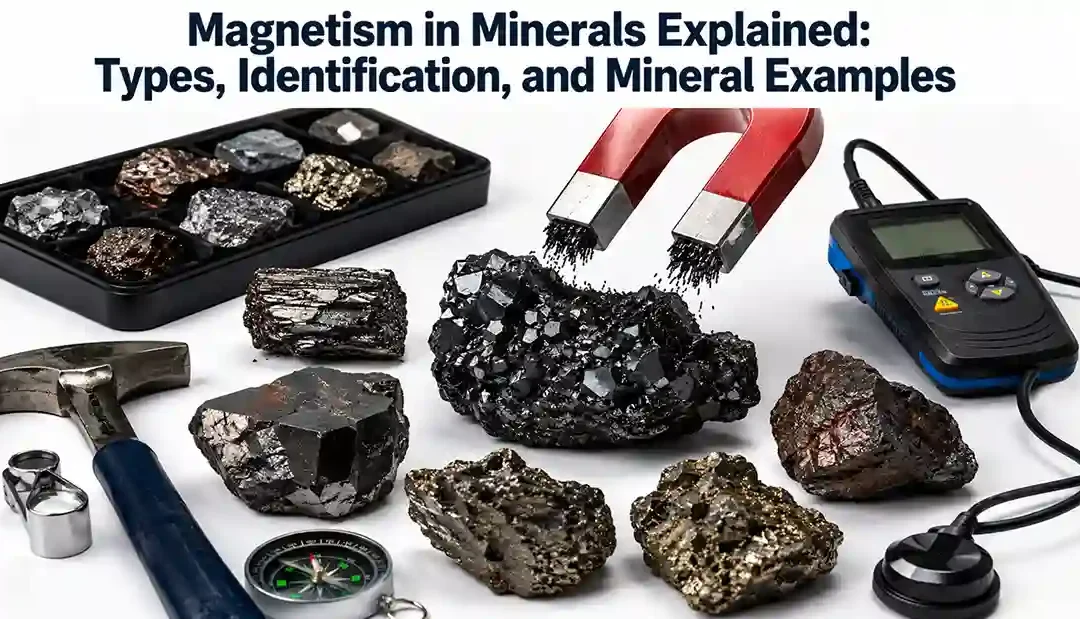
Magnetism is one of the most distinctive physical properties used in mineral identification. While most minerals show little or no magnetic behavior, a small number respond strongly to magnets because of their chemical composition and crystal structure. The most famous example is magnetite, a naturally magnetic iron oxide that has been used for centuries in navigation and geological exploration.
Today, geologists use simple hand magnets and advanced magnetic instruments to identify minerals, map ore deposits, and explore for valuable resources. Although magnetism alone cannot identify every mineral, it is an important property when combined with hardness, streak, cleavage, fracture, luster, and specific gravity.
If you are learning mineral identification, the magnetism test should be studied alongside the Mineral Hardness Test, Acid Test for Minerals, and How to Identify Minerals.
What Is Magnetism in Minerals?
Magnetism is the ability of a mineral to be attracted to a magnetic field or to produce its own magnetic field.
This property depends on:
- Chemical composition
- Crystal structure
- Iron content
- Electron arrangement
Only a relatively small number of minerals exhibit noticeable magnetic behavior.
Why Are Some Minerals Magnetic?
Magnetism results from the movement and alignment of electrons inside atoms.
Minerals containing elements such as:
- Iron (Fe)
- Nickel (Ni)
- Cobalt (Co)
are more likely to display magnetic properties.
However, not all iron-bearing minerals are magnetic because magnetism also depends on crystal structure and electron configuration.
Types of Mineral Magnetism
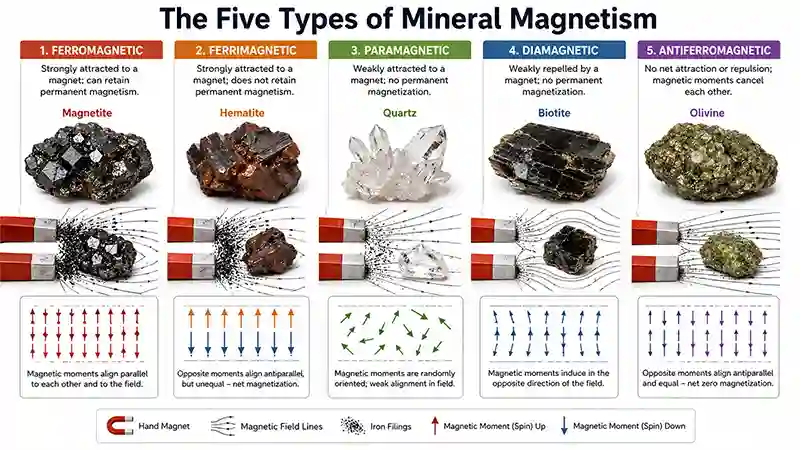
Minerals display several different types of magnetic behavior.
Ferromagnetic
Strongly attracted to magnets and may become permanently magnetized.
Examples:
- Magnetite
- Native Iron
Ferrimagnetic
Similar to ferromagnetism but with opposing magnetic moments of different strengths.
Example:
- Magnetite
Most naturally magnetic minerals belong to this category.
Paramagnetic
Weakly attracted to magnetic fields.
Examples:
- Biotite
- Olivine
- Pyroxene
- Garnet
These minerals usually require sensitive instruments to measure their magnetic properties.
Diamagnetic
Slightly repelled by magnetic fields.
Examples:
- Quartz
- Calcite
- Gypsum
- Halite
Diamagnetism is generally too weak to observe with an ordinary hand magnet.
Antiferromagnetic
Adjacent magnetic moments cancel each other.
Example:
- Hematite (under certain conditions)
Common Magnetic Minerals
Several minerals exhibit measurable magnetic properties.
| Mineral | Formula | Magnetic Property |
|---|---|---|
| Magnetite | Fe₃O₄ | Very Strong |
| Pyrrhotite | Fe₁₋ₓS | Strong |
| Native Iron | Fe | Strong |
| Ilmenite | FeTiO₃ | Weak to Moderate |
| Chromite | FeCr₂O₄ | Weak |
| Hematite | Fe₂O₃ | Weak to Moderate |
| Franklinite | ZnFe₂O₄ | Moderate |
Among these, magnetite is by far the strongest naturally occurring magnetic mineral.
Minerals That Are Not Magnetic
Most common rock-forming minerals show little or no magnetic attraction.
Examples include:
- Quartz
- Feldspar
- Calcite
- Dolomite
- Gypsum
- Fluorite
- Muscovite
These minerals can usually be distinguished easily from magnetite during fieldwork.
How to Perform a Magnetism Test
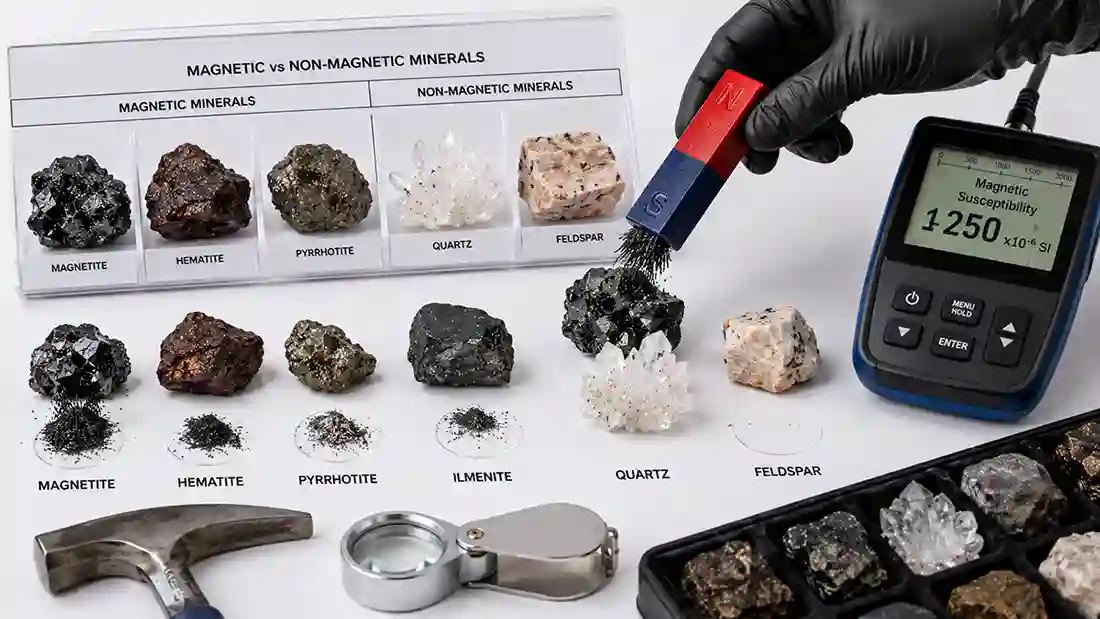
A magnetism test is simple and requires only basic equipment.
Step 1
Clean the mineral surface.
Step 2
Bring a small hand magnet close to the specimen.
Step 3
Observe whether the mineral:
- Strongly attracts
- Weakly attracts
- Shows no attraction
Step 4
Compare the result with known mineral properties.
Never assume a dark-colored mineral is magnetic without testing.
Magnetite vs Hematite
Magnetite and hematite are both important iron ores, but they differ significantly in magnetic behavior.
| Property | Magnetite | Hematite |
| Formula | Fe₃O₄ | Fe₂O₃ |
| Magnetism | Strong | Weak or None |
| Streak | Black | Reddish Brown |
| Iron Content | ~72% | ~70% |
This difference makes the magnetism test valuable for distinguishing between the two minerals.
Equipment Used
Geologists commonly use:
- Hand magnet
- Compass
- Magnetic susceptibility meter
- Electromagnet
- Magnetometer
These tools range from simple field equipment to sophisticated exploration instruments.
Importance in Mineral Identification
Magnetism helps geologists:
- Identify iron-rich minerals
- Distinguish similar-looking minerals
- Locate ore deposits
- Interpret rock composition
- Support laboratory analysis
Although not all minerals are magnetic, this property provides valuable identification clues.
Uses in Geological Exploration
Magnetic properties are widely used in:
- Iron ore exploration
- Nickel exploration
- Geological mapping
- Airborne magnetic surveys
- Mineral resource assessment
Large magnetic anomalies often indicate buried ore bodies.
Everyday Uses of Magnetic Minerals
Magnetic minerals are used in:
- Steel production
- Electronic devices
- Magnetic recording
- Compasses
- Scientific instruments
- Heavy media separation
Historically, naturally magnetized magnetite (lodestone) was used to make early compasses.
Advantages of the Magnetism Test
The magnetism test is:
- Fast
- Non-destructive
- Easy to perform
- Inexpensive
- Reliable for certain minerals
It is especially useful in field geology.
Limitations
Magnetism should never be used as the only identification test.
Some minerals exhibit:
- Weak magnetism
- Variable magnetism
- Weathered surfaces that reduce response
Always combine magnetism with:
- Mineral Hardness Test
- Acid Test for Minerals
- Cleavage Test Explained
- Fracture in Minerals
- Streak Test Explained
- Specific Gravity Test Explained
Comparison Table
| Property | Magnetism Test |
| Purpose | Detect Magnetic Minerals |
| Equipment | Hand Magnet |
| Most Common Mineral | Magnetite |
| Field Use | Excellent |
| Identification Value | High |
Summary Table
| Magnetic Behavior | Example Minerals |
| Ferromagnetic | Native Iron |
| Ferrimagnetic | Magnetite |
| Paramagnetic | Biotite, Olivine |
| Diamagnetic | Quartz, Calcite |
| Antiferromagnetic | Hematite |
Magnetite is the strongest naturally occurring magnetic mineral.
No. Many iron-bearing minerals, such as hematite, are only weakly magnetic or not noticeably magnetic.
No. Quartz is diamagnetic and is not attracted by an ordinary hand magnet.
Magnetism helps identify minerals, locate ore deposits, and conduct geophysical exploration.
Geologists commonly use hand magnets, compasses, magnetic susceptibility meters, and magnetometers.
Final Thoughts
Magnetism is a unique and valuable physical property that plays an important role in mineral identification and geological exploration. From the strongly magnetic magnetite to weakly magnetic hematite and non-magnetic quartz, magnetic behavior reflects the chemistry and crystal structure of minerals.
When combined with hardness, cleavage, fracture, streak, luster, specific gravity, and acid testing, the magnetism test provides geologists with another reliable method for identifying minerals and discovering valuable ore deposits.
Continue Learning
Build your mineral identification skills with these related guides: