
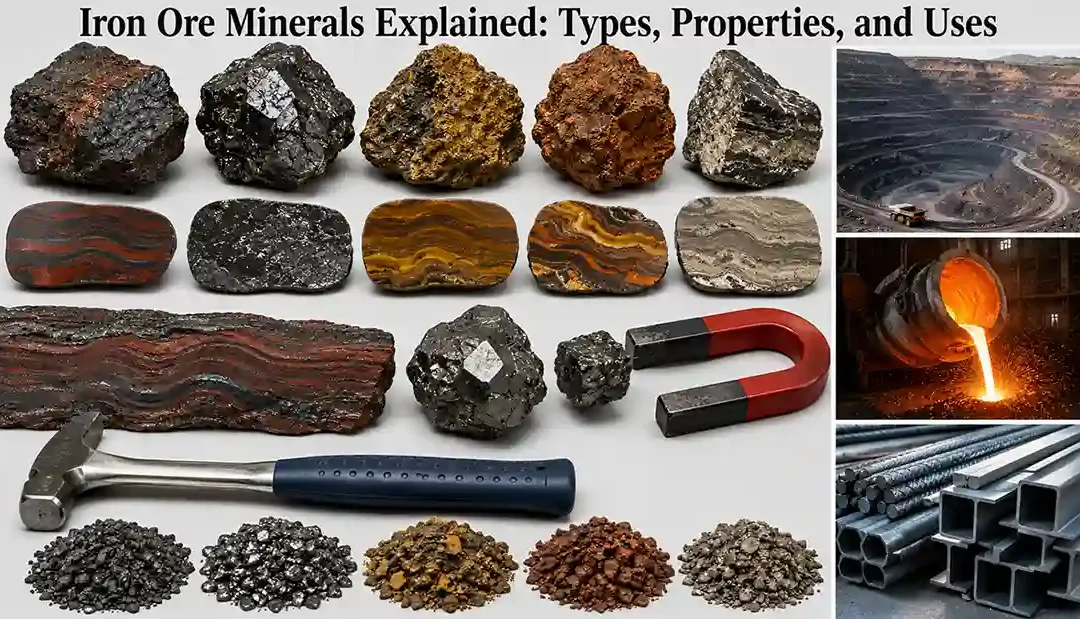
Iron ore minerals are among the world's most important natural resources because they provide the primary raw material for producing iron and steel. Nearly every modern industry—including construction, transportation, manufacturing, and infrastructure—depends on iron ore.
Although many minerals contain iron, only a few occur in sufficient concentrations to be mined economically. The most important iron ore minerals are hematite, magnetite, goethite, limonite, and siderite.
What Are Iron Ore Minerals?
Iron ore minerals are naturally occurring minerals that contain enough iron to be economically extracted and processed.
These minerals are used to produce:
- iron metal
- steel
- industrial alloys
- machinery
- construction materials
Iron ores are among the most valuable mineral resources in economic geology.
Major Iron Ore Minerals
Hematite
Most important commercial iron ore.
Chemical formula:
Iron content:
Approximately 70% Fe
Color:
- steel gray
- black
- reddish brown
Magnetite
Highly magnetic iron ore.
Chemical formula:
Iron content:
Approximately 72% Fe
Color:
- black
- dark gray
Goethite
Common weathering product.
Chemical formula:
Iron content:
Approximately 63% Fe
Color:
- yellowish brown
- dark brown
Limonite
Hydrated iron oxide mixture.
Approximate formula:
Color:
- yellow
- brown
Siderite
Iron carbonate mineral.
Chemical formula:
Iron content:
Approximately 48% Fe
Color:
- gray
- tan
- brown
Iron Ore Mineral Comparison
| Mineral | Formula | Iron Content | Economic Importance |
|---|---|---|---|
| Hematite | Fe₂O₃ | ~70% | Excellent |
| Magnetite | Fe₃O₄ | ~72% | Excellent |
| Goethite | FeO(OH) | ~63% | High |
| Limonite | FeO(OH)·nH₂O | Variable | Moderate |
| Siderite | FeCO₃ | ~48% | Moderate |
Formation of Iron Ore
Iron ore forms through several geological processes.
Banded Iron Formations (BIF)
The world's largest iron deposits.
Magmatic Processes
Magnetite crystallizes from magma.
Weathering
Produces goethite and limonite.
Hydrothermal Activity
Iron-rich fluids concentrate ore.
Most commercial iron ore originates from ancient banded iron formations.
Banded Iron Formations (BIF)
BIFs formed over:
2.5–1.8 billion years ago
They consist of alternating layers of:
- iron oxides
- silica (chert)
BIFs represent the largest source of iron ore worldwide.
Physical Properties
| Property | Typical Value |
|---|---|
| Hardness | 3.5–6.5 |
| Luster | Metallic to Earthy |
| Streak | Red, Black, Brown |
| Specific Gravity | 3.5–5.3 |
| Crystal System | Varies |
Major Iron Ore Deposits
Important iron ore-producing countries include:
- Australia
- Brazil
- China
- India
- Russia
- South Africa
- Canada
- Sweden
Famous Iron Ore Mines
Some of the world's largest iron ore operations include:
- Pilbara
- Carajás Mine
- Kiruna Mine
These mines supply a significant portion of the world's iron ore.
Mining Methods
Iron ore is extracted using:
- open-pit mining
- drilling
- blasting
- crushing
- screening
- beneficiation
Open-pit mining is the most common method because most deposits occur near the surface.
Iron Ore Processing
After mining, iron ore undergoes:
- Crushing
- Grinding
- Magnetic separation
- Gravity separation
- Concentration
- Pelletizing
The concentrated ore is then transported to steel plants.
Uses of Iron Ore
Iron ore is essential for manufacturing:
- structural steel
- buildings
- bridges
- automobiles
- railways
- ships
- machinery
- pipelines
- household appliances
Nearly all modern infrastructure depends on iron ore.
Iron Ore vs Iron Minerals
Not every iron-bearing mineral is an iron ore.
A mineral qualifies as an ore when it:
- contains sufficient iron
- can be mined economically
- can be processed profitably
Many iron minerals are too scarce or too low in grade for commercial mining.
Environmental Considerations
Iron ore mining may affect:
- landforms
- vegetation
- water quality
- dust levels
Modern mining operations reduce impacts through:
- land rehabilitation
- water management
- dust control
- environmental monitoring
Iron Ore Summary
Iron ore remains one of the world's most important mineral resources, supporting global industrial development and infrastructure.
| Feature | Iron Ore Minerals |
|---|---|
| Main Minerals | Hematite, Magnetite, Goethite, Limonite, Siderite |
| Major Metal | Iron (Fe) |
| Main Product | Steel |
| Largest Deposit Type | Banded Iron Formation |
| Main Mining Method | Open-Pit Mining |
The principal iron ore minerals are hematite, magnetite, goethite, limonite, and siderite.
Magnetite contains approximately 72% iron, making it the richest common iron ore, while hematite contains about 70% iron.
Most commercial iron ore comes from ancient banded iron formations (BIFs).
Iron ore is primarily used to produce iron and steel for construction, transportation, machinery, and manufacturing.
Australia and Brazil are the world's leading iron ore producers, followed by China, India, Russia, Canada, South Africa, and Sweden.
Final Thoughts
Iron ore minerals are the foundation of modern civilization. From skyscrapers and bridges to automobiles, railways, and industrial machinery, nearly every major engineering project depends on iron extracted from minerals such as hematite and magnetite.
Understanding the geology, formation, mining, and processing of iron ore provides valuable insight into one of Earth's most important mineral resources. As global demand for steel continues to grow, iron ore will remain a cornerstone of economic geology and industrial development.
Continue learning with → /economic-geology-explained/, /mineral-resources/, /mining-and-mineral-extraction/, and /mineral-processing-basics/.