
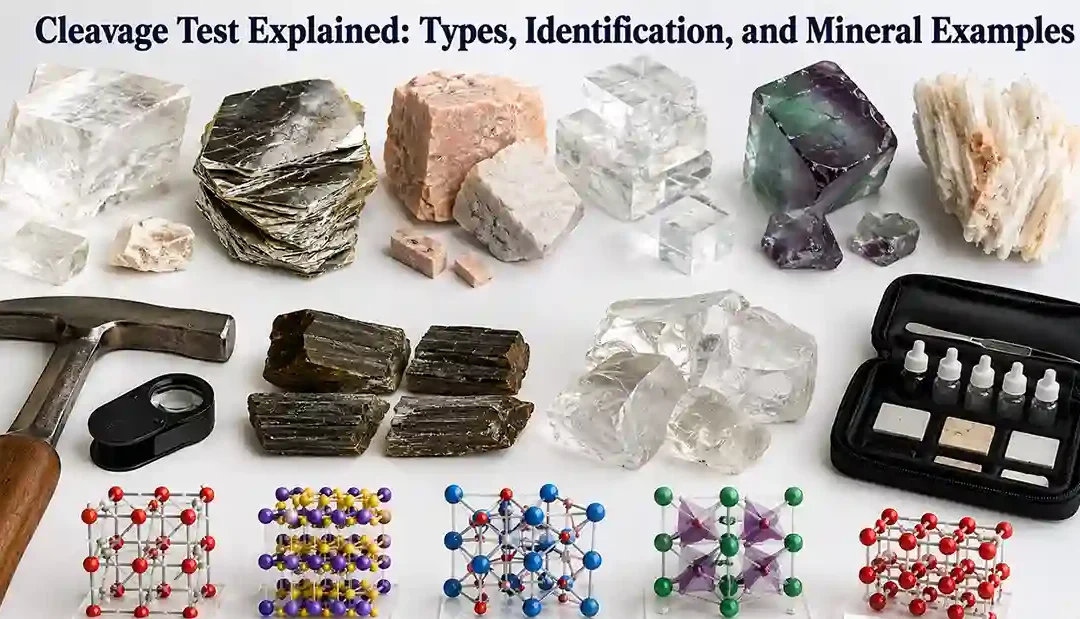
The cleavage test is one of the most useful techniques for identifying minerals in both laboratory and field settings. Cleavage describes a mineral's tendency to break along smooth, flat surfaces where atomic bonds within its crystal structure are weaker. Because every mineral has a unique internal arrangement of atoms, cleavage patterns vary from one mineral to another.
Geologists rarely rely on cleavage alone. Instead, they combine it with hardness, streak, luster, crystal habit, and specific gravity to accurately identify unknown mineral specimens. If you're new to mineral identification, this test is an excellent companion to the How to Identify Minerals guide and the Mineral Hardness Test.
What Is Mineral Cleavage?
Mineral cleavage is the tendency of a crystal to split repeatedly along specific planes of weakness within its crystal lattice.
Unlike random breakage, cleavage produces:
- Smooth surfaces
- Flat reflective planes
- Predictable breakage directions
The number of cleavage directions and the angles between them are often unique for each mineral.
Why Do Minerals Show Cleavage?
Minerals are made of atoms arranged in repeating three-dimensional crystal structures. Where atomic bonds are weak, minerals split easily. Where bonds are equally strong in every direction, minerals usually fracture instead of showing cleavage.
This explains why mica separates into thin sheets while quartz breaks irregularly.
For a better understanding of atomic arrangements, see our Crystal Systems Explained article.
Types of Cleavage
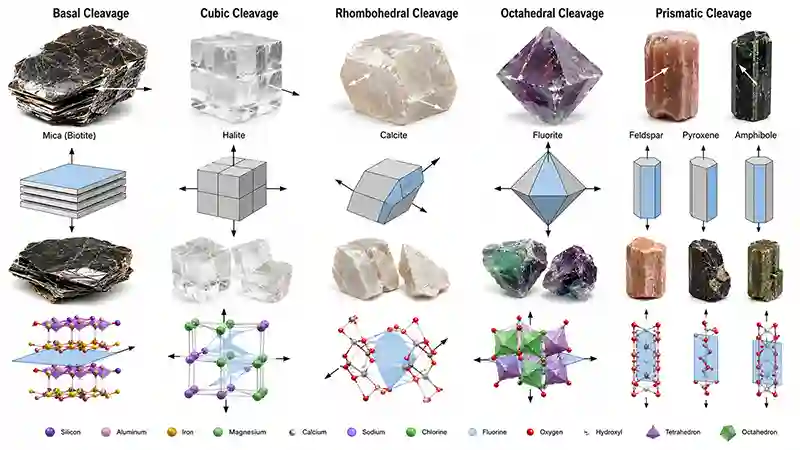
Different minerals display different qualities of cleavage.
Perfect Cleavage
Minerals separate very easily into smooth surfaces.
Examples:
- Muscovite
- Biotite
- Halite
Good Cleavage
Breakage is generally smooth but less perfect.
Examples:
- Orthoclase Feldspar
- Plagioclase Feldspar
Distinct Cleavage
Visible but not always well developed.
Examples:
- Pyroxene
- Amphibole
Poor Cleavage
Only weak cleavage is visible.
Example:
- Apatite
No Cleavage
Minerals break irregularly.
Examples:
- Quartz
- Garnet
- Olivine
Cleavage Directions
The number of cleavage directions is another important identification feature.
| Cleavage Directions | Example Minerals |
|---|---|
| One | Muscovite, Biotite |
| Two | Feldspar, Amphibole, Pyroxene |
| Three (90°) | Halite, Galena |
| Three (Not 90°) | Calcite |
| Four | Fluorite |
| Six | Sphalerite |
Cleavage vs Fracture
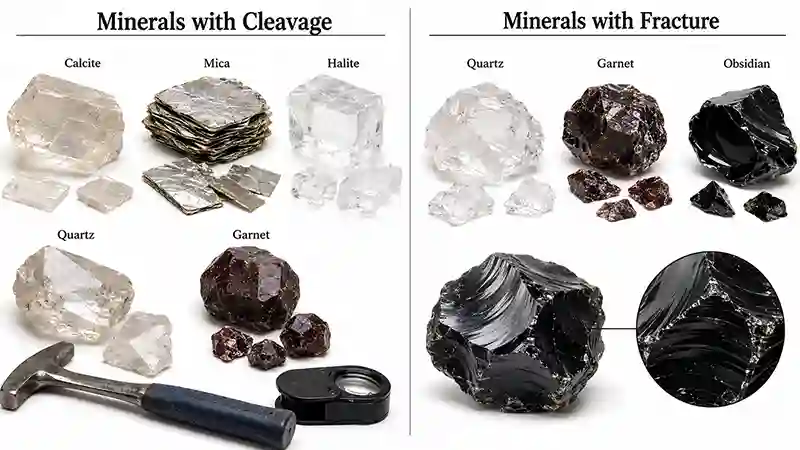
Many beginners confuse cleavage with fracture.
| Cleavage | Fracture |
| Smooth, flat surfaces | Irregular surfaces |
| Controlled by crystal structure | Random breakage |
| Predictable | Unpredictable |
| Common in many minerals | Seen in minerals without cleavage |
Quartz is a classic example of a mineral with no cleavage. Instead, it displays conchoidal fracture.
How to Perform a Cleavage Test
Follow these simple steps:
- Examine a fresh broken surface.
- Look for smooth, reflective planes.
- Count the number of cleavage directions.
- Observe the angles between planes.
- Compare your observations with mineral identification charts.
Always examine freshly broken surfaces because weathering may hide cleavage.
Common Minerals and Their Cleavage
| Mineral | Cleavage |
| Muscovite | One Perfect |
| Biotite | One Perfect |
| Halite | Three at 90° |
| Calcite | Three not at 90° |
| Feldspar | Two nearly 90° |
| Amphibole | Two at 56° and 124° |
| Pyroxene | Two nearly 90° |
| Fluorite | Four Perfect |
| Quartz | None |
| Garnet | None |
Why the Cleavage Test Is Important
The cleavage test helps geologists:
- Identify unknown minerals
- Differentiate similar-looking minerals
- Understand crystal structure
- Improve field identification
- Support laboratory analysis
It is most effective when combined with the Streak Test, Mineral Hardness Test, and Luster Test.
Quick Comparison Table
| Property | Cleavage Test |
| Purpose | Mineral Identification |
| Best Observed On | Fresh Broken Surface |
| Based On | Crystal Structure |
| Reliable | Yes |
| Used With | Hardness, Streak, Luster |
Summary Table
| Feature | Cleavage |
| Definition | Breaking along planes of weakness |
| Controlled By | Crystal Structure |
| Surface | Smooth and Flat |
| Identification Value | Very High |
| Common Minerals | Mica, Calcite, Halite, Feldspar |
It is a mineral identification test that examines how a mineral breaks along flat planes of weakness.
Cleavage helps distinguish minerals that may have similar colors or crystal shapes.
Muscovite mica is one of the best examples of perfect basal cleavage.
No. Quartz has no cleavage and breaks with a conchoidal fracture.
No. Cleavage is determined by the mineral's internal crystal structure and remains constant.
Final Thoughts
The cleavage test is one of the most dependable methods for identifying minerals because it reflects their internal atomic structure. Whether examining the sheet-like cleavage of mica, the cubic cleavage of halite, or the rhombohedral cleavage of calcite, recognizing these patterns makes mineral identification faster and more accurate.
For the best results, always combine cleavage observations with other physical properties. Continue your learning with our How to Identify Minerals, Mineral Hardness Test, and Streak Test Explained guides to build a complete understanding of mineral identification.