
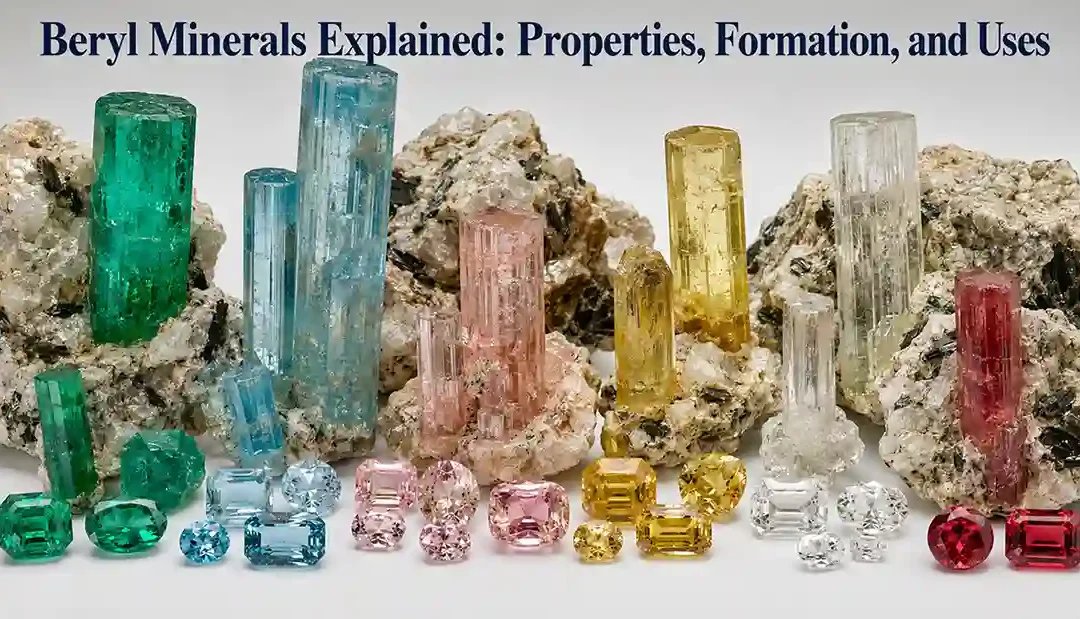
Beryl is one of the most important gemstone mineral groups in the world. It includes several famous gemstones such as emerald, aquamarine, morganite, heliodor, and goshenite.
The mineral is valued for:
- exceptional crystal quality
- beautiful colors
- gemstone transparency
- industrial importance
- beryllium content
Many of the world's most valuable colored gemstones belong to the beryl family.
What Are Beryl Minerals?
Beryl is a beryllium aluminum cyclosilicate mineral that occurs in a variety of colors depending on trace elements present within its crystal structure.
Beryl is known for:
- large crystal size
- hexagonal crystal habit
- gemstone varieties
- high hardness
- geological significance
Chemical Formula of Beryl
The chemical formula of beryl is: Be₃Al₂Si₆O₁₈
This structure contains rings of silicate tetrahedra that form channels within the crystal.
Beryl Mineral Profile
| Property | Value |
|---|---|
| Mineral Group | Cyclosilicate |
| Chemical Formula | Be₃Al₂Si₆O₁₈ |
| Hardness | 7.5–8 |
| Crystal System | Hexagonal |
| Luster | Vitreous |
| Streak | White |
| Specific Gravity | 2.6–2.9 |
| Transparency | Transparent to Opaque |
Major Beryl Varieties
Different trace elements produce different colors.
Emerald
Green beryl colored by chromium and vanadium.
Formula:
Same as beryl:
Color:
- deep green
- bluish green
Aquamarine
Blue beryl colored by iron.
Color:
- sky blue
- ocean blue
- blue-green
Morganite
Pink beryl colored by manganese.
Color:
- pink
- peach
- salmon
Heliodor
Yellow beryl colored by iron.
Color:
- golden yellow
- greenish yellow
Goshenite
Colorless variety of beryl.
Color:
- clear
- transparent
Red Beryl
Rare red variety colored by manganese.
Color:
- red
- crimson red
One of the rarest gemstones on Earth.
Beryl Varieties
| Variety | Color |
|---|---|
| Emerald | Green |
| Aquamarine | Blue |
| Morganite | Pink |
| Heliodor | Yellow |
| Goshenite | Colorless |
| Red Beryl | Red |
Crystal Structure
Beryl crystallizes in the hexagonal crystal system.
Characteristics include:
- six-sided crystals
- long prismatic habit
- striated crystal faces
- large crystal sizes
Learn more → hexagonal-crystal-system
Physical Properties
Luster
Vitreous.
Cleavage
Poor.
Fracture
Conchoidal to uneven.
Transparency
Transparent to opaque.
Its hardness and durability make beryl excellent for gemstones.
Formation of Beryl
Beryl forms in several geological environments.
Granite Pegmatites
Most important source.
Hydrothermal Veins
Crystals form from mineral-rich fluids.
Metamorphic Rocks
Especially emerald-bearing deposits.
Greisen Systems
Associated with granitic intrusions.
Most gem-quality beryl develops in pegmatites and hydrothermal environments.
Why Beryl Forms Large Crystals
Beryl is famous for producing enormous crystals. Some crystals exceed in length.
Large crystals form because:
- pegmatites cool slowly
- mineral-rich fluids remain available
- crystal growth continues for long periods
Major Sources of Beryl
Important beryl-producing countries include:
- Brazil
- Colombia
- Zambia
- Madagascar
- Pakistan
- Afghanistan
- United States
Emerald: The Most Famous Beryl
Emerald is the most valuable member of the beryl family.
It is prized for:
- intense green color
- rarity
- historical significance
- jewelry applications
Learn more → emerald-mineral-explained
Aquamarine: The Ocean Gem
Aquamarine is among the most popular blue gemstones.
Characteristics:
- excellent transparency
- attractive blue color
- good durability
Learn more → aquamarine-mineral-explained
Morganite: The Pink Beryl
Morganite has become increasingly popular in jewelry because of its:
- soft pink color
- excellent clarity
- affordability
Learn more → morganite-mineral-explained
Industrial Uses of Beryl
Besides gemstones, beryl is an important ore of Beryllium (Be)
Beryllium is used in:
- aerospace technology
- electronics
- nuclear applications
- defense systems
- X-ray equipment
Beryl remains one of the most important commercial sources of beryllium.
Beryl vs Quartz
| Property | Beryl | Quartz |
|---|---|---|
| Hardness | 7.5–8 | 7 |
| Crystal System | Hexagonal | Trigonal |
| Formula | Be₃Al₂Si₆O₁₈ | SiO₂ |
| Cleavage | Poor | None |
Beryl is generally harder than quartz.
Beryl Mining and Gemstones
Gem-quality beryl is commonly mined from:
- pegmatites
- hydrothermal veins
- metamorphic deposits
- alluvial gravels
Large transparent crystals are cut into valuable gemstones.
Why Beryl Is Important
Beryl remains significant because of:
- world-famous gemstones
- industrial beryllium production
- geological importance
- exceptional crystal size
- collector interest
Few mineral groups contribute as much to both geology and gemology.
Beryl Identification Summary
| Property | Beryl |
|---|---|
| Formula | Be₃Al₂Si₆O₁₈ |
| Hardness | 7.5–8 |
| Crystal System | Hexagonal |
| Streak | White |
| Luster | Vitreous |
| Key Feature | Hexagonal Prismatic Crystals |
Beryl is a beryllium aluminum silicate mineral that includes emerald, aquamarine, and several other gemstone varieties.
The formula is Be₃Al₂Si₆O₁₈.
Emerald, aquamarine, morganite, heliodor, goshenite, and red beryl are all varieties of beryl.
Beryl has a Mohs hardness of approximately 7.5–8.
Beryl is valuable both as a gemstone mineral and as a major source of beryllium used in advanced technology.
Final Thoughts
Beryl is one of the most important mineral groups in geology and gemology. From the deep green beauty of emerald to the ocean-blue brilliance of aquamarine and the delicate pink tones of morganite, the beryl family showcases an extraordinary range of colors and gemstone varieties.
Its role as both a precious gemstone source and an industrial beryllium ore makes beryl one of the most significant mineral groups on Earth. Whether studied by geologists, collected by mineral enthusiasts, or worn as jewelry, beryl continues to captivate people worldwide.