
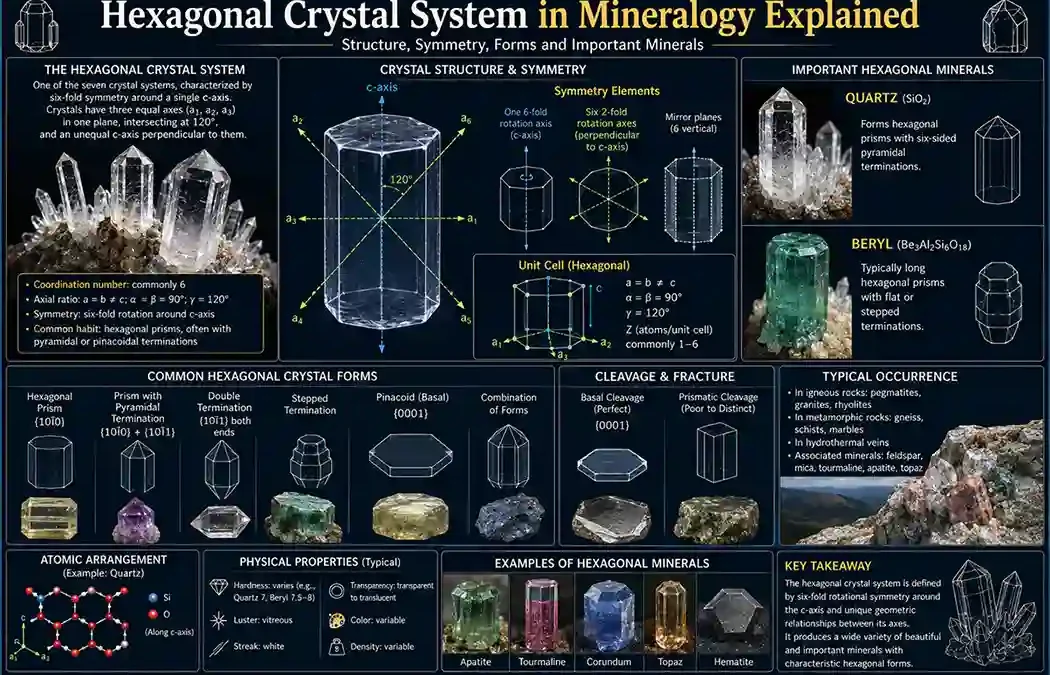
The Hexagonal Crystal System is one of the seven major crystal systems in mineralogy and crystallography. It is known for its distinctive six-fold symmetry and beautiful six-sided crystal shapes.
Many famous minerals belong to the hexagonal system, including:
- Quartz
- Beryl
- Apatite
- Graphite
The hexagonal crystal system is especially important because quartz, one of the most abundant minerals in Earth's crust, crystallizes in this system.
Geologists use crystal symmetry and crystal forms to identify minerals and understand how they formed.
Learn more → crystal systems explained
What Is the Hexagonal Crystal System?
The hexagonal crystal system is a crystal system with four crystal axes and six-fold symmetry
Its crystallographic relationship can be expressed as:
a1=a2=a3=c
Key Characteristics
- Four crystal axes
- Three equal horizontal axes
- One vertical axis
- Six-fold rotational symmetry
- Six-sided crystal forms
Hexagonal Crystal System Properties
| Property | Value |
|---|---|
| Crystal Axes | 4 |
| Equal Horizontal Axes | 3 |
| Vertical Axis | 1 |
| Symmetry | Six-fold |
| Common Shape | Hexagonal prism |
Why Hexagonal Crystals Have Six Sides
The three equal horizontal axes intersect at 120°
This arrangement creates:
- six-sided symmetry
- hexagonal crystal outlines
- characteristic prism shapes
As crystals grow, this internal symmetry produces the recognizable hexagonal forms seen in many minerals.
Common Crystal Forms
Hexagonal Prism
The most common crystal form.
Characteristics:
- six rectangular sides
- elongated crystal shape
- flat or pointed ends
Hexagonal Pyramid
A pointed crystal termination composed of triangular crystal faces. Many minerals combine prisms and pyramids during growth.
Common Hexagonal Crystal Forms
| Crystal Form | Appearance |
|---|---|
| Hexagonal Prism | Six-sided column |
| Hexagonal Pyramid | Pointed termination |
| Prism + Pyramid | Typical quartz crystal |
Quartz: The Most Famous Hexagonal Mineral
Quartz is the best-known mineral in the hexagonal crystal system.
Characteristics
- Six-sided prisms
- Pyramid-shaped ends
- Hardness of 7
- Common rock-forming mineral
Quartz is found in:
- igneous rocks
- metamorphic rocks
- sedimentary rocks
Beryl and the Hexagonal System
Beryl also crystallizes in the hexagonal system.
Gemstone Varieties
- Emerald
- Aquamarine
- Morganite
Beryl often forms:
- long hexagonal prisms
- well-developed crystal faces
These crystals can grow to impressive sizes.
Apatite Crystals
Apatite is another common hexagonal mineral.
Importance
- Source of phosphorus
- Used in fertilizers
- Common accessory mineral
Its crystal shape often reflects hexagonal symmetry.
Common Minerals of the Hexagonal System
| Mineral | Typical Crystal Form |
|---|---|
| Quartz | Prism + Pyramid |
| Beryl | Hexagonal Prism |
| Apatite | Prism |
| Graphite | Hexagonal Plates |
| Nepheline | Prism |
Hexagonal vs Trigonal Crystal System
| Property | Hexagonal | Trigonal |
|---|---|---|
| Symmetry | Six-fold | Three-fold |
| Crystal Shape | Six-sided | Rhombohedral |
| Common Mineral | Quartz | Calcite |
The trigonal system is closely related to the hexagonal system but has lower symmetry.
Learn more → crystal systems explained
Crystal Structure and Hexagonal Symmetry
The hexagonal system is controlled by the crystal structure
Atomic arrangement determines:
- crystal symmetry
- crystal faces
- growth direction
- crystal habit
This is why quartz consistently develops six-sided crystals.
Learn more → crystal structure in minerals
Symmetry Comparison
SymmetryIsometric>SymmetryHexagonal>SymmetryOrthorhombic
The hexagonal system possesses relatively high symmetry among the seven crystal systems.
Importance of the Hexagonal Crystal System
The hexagonal system is important in:
- mineral identification
- crystallography
- gemstone studies
- petrology
- materials science
Many economically important minerals belong to this crystal system.
Hexagonal Minerals in Geology
Geologists study hexagonal minerals to understand:
- rock formation
- magma crystallization
- metamorphic processes
- gemstone formation
Quartz alone makes the hexagonal system one of the most significant crystal systems in Earth science.
Learn more → mineral classification system
It is a crystal system with four axes and six-fold rotational symmetry.
Quartz is the best-known mineral in the hexagonal crystal system.
Their internal crystal symmetry produces six-sided crystal growth.
Yes. Beryl crystallizes in the hexagonal crystal system.
There are seven major crystal systems in mineralogy.
Final Thoughts
The Hexagonal Crystal System is one of the most recognizable crystal systems in mineralogy, known for its six-fold symmetry and beautiful six-sided crystal forms.
From quartz and beryl to apatite and graphite, hexagonal minerals play a major role in geology, gemstone studies, and Earth science. Understanding this crystal system helps explain how crystal symmetry influences the shape and appearance of minerals.
Continue learning with → crystal systems explained and crystal structure in minerals.