
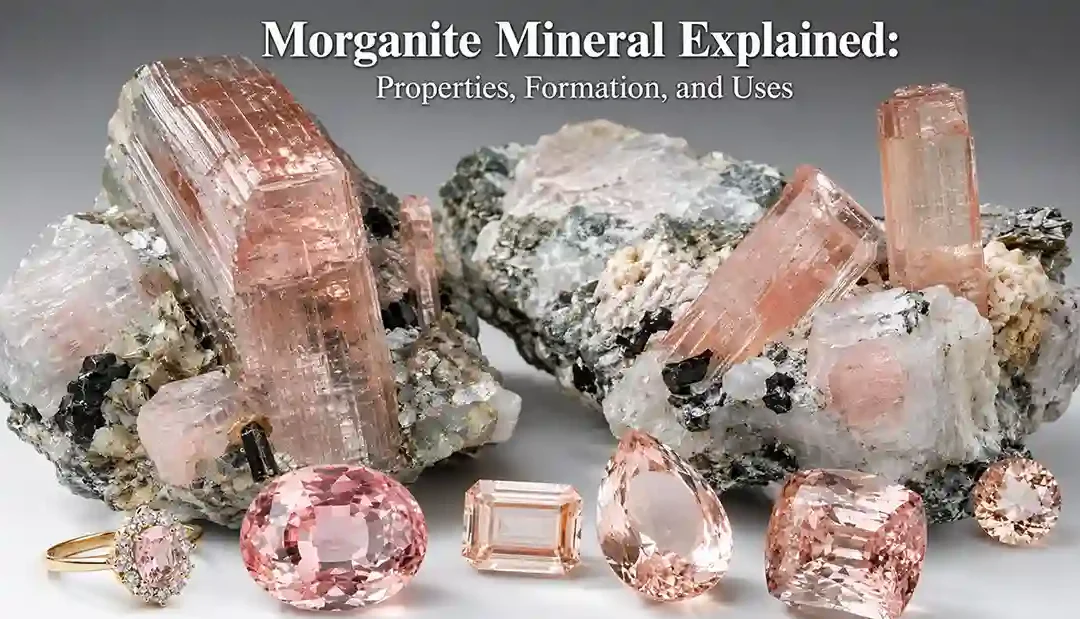
Morganite is a beautiful pink-to-peach gemstone variety of the mineral beryl. Known for its delicate pastel colors and exceptional clarity, morganite has become increasingly popular in fine jewelry, particularly engagement rings and luxury gemstone collections.
Morganite belongs to the same mineral family as:
- emerald
- aquamarine
- heliodor
- goshenite
Its soft pink appearance, rarity, and durability make it one of the most sought-after colored gemstones in the world.
What Is Morganite?
Morganite is the pink, peach, or salmon-colored variety of the mineral beryl.
Its attractive color is caused primarily by trace amounts of manganese within the crystal structure.
Morganite is valued for:
- delicate pink color
- gemstone transparency
- excellent durability
- large crystal size
- jewelry applications
Morganite Mineral Profile
| Property | Value |
|---|---|
| Mineral Group | Beryl |
| Chemical Formula | Be₃Al₂Si₆O₁₈ |
| Color | Pink, Peach, Salmon |
| Hardness | 7.5–8 |
| Crystal System | Hexagonal |
| Luster | Vitreous |
| Streak | White |
| Specific Gravity | 2.7–2.9 |
Discovery of Morganite
Morganite was first recognized as a distinct gemstone variety in the early 20th century. It was named after J. P. Morgan. The name was proposed by renowned mineralogist George Frederick Kunz to honor Morgan's support of mineralogical collections and scientific research.
What Causes Morganite's Pink Color?
The characteristic color results primarily from:
Manganese (Mn)
Trace amounts create pink and peach hues.
Additional factors include:
- crystal chemistry
- trace element concentrations
- natural radiation exposure
Color ranges from pale pink to rich peach-orange.
Crystal Structure
Morganite crystallizes in the Hexagonal Crystal System.
Characteristics include:
- long prismatic crystals
- hexagonal symmetry
- well-developed crystal faces
- large transparent crystals
Learn more → hexagonal-crystal-system
Physical Properties
Hardness
Luster
Vitreous (glass-like).
Transparency
Transparent to translucent.
Cleavage
Poor to indistinct.
Fracture
Conchoidal to uneven.
Its relatively high hardness makes morganite suitable for everyday jewelry wear.
Formation of Morganite
Morganite typically forms in:
Granite Pegmatites
Large crystals grow in slowly cooled magma.
Hydrothermal Systems
Mineral-rich fluids promote crystal growth.
Rare Beryllium Deposits
Beryllium-rich environments are essential.
These geological settings also produce other gemstones such as aquamarine and emerald.
Where Is Morganite Found?
Major sources include:
- Brazil
- Madagascar
- Afghanistan
- Mozambique
- Namibia
- United States
Brazil and Madagascar are among the most important modern sources.
Morganite vs Pink Tourmaline
| Property | Morganite | Pink Tourmaline |
|---|---|---|
| Mineral Group | Beryl | Tourmaline |
| Hardness | 7.5–8 | 7–7.5 |
| Crystal System | Hexagonal | Trigonal |
| Color | Soft Pink-Peach | Bright Pink |
| Clarity | Often Excellent | Variable |
Morganite generally exhibits softer pastel colors and greater transparency.
Morganite vs Rose Quartz
| Property | Morganite | Rose Quartz |
|---|---|---|
| Mineral Group | Beryl | Quartz |
| Hardness | 7.5–8 | 7 |
| Transparency | Transparent | Usually Translucent |
| Crystal Quality | Gem Grade | Rarely Gem Grade |
Morganite is typically more valuable because of its clarity and rarity.
Morganite and the Beryl Family
Morganite belongs to the famous beryl group.
Other varieties include:
| Variety | Color |
|---|---|
| Emerald | Green |
| Aquamarine | Blue |
| Morganite | Pink |
| Heliodor | Yellow |
| Goshenite | Colorless |
All share the same chemical formula but differ because of trace elements.
Morganite in Jewelry
Morganite is widely used in:
- engagement rings
- pendants
- necklaces
- earrings
- luxury gemstone jewelry
Its soft pink color pairs especially well with:
- rose gold
- white gold
- platinum
Factors Affecting Morganite Value
Color
Rich pink and peach colors are preferred.
Clarity
Eye-clean stones command higher prices.
Cut
Well-cut gems maximize brilliance.
Carat Weight
Large stones are more valuable.
Origin
Certain localities may command premiums.
Heat Treatment
Many morganite gemstones are heat treated.
Benefits include:
- removing yellow tones
- enhancing pink coloration
- improving appearance
This treatment is stable and widely accepted in the gemstone trade.
Morganite Mining and Gemstones
Morganite is commonly recovered from:
- pegmatite mines
- gemstone-bearing granite bodies
- weathered pegmatite deposits
Large transparent crystals can yield impressive gemstones.
Why Morganite Is Popular
Morganite has gained popularity because of:
- romantic pink color
- excellent durability
- gemstone clarity
- affordability compared with some precious gems
- growing demand for colored gemstones
It has become one of the fastest-growing gemstone choices in modern jewelry.
Morganite Identification Summary
| Property | Morganite |
|---|---|
| Mineral Group | Beryl |
| Formula | Be₃Al₂Si₆O₁₈ |
| Color | Pink to Peach |
| Hardness | 7.5–8 |
| Crystal System | Hexagonal |
| Streak | White |
| Luster | Vitreous |
Morganite is the pink-to-peach gemstone variety of the mineral beryl.
Trace amounts of manganese within the crystal structure produce its pink and peach coloration.
Yes. Morganite and emerald are both varieties of beryl.
Morganite has a Mohs hardness of approximately 7.5–8.
Major sources include Brazil, Madagascar, Afghanistan, Mozambique, Namibia, and the United States.
Final Thoughts
Morganite is one of the most elegant members of the beryl family. Its soft pink color, excellent clarity, and durable crystal structure make it a favorite among gemstone collectors and jewelry designers.
From granite pegmatites deep within Earth's crust to sparkling gemstones in luxury jewelry, morganite showcases the beauty and diversity of mineral formation. Its growing popularity ensures that this remarkable pink gemstone will remain highly valued for years to come.
Continue learning with → /aquamarine-mineral-explained/, and /emerald-mineral-explained/.