
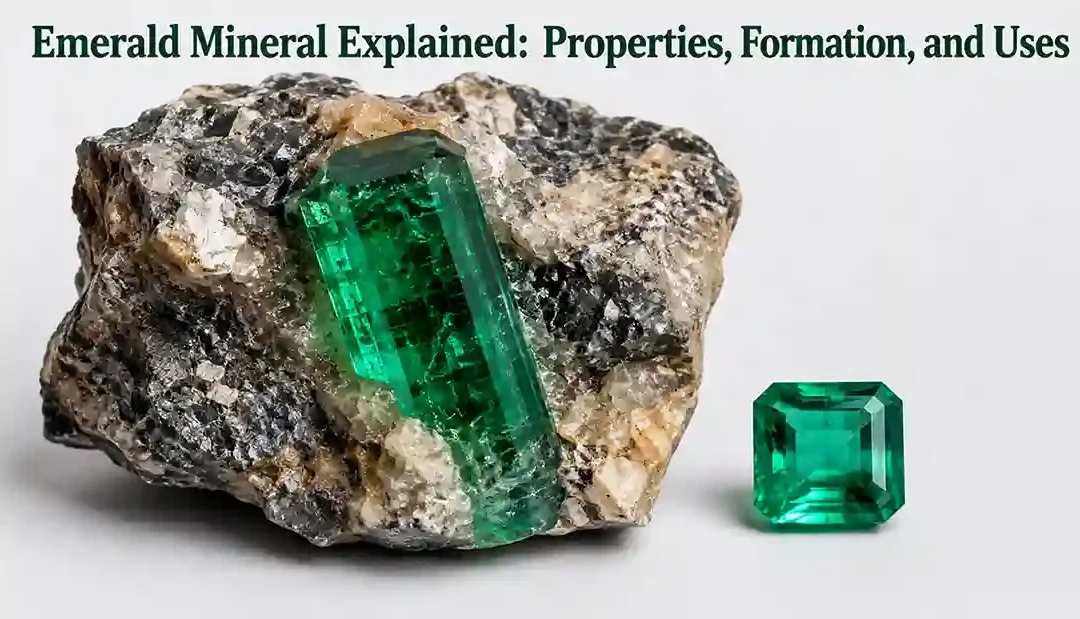
Emerald is one of the world's most famous and valuable gemstones. It is the green variety of the mineral beryl and is prized for its rich color, rarity, and historical significance.
For thousands of years, emerald has symbolized:
- wealth
- royalty
- wisdom
- renewal
Emerald belongs to the same mineral family as aquamarine and morganite, but its vivid green color makes it one of the most recognizable gemstones on Earth.
What Is Emerald?
Emerald is the green gemstone variety of beryl. Its chemical formula is:
Emerald contains:
- beryllium
- aluminum
- silicon
- oxygen
Its green color comes primarily from:
- chromium (Cr)
- vanadium (V)
Basic Properties of Emerald
| Property | Value |
|---|---|
| Chemical Formula | Be₃Al₂Si₆O₁₈ |
| Mineral Group | Cyclosilicate |
| Crystal System | Hexagonal |
| Hardness | 7.5–8 |
| Streak | White |
| Luster | Vitreous |
Why Is Emerald Green?
Chromium and Vanadium Create the Color
Pure beryl is colorless.
When trace amounts of chromium or vanadium replace aluminum in the crystal structure, emerald develops its famous green coloration.
Colors range from:
- light green
- bluish green
- vivid green
- deep emerald green
The most valuable emeralds display intense, saturated green colors.
Crystal Structure of Emerald
Emerald belongs to the beryl mineral family.
Its structure contains:
- rings of silicate tetrahedra
- aluminum atoms
- beryllium atoms
This arrangement forms:
- hexagonal crystals
- excellent transparency
- gemstone-quality specimens
Learn more → crystal structure in minerals
Crystal System of Emerald
Emerald belongs to the hexagonal crystal system. Its crystallographic relationship is:
Common crystal habits include:
- hexagonal prisms
- columnar crystals
- elongated crystals
Learn more → hexagonal crystal system
Physical Properties of Emerald
| Property | Description |
|---|---|
| Color | Green to bluish green |
| Streak | White |
| Luster | Vitreous |
| Hardness | 7.5–8 |
| Cleavage | Poor |
| Transparency | Transparent to translucent |
| Specific Gravity | 2.7–2.8 |
Emerald and Inclusions
The Emerald Garden
Most natural emeralds contain:
- fractures
- fluid inclusions
- mineral inclusions
These internal features are often called Jardin (French for "garden"). Unlike many gemstones, inclusions are common and expected in natural emeralds.
How Emerald Forms
Hydrothermal Processes
Mineral-rich fluids deposit emerald crystals.
Metamorphic Processes
Many deposits form during regional metamorphism.
Pegmatitic Activity
Emerald may form where pegmatites interact with surrounding rocks.
Tectonic Activity
Faults and fractures provide pathways for mineral-rich fluids.
Geological Conditions Required for Emerald
Emerald formation is unusual because it requires:
- beryllium-rich sources
- chromium or vanadium sources
- suitable fluids
- specific geological conditions
These elements rarely occur together, making emerald relatively rare.
Famous Emerald-Producing Countries
Major emerald sources include:
- Colombia
- Zambia
- Brazil
- Afghanistan
- Pakistan
- Ethiopia
Colombia is widely regarded as the source of some of the world's finest emeralds.
Emerald vs Other Beryl Varieties
| Variety | Color |
|---|---|
| Emerald | Green |
| Aquamarine | Blue |
| Morganite | Pink |
| Heliodor | Yellow |
| Goshenite | Colorless |
All belong to the same mineral species, beryl.
Industrial and Gemstone Uses
Jewelry
The primary use of emerald.
Mineral Collections
Highly prized by collectors.
Museum Displays
Important gemstone specimens.
Scientific Research
Studied for inclusions and formation processes.
Major Uses of Emerald
| Industry | Application |
|---|---|
| Jewelry | Gemstones |
| Museums | Displays |
| Collecting | Mineral specimens |
| Research | Geological studies |
Emerald Value Factors
The value of emerald depends on:
Color
The most important factor.
Clarity
Fewer inclusions generally increase value.
Cut
Affects brilliance and appearance.
Carat Weight
Larger stones are rarer and more valuable.
Emerald in Mineral Identification
Geologists identify emerald using:
- vivid green color
- hexagonal crystals
- hardness of 7.5–8
- vitreous luster
- beryl crystal habit
Chromium and vanadium content help distinguish emerald from other green gemstones.
Learn more → mineral identification guide
Emerald Identification Summary
| Property | Emerald |
|---|---|
| Formula | Be₃Al₂Si₆O₁₈ |
| Hardness | 7.5–8 |
| Crystal System | Hexagonal |
| Color | Green |
| Luster | Vitreous |
| Mineral Group | Cyclosilicate |
Emerald is the green variety of beryl with the formula Be₃Al₂Si₆O₁₈.
Emerald gets its green color from trace amounts of chromium and vanadium.
Emerald is the gemstone variety of the mineral beryl.
Emerald belongs to the hexagonal crystal system.
Most natural emeralds form with fractures and inclusions due to their complex geological environment.
Final Thoughts
Emerald is one of the most treasured gemstones in human history and a remarkable variety of the mineral beryl. Its vivid green color, rarity, and unique geological formation make it both scientifically fascinating and economically valuable.
From hydrothermal mineral deposits deep within Earth's crust to some of the world's most famous jewelry collections, emerald showcases the extraordinary beauty and complexity of mineral formation.