
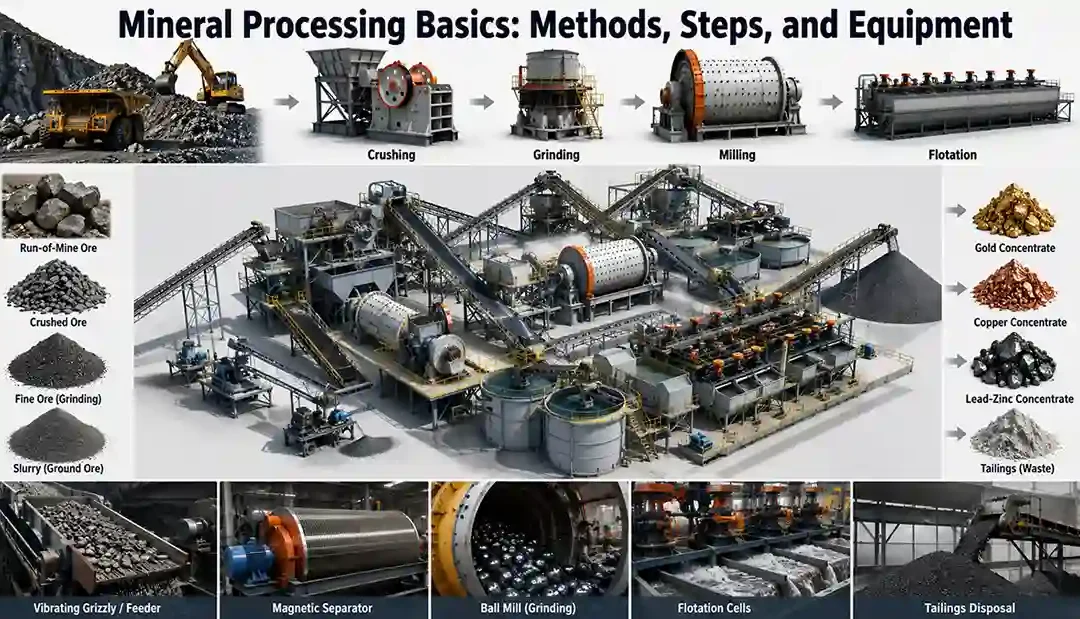
Mining removes ore from the ground, but the ore often contains only a small percentage of valuable minerals. Before metals can be extracted, the valuable minerals must be separated from waste rock through a process known as mineral processing.
Mineral processing is one of the most important stages in mining because it increases the concentration of valuable minerals and improves the efficiency of metal extraction.
Almost every metal-producing mine uses mineral processing techniques before refining.
What Is Mineral Processing?
Mineral processing is the science and engineering of separating valuable minerals from ore and waste rock.
It is also called:
- ore dressing
- mineral beneficiation
- ore processing
The goal is to produce a concentrated product that contains a much higher percentage of valuable minerals than the original ore.
Why Mineral Processing Is Important
Mineral processing helps:
Increase Ore Value
Concentrates valuable minerals.
Reduce Transportation Costs
Less waste material is transported.
Improve Metal Recovery
More metal can be extracted.
Increase Mine Profitability
Higher-grade concentrates generate greater value.
Without mineral processing, many ore deposits would be uneconomic.
Mining vs Processing vs Metallurgy
| Stage | Purpose |
|---|---|
| Mining | Extract Ore |
| Mineral Processing | Concentrate Minerals |
| Metallurgy | Extract Metals |
The Mineral Processing Workflow
Most processing plants follow a similar sequence:
1. Crushing
Reduce ore size.
2. Grinding
Liberate minerals.
3. Classification
Separate particles by size.
4. Concentration
Separate valuable minerals.
5. Dewatering
Remove water.
6. Concentrate Handling
Prepare product for smelting or sale.
Mineral Processing Flow Sheet
| Stage | Main Objective |
|---|---|
| Crushing | Size Reduction |
| Grinding | Mineral Liberation |
| Classification | Size Separation |
| Concentration | Mineral Recovery |
| Dewatering | Water Removal |
| Product Handling | Final Concentrate |
Crushing
First Stage of Processing: Crushing reduces large rocks into smaller fragments.
Common crushers include:
Jaw Crushers
Primary crushing.
Gyratory Crushers
Large-scale operations.
Cone Crushers
Secondary crushing.
Impact Crushers
Specialized applications.
Crushing prepares ore for grinding.
Grinding
After crushing, ore enters grinding circuits.
Grinding liberates mineral grains from surrounding rock.
Common equipment includes:
Ball Mills
Most common grinding equipment.
SAG Mills
Semi-autogenous grinding.
Rod Mills
Specialized grinding applications.
Grinding is often the most energy-intensive stage of mineral processing.
Mineral Liberation
Key Processing Concept: Liberation occurs when valuable minerals become separated from waste minerals. Higher liberation generally improves recovery.
The required grind size depends on:
- mineral type
- ore texture
- mineral grain size
Classification
Classification separates particles according to size.
Common equipment:
Hydrocyclones
Most widely used.
Screens
Mechanical size separation.
Classifiers
Control grinding circuits.
Classification ensures that material receives the proper amount of grinding.
Concentration Methods
Concentration separates valuable minerals from waste material. Several methods are used depending on mineral properties.
Gravity Separation
Uses differences in density.
Suitable for:
- gold
- tin
- tungsten
- heavy minerals
Common equipment:
- shaking tables
- spirals
- jigs
Magnetic Separation
Uses magnetic properties.
Suitable for:
- magnetite
- hematite
- ilmenite
Magnetic separators recover magnetic minerals efficiently.
Flotation
Flotation separates minerals based on surface chemistry.
Widely used for:
- copper
- lead
- zinc
- nickel
- molybdenum
Fine air bubbles attach to valuable minerals and carry them to the surface.
Electrostatic Separation
Uses electrical conductivity differences.
Commonly used for:
- rutile
- zircon
- heavy mineral sands
Dense Media Separation
Uses density differences in a heavy liquid medium.
Common applications:
- diamonds
- coal
- industrial minerals
Major Concentration Methods
| Method | Property Used |
|---|---|
| Gravity Separation | Density |
| Magnetic Separation | Magnetism |
| Flotation | Surface Chemistry |
| Electrostatic Separation | Conductivity |
| Dense Media Separation | Density |
Flotation Process
A typical flotation circuit involves:
Reagents
Modify mineral surfaces.
Air Injection
Creates bubbles.
Froth Formation
Minerals attach to bubbles.
Concentrate Recovery
Valuable minerals are collected.
Flotation is one of the most effective methods for sulfide ores.
Dewatering
After concentration, water must be removed.
Methods include:
Thickening
Settles solids.
Filtration
Removes excess water.
Drying
Produces final concentrate.
Dewatering reduces transportation and handling costs.
Mineral Processing Equipment
Common equipment includes:
- crushers
- grinding mills
- flotation cells
- hydrocyclones
- magnetic separators
- filters
- thickeners
These systems work together to maximize mineral recovery.
Common Minerals Processed
Mineral processing is used for:
Copper Ores
Flotation concentration.
Gold Ores
Gravity and flotation methods.
Iron Ores
Magnetic separation.
Lead-Zinc Ores
Flotation recovery.
Rare Earth Ores
Specialized processing circuits.
Lithium Ores
Dense media and flotation methods.
Recovery and Grade
Two important processing terms are:
Recovery
Percentage of valuable mineral recovered.
Grade
Concentration of valuable mineral in the product.
Processing plants aim to maximize both recovery and grade.
Modern Trends in Mineral Processing
Modern plants increasingly use:
- automation
- artificial intelligence
- real-time sensors
- advanced process control
- machine learning
These technologies improve efficiency and reduce costs.
Why Mineral Processing Matters
Mineral processing:
- increases resource utilization
- reduces waste
- improves metal recovery
- lowers operating costs
- supports sustainable mining
It is a critical link between mining and metallurgy.
Mineral Processing Summary
| Step | Main Purpose |
|---|---|
| Crushing | Reduce Size |
| Grinding | Liberate Minerals |
| Classification | Sort by Size |
| Concentration | Recover Minerals |
| Dewatering | Remove Water |
| Product Handling | Final Concentrate |
Mineral processing is the separation of valuable minerals from ore and waste rock to produce a concentrate.
It increases the concentration of valuable minerals and improves metal recovery efficiency.
Mineral liberation occurs when valuable minerals are separated from surrounding waste minerals during grinding.
Flotation is a mineral separation method that uses air bubbles and chemical reagents to recover valuable minerals.
Mineral processing concentrates minerals, while metallurgy extracts metals from those concentrates.
Final Thoughts
Mineral processing is a fundamental part of the mining industry. By crushing, grinding, classifying, and concentrating ore, processing plants transform low-grade rock into valuable mineral concentrates ready for metal extraction.
Whether producing copper, gold, iron, lithium, or rare earth elements, mineral processing plays a vital role in maximizing resource recovery and supporting modern industry. Understanding these basic principles provides an essential foundation for studying mining engineering, economic geology, and metallurgy.
Continue learning with → /mining-and-mineral-extraction/, /ore-deposits-explained/, and /mineral-reserves-explained/.