
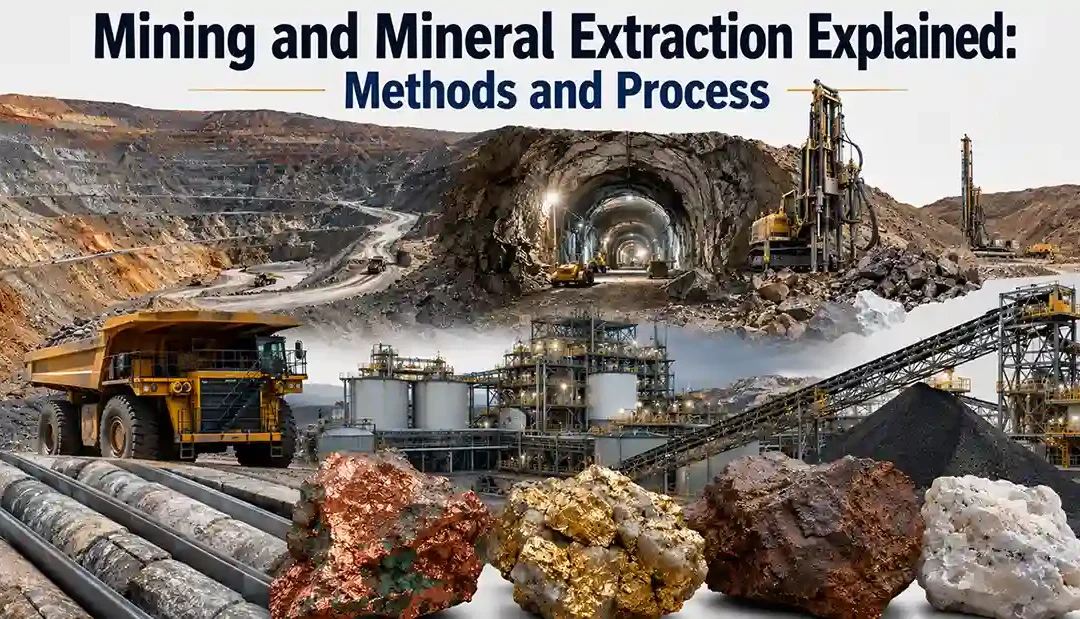
Modern civilization depends heavily on mining and mineral extraction. Every building, road, vehicle, smartphone, battery, and renewable energy system contains materials obtained through mining.
Mining is the process of removing valuable minerals and rocks from Earth's crust, while mineral extraction includes the recovery and processing of useful materials from those mined resources. Without mining, society would lack access to essential metals, industrial minerals, and energy resources.
What Is Mining?
Mining is the process of extracting valuable minerals, metals, rocks, and other geological materials from Earth.
Mining targets:
- metallic minerals
- industrial minerals
- gemstones
- coal
- uranium
- critical minerals
The goal is to recover economically valuable resources from ore deposits.
What Is Mineral Extraction?
Mineral extraction refers to the recovery of useful minerals from mined ore.
It involves:
- Mining the ore
- Crushing and grinding
- Mineral separation
- Concentration
- Refining and processing
Extraction transforms raw ore into usable products.
Mining vs Mineral Extraction
| Process | Purpose |
|---|---|
| Mining | Remove ore from Earth |
| Mineral Extraction | Recover valuable minerals |
| Processing | Produce usable materials |
| Refining | Create pure metals |
Why Mining Is Important
Mining provides raw materials for:
Construction
- iron
- limestone
- gypsum
Technology
- copper
- lithium
- rare earth elements
Transportation
- steel
- aluminum
- nickel
Energy
- coal
- uranium
- battery minerals
The Mining Cycle
The mining process typically follows several stages.
1. Exploration
Geologists search for mineral deposits.
2. Resource Evaluation
Estimate ore size and grade.
3. Mine Planning
Design mining operations.
4. Extraction
Remove ore from the ground.
5. Processing
Separate valuable minerals.
6. Reclamation
Restore the mining site.
Stages of Mining
| Stage | Purpose |
|---|---|
| Exploration | Locate deposits |
| Evaluation | Estimate resources |
| Planning | Design mine |
| Extraction | Remove ore |
| Processing | Recover minerals |
| Reclamation | Restore land |
Surface Mining
Surface mining removes materials close to Earth's surface.
Common types include:
Open-Pit Mining
Large pits excavated from the surface.
Examples:
- copper mines
- gold mines
- iron ore mines
Quarrying
Used for:
- limestone
- granite
- aggregates
Strip Mining
Commonly used for:
- coal
- phosphate
Underground Mining
When ore deposits are deep underground, underground mining is used.
Methods include:
Room and Pillar Mining
Leaves pillars to support the roof.
Cut and Fill Mining
Excavated areas are backfilled.
Block Caving
Large-scale ore extraction method.
Longwall Mining
Widely used for coal.
Underground mining is generally more expensive than surface mining.
Open-Pit vs Underground Mining
| Feature | Open-Pit | Underground |
|---|---|---|
| Cost | Lower | Higher |
| Depth | Shallow Deposits | Deep Deposits |
| Safety | Generally Safer | More Complex |
| Production Rate | Higher | Lower |
Drilling and Blasting
Many mines use:
Drilling
Creates holes in rock.
Blasting
Uses explosives to break rock.
This process makes ore easier to excavate and transport.
Ore Processing
After mining, ore is transported to processing facilities.
Major steps include:
Crushing
Reduce ore size.
Grinding
Liberate minerals.
Concentration
Separate valuable minerals.
Smelting
Extract metals.
Refining
Produce pure metals.
Mineral Processing Methods
Gravity Separation
Uses density differences.
Magnetic Separation
Separates magnetic minerals.
Flotation
Separates sulfide minerals.
Leaching
Uses chemical solutions.
Mining and Critical Minerals
Mining supplies critical minerals such as:
- lithium
- cobalt
- nickel
- graphite
- rare earth elements
These minerals are essential for:
- electric vehicles
- renewable energy
- battery storage
- electronics
Learn more → critical minerals for technology
Environmental Impacts of Mining
Mining can affect:
Land
Landscape changes.
Water
Potential contamination.
Air
Dust generation.
Ecosystems
Habitat disturbance.
Modern mining emphasizes responsible environmental management.
Mine Reclamation
Reclamation restores land after mining.
Activities include:
- reshaping terrain
- replacing topsoil
- planting vegetation
- water management
- habitat restoration
Responsible reclamation reduces long-term environmental impacts.
Mining and Economic Development
Mining contributes to:
- employment
- infrastructure
- industrial growth
- government revenue
- technological development
Many regions depend heavily on mining industries.
Modern Mining Technologies
Modern mining increasingly uses:
- automation
- drones
- artificial intelligence
- remote sensing
- advanced exploration tools
These technologies improve efficiency and safety.
Major Minerals Extracted by Mining
| Mineral Resource | Main Use |
|---|---|
| Iron Ore | Steel |
| Copper | Electricity |
| Gold | Electronics & Investment |
| Lithium | Batteries |
| Coal | Energy |
| Phosphate | Fertilizer |
| Rare Earths | Magnets |
Future of Mining
Future mining will focus on:
- critical minerals
- sustainable extraction
- renewable energy supply chains
- automation
- lower environmental impact
Demand for minerals is expected to increase as technology advances.
Mining is the process of extracting valuable minerals, rocks, and resources from Earth's crust.
Mineral extraction is the recovery and processing of useful minerals from mined ore.
Surface mining removes shallow deposits from the surface, while underground mining accesses deeper deposits through tunnels and shafts.
Ore processing separates valuable minerals from waste rock and prepares materials for refining.
Mining provides the raw materials needed for construction, technology, transportation, energy production, and modern industry.
Final Thoughts
Mining and mineral extraction are fundamental to modern civilization. They provide the metals, industrial minerals, and critical resources needed for infrastructure, manufacturing, renewable energy, and technological innovation.
From exploration and drilling to mineral processing and land reclamation, mining combines geology, engineering, and environmental management to transform Earth's natural resources into materials that support everyday life.
Continue learning with → ore-deposits-explained, and economic-geology-explained.