
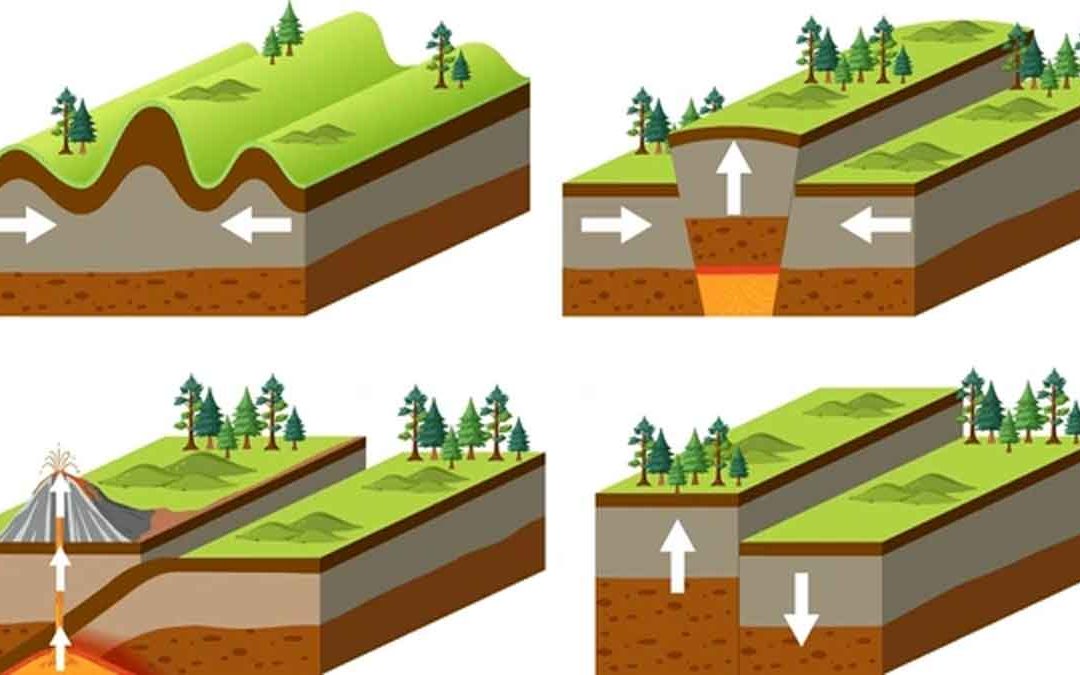
Convergent margins are among the most powerful and dynamic geological features on Earth. They are the places where two tectonic plates move toward each other, creating immense forces that shape the planet's surface over millions of years. These plate interactions are responsible for forming towering mountain ranges, deep ocean trenches, active volcanic arcs, and some of the world's strongest earthquakes. Although tectonic plates move only a few centimeters each year, their continuous motion has transformed Earth's continents and oceans throughout geological history.
Understanding convergent margins is essential for learning how plate tectonics works. Depending on the type of plates involved, one plate may sink beneath another through a process called subduction, or two continental plates may collide and uplift to form massive mountain ranges. These geological processes recycle Earth's crust, generate magma, and create many of the landscapes and natural hazards observed today.
From the snow-capped Himalayas to the volcanic Andes and the Mariana Trench, convergent margins have played a fundamental role in shaping Earth's crust. They are also closely linked to volcanic eruptions, tsunamis, metamorphism, and the formation of valuable mineral deposits, making them one of the most important topics in geology and Earth science.
Convergent Margins:
Convergent margins occur where the adjacent plates move toward each other and the motion is accommodated by one plate overriding the other. In plate tectonics, a convergent boundary, also known as a destructive plate boundary (because of subduction).
As a result of pressure, friction, and plate material melting in the mantle, earthquakes and volcanoes are common near convergent boundaries. When two plates move towards one another, they form either a subduction zone or a nature of the plates involved continental collision. This depends on the type of plates.
In a subduction zone, the subducting plate, which is normally a plate with oceanic crust, moves beneath the other plate. But it can be made of continental crust also. During collisions between two continental plates, large mountain ranges, such as the Himalayas, are formed.
Formation of Convergent Margins:
Convergent margins develop as tectonic plates slowly move toward one another across Earth's surface. Although these plates travel only a few centimeters each year, their movement is continuous and is driven by heat from Earth's interior through processes such as mantle convection, slab pull, and ridge push. Over millions of years, this gradual motion brings two plates into collision.
What happens next depends on the type of plates involved. If an oceanic plate meets either another oceanic plate or a continental plate, the denser oceanic plate bends and sinks beneath the other. This process, known as subduction, forms deep ocean trenches and creates the conditions needed for magma generation and volcanic activity. In contrast, when two continental plates collide, neither is dense enough to subduct. Instead, the crust compresses, folds, and thickens, eventually producing massive mountain ranges like the Himalayas.
As the subducting plate descends deeper into the mantle, increasing heat and pressure release water from the plate into the surrounding mantle. This lowers the melting point of nearby rocks, allowing magma to form. Because magma is less dense than the surrounding rock, it rises through the crust and may eventually erupt as volcanoes.
Over time, these tectonic processes create many of the landforms associated with convergent margins, including deep ocean trenches, volcanic arcs, fold mountains, and active earthquake zones. They also recycle old oceanic crust back into the mantle, making convergent margins an essential part of Earth's continuous plate tectonic cycle.
Characteristics of Convergent Margins:
Convergent margins are some of the most geologically active regions on Earth because they form where two tectonic plates move toward each other. The intense compressional forces generated by this movement reshape Earth's crust, creating mountain ranges, volcanic arcs, deep ocean trenches, and frequent earthquakes. While each type of convergent margin has unique features, they share several important characteristics.
1. Plates Move Toward Each Other
The defining characteristic of a convergent margin is that two tectonic plates move toward one another. As they converge, the collision generates powerful compressional forces that continuously deform the Earth's crust.
2. Compression Is the Dominant Force
Compression shortens and thickens the crust, causing rocks to fold, fault, and uplift over millions of years. This process is responsible for the formation of many mountain ranges around the world.
3. Subduction Commonly Occurs
Where an oceanic plate is involved, the denser plate usually sinks beneath the other in a process known as subduction. This recycles old oceanic crust into the mantle and drives many of the geological processes associated with convergent margins.
4. Earthquakes and Volcanoes Are Frequent
Convergent margins are well known for their intense geological activity. The movement of tectonic plates generates powerful earthquakes, while magma produced in subduction zones feeds chains of volcanoes along many plate boundaries.
5. Distinctive Landforms Develop
Over millions of years, convergent margins create some of Earth's most recognizable landforms, including deep ocean trenches, volcanic arcs, fold mountains, and island arcs. These features provide clear evidence of ongoing plate interactions and help scientists understand Earth's tectonic evolution.
Key Characteristics at a Glance
| Characteristic | Description |
|---|---|
| Plate Movement | Two tectonic plates move toward each other. |
| Dominant Force | Compression |
| Main Process | Subduction or continental collision |
| Common Landforms | Mountains, volcanoes, trenches, and island arcs |
| Geological Activity | Frequent earthquakes and volcanic eruptions |
Together, these characteristics make convergent margins one of the most dynamic tectonic environments on Earth. They continuously reshape the planet's surface, recycle crust, and create many of the geological features and natural hazards observed today.
Types of Convergent Margins:
There are three types of convergent margins,
- Ocean-Continent Convergent
- Ocean-Ocean Convergent
- Continent-Continent Convergent
Ocean-Continent Convergent:
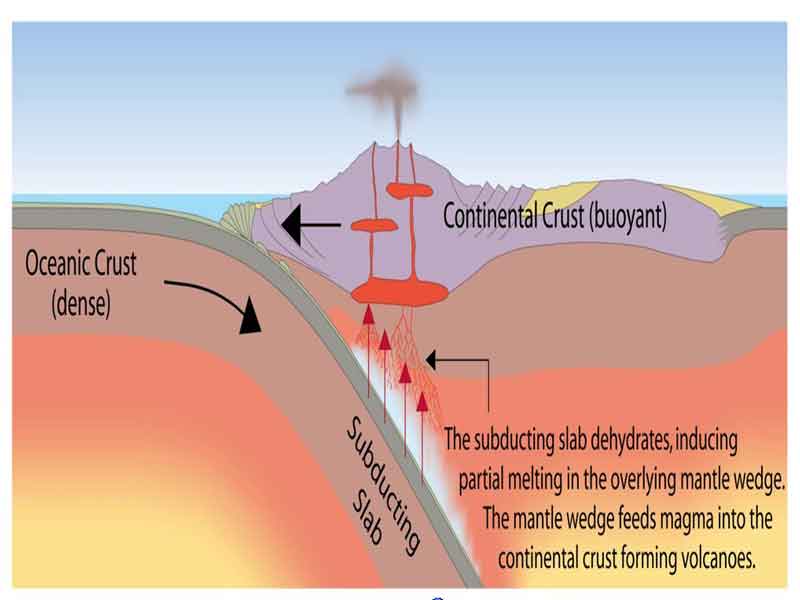
- When continental and oceanic plates collide the thinner and more dense oceanic plate is overridden by the thicker and less dense continental plate.
- The oceanic plate is forced down into the mantle in a process known as "subduction".
- As the oceanic plate descends it is forced into higher temperature environments. At a depth of about 100 miles (160 km) materials in the subducting plate begin to approach their melting temperatures and a process of partial melting begins.
- This partial melting produces magma chambers above the subducting oceanic plate. These magma chambers are less dense than the surrounding mantle materials and are buoyant.
- The buoyant magma chambers begin a slow ascent through the overlying materials, melting and fracturing their way upwards.
- The size and depth of these magma chambers can be determined by mapping the earthquake activity around them.
- If a magma chamber rises to the surface without solidifying, the magma will break through in the form of a volcanic eruption.
- The Andes mountain range along the western edge of the South American continent is an example of a mountain belt formed by subduction. The continental crust of the South American plate has buckled under the compressional strain of converging with the Nasca and Antarctic plates. Additionally, there are many volcanoes, the result of the melting of the subducting slab and the production of new material that has risen through the crust to the surface.
- Oceanic lithosphere subducts underneath the continental lithosphere
- Oceanic lithosphere heats and dehydrates as it subsides
- The melt rises, forming volcanism
- E.g., The Andes
- The convergence of the Nazca and South American Plates has deformed and pushed up limestone strata to form towering peaks of the Andes
Ocean-Ocean Convergent:
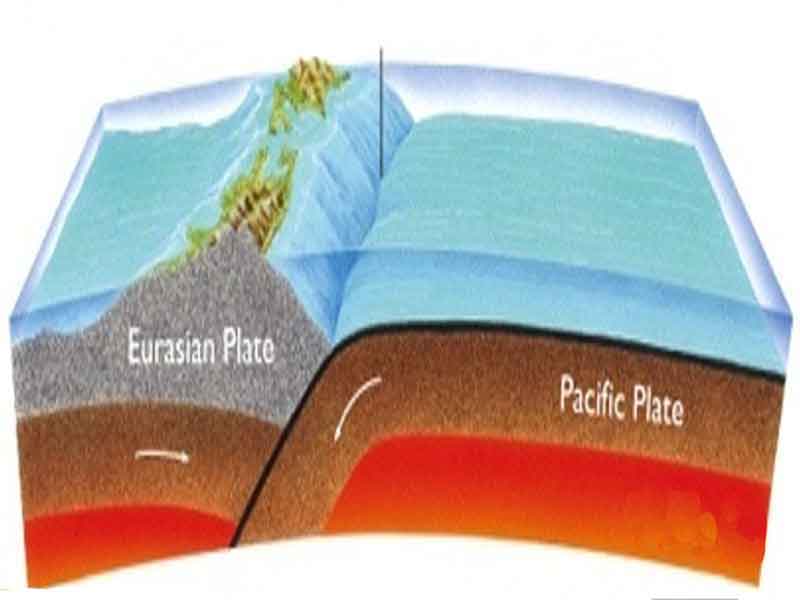
- When a convergent boundary occurs between two oceanic plates one of those plates will subduct beneath the other. Normally the older plate will subduct because of its higher density.
- The subducting plate is heated as it is forced deeper into the mantle and at a depth of about 100 miles (160 km) the plate begins to melt.
- Magma chambers are produced as a result of this melting and the magma is lower in density than the surrounding rock material.
- It begins ascending by melting and fracturing its way through the overlying rock material.
- Magma chambers that reach the surface break through to form a volcanic eruption cone. In the early stages of this type of boundary the cones will be deep beneath the ocean surface but later grow to be higher than sea level.
- This produces an island chain. With continued development the islands grow larger, merge and an elongated landmass is created.
- Japan, the Aleutian islands and the Eastern Caribbean islands of Martinique, St. Lucia and St. Vincent and the Grenadines are examples of islands formed through this type of plate boundary.
Continent-Continent Convergent:

- When continental crust pushes against continental crust both sides of the convergent boundary have the same properties (think back to the description of continental crust: thick and buoyant).
- Neither side of the boundary wants to sink beneath the other side, and as a result the two plates push against each other and the crust buckles and cracks, pushing up (and down into the mantle) high mountain ranges.
- For example, the European Alps and Himalayas formed this way.
- Forms mountains, e.g. European Alps, Himalayas
Example:
- India used to be an island, but about 15 million years ago it crashed into Asia (see map).
- As continental crust was pushing against continental crust the Himalayan mountain belt was pushed up.
- “Mountains” were also pushed down into the mantle as the normally 35 km thick crust is approximately 70 km thick in this region.
- Mt Everest is the highest altitude mountain on our planet standing 8,840 metres high. This means that below the surface at the foot of the mountain the crust is a further 61 km deep!!
When two plates converge, they either collide or one plate subducts beneath the other. This process can create mountains, volcanoes, deep ocean trenches, and powerful earthquakes.
Earthquakes occur because the moving plates build up stress as they push against each other. When that stress is released, the ground shakes.
No. Volcanoes usually form where an oceanic plate subducts beneath another plate. When two continental plates collide, mountain ranges form instead of volcanoes.
The Himalayas are one of the best examples of a continental–continental convergent margin, while the Andes Mountains are a classic example of an oceanic–continental convergent margin.
Convergent margins help shape Earth's surface by forming mountains, volcanoes, and ocean trenches. They also recycle oceanic crust and play an important role in Earth's plate tectonic cycle.
Final Thoughts
Convergent margins are among the most powerful forces shaping our planet. Although tectonic plates move only a few centimeters each year, their continuous interaction over millions of years has created towering mountain ranges, deep ocean trenches, volcanic arcs, and some of Earth's most active earthquake zones.
Understanding how convergent margins form and how the three types differ provides valuable insight into the dynamic nature of plate tectonics. These boundaries not only explain many of Earth's spectacular landscapes but also help scientists assess geological hazards and better understand the planet's ongoing evolution.
Whether you're a geology student, educator, or simply curious about Earth's processes, learning about convergent margins offers a deeper appreciation of the forces that continue to shape the world beneath our feet.