
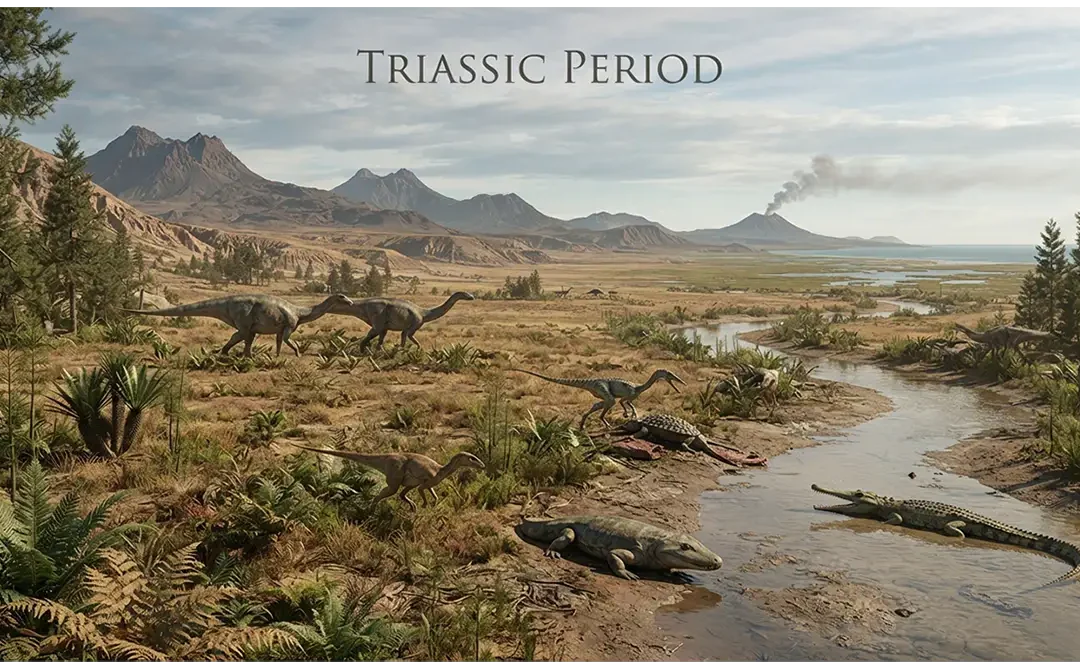
Triassic Period was the first period of the Mesozoic Era and a time of major recovery and evolutionary change after the devastating end-Permian mass extinction. During this period, ecosystems were rebuilt, Pangaea remained the dominant supercontinent, and many important groups of reptiles, marine animals, plants, and early mammals diversified.
The Triassic also witnessed the appearance of the first dinosaurs, although dinosaurs were not yet the dominant land animals they would become during the Jurassic and Cretaceous. Early pterosaurs took to the skies, marine reptiles diversified in the oceans, and the ancestors of modern crocodiles, turtles, mammals, and other groups developed during this important interval.
The period ended with another major extinction around 201.3 million years ago. This event removed many competing groups and helped create ecological opportunities for dinosaurs to expand during the Jurassic.
What Was the Triassic Period?
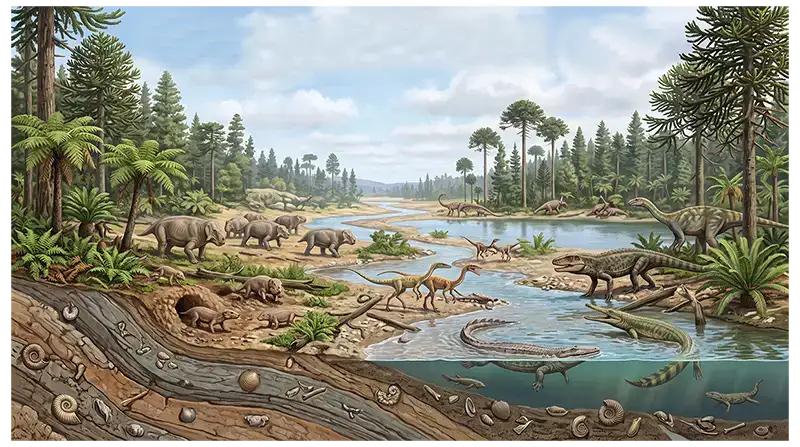
The Triassic Period was the first geological period of the Mesozoic Era, following the Permian Period and preceding the Jurassic Period. It began after the end-Permian mass extinction, the most severe known extinction event in Earth's history, and marked the beginning of a long recovery of terrestrial and marine ecosystems.
The name “Triassic” was introduced in the 19th century to describe a distinctive three-part sequence of rocks recognized in Germany. Today, the Triassic is recognized globally through geological and fossil evidence from many regions. The period was characterized by major biological transitions. Groups that had survived the Permian extinction began to diversify, while new lineages appeared and expanded into newly available environments.
Among the most important developments were the appearance and early diversification of dinosaurs, pterosaurs, early mammals and mammaliaforms, crocodile-line archosaurs, marine reptiles, and several important plant groups.
However, the Triassic was not simply an “age of dinosaurs.” Early dinosaurs were only one component of much more diverse ecosystems. Other reptiles and mammal relatives were widespread on land, while marine ecosystems contained a variety of fish, mollusks, brachiopods, and newly diversified marine reptiles.
The Triassic therefore represents a crucial transition between the Paleozoic world and the better-known Jurassic and Cretaceous ecosystems.
When Was the Triassic Period?
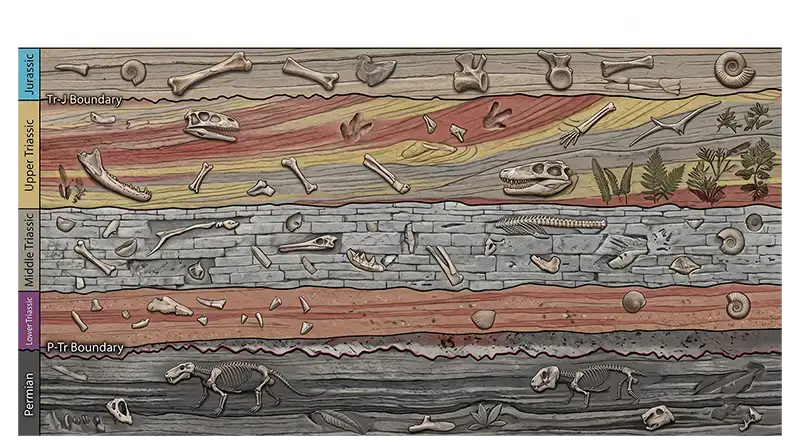
The Triassic Period lasted from about 251.9 million years ago to 201.4 million years ago, making it the first period of the Mesozoic Era. It began immediately after the Permian Period and ended before the Jurassic Period. This places the Triassic between two major transitions in Earth's history: the recovery from the end-Permian mass extinction and the ecological changes associated with the end-Triassic extinction.
The Triassic lasted for roughly 50 million years, giving organisms considerable time to recover, diversify, and establish new ecosystems after the severe biological losses at the end of the Permian.
Early Triassic
The Early Triassic began around 251.9 million years ago. At this time, Earth's ecosystems were still recovering from the end-Permian extinction. Many marine and terrestrial communities had relatively low diversity compared with later stages of the period.
Surviving organisms gradually expanded into available habitats. Reptiles, synapsids, amphibians, plants, and marine organisms began rebuilding food webs as environmental conditions stabilized.
Middle Triassic
The Middle Triassic began roughly 247 million years ago and was a period of increasing biological diversification. Marine ecosystems became more complex, while several reptile groups expanded across terrestrial and aquatic environments.
This interval also witnessed important evolutionary developments among archosaurs and other reptile lineages. The ancestors of later dinosaurs and other major Mesozoic groups became increasingly diverse.
Late Triassic
The Late Triassic, beginning around 237 million years ago, included some of the most important developments in Triassic evolution. Dinosaurs became more diverse, early pterosaurs appeared, and the earliest mammals and mammaliaforms continued to evolve.
During this time, geological activity also increased as Pangaea began to rift apart. Large volcanic eruptions associated with this continental breakup contributed to major environmental changes near the end of the period.
The End of the Triassic
The Triassic ended around 201.4 million years ago with the Triassic–Jurassic extinction event. Significant groups of marine and terrestrial organisms disappeared, while dinosaurs survived and entered the Jurassic with new ecological opportunities.
The transition from the Triassic to the Jurassic therefore represents more than a simple change in geological time. It marked a major shift in Earth's ecosystems and helped establish the biological conditions that would shape the Jurassic Period.
What Was Pangaea Like During the Triassic?
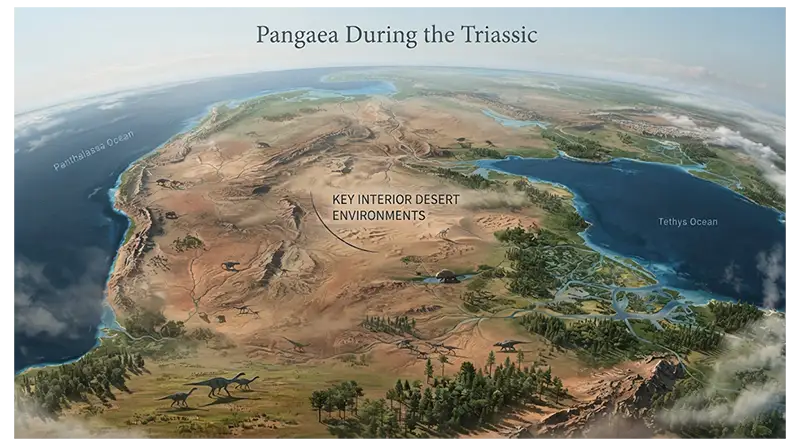
During much of the Triassic, Earth's continents were joined together in the enormous supercontinent Pangaea. This landmass brought many regions that are now separated by oceans into a single connected continental system.
Pangaea was surrounded by the vast Panthalassa Ocean, while the Tethys Ocean occupied a major region along its eastern side. The enormous size of Pangaea strongly influenced its environments. Continental interiors were far from oceanic moisture, which contributed to extensive dry and seasonally arid regions. Coastal areas could experience very different conditions from the interior.
Mountains also influenced rainfall and regional climates. As a result, Pangaea was not environmentally uniform. Some regions supported relatively moist forests and wetlands, while others contained dry plains and desert-like landscapes. The arrangement of the continents also affected the distribution of organisms. Because large portions of the land were connected, animals and plants could spread across regions that are now separated by oceans.
Toward the end of the Triassic, geological forces increasingly affected Pangaea. Rifting began along parts of the future Atlantic margins, accompanied by major volcanic activity. This process eventually contributed to the breakup of the supercontinent and the development of new ocean basins.
What Was the Triassic Climate Like?
The Triassic climate was generally warm, but conditions varied considerably across Pangaea. Large continental interiors were often dry and experienced strong seasonal changes.
The enormous size of Pangaea contributed to a pronounced contrast between coastal and inland environments. Coastal regions could receive more moisture, while areas deep inside the supercontinent were more strongly influenced by continental dryness. Seasonality was also important. Some regions probably experienced alternating wet and dry periods, creating environments that changed significantly throughout the year.
There were no modern-style polar ice caps covering the planet during the Triassic. Warm conditions allowed reptiles and other animals to occupy a wide range of environments. Climate also changed through the period. The Early Triassic inherited environmental stresses from the end-Permian extinction, while later Triassic conditions were influenced by changes in atmospheric composition, volcanism, continental geography, and ocean systems.
Near the end of the Triassic, massive volcanic activity associated with the breakup of Pangaea released large quantities of gases into the atmosphere. These changes contributed to climate and ocean-chemistry disruption during the extinction interval.
How Did Animal Life Recover and Diversify During the Triassic?
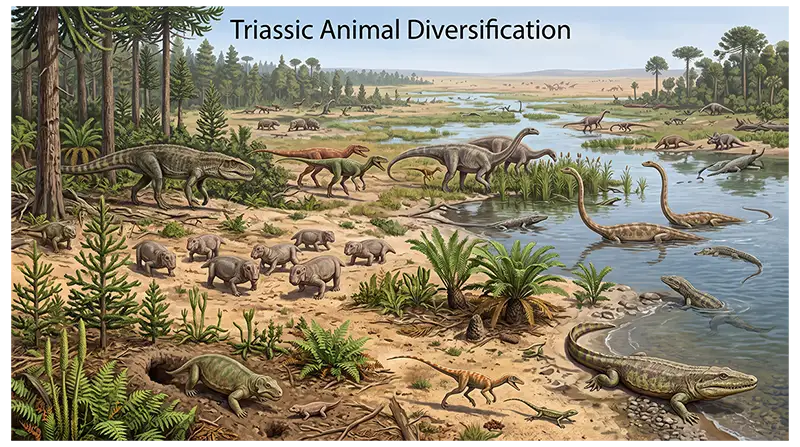
The Triassic began with ecosystems recovering from the Permian–Triassic mass extinction. Many previously dominant organisms had disappeared, leaving ecological spaces that surviving groups could occupy.
The earliest Triassic terrestrial ecosystems included animals such as Lystrosaurus and other surviving synapsids, along with reptiles, amphibians, and other vertebrates. Plant communities were also rebuilding after the severe environmental disruption at the end of the Permian.
As the Triassic progressed, archosaurs became increasingly important. This broad reptile group included the lineages that eventually produced dinosaurs, pterosaurs, and crocodilians.
Other terrestrial animals included:
- Early dinosaurs
- Phytosaurs
- Aetosaurs
- Early crocodile relatives
- Mammal relatives
- Early mammals and mammaliaforms
- Large amphibians
- Various reptiles and insects
Marine ecosystems also underwent major recovery and diversification. Fish, mollusks, brachiopods, ammonoids, and marine reptiles occupied different ecological roles. This diversification did not happen instantly. It unfolded over millions of years as ecosystems recovered, environmental conditions changed, and organisms evolved new adaptations.
Importantly, dinosaurs were not dominant throughout the Triassic. Many other reptile groups were abundant, and several of them disappeared during the end-Triassic extinction. The ecological changes that followed helped dinosaurs become much more prominent during the Jurassic.
How Did Dinosaurs Evolve During the Triassic?
Dinosaurs originated during the Triassic, probably from small, lightly built archosaur relatives. The earliest dinosaur record comes primarily from the Southern Hemisphere, especially South America.
True dinosaurs appear in the fossil record by approximately 233 million years ago, during the Late Triassic. Early forms were generally much smaller than many of the giant dinosaurs that later became famous. Some were lightly built, two-legged animals capable of fast movement.
Examples of Late Triassic dinosaurs include Coelophysis and related early theropods. Other early dinosaurs occupied herbivorous or omnivorous roles. Their bodies already displayed several features that would become important in later dinosaur evolution, including an upright posture and specialized limb structures.
However, early dinosaurs shared their environments with many other reptiles. Phytosaurs, aetosaurs, crocodile-line archosaurs, large amphibians, and mammal relatives were important components of Late Triassic ecosystems. The end-Triassic extinction changed this balance. Many competing terrestrial groups disappeared, while dinosaurs survived. This allowed dinosaur lineages to expand into ecological roles that became increasingly important during the Jurassic.
The Triassic therefore represents the early evolutionary chapter of dinosaur history, rather than the period when dinosaurs reached their greatest diversity and size.
What Plants Grew During the Triassic Period?
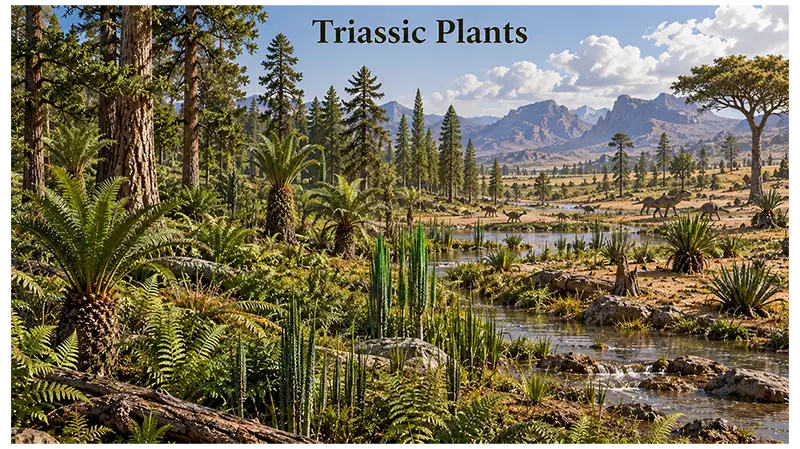
Triassic landscapes were dominated by seed-producing plants and other vegetation adapted to generally warm and seasonally dry conditions.
Important plant groups included:
- Conifers
- Ferns
- Seed ferns
- Cycad-like plants
- Horsetails
- Other gymnosperms and seed-producing plants
Conifers became particularly important in many Triassic environments. Some grew into large trees and formed extensive forests. Ferns also occupied wetter environments and could become abundant where moisture was available.
Flowering plants had not yet evolved, so Triassic ecosystems lacked the familiar flowering forests and grasslands that characterize much later Earth history. Plant distribution was strongly influenced by the climate of Pangaea. Wetter regions could support denser vegetation, while dry continental interiors favored plants capable of tolerating seasonal water shortages.
Plant fossils, pollen, wood, leaves, and other preserved remains allow scientists to reconstruct these ancient environments and determine how vegetation changed through the period. Plants were also essential to ecosystem recovery after the end-Permian extinction. The gradual return of productive plant communities helped support expanding terrestrial food webs.
What Was Life Like in the Triassic Oceans?
Triassic oceans supported diverse marine ecosystems containing both long-established groups and newly diversified organisms. Ammonoids became important marine predators and prey, while bivalves, brachiopods, gastropods, crustaceans, and other invertebrates occupied different ecological roles.
Fish also diversified, providing an important component of marine food webs. One of the most notable developments was the diversification of marine reptiles. Groups such as ichthyosaurs evolved fish-like bodies suited to life in the open ocean, while other marine reptiles developed different swimming and feeding strategies.
Some Triassic marine reptiles were large predators. Their evolution demonstrates how quickly reptile lineages could adapt to marine environments following major ecological disruption. Coral communities also changed during the Triassic as marine ecosystems recovered from the Permian extinction.
The fossil record shows that Triassic marine ecosystems were not simply a continuation of Paleozoic oceans. They represented a major transition toward the marine communities that would become characteristic of the later Mesozoic.
Marine fossils are especially useful because shells, bones, teeth, and other hard structures can be preserved in sedimentary rocks. These remains allow researchers to reconstruct ancient food webs, ocean environments, and patterns of extinction and recovery.
What Fossils Reveal the Triassic World?
Triassic fossils provide evidence for an ecosystem that was much more diverse than the familiar image of a few early dinosaurs walking across a desert.
Fossils from this period include:
- Dinosaur bones and teeth
- Animal footprints and trackways
- Plant leaves and wood
- Pollen and spores
- Marine reptile remains
- Fish fossils
- Ammonoid shells
- Brachiopods and other marine invertebrates
- Fossilized burrows and other trace fossils
Trace fossils are especially valuable because they record animal behavior rather than simply preserving body parts. Footprints can reveal how animals moved, whether they traveled in groups, and which environments they occupied.
Plant fossils provide evidence about ancient vegetation and climate. Fossil wood, leaves, pollen, and spores can help reconstruct forests and other plant communities.
Marine fossils are useful for reconstructing ancient oceans. The presence of particular shells, fish, and marine reptiles can provide information about water depth, temperature, food availability, and environmental change.
Triassic fossils are found on several continents, reflecting the widespread nature of Pangaea. Fossil evidence from South America, North America, Europe, Africa, India, China, and other regions has helped scientists reconstruct the biological and environmental history of the period.
Together, body fossils and trace fossils show that the Triassic was a period of recovery, diversification, competition, and environmental change.
How Did the Triassic Period End?
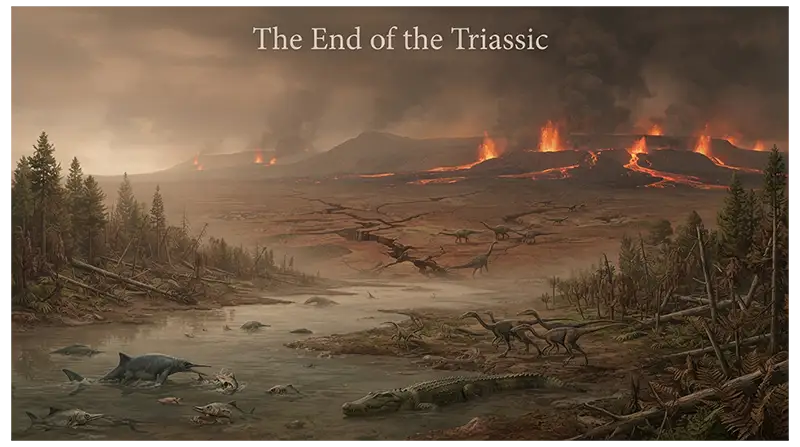
The Triassic Period ended with the Triassic–Jurassic extinction event around 201.3 million years ago. This extinction caused major losses among marine and terrestrial organisms and fundamentally changed the composition of ecosystems entering the Jurassic.
One of the leading explanations connects the extinction with enormous volcanic activity associated with the Central Atlantic Magmatic Province, or CAMP. This volcanic province formed as Pangaea began to split apart and included extensive lava eruptions across areas that would eventually become parts of North America, South America, Africa, and Europe.
These eruptions released large quantities of gases, including carbon dioxide and sulfur dioxide. Such emissions can alter climate and ocean chemistry. Environmental consequences likely included major temperature changes, ocean acidification, and disruption of marine and terrestrial ecosystems. Different organisms may have been affected at different times, so the extinction was not necessarily one instantaneous event everywhere.
Several important groups disappeared or suffered severe losses. Among them were phytosaurs and aetosaurs, which had been important components of Triassic terrestrial ecosystems. Some marine groups also experienced major declines, including conodonts and several ammonoid lineages.
Dinosaurs survived the extinction. Their survival, combined with the disappearance of several competing groups, opened ecological opportunities during the Jurassic. The end-Triassic extinction therefore marks an important transition from a diverse Triassic world to the very different ecosystems of the Jurassic.
Why Is the Triassic Period Important?
The Triassic Period is important because it records one of the major transitions in Earth's biological history. It began with ecosystems recovering from the largest mass extinction known from the fossil record and ended with another major extinction. Between these events, life diversified into many new forms.
The Triassic was especially important for the evolution of:
- Dinosaurs
- Early mammals and mammaliaforms
- Pterosaurs
- Modern crocodile-line relatives
- Marine reptiles
- New Mesozoic plant communities
It also provides evidence for the environmental influence of Pangaea. The arrangement of the continents affected climate, rainfall, habitats, and the movement of organisms. The fossil record from this period also allows scientists to study how ecosystems recover after mass extinctions. By comparing Early, Middle, and Late Triassic fossils, researchers can observe how biological communities changed over millions of years.
Finally, the Triassic–Jurassic extinction demonstrates how volcanic activity, atmospheric change, ocean chemistry, and biological turnover can interact on a global scale.
The Triassic was therefore more than simply the period when dinosaurs first appeared. It was a critical stage in the rebuilding of life after the Permian extinction and in the development of the ecosystems that later supported the great dinosaur diversity of the Jurassic and Cretaceous.
Conclusion
The Triassic Period was a major turning point in Earth's history. Beginning after the devastating end-Permian extinction, it witnessed the gradual recovery of ecosystems and the diversification of many important groups. Pangaea shaped the period's geography and climate, while conifers, ferns, reptiles, amphibians, marine organisms, early mammals, and other life forms occupied a wide range of environments.
Most importantly, the first dinosaurs appeared and began their long evolutionary history. The Triassic ended with another major extinction linked strongly to volcanic activity and environmental disruption during the early breakup of Pangaea. The survivors entered the Jurassic world, where dinosaurs eventually became far more prominent.
For this reason, the Triassic is best understood as a period of recovery, innovation, diversification, and transition between the Paleozoic world and the later Mesozoic ecosystems.
Pangaea was a huge connected supercontinent surrounded by the Panthalassa Ocean. Its enormous interior was generally much drier than many coastal regions and experienced strong seasonal conditions.
Yes. Early mammals and mammaliaforms evolved during the Triassic, although they were generally much smaller and less ecologically dominant than many later mammals.
The leading explanation involves massive volcanic activity associated with the breakup of Pangaea and the Central Atlantic Magmatic Province. The resulting atmospheric and oceanic changes likely contributed to widespread environmental disruption.
The Jurassic Period followed the Triassic and began around 201.3 million years ago.
The earliest true dinosaurs appear in the fossil record by approximately 233 million years ago, during the Late Triassic.