
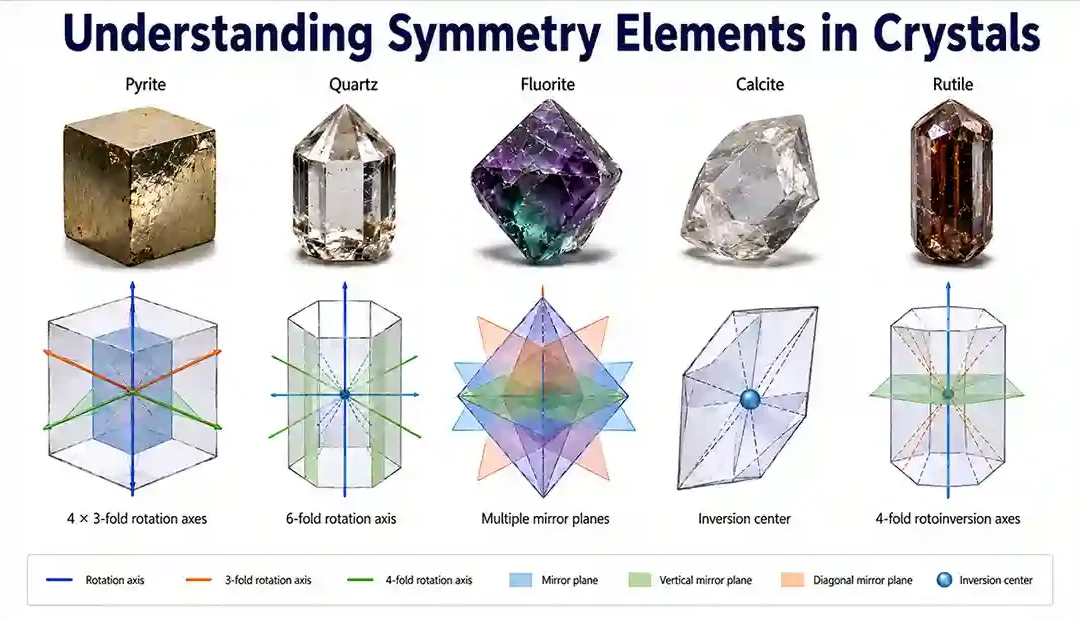
Symmetry is one of the most fundamental concepts in crystallography. Every crystal possesses a specific arrangement of atoms that repeats in a regular pattern, giving rise to predictable symmetry. These symmetrical features are described by symmetry elements, which are imaginary geometric references such as axes, planes, and points around which symmetry operations can be performed without changing the crystal's overall appearance.
Symmetry elements determine crystal shapes, define crystal systems, and help scientists classify minerals into different crystallographic groups. They also play an essential role in X-ray diffraction, optical mineralogy, materials science, and solid-state physics.
Understanding symmetry elements allows geologists to identify minerals, interpret crystal structures, and understand how crystals grow.
This topic should be studied together with Crystal Systems Explained, Crystal Habits Explained, and Mineralogy Explained.
What Are Symmetry Elements?
Symmetry elements are imaginary geometric features about which a crystal can undergo a symmetry operation and still appear unchanged.
They include:
- Rotation axes
- Mirror planes
- Centers of inversion
- Rotoinversion axes
Each crystal contains one or more symmetry elements depending on its internal atomic arrangement.
Symmetry Elements vs Symmetry Operations
These two terms are closely related but different.
| Symmetry Element | Symmetry Operation |
|---|---|
| Geometric reference | Action performed |
| Axis, plane, or point | Rotation, reflection, inversion |
| Fixed within crystal | Moves the crystal mathematically |
| Describes symmetry location | Describes symmetry movement |
For example, a mirror plane is a symmetry element, while reflecting the crystal across that plane is the symmetry operation.
Why Crystal Symmetry Matters
Crystal symmetry helps scientists:
- Classify minerals
- Determine crystal systems
- Predict crystal faces
- Understand atomic arrangements
- Analyze diffraction patterns
- Interpret optical properties
Symmetry forms the foundation of crystallography.
Major Symmetry Elements
Rotation Axis
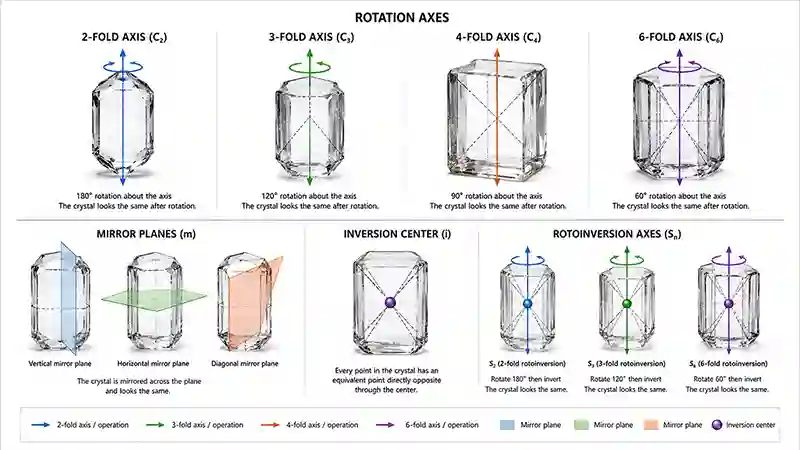
A rotation axis is an imaginary line around which a crystal can be rotated by a specific angle and appear unchanged.
Common rotation axes include:
- 2-fold (180°)
- 3-fold (120°)
- 4-fold (90°)
- 6-fold (60°)
Examples:
- Quartz → 6-fold axis
- Pyrite → Multiple 3-fold axes
Mirror Plane
A mirror plane divides a crystal into two identical halves.
Reflection across the plane produces an identical image.
Common minerals:
- Fluorite
- Halite
- Many cubic crystals
Center of Inversion
A center of inversion is a point inside the crystal where every atom has an equivalent atom located directly opposite at the same distance.
Many centrosymmetric minerals possess inversion centers.
Example:
- Calcite
Rotoinversion Axis
A rotoinversion combines two operations:
- Rotation
- Inversion
This is one of the more advanced symmetry elements used in crystallography.
It is especially important for classifying crystal point groups.
Rotation Axes Explained
| Rotation Axis | Rotation Angle |
| 2-fold | 180° |
| 3-fold | 120° |
| 4-fold | 90° |
| 6-fold | 60° |
Only these rotational symmetries are compatible with repeating crystal lattices in three-dimensional space.
Mirror Planes
Mirror planes may occur in different orientations.
Common types include:
- Vertical mirror planes
- Horizontal mirror planes
- Diagonal mirror planes
Different crystal systems contain different numbers of mirror planes.
Centers of Inversion
Not every crystal has inversion symmetry.
Crystals lacking inversion centers often display properties such as:
- Piezoelectricity
- Pyroelectricity
- Optical activity
Quartz is a well-known example of a non-centrosymmetric mineral.
Symmetry Elements in Common Minerals
Quartz
- 6-fold rotation axis
- No center of inversion
- Limited mirror symmetry
Halite
- Multiple 4-fold rotation axes
- Mirror planes
- Center of inversion
Pyrite
- Multiple 3-fold rotation axes
- High cubic symmetry
Calcite
- 3-fold rotation axis
- Center of inversion
- Mirror symmetry
Fluorite
- Four 3-fold rotation axes
- Numerous mirror planes
- High symmetry
Diamond
- Cubic symmetry
- Multiple rotation axes
- Mirror planes
- Inversion center
Symmetry and Crystal Systems
Symmetry elements determine crystal systems.
| Crystal System | Highest Rotation Axis |
| Cubic | 4-fold |
| Tetragonal | 4-fold |
| Orthorhombic | 2-fold |
| Hexagonal | 6-fold |
| Trigonal | 3-fold |
| Monoclinic | 2-fold |
| Triclinic | None |
Each crystal system has its own characteristic symmetry.
Point Groups
Combinations of symmetry elements produce 32 crystallographic point groups.
Point groups describe all possible external crystal symmetries.
They are widely used in:
- Mineralogy
- Crystallography
- Materials Science
- Solid-State Physics
Space Groups
When translational symmetry is combined with point-group symmetry, crystals are classified into 230 space groups.
Space groups describe the complete three-dimensional symmetry of crystal structures.
Geological Importance
Symmetry elements help geologists:
- Classify minerals
- Interpret crystal growth
- Understand crystal morphology
- Identify unknown crystals
- Predict physical properties
They are fundamental to crystallography and mineral identification.
Laboratory Investigation
Crystal symmetry is studied using:
- X-Ray Diffraction (XRD)
- Electron Backscatter Diffraction (EBSD)
- Single-Crystal XRD
- Polarizing Microscope
- Scanning Electron Microscopy (SEM)
- Electron Microprobe Analysis
These techniques reveal both external and internal symmetry.
Applications
Understanding symmetry elements is important in:
- Mineralogy
- Crystallography
- Materials Science
- Solid-State Physics
- Gemology
- Nanotechnology
- Chemistry
- Engineering
Advantages of Studying Symmetry Elements
Studying symmetry elements helps scientists:
- Classify crystal structures
- Predict crystal shapes
- Understand atomic arrangements
- Interpret diffraction data
- Explain physical properties
- Design advanced materials
Limitations
Although symmetry is fundamental, it has limitations when used alone.
- External crystal faces may not display all internal symmetry.
- Crystal defects can reduce apparent symmetry.
- Weathering may distort crystal shapes.
- Laboratory techniques are often needed to determine complete symmetry.
For a complete understanding, study this topic together with:
- Crystal Structure of Minerals Explained
- Crystal Systems Explained
- Crystal Habits Explained
- Crystal Chemistry Explained
- X-Ray Diffraction in Mineralogy
- Optical Mineralogy Explained
- Mineralogy Explained
- Crystallography Explained
Comparison Table
| Symmetry Element | Description | Example |
| Rotation Axis | Rotation leaves crystal unchanged | Quartz |
| Mirror Plane | Reflection produces identical halves | Fluorite |
| Center of Inversion | Opposite points are equivalent | Calcite |
| Rotoinversion Axis | Rotation followed by inversion | Cubic crystals |
Summary Table
| Feature | Symmetry Elements in Crystals |
| Definition | Geometric Features Defining Crystal Symmetry |
| Main Elements | Rotation Axis, Mirror Plane, Inversion Center, Rotoinversion Axis |
| Related Concepts | Point Groups, Space Groups, Crystal Systems |
| Study Methods | XRD, EBSD, SEM, Polarizing Microscope |
| Geological Importance | Crystal Classification and Structure Analysis |
Symmetry elements are imaginary geometric features—such as rotation axes, mirror planes, inversion centers, and rotoinversion axes—around which symmetry operations leave a crystal looking unchanged.
A symmetry element is the geometric feature itself, while a symmetry operation is the movement, such as rotation or reflection, performed around that feature.
The four principal symmetry elements are rotation axes, mirror planes, centers of inversion, and rotoinversion axes.
They help classify crystals, determine crystal systems, explain physical properties, and interpret diffraction patterns used to identify minerals.
Scientists commonly use X-ray diffraction (XRD), electron backscatter diffraction (EBSD), single-crystal XRD, scanning electron microscopy (SEM), and polarizing microscopy to analyze crystal symmetry.
Final Thoughts
Symmetry elements are the geometric foundation of crystallography. They reveal how atoms are arranged within crystals and explain why minerals develop characteristic shapes and physical properties. From simple mirror planes to complex rotoinversion axes, these symmetry features provide a universal framework for classifying crystals into crystal systems, point groups, and space groups.
Understanding symmetry elements not only improves mineral identification but also supports research in geology, chemistry, materials science, and engineering. By combining symmetry analysis with crystal structure, crystal habits, and diffraction techniques, scientists gain a deeper understanding of the microscopic order that governs the natural world.
Continue Learning
Continue exploring crystallography with these related guides: