
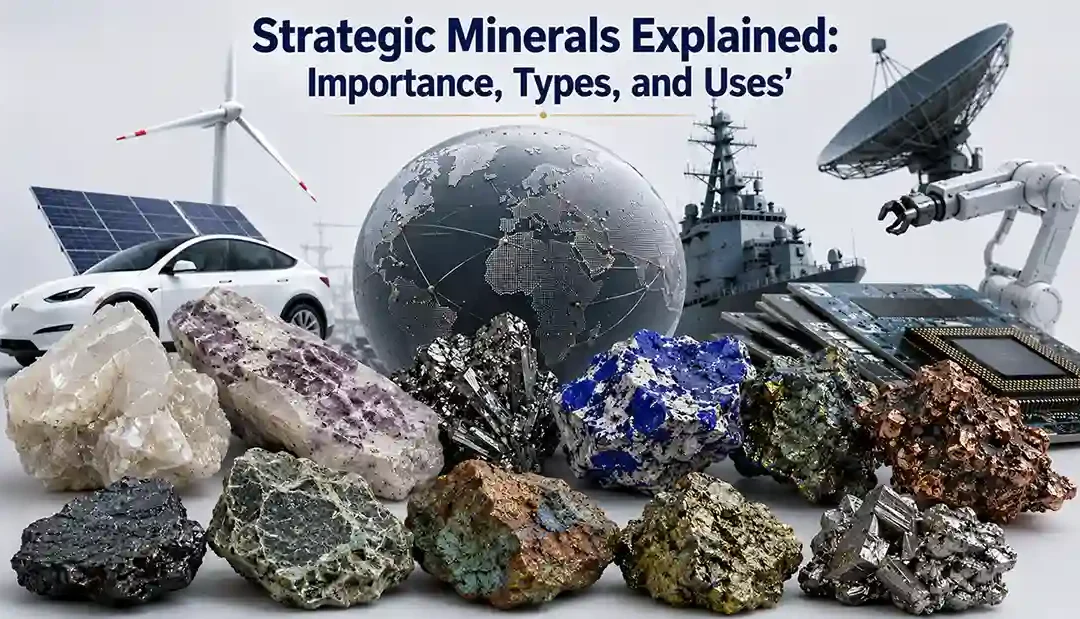
Strategic minerals are mineral resources that are essential for a nation's economy, technological development, energy security, and national defense. These minerals often have limited supply sources, making them critical for long-term economic stability.
In today's world, strategic minerals are increasingly important because they support:
- electric vehicles
- renewable energy systems
- semiconductor manufacturing
- defense technologies
- aerospace industries
- advanced electronics
As technology advances, strategic minerals have become central to global economic and geopolitical discussions.
What Are Strategic Minerals?
Strategic minerals are minerals that are:
- essential for economic development
- important for national security
- difficult to substitute
- vulnerable to supply disruptions
A mineral may be considered strategic if a country relies heavily on imports or if demand significantly exceeds domestic production.
Strategic Minerals vs Critical Minerals
Although the terms are often used interchangeably, they are slightly different.
Strategic Minerals
Focus on:
- national security
- economic stability
- industrial importance
Critical Minerals
Focus on:
- supply chain risks
- technological importance
- economic vulnerability
Many minerals are both strategic and critical.
Strategic vs Critical Minerals
| Feature | Strategic Minerals | Critical Minerals |
|---|---|---|
| National Security | High Priority | Important |
| Supply Risk | Significant | Significant |
| Economic Importance | High | High |
| Technology Applications | Major | Major |
Why Strategic Minerals Matter
Strategic minerals are essential because they support:
Energy Security
Renewable energy and battery technologies.
National Defense
Military systems and aerospace equipment.
Industrial Production
Manufacturing and infrastructure.
Technological Innovation
Advanced electronics and semiconductors.
Major Strategic Minerals
Several minerals are commonly classified as strategic.
Lithium
Used in:
- electric vehicles
- battery storage
- consumer electronics
Important minerals:
- spodumene
- lepidolite
- petalite
Learn more → lithium minerals explained
Cobalt
Important for:
- lithium-ion batteries
- aerospace alloys
- energy storage systems
Important minerals:
- cobaltite
- erythrite
- carrollite
Learn more → cobalt minerals explained
Rare Earth Elements
Rare earth elements are essential for:
- permanent magnets
- electric motors
- wind turbines
- military technologies
Important minerals:
- bastnäsite
- monazite
- xenotime
Learn more → rare earth minerals explained
Nickel
Nickel supports:
- EV batteries
- stainless steel
- aerospace alloys
Important minerals:
- pentlandite
- garnierite
- millerite
Graphite
Graphite is critical for:
- battery anodes
- electric vehicles
- energy storage
Natural graphite remains essential despite synthetic alternatives.
Copper
Copper is a strategic mineral because modern societies require large amounts for:
- electrical grids
- renewable energy systems
- electric vehicles
- communications infrastructure
Uranium
Uranium remains strategically important for:
- nuclear energy
- national defense applications
- scientific research
Important minerals:
- uraninite
- coffinite
- carnotite
Learn more → uranium minerals explained
Platinum Group Metals
Used in:
- catalytic converters
- hydrogen fuel cells
- advanced industrial catalysts
Important minerals:
- sperrylite
- cooperite
- braggite
Learn more → platinum group minerals explained
Major Strategic Minerals and Their Uses
| Strategic Mineral | Main Application |
|---|---|
| Lithium | Batteries |
| Cobalt | Battery Cathodes |
| Nickel | Energy Storage |
| Rare Earths | Magnets |
| Graphite | Battery Anodes |
| Copper | Electrical Systems |
| Uranium | Nuclear Energy |
| Platinum Group Metals | Fuel Cells |
Strategic Minerals and National Security
Many strategic minerals are essential for:
- fighter aircraft
- missiles
- radar systems
- satellites
- naval vessels
Supply disruptions can directly affect national defense capabilities.
Strategic Minerals and Renewable Energy
The transition to renewable energy requires large quantities of:
- lithium
- cobalt
- nickel
- rare earth elements
- copper
Many clean-energy technologies use significantly more minerals than traditional technologies.
Strategic Mineral Supply Challenges
Supply Concentration
Production is often concentrated in a few countries.
Increasing Demand
Global demand continues to rise.
Long Mine Development Times
New mines require years to develop.
Environmental Considerations
Responsible extraction remains important.
Major Strategic Mineral Producers
Important producing countries include:
- China
- Australia
- Canada
- Chile
- United States
- Democratic Republic of the Congo
These countries play important roles in global mineral supply chains.
Future of Strategic Minerals
Demand is expected to increase because of:
- electric vehicle growth
- renewable energy expansion
- artificial intelligence infrastructure
- advanced manufacturing
- semiconductor production
Strategic minerals will remain fundamental to technological and economic development.
Industries Dependent on Strategic Minerals
| Industry | Strategic Minerals |
|---|---|
| Electric Vehicles | Lithium, Nickel, Cobalt |
| Renewable Energy | Rare Earths, Copper |
| Electronics | Copper, Rare Earths |
| Aerospace | Nickel, Cobalt |
| Nuclear Energy | Uranium |
Strategic minerals are mineral resources essential for national security, economic development, and advanced technologies.
They support energy systems, defense technologies, manufacturing, transportation, and modern electronics.
Not exactly. Strategic minerals emphasize national importance, while critical minerals focus more on supply risks and technological dependence.
Common strategic minerals include lithium, cobalt, nickel, rare earth elements, graphite, copper, uranium, and platinum group metals.
They are essential for batteries, wind turbines, solar panels, power grids, and energy storage systems.
Final Thoughts
Strategic minerals are the foundation of modern technology, national security, and the global energy transition. Resources such as lithium, cobalt, rare earth elements, graphite, copper, uranium, and platinum group metals support everything from electric vehicles and renewable energy to advanced defense systems and semiconductor manufacturing.
As the world becomes increasingly dependent on clean energy and high-tech industries, strategic minerals will continue to shape economic growth, technological innovation, and global resource security.