
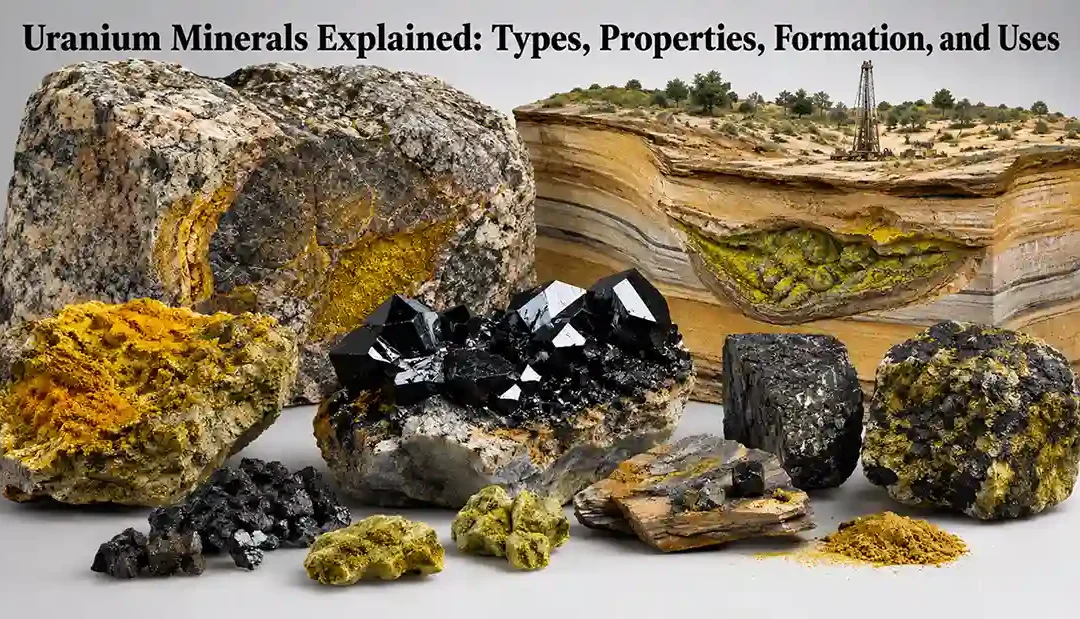
Uranium is one of the most important energy-related elements on Earth. It is primarily used as fuel in nuclear power plants and plays a major role in scientific research, medicine, and geochronology.
Uranium minerals are important because they:
- provide nuclear fuel
- help date geological events
- occur in economically valuable deposits
- reveal information about Earth's crustal evolution
Most uranium occurs in specialized uranium-bearing minerals rather than as native metal.
Learn more → mineral classification system
What Are Uranium Minerals?
Uranium minerals are naturally occurring minerals that contain uranium as a major component.
These minerals occur in:
- granitic rocks
- hydrothermal veins
- sandstone deposits
- sedimentary basins
- metamorphic rocks
Many uranium minerals are radioactive because uranium isotopes naturally decay over time.
Chemical Formula of Uranium
Uranium is a metallic chemical element represented by:
Basic Properties
| Property | Value |
|---|---|
| Element Name | Uranium |
| Symbol | U |
| Atomic Number | 92 |
| Atomic Weight | 238.03 |
| Classification | Actinide Metal |
| Density | 19.1 g/cm³ |
Major Uranium Minerals
| Mineral | Formula | Importance |
|---|---|---|
| Uraninite | UO₂ | Primary Uranium Ore |
| Coffinite | USiO₄·nH₂O | Major Uranium Ore |
| Carnotite | K₂(UO₂)₂(VO₄)₂·3H₂O | Secondary Uranium Ore |
| Autunite | Ca(UO₂)₂(PO₄)₂·10–12H₂O | Secondary Uranium Mineral |
| Torbernite | Cu(UO₂)₂(PO₄)₂·8–12H₂O | Collector Mineral |
Uraninite – The Most Important Uranium Mineral
Primary Uranium Ore
Uraninite is the world's most important uranium mineral.
Its formula is: UO2
Characteristics include:
- black color
- very high density
- strong radioactivity
- metallic to submetallic luster
Most commercial uranium production originates from uraninite-bearing deposits.
Coffinite
Coffinite is an important uranium silicate mineral.
Its formula is: U(SiO4)1−x(OH)4x
Features include:
- black to brown color
- uranium-rich composition
- association with sandstone deposits
It is commonly found alongside uraninite.
Carnotite
Carnotite is a bright yellow uranium mineral.
Its formula is: K2(UO2)2(VO4)2·3H2O
Characteristics include:
- vivid yellow color
- uranium and vanadium content
- secondary mineral origin
Carnotite commonly forms in arid environments.
Autunite
Autunite is one of the most recognizable uranium minerals.
Its formula is: Ca(UO2)2(PO4)2·10–12H2O
Features include:
- bright yellow-green color
- fluorescence under UV light
- tabular crystals
It often develops in oxidized uranium deposits.
Torbernite
Torbernite is a hydrated copper uranium phosphate mineral.
Its formula is: Cu[(UO2)(PO4)]2·12H2O
Characteristics include:
- emerald-green crystals
- square crystal plates
- collector appeal
Formation of Uranium Deposits
Magmatic Processes
Uranium may concentrate in granitic rocks.
Hydrothermal Activity
Mineral-rich fluids deposit uranium minerals.
Sandstone Deposits
Important uranium ore environments.
Sedimentary Basins
Large uranium resources often form here.
Uranium Deposit Environments
Major uranium deposits occur in:
- sandstone-hosted deposits
- unconformity deposits
- hydrothermal veins
- granitic systems
These geological environments account for most of the world's uranium resources.
Uranium and Radiometric Dating
Geological Time Measurement
Uranium isotopes naturally decay into lead.
Important decay systems include:
and
These decay relationships help geologists determine the ages of rocks and minerals.
Learn more → zircon mineral explained
Industrial Uses of Uranium
Nuclear Power
Primary commercial use.
Scientific Research
Used in physics and geology.
Medical Applications
Supports some specialized technologies.
Radiometric Dating
Essential for age determination studies.
Major Uses of Uranium
| Industry | Application |
|---|---|
| Energy | Nuclear Fuel |
| Science | Research |
| Geology | Radiometric Dating |
| Technology | Specialized Equipment |
Major Uranium-Producing Countries
Important uranium producers include:
- Kazakhstan
- Canada
- Australia
- Namibia
- Uzbekistan
- Niger
These countries host some of the world's largest uranium resources.
How Geologists Identify Uranium Minerals
Uraninite
- black color
- high density
- radioactive nature
Carnotite
- bright yellow coatings
- uranium-vanadium association
Autunite
- fluorescent yellow-green crystals
Torbernite
- green square crystals
These minerals are commonly identified using mineralogical and radiometric methods.
Learn more → mineral identification guide
Uranium Minerals Summary
| Mineral | Formula | Main Use |
|---|---|---|
| Uraninite | UO₂ | Uranium Ore |
| Coffinite | USiO₄·nH₂O | Uranium Ore |
| Carnotite | K₂(UO₂)₂(VO₄)₂·3H₂O | Uranium Ore |
| Autunite | Ca(UO₂)₂(PO₄)₂·10–12H₂O | Collector Mineral |
| Torbernite | Cu(UO₂)₂(PO₄)₂·8–12H₂O | Collector Mineral |
Uraninite (UO₂) is the world's primary uranium ore mineral.
The chemical symbol for uranium is U.
Major uranium minerals include uraninite, coffinite, carnotite, autunite, and torbernite.
Most uranium deposits form through hydrothermal, sedimentary, or magmatic geological processes.
Uranium is primarily used as fuel for nuclear power generation and in scientific research.
Final Thoughts
Uranium minerals are among the most scientifically and economically important mineral resources on Earth. From uraninite-rich ore bodies to colorful secondary minerals such as carnotite and autunite, these minerals play a vital role in energy production, geological research, and our understanding of Earth's history.
Studying uranium minerals helps geologists locate valuable resources while also providing powerful tools for measuring geological time and reconstructing the evolution of our planet.