
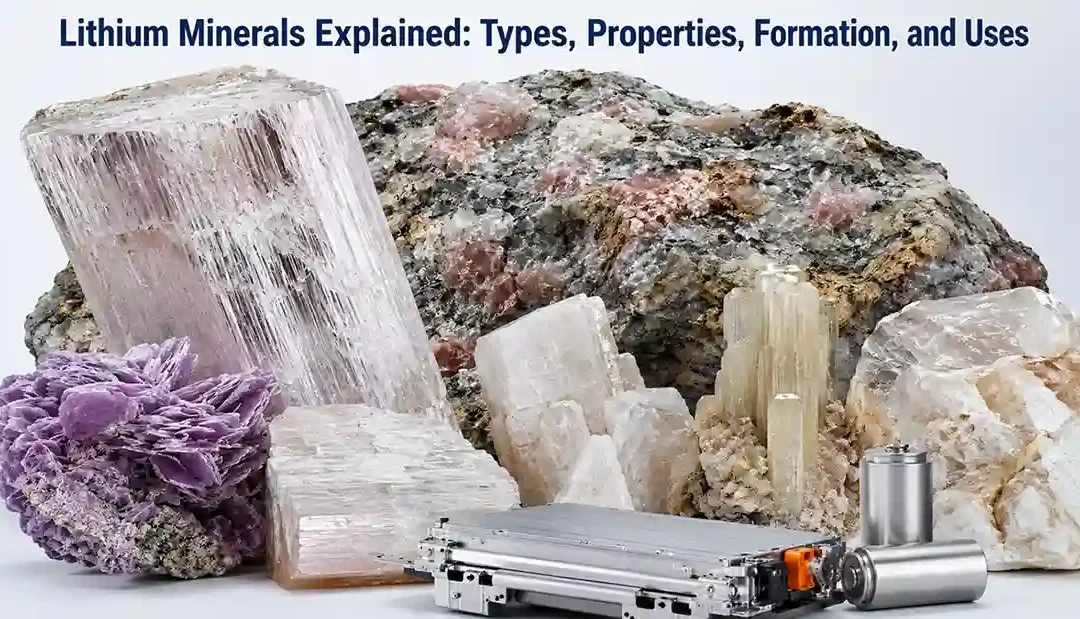
Lithium minerals have become some of the most important mineral resources in the modern world. Lithium is a key component of rechargeable batteries used in:
- electric vehicles
- smartphones
- laptops
- renewable energy storage systems
- portable electronics
As global demand for clean energy grows, lithium minerals have become critical resources for the energy transition.
Learn more → mineral classification system
What Are Lithium Minerals?
Lithium minerals are naturally occurring minerals that contain significant amounts of lithium.
These minerals occur mainly in:
- granite pegmatites
- lithium-rich brines
- rare-element deposits
- hydrothermal systems
Most hard-rock lithium production comes from pegmatite-hosted lithium minerals.
Chemical Formula of Lithium
Lithium is a chemical element represented by:
Basic Properties
| Property | Value |
|---|---|
| Element Name | Lithium |
| Symbol | Li |
| Atomic Number | 3 |
| Atomic Weight | 6.94 |
| Classification | Alkali Metal |
| Density | 0.534 g/cm³ |
Lithium is the lightest metal and the lightest solid element on Earth.
Major Lithium Minerals
Spodumene – The Most Important Lithium Mineral
Spodumene is the world's most important hard-rock lithium mineral.
Its formula is: LiAlSi₂O₆
Characteristics include:
- white to green color
- prismatic crystals
- high lithium content
- pegmatite occurrence
Most modern lithium mines extract lithium from spodumene-rich pegmatites.
Lepidolite
Lepidolite is a lithium-rich mica mineral.
Its generalized formula is: K(Li,Al)3(Al,Si)4O10(F,OH)2
Features include:
- purple coloration
- sheet-like mica structure
- lithium enrichment
- pegmatite occurrence
Lepidolite is one of the most recognizable lithium-bearing minerals.
Petalite
Petalite is an important lithium aluminosilicate mineral.
Its formula is: LiAlSi₄O₁₀
Characteristics include:
- white to gray color
- vitreous luster
- pegmatite occurrence
- lithium-rich composition
Petalite was one of the first minerals from which lithium was identified.
Amblygonite
Amblygonite is a lithium aluminum phosphate mineral.
Its formula is: LiAlPO₄(F,OH)
It commonly occurs in:
- lithium pegmatites
- phosphate-rich environments
- rare-element deposits
Zinnwaldite
Zinnwaldite is a lithium-bearing mica.
Its generalized formula is: KLiFeAl(AlSi₃O₁₀)(F,OH)₂
It is commonly associated with:
- granites
- pegmatites
- tin deposits
Formation of Lithium Deposits
Pegmatite Formation
The most important hard-rock lithium deposits.
Magmatic Differentiation
Lithium becomes concentrated during late-stage magma evolution.
Hydrothermal Processes
Lithium-rich fluids may deposit minerals.
Evaporative Brines
Lithium can also concentrate in saline lake systems.
Lithium Pegmatite Deposits
Many of the world's lithium resources occur in:
- granite pegmatites
- rare-element pegmatites
- lithium-rich intrusive systems
These environments allow lithium to become highly concentrated.
Lithium and Battery Technology
Lithium is essential for:
Electric Vehicles
Rechargeable lithium-ion batteries.
Smartphones
Portable power storage.
Renewable Energy
Grid-scale battery systems.
Consumer Electronics
Long-lasting rechargeable batteries.
Major Uses of Lithium
| Industry | Application |
|---|---|
| Transportation | Electric Vehicles |
| Electronics | Smartphones |
| Energy Storage | Batteries |
| Renewable Energy | Grid Storage |
| Ceramics | Specialty Glass |
Major Lithium-Producing Countries
Important lithium producers include:
- Australia
- Chile
- China
- Argentina
- Brazil
- Canada
Australia is one of the world's leading producers of spodumene concentrate.
How Geologists Identify Lithium Minerals
Spodumene
- long prismatic crystals
- white to green color
- perfect cleavage
Lepidolite
- purple mica flakes
- sheet structure
- pearly luster
Petalite
- white-gray color
- vitreous luster
Amblygonite
- phosphate composition
- pegmatite association
Learn more → mineral identification guide
Lithium Minerals Summary
| Mineral | Formula | Main Use |
|---|---|---|
| Spodumene | LiAlSi₂O₆ | Lithium Ore |
| Lepidolite | K(Li,Al)₃(Si,Al)₄O₁₀(F,OH)₂ | Lithium Source |
| Petalite | LiAlSi₄O₁₀ | Lithium Ore |
| Amblygonite | LiAlPO₄(F,OH) | Lithium Resource |
| Zinnwaldite | KLiFeAl(AlSi₃O₁₀)(F,OH)₂ | Lithium Mica |
Spodumene (LiAlSi₂O₆) is the world's most important hard-rock lithium ore mineral.
The chemical symbol for lithium is Li.
Major lithium minerals include spodumene, lepidolite, petalite, amblygonite, and zinnwaldite.
Most lithium minerals form in pegmatites through late-stage magmatic processes.
Lithium is primarily used in rechargeable batteries, electric vehicles, energy storage systems, and electronics.
Final Thoughts
Lithium minerals have become essential resources for modern technology and the global transition toward clean energy. Minerals such as spodumene, lepidolite, and petalite provide the lithium needed for batteries, renewable energy systems, and electric transportation.
As demand for energy storage continues to increase, lithium minerals will remain among the most strategically important geological resources of the 21st century.