
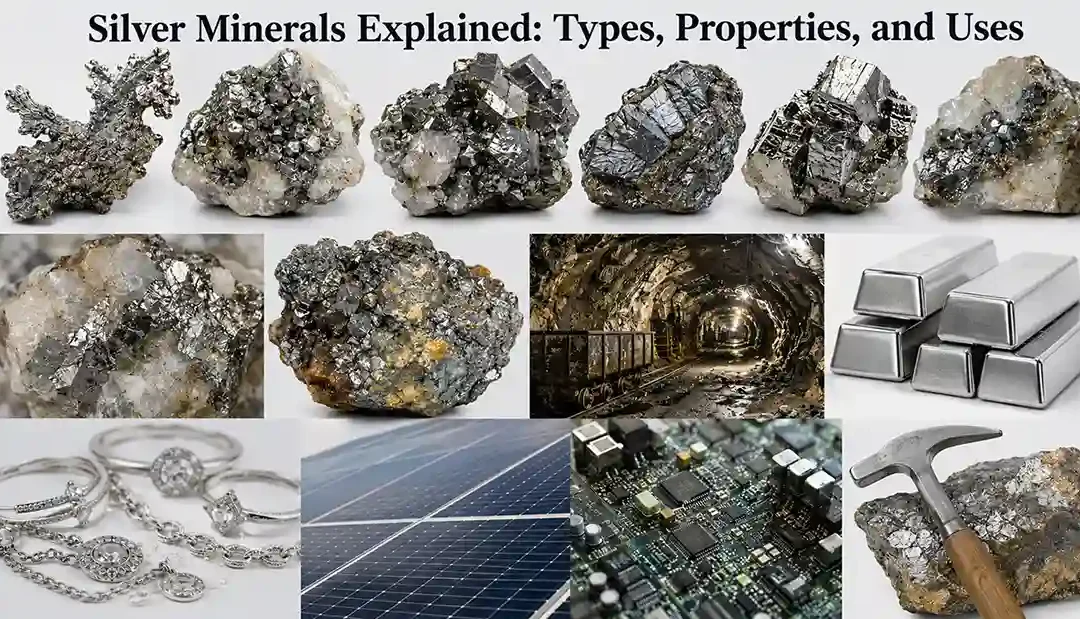
Silver minerals are among the world's most valuable mineral resources because they supply silver, a precious metal widely used in jewelry, investment, electronics, medicine, renewable energy, and industrial manufacturing. Silver is highly valued for its exceptional electrical conductivity, thermal conductivity, reflectivity, and corrosion resistance.
Although native silver occurs naturally, most commercial silver is produced from sulfide minerals and as a by-product of lead, zinc, copper, and gold mining.
What Are Silver Minerals?
Silver minerals are naturally occurring minerals that contain economically recoverable silver.
They are mined to produce:
- metallic silver
- jewelry
- coins and bullion
- electrical components
- solar panels
- industrial products
Silver is one of the most important precious metals in economic geology.
Major Silver Minerals
Native Silver
Pure metallic silver.
Chemical formula:
Color:
- silver white
- metallic gray
Argentite
High-temperature silver sulfide.
Chemical formula:
Color:
- dark gray
- black
Acanthite
Low-temperature form of silver sulfide and the stable form at Earth's surface.
Chemical formula:
Color:
- black
- lead gray
Pyrargyrite
Known as "Ruby Silver."
Chemical formula:
Color:
- dark red
- blackish red
Proustite
Another ruby silver mineral.
Chemical formula:
Color:
- scarlet red
- crimson
Cerargyrite
Silver chloride mineral.
Chemical formula:
Color:
- gray
- white
- violet-gray
Silver Mineral Comparison
| Mineral | Formula | Mineral Type | Importance |
|---|---|---|---|
| Native Silver | Ag | Native Element | Excellent |
| Argentite | Ag₂S | Sulfide | High |
| Acanthite | Ag₂S | Sulfide | Excellent |
| Pyrargyrite | Ag₃SbS₃ | Sulfosalt | Moderate |
| Proustite | Ag₃AsS₃ | Sulfosalt | Moderate |
| Cerargyrite | AgCl | Halide | Local Importance |
Formation of Silver Deposits
Silver deposits form through several geological processes.
Epithermal Veins
One of the world's most important silver deposit types.
Polymetallic Veins
Silver occurs with lead, zinc, and copper.
Volcanogenic Massive Sulfide (VMS) Deposits
Silver accompanies base-metal sulfides.
Skarn Deposits
Silver is associated with contact metamorphism.
Hydrothermal Systems
Hot mineral-rich fluids deposit silver minerals in fractures.
Silver-Bearing Veins
Many rich silver deposits occur within:
- quartz veins
- hydrothermal fractures
- fault zones
- volcanic rocks
These deposits are formed by hot, metal-rich fluids circulating through the Earth's crust.
Physical Properties
| Property | Typical Value |
|---|---|
| Hardness | 2–3 |
| Luster | Metallic |
| Streak | Silver White |
| Specific Gravity | 7.2–10.5 |
| Crystal System | Varies |
Silver is soft, highly ductile, and an excellent conductor of heat and electricity.
Major Silver-Producing Countries
Leading silver producers include:
- Mexico
- China
- Peru
- Chile
- Australia
- Poland
- Russia
- Bolivia
Famous Silver Mines
Some of the world's best-known silver mines include:
- Fresnillo Mine
- Cannington Mine
- San Cristóbal Mine
Silver Mining Methods
Silver is extracted using:
- underground mining
- open-pit mining
- drilling
- blasting
- crushing
- flotation
Many silver mines also recover lead, zinc, copper, and gold.
Silver Processing
After mining, silver ore is processed through:
- Crushing
- Grinding
- Froth flotation
- Smelting
- Electrorefining
Silver is commonly recovered alongside other valuable metals during refining.
Uses of Silver
Silver is widely used in:
- jewelry
- coins and bullion
- electronics
- solar panels
- batteries
- electrical contacts
- mirrors
- medical instruments
- antimicrobial coatings
- photography (historically)
Silver has the highest electrical conductivity of all metals.
Silver Minerals vs Silver Ores
Not every silver-bearing mineral is an economic ore.
A silver mineral becomes an ore when it:
- contains sufficient silver
- occurs in mineable concentrations
- can be processed profitably
Most global silver production comes from polymetallic ore deposits.
Environmental Considerations
Silver mining may impact:
- water quality
- mine waste
- land disturbance
- tailings management
Modern mining reduces impacts through:
- water recycling
- environmental monitoring
- land rehabilitation
- responsible tailings storage
Silver Minerals Summary
Silver remains one of the world's most valuable precious metals, supporting industries ranging from renewable energy and electronics to jewelry and investment.
| Feature | Silver Minerals |
|---|---|
| Main Minerals | Native Silver, Argentite, Acanthite, Pyrargyrite, Proustite |
| Main Metal | Silver (Ag) |
| Major Deposit Types | Epithermal, Polymetallic Veins, VMS, Skarn |
| Main Processing | Flotation, Smelting, Electrorefining |
| Major Uses | Jewelry, Electronics, Solar Panels, Investment |
Native silver (Ag) is the pure metallic form of silver, while acanthite (Ag₂S) is the most important commercial silver sulfide ore at Earth's surface.
Argentite and acanthite have the same chemical composition (Ag₂S). Argentite is the high-temperature form, while acanthite is the stable low-temperature form found under normal surface conditions.
Most silver is mined from epithermal and polymetallic deposits, often as a by-product of lead, zinc, copper, and gold mining.
Silver is widely used in jewelry, electronics, solar panels, electrical contacts, medical applications, mirrors, and investment products.
Mexico is the world's largest silver producer, followed by China, Peru, Chile, Australia, Poland, Russia, and Bolivia.
Final Thoughts
Silver minerals are essential resources that support both traditional industries and emerging technologies. From native silver and acanthite to the striking ruby-silver minerals pyrargyrite and proustite, these minerals illustrate the remarkable diversity of silver-bearing ores.
Their exceptional conductivity, durability, and economic value make silver indispensable for modern electronics, renewable energy, medicine, and investment. Understanding silver mineralogy, deposit formation, mining, and processing provides valuable insight into one of the world's most important precious metals.
Continue learning with → /gold-minerals-explained/, /economic-geology-explained/, /ore-deposits-explained/, /mineral-processing-basics/, and /smelting-and-refining-minerals/.