
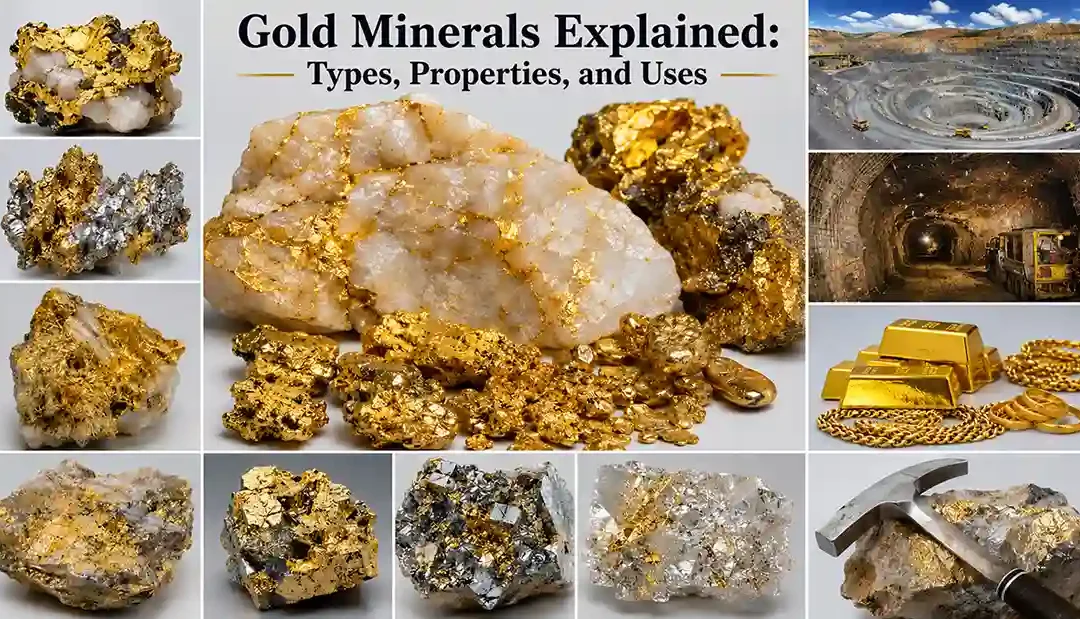
Gold minerals are among the most valuable mineral resources on Earth. Gold has fascinated civilizations for thousands of years because of its rarity, beauty, corrosion resistance, and exceptional physical properties. Today, gold remains essential for jewelry, investment, electronics, aerospace, medicine, and advanced technologies.
Although native gold is the best-known form, gold also occurs in several telluride minerals and as microscopic particles within sulfide ores. Understanding gold minerals is fundamental to economic geology and mineral exploration.
What Are Gold Minerals?
Gold minerals are naturally occurring minerals that contain economically recoverable gold.
Gold occurs as:
- native metallic gold
- gold-silver alloys
- gold tellurides
- microscopic inclusions in sulfide minerals
These minerals form the basis of the global gold mining industry.
Major Gold Minerals
Native Gold
The most important gold mineral.
Chemical formula:
Gold content:
Up to 100% Au (commonly contains silver impurities)
Color:
- metallic gold
- golden yellow
Electrum
Natural alloy of gold and silver.
Chemical formula:
Gold content:
Typically 50–80% gold
Color:
- pale yellow
- silvery gold
Calaverite
Gold telluride mineral.
Chemical formula:
Color:
- bronze yellow
- silver white
Sylvanite
Gold-silver telluride.
Chemical formula:
Color:
- steel gray
- silver white
Petzite
Silver-gold telluride.
Chemical formula:
Color:
- black
- gray
Krennerite
Gold telluride mineral.
Chemical formula:
Color:
- bronze white
- yellowish
Gold Mineral Comparison
| Mineral | Formula | Main Gold Form | Importance |
|---|---|---|---|
| Native Gold | Au | Pure Gold | Excellent |
| Electrum | AuAg | Gold-Silver Alloy | High |
| Calaverite | AuTe₂ | Gold Telluride | High |
| Sylvanite | (Au,Ag)Te₂ | Gold-Silver Telluride | Moderate |
| Petzite | Ag₃AuTe₂ | Telluride | Moderate |
| Krennerite | (Au,Ag)Te₂ | Telluride | Moderate |
Formation of Gold Deposits
Gold forms through several geological processes.
Orogenic Gold Deposits
Formed during mountain-building events.
Epithermal Deposits
Created by shallow hydrothermal fluids.
Porphyry Deposits
Gold occurs with copper and molybdenum.
Placer Deposits
Gold accumulates in rivers after weathering.
Carlin-Type Deposits
Microscopic gold disseminated in sedimentary rocks.
Quartz Gold Veins
Many gold deposits occur in:
- quartz veins
- hydrothermal fractures
- fault zones
Hot, gold-bearing fluids deposit quartz and native gold as they cool.
Physical Properties
| Property | Typical Value |
|---|---|
| Hardness | 2.5–3 |
| Luster | Metallic |
| Streak | Golden Yellow |
| Specific Gravity | 15.5–19.3 |
| Crystal System | Isometric (Native Gold) |
Gold is extremely dense, malleable, and ductile.
Major Gold-Producing Countries
Leading gold producers include:
- China
- Australia
- Russia
- Canada
- United States
- South Africa
- Ghana
- Peru
Famous Gold Mines
Some of the world's best-known gold mines include:
- Muruntau Mine
- Grasberg Mine
- Carlin Trend
- Super Pit
Gold Mining Methods
Gold is extracted using:
- open-pit mining
- underground mining
- placer mining
- dredging
- heap leaching
- gravity separation
The mining method depends on deposit type and ore grade.
Gold Processing
After mining, gold ore is processed by:
- Crushing
- Grinding
- Gravity concentration
- Flotation (for some ores)
- Cyanide leaching
- Smelting and refining
Modern refineries can produce gold with purity exceeding 99.99%.
Uses of Gold
Gold is widely used in:
- jewelry
- coins and bullion
- electronics
- aerospace
- dentistry
- medical devices
- telecommunications
- high-reliability electrical connectors
Its excellent conductivity and resistance to corrosion make it valuable beyond decorative uses.
Native Gold vs Gold Ores
Not all gold occurs as visible nuggets.
Gold may occur as:
- microscopic particles
- inclusions in pyrite
- inclusions in arsenopyrite
- telluride minerals
- disseminated ore
Many modern gold mines recover invisible microscopic gold.
Environmental Considerations
Gold mining may impact:
- water resources
- landscapes
- biodiversity
- mine waste management
Responsible mining practices include:
- water recycling
- tailings management
- land rehabilitation
- environmental monitoring
Gold Minerals Summary
Gold remains one of the world's most valuable metals because of its rarity, durability, and broad range of industrial, financial, and technological applications.
| Feature | Gold Minerals |
|---|---|
| Main Minerals | Native Gold, Electrum, Calaverite, Sylvanite, Petzite |
| Main Metal | Gold (Au) |
| Largest Deposit Types | Orogenic, Epithermal, Porphyry, Placer |
| Main Processing | Gravity Separation, Cyanide Leaching, Smelting |
| Major Uses | Jewelry, Electronics, Investment, Aerospace |
Native gold (Au) is the most important and economically valuable gold mineral.
No. Gold also occurs in natural alloys such as electrum and in telluride minerals like calaverite and sylvanite.
The major deposit types are orogenic, epithermal, porphyry, placer, and Carlin-type deposits.
Gold is widely used in jewelry, investment products, electronics, aerospace, dentistry, and high-performance electrical components.
China, Australia, Russia, Canada, the United States, South Africa, Ghana, and Peru are among the world's leading gold producers.
Final Thoughts
Gold minerals have shaped economies, civilizations, and technological progress for thousands of years. From native gold nuggets in placer streams to microscopic gold locked within sulfide ores and telluride minerals, gold occurs in a remarkable variety of geological settings.
Understanding gold mineralogy, deposit formation, mining methods, and processing techniques is essential for economic geology, mineral exploration, and the global mining industry. As demand continues to grow across technology, finance, and renewable energy sectors, gold will remain one of Earth's most valuable and strategically important mineral resources.
Continue learning with → /ore-deposits-explained/, /smelting-and-refining-minerals/, and /mineral-processing-basics/.