
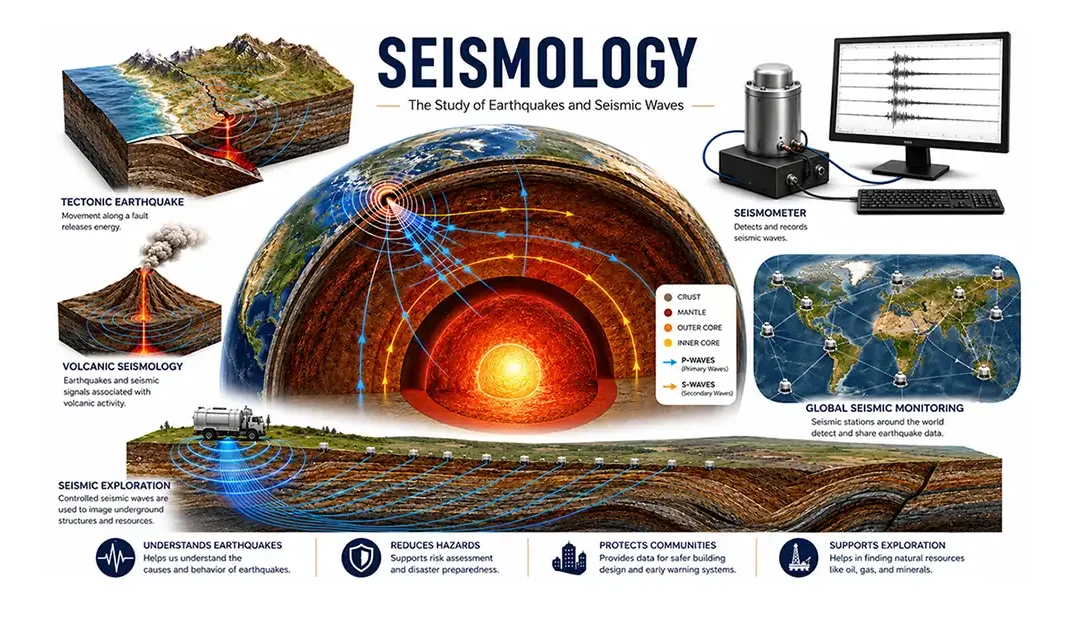
Seismology is the study of earthquakes. Much of the information about the nature of faulting during an earthquake comes from the resulting seismograms. Most earthquakes occur due to plate motion, and understanding the direction and magnitude of this movement helps describe plate motions and the forces that generate them.
Seismogram analysis allows researchers to investigate the physical processes that happen before, during, and after a fault rupture. Such studies help scientists assess the hazards posed by earthquakes.
What is Seismology?
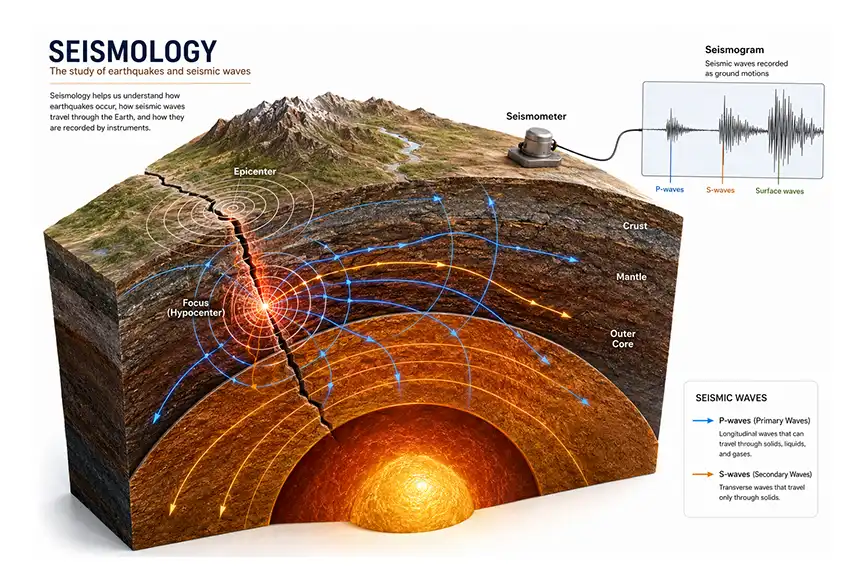
Seismology (from Greek σεισμός "earthquake" and -λογία "study of") is the scientific study of earthquakes and the propagation of elastic waves through the Earth or other planet-like bodies. It focuses on seismic waves that travel through and around the Earth, including those caused by earthquakes.
Geophysicists study how these waves move and affect the Earth to understand the nature of regions deep below the surface, where direct observation is impossible. Seismic waves can originate from natural events, such as earthquakes, or be artificially generated.
The field also includes studies of earthquake effects, such as tsunamis, and diverse seismic sources such as volcanic, tectonic, oceanic, atmospheric, and artificial processes (like explosions).
A related discipline, paleoseismology, uses geological evidence to infer information about past earthquakes. A record of Earth’s motion over time is called a seismogram, and a seismologist is the scientist who researches and interprets these records.
Development History of Seismology:
Some major milestones in the development of seismology include:
- Ancient Observations: Early speculations on the natural causes of earthquakes appeared in the writings of Thales of Miletus (c. 585 BCE/BC), Anaximenes of Miletus (c. 550 BCE), Aristotle (c. 340 BCE), and Zhang Heng (132 CE/AD).
- The First Seismoscope: In 132 CE, Zhang Heng of China’s Han dynasty designed the first known seismoscope.
- Early Theories: In 1664, Athanasius Kircher suggested that earthquakes were caused by fire moving through channels inside the Earth. Later, in 1703, Martin Lister and Nicolas Lemery proposed that chemical explosions within the Earth triggered quakes.
- The Lisbon Earthquake of 1755: This event inspired scientific investigations by John Bevis (1757) and John Michell (1761). Michell proposed that earthquakes originate within the Earth as waves caused by shifting rock masses deep below the surface.
- Instrumental Seismology: In 1857, Robert Mallet established the foundations of instrumental seismology through experiments using explosives. In 1897, Emil Wiechert theorized that Earth’s interior consists of a silicate mantle surrounding an iron core.
- Major Discoveries: In 1906, Richard Dixon Oldham identified the separate arrivals of P-waves, S-waves, and surface waves, providing clear evidence of Earth’s core.
- Elastic Rebound Theory: In 1910, Harry Fielding Reid introduced the “elastic rebound theory” after studying the 1906 San Francisco earthquake, forming the basis for modern tectonic science.
- Advances in the 20th Century: Harold Jeffreys (1926) concluded that Earth’s core is liquid, while Inge Lehmann (1937) discovered a solid inner core within the liquid outer core.
- The Plate Tectonic Revolution: By the 1960s, earth sciences had progressed to form the comprehensive theory of plate tectonics, explaining most seismic events worldwide.
How Seismology Works
Seismology works by detecting and analyzing the seismic waves produced when energy is suddenly released within the Earth. These waves are generated by earthquakes, volcanic eruptions, landslides, and even some human activities such as mining or underground explosions. By studying how seismic waves travel through the Earth, scientists can determine where an earthquake occurred, how powerful it was, and what it reveals about the Earth's internal structure.
Although modern seismology relies on advanced technology, the basic process can be understood in a few simple steps.
1. An Earthquake Releases Energy
The process begins when stress built up along a fault is suddenly released. This release of energy generates seismic waves that spread outward in all directions from the earthquake's focus (hypocenter). The point directly above the focus on Earth's surface is called the epicenter.
2. Seismic Waves Travel Through the Earth
The energy released during an earthquake travels through the Earth as different types of seismic waves. The two main body waves are Primary (P) waves and Secondary (S) waves, while surface waves travel along Earth's surface and are usually responsible for the strongest ground shaking.
Because each wave travels at a different speed and behaves differently in various materials, they provide valuable information about Earth's interior.
3. Seismometers Detect Ground Motion
As seismic waves reach monitoring stations, they are recorded by highly sensitive instruments called seismometers. These instruments can detect ground movements that are far too small for people to notice, allowing scientists to monitor earthquakes occurring anywhere in the world.
4. A Seismogram Is Created
The data collected by a seismometer are displayed as a seismogram, which is a graphical record of ground motion over time. By examining the arrival times and amplitudes of different seismic waves, seismologists can calculate the earthquake's location, depth, and magnitude.
5. Scientists Analyze the Data
Once the seismic data have been collected, scientists compare records from multiple seismic stations. This information helps them determine:
- The earthquake's epicenter
- The depth of the earthquake
- Its magnitude
- The type of fault movement
- The distribution of aftershocks
- The properties of Earth's interior
Major Branches of Seismology
Seismology covers several specialized fields, each focusing on different aspects of earthquakes, seismic waves, and Earth's interior. Although classifications vary among universities and research organizations, the following are the major branches commonly recognized in geology and geophysics.
1. Earthquake Seismology
Earthquake seismology focuses on the causes and effects of earthquakes. It examines how faults rupture, how seismic waves travel, and how earthquakes can be located and measured. This branch plays a key role in seismic hazard assessment and earthquake monitoring.
2. Exploration Seismology
Exploration seismology uses artificially generated seismic waves to investigate underground rock formations. It is widely used in the exploration of oil, natural gas, minerals, and groundwater, as well as in geological mapping for engineering and environmental studies.
3. Engineering Seismology
Engineering seismology studies how earthquakes affect buildings, bridges, dams, and other structures. The information gathered helps engineers design earthquake-resistant infrastructure and improve construction standards in seismic regions.
4. Volcanic Seismology
Volcanic seismology focuses on seismic activity associated with volcanoes. By monitoring earthquake patterns beneath active volcanoes, scientists can detect magma movement and identify signs of possible volcanic eruptions.
5. Global Seismology
Global seismology investigates how seismic waves travel through the entire Earth. These observations allow scientists to study the structure of the crust, mantle, and core, providing valuable insights into the planet's internal composition.
6. Planetary Seismology
Planetary seismology extends seismic studies beyond Earth. Scientists use seismic instruments on other planetary bodies, such as the Moon and Mars, to understand their internal structures and geological evolution.
Development of Seismology
Seismology has evolved from simple observations of earthquakes to a sophisticated scientific discipline that helps researchers understand Earth's interior and monitor seismic hazards. Over thousands of years, improvements in scientific knowledge and technology have transformed the way earthquakes are studied.
Early Observations of Earthquakes
People have been observing earthquakes since ancient times, long before the science of seismology existed. Early civilizations in China, Greece, India, and Japan recorded earthquake events and attempted to explain their causes. Although many early explanations were based on myths and religious beliefs, these observations laid the foundation for future scientific studies.
The First Seismoscope
A major milestone came in 132 CE, when the Chinese scientist Zhang Heng invented the world's first seismoscope. Although it could not measure an earthquake's strength, the instrument could detect distant earthquakes and indicate the direction from which seismic waves arrived. It is considered one of the earliest scientific instruments designed to study earthquakes.
The Birth of Modern Seismology
Modern seismology began to take shape during the late nineteenth century with the invention of more accurate seismic instruments. Scientists started recording earthquake vibrations systematically, allowing them to determine earthquake locations, measure seismic wave speeds, and better understand how earthquakes occur.
During this period, John Milne, often called the Father of Modern Seismology, developed one of the first practical seismographs and established a global network of seismic observation stations. His work greatly improved the accuracy of earthquake monitoring.
Advances in the Twentieth Century
The twentieth century marked a period of rapid progress in seismology. Improvements in seismographs, global communication, and data analysis enabled scientists to detect earthquakes worldwide with much greater precision.
The development of the plate tectonic theory during the 1960s also transformed seismology by providing a scientific explanation for why most earthquakes occur along plate boundaries. At the same time, studies of seismic waves revealed important details about the Earth's crust, mantle, and core.
Modern Seismology
Today, seismology relies on advanced digital seismometers, satellite technology, computer modeling, and global seismic networks. These tools allow scientists to monitor earthquakes in real time, issue tsunami warnings, study volcanic activity, and investigate the Earth's interior with remarkable accuracy.
Modern seismology also supports engineering, disaster preparedness, natural resource exploration, and even planetary science, where seismic instruments have been used to study the Moon and Mars.
Tools Used in Seismology
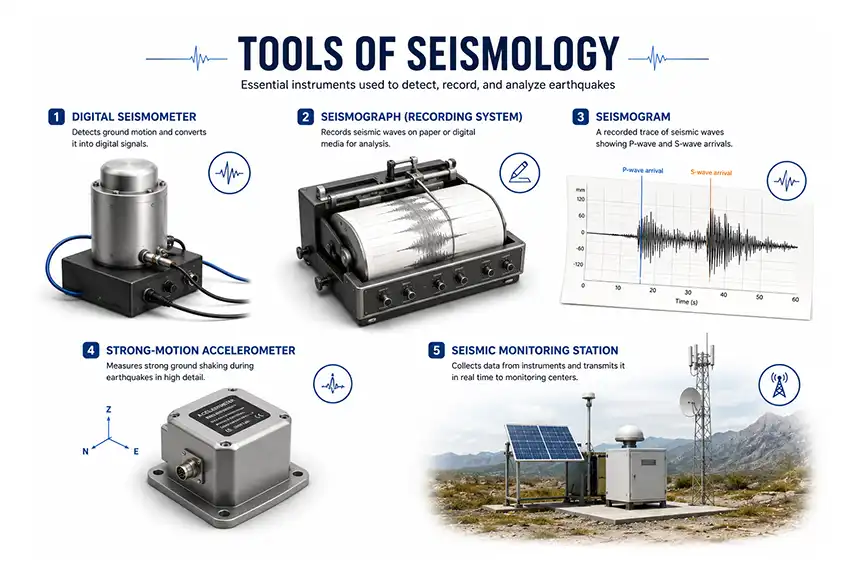
Seismology relies on a variety of specialized instruments to detect, record, and analyze seismic waves. These tools enable scientists to monitor earthquakes, study Earth's interior, and assess seismic hazards with remarkable accuracy. While technology has advanced significantly over the years, the primary goal remains the same—to measure ground motion and understand the processes occurring beneath Earth's surface.
1. Seismometer
A seismometer is the primary instrument used in seismology. It is designed to detect and measure even the smallest ground vibrations caused by earthquakes, volcanic activity, or human-made events. Modern digital seismometers are highly sensitive and continuously record ground motion at seismic monitoring stations worldwide.
2. Seismograph
A seismograph is a recording system that combines a seismometer with data-recording equipment. It converts detected ground motion into a permanent record, allowing scientists to analyze the timing, duration, and intensity of seismic waves.
3. Seismogram
A seismogram is the graphical record produced by a seismograph. It displays the arrival of different seismic waves over time and helps seismologists determine an earthquake's epicenter, depth, and magnitude.
4. Accelerometer
An accelerometer measures strong ground acceleration during earthquakes. Unlike traditional seismometers, it is designed to record intense shaking, making it especially useful for engineering studies and earthquake-resistant building design.
5. Seismic Monitoring Stations
Seismic monitoring stations are equipped with digital sensors, communication systems, and data-processing equipment that continuously record ground motion. Networks of these stations share real-time data, enabling scientists to detect earthquakes quickly and issue timely hazard information.
Applications of Seismology
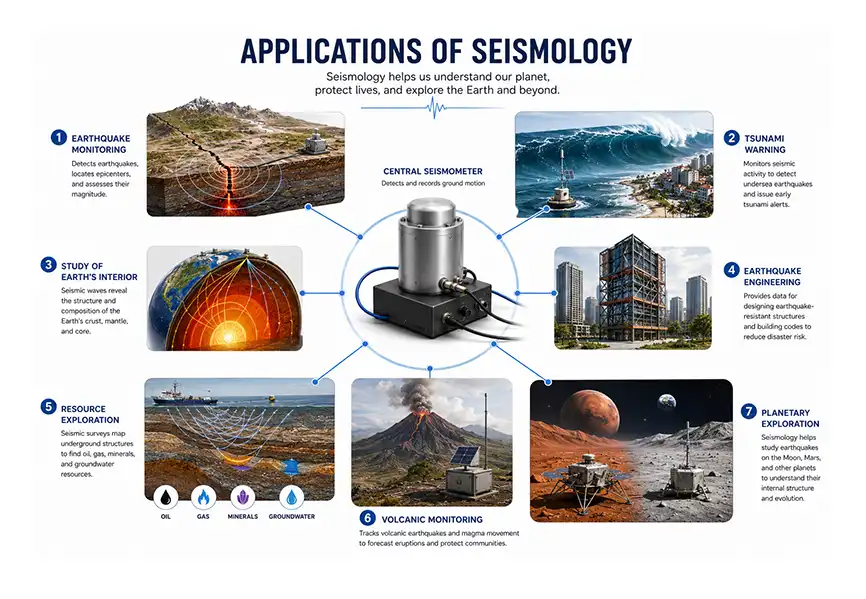
Seismology has applications far beyond studying earthquakes. By analyzing seismic waves, scientists can investigate Earth's interior, monitor natural hazards, and support industries such as engineering, construction, and natural resource exploration. Today, seismology plays an important role in both scientific research and everyday life.
1. Earthquake Monitoring and Hazard Assessment
One of the primary applications of seismology is monitoring earthquakes. Seismic networks record earthquake activity around the world, helping scientists determine an earthquake's location, depth, and magnitude. This information is essential for assessing seismic hazards and improving disaster preparedness.
2. Tsunami Warning Systems
Large undersea earthquakes can generate destructive tsunamis. Seismologists rapidly analyze seismic data to identify earthquakes capable of producing tsunami waves. Their observations provide valuable information for early warning systems, allowing coastal communities to prepare before tsunami waves reach the shore.
3. Understanding Earth's Interior
Seismic waves travel differently through various materials inside the Earth. By studying these wave patterns, scientists can investigate the structure of the crust, mantle, and core. Much of what we know about Earth's interior comes from seismological research.
4. Engineering and Infrastructure Design
Engineers use seismic data to design buildings, bridges, dams, and other structures that can better withstand earthquake shaking. Seismology also helps identify areas with higher seismic risk, supporting safer urban planning and construction.
5. Natural Resource Exploration
Exploration seismology is widely used to locate underground resources such as oil, natural gas, minerals, and groundwater. Artificially generated seismic waves create detailed images of subsurface rock layers, helping geologists identify potential resource deposits.
6. Volcano Monitoring
Many active volcanoes produce small earthquakes as magma moves beneath the surface. By monitoring these seismic signals, scientists can detect changes in volcanic activity and improve eruption forecasting.
7. Scientific Research and Planetary Exploration
Seismology is also used to study the geological evolution of Earth and other planetary bodies. Seismic instruments deployed on the Moon and Mars have provided valuable insights into their internal structures, expanding our understanding of planetary geology.
Learning from Seismology:
Plate tectonics explains about 90% but not all of the phenomena. However, this knowledge does not yet allow precise earthquake prediction because tectonic processes occur over millions of years, far beyond the human timescale.
These movements happen slowly, yet the signs that precede an earthquake usually appear only seconds before it strikes. Even with highly sophisticated seismometers, scientists often receive too little warning to provide lifesaving alerts.
Each year, thousands of small tremors occur, most too weak to notice. Some may act as foreshocks, hinting at larger quakes to come. Additionally, studies of other natural phenomena, such as tidal patterns and animal behavior, may offer clues about future earthquakes.
Conclusion:
Seismology is much more than the study of earthquakes—it is a science that helps us understand how our planet works. By analyzing seismic waves, scientists can investigate Earth's internal structure, monitor earthquake activity, study volcanic processes, and improve our understanding of plate tectonics.
Over the years, seismology has evolved from simple observations of ground shaking to a highly advanced scientific discipline supported by digital instruments, global monitoring networks, and powerful computer technologies. Today, its applications extend beyond earthquake research, contributing to engineering, disaster risk reduction, natural resource exploration, and planetary science.
As technology continues to advance, seismology will remain an essential field for protecting communities, improving infrastructure, and expanding our knowledge of Earth's dynamic processes. Whether you are a geology student, researcher, or simply curious about our planet, understanding seismology provides valuable insight into the forces that continue to shape the Earth.
A seismometer is the instrument that detects ground motion, while a seismograph is the system that records those measurements as a seismogram.
Seismology helps monitor earthquakes, improve disaster preparedness, design safer structures, study Earth's interior, and support tsunami warning systems.
No. Scientists cannot accurately predict when or where an earthquake will occur. However, seismology helps assess earthquake hazards, monitor seismic activity, and provide rapid warnings after an earthquake begins.
Seismology is a branch of geophysics that closely supports geology. It helps geologists study plate tectonics, faults, volcanoes, mountain building, and the internal structure of the Earth.
A seismologist studies earthquakes and analyzes seismic data to locate earthquakes, investigate Earth's interior, assess seismic hazards, and monitor volcanic activity.