
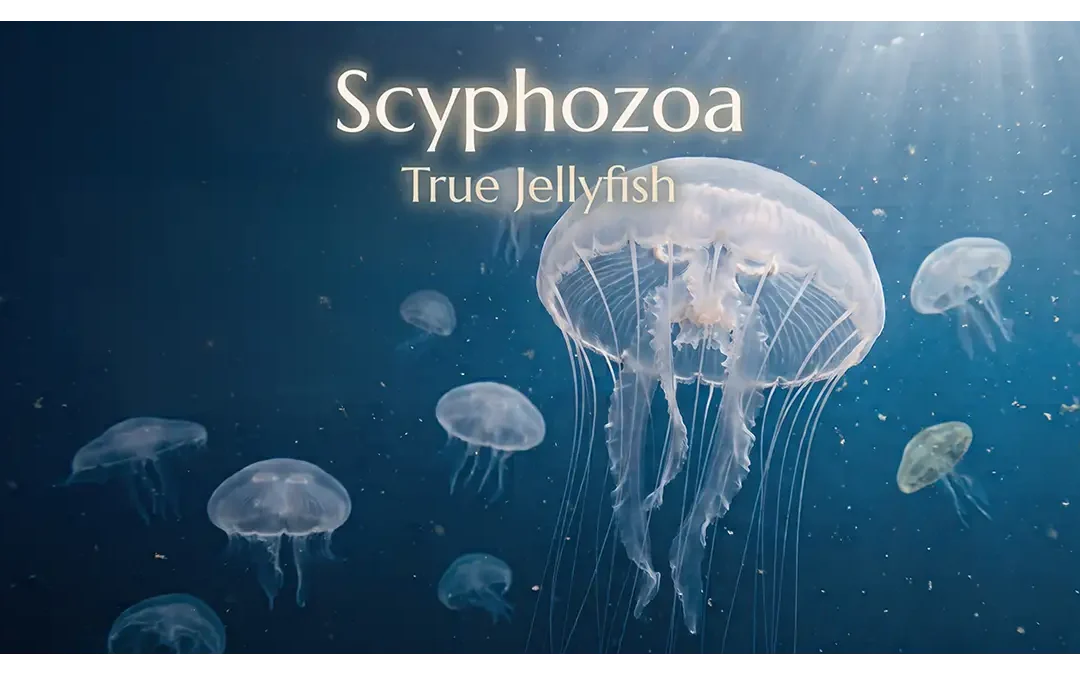
Scyphozoa is a class of marine cnidarians commonly known as true jellyfish. These animals are best known for their soft, bell-shaped bodies, stinging cells, and free-swimming adult stage. They live mainly in oceans and play important roles as predators and prey in marine food webs.
Unlike many animals with hard shells or bones, scyphozoans have soft bodies that are difficult to preserve as fossils. Their evolutionary history is therefore studied through a combination of living species, developmental biology, anatomy, and rare fossil impressions.
What Is Scyphozoa?
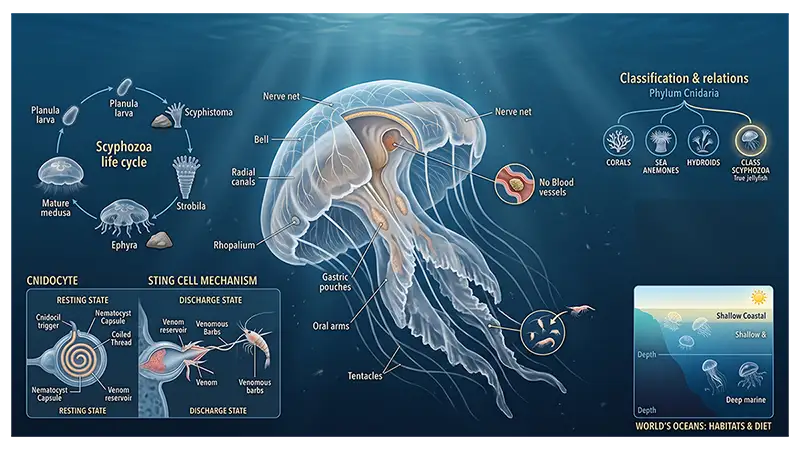
Scyphozoa is a class within the phylum Cnidaria, the same major animal group that includes corals, sea anemones, hydroids, and other jellyfish-like animals. Members of Scyphozoa are commonly called true jellyfish.
Most scyphozoans spend their adult lives as medusae, the familiar swimming form with a bell or umbrella-shaped body. This adult stage is different from the small polyp stage that occurs earlier in their life cycle.
Scyphozoans are simple in body organization but highly effective marine animals. They do not have a brain, heart, lungs, or blood vessels. Instead, their bodies contain a network of tissues and a gastrovascular cavity that helps with digestion and distribution of nutrients.
One of their most important features is the presence of cnidocytes. These specialized cells contain structures called nematocysts that can rapidly discharge and help capture prey or defend the animal.
Most Scyphozoa are marine and occur in many parts of the world's oceans. Different species occupy different habitats, from shallow coastal waters to deeper marine environments.
Key Characteristics of Scyphozoa
- Belong to the phylum Cnidaria
- Commonly called true jellyfish
- Mostly marine animals
- Adult medusa is usually the main visible life stage
- Have a soft, gelatinous body
- Possess cnidocytes and nematocysts
- Have radial body organization
- Lack a brain and complex internal organs
- Feed mainly on plankton and other small marine animals
- Usually have both polyp and medusa stages in their life cycle
What Does a Scyphozoan Look Like?
A typical scyphozoan has a rounded or bell-shaped umbrella that allows it to move through the water. The body is largely made of water and gelatinous tissue, which gives jellyfish their soft appearance.
The thickness and shape of the bell differ among species. Some have broad, flattened bells, while others have more rounded or deeply curved forms.
The outer edge of the bell may contain structures that help with swimming, sensing the environment, or feeding. Many species also have tentacles that extend into the surrounding water.
Main Body Structures
Bell or umbrella:
The bell is the main swimming structure. Rhythmic contractions push water away from the body and help the jellyfish move.
Mesoglea:
Between the outer and inner tissue layers is a thick gelatinous material called mesoglea. It gives the body much of its volume and helps maintain its shape.
Tentacles:
Many scyphozoans have tentacles containing cnidocytes. These structures help immobilize prey and can also provide protection.
Oral arms:
Some species have long structures around the mouth called oral arms. These can help move food toward the mouth and are especially noticeable in many rhizostome jellyfish.
Mouth:
Food enters through an opening associated with the oral region. In many scyphozoans, the same general opening is involved in releasing undigested material.
Gastrovascular cavity:
The digestive system is relatively simple. Food is broken down inside a gastrovascular cavity, where nutrients can then be distributed through the body.
Sensory structures:
Many jellyfish have structures called rhopalia around the bell. These contain sensory organs that help detect light, movement, and changes in orientation.
The body plan is based on radial symmetry, meaning that many structures are arranged around a central axis rather than along a clear left and right side.
How Does the Scyphozoan Life Cycle Work?
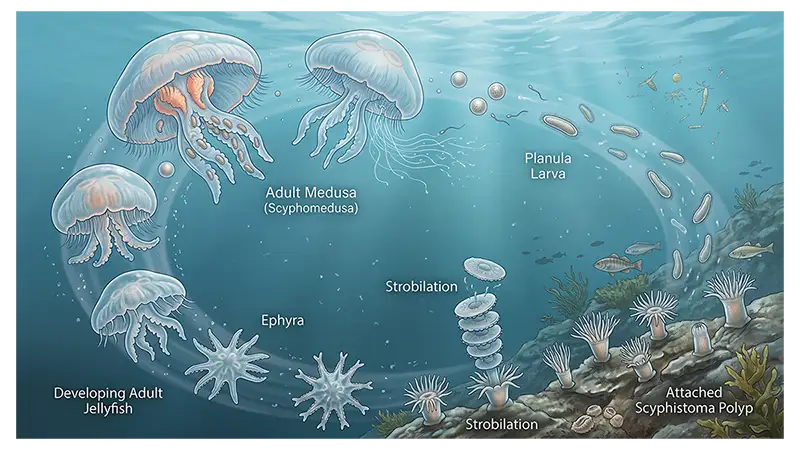
The life cycle of Scyphozoa is one of its most interesting biological features. Many species alternate between a swimming medusa stage and a much smaller polyp stage. The exact sequence can vary among species, but a common pattern begins with reproduction by adult jellyfish.
A Typical Scyphozoan Life Cycle
1. Adult medusa
The mature jellyfish produces eggs or sperm. In many species, males and females are separate individuals.
2. Fertilization
Egg and sperm combine to form a fertilized egg. Depending on the species, fertilization may occur inside or outside the body.
3. Planula larva
The fertilized egg develops into a small, ciliated larva called a planula. It can swim for a period of time before settling.
4. Scyphistoma
After settlement, the planula develops into a small polyp known as a scyphistoma. It is attached to a surface rather than freely swimming like the adult.
5. Strobilation
In many species, the polyp undergoes a process called strobilation. Its body develops a series of segments that can eventually separate.
6. Ephyra
The released young jellyfish is called an ephyra. It has a distinctive star-like or lobed shape and begins living as a small free-swimming medusa.
7. Adult medusa
The ephyra grows and develops into the familiar adult jellyfish.
This cycle allows Scyphozoa to use two very different lifestyles. The polyp is attached and relatively stationary, while the adult medusa moves through the water.
Not every species follows exactly the same pattern. Some have reduced or modified stages, so the life cycle should be understood as a general pattern rather than a rule that applies identically to every scyphozoan.
How Do Scyphozoa Feed and Capture Prey?
Scyphozoans are predators, although the size and type of prey vary among species. Many feed on plankton, including small crustaceans, fish larvae, eggs, and other tiny marine organisms. Their feeding method depends heavily on cnidocytes. These specialized cells are concentrated in areas that come into contact with prey.
When suitable prey touches a triggering structure, a nematocyst can discharge extremely quickly. The released structure helps attach to or penetrate the prey and may deliver venom. Once prey has been captured, the jellyfish moves it toward the mouth or oral region. Digestion takes place in the gastrovascular cavity. Enzymes help break food into smaller substances that the tissues can use.
What Determines What a Scyphozoan Eats?
Diet can depend on:
- Body size
- Tentacle structure
- Habitat
- Available prey
- Swimming behavior
- Water currents
- Feeding structures
- Life stage
Some larger jellyfish can capture relatively large prey, while smaller species and young individuals may depend more heavily on tiny plankton.
Their feeding also connects them to wider marine food webs. By consuming plankton and other organisms, scyphozoans influence the abundance and movement of energy within ocean ecosystems.
Where Do Scyphozoa Live?
Scyphozoa are primarily marine animals and are found in oceans around the world. Their distribution depends on the species, because different jellyfish have different environmental requirements.
Many species occur in coastal waters where food is plentiful. Others can live farther offshore and may spend much of their lives moving with currents.
Some species are associated with particular water depths, temperatures, or salinity conditions. Seasonal changes can also influence where jellyfish are found.
Environmental Factors That Affect Scyphozoa
Temperature:
Water temperature can affect growth, reproduction, metabolism, and the development of different life stages.
Salinity:
Jellyfish generally require suitable salt concentrations, although tolerance varies between species.
Food availability:
Areas with abundant plankton can provide favorable feeding conditions.
Ocean currents:
Currents transport both jellyfish and their food. They can strongly influence where populations occur.
Depth:
Different species and life stages may occupy different parts of the water column.
Light:
Light can influence the behavior and distribution of some species, particularly through sensory structures.
Scyphozoans are therefore not evenly distributed throughout the ocean. Their populations are shaped by the interaction between biology and physical conditions.
What Are the Main Groups of Scyphozoa?
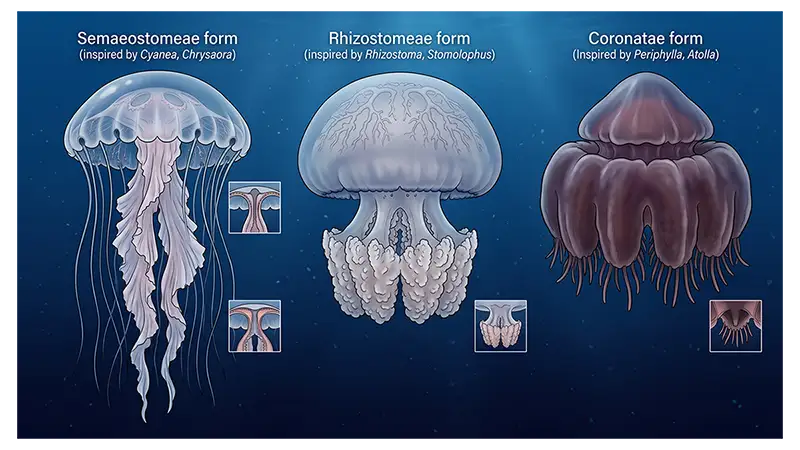
Scyphozoa contains several evolutionary lineages of true jellyfish. Modern classifications have changed over time as scientists have gained more information from anatomy, development, and molecular studies.
Two familiar groups include Semaeostomeae and Rhizostomeae. Coronatae is another important lineage containing distinctive crown jellyfish.
Semaeostomeae
Many well-known jellyfish belong to this group. They commonly have a large bell and marginal tentacles. The moon jelly, Aurelia, is one of the best-known examples.
Rhizostomeae
Rhizostome jellyfish often have complex oral arms rather than a simple central mouth. In many species, the oral arms contain numerous small openings that help process food.
Some members are associated with warm coastal waters and can form large populations under suitable conditions.
Coronatae
Coronate jellyfish are recognized by features associated with a ring or crown-like division of the bell. Many are adapted to deeper marine environments, although their distribution varies among species.
An Important Classification Note
Jellyfish diversity is broader than Scyphozoa alone. Cubozoa, Hydrozoa, and some other cnidarian groups also contain medusoid animals that people may casually call jellyfish. In addition, Staurozoa, which contains stalked jellyfish, is treated as a separate class in many modern classifications rather than being included within Scyphozoa.
This distinction is important because the everyday word "jellyfish" does not represent one single taxonomic group.
What Role Do Scyphozoa Play in Marine Ecosystems?
Scyphozoa are active members of marine food webs. They can act as predators, competitors, and prey, depending on the species and ecosystem. As predators, jellyfish consume plankton and other small organisms. This can affect the abundance of prey populations and influence how energy moves through the food web.
At the same time, jellyfish provide food for other marine animals. Certain fish, sea turtles, ocean sunfish, and other predators can consume jellyfish. Their role becomes especially noticeable when jellyfish populations increase rapidly.
Jellyfish Blooms
A jellyfish bloom occurs when jellyfish become unusually abundant in an area. Blooms can develop under favorable environmental conditions, although the causes differ between species and locations.
Possible contributing factors include:
- High food availability
- Suitable water temperatures
- Favorable currents
- Changes in predator populations
- Human-driven changes to marine environments
Not every bloom has the same ecological effect. Some are short-lived and cause limited disruption, while others can influence fisheries, tourism, aquaculture, and local food webs.
Jellyfish therefore form an important part of ocean ecology even though they may sometimes become problematic for human activities.
How Did Scyphozoa Evolve?
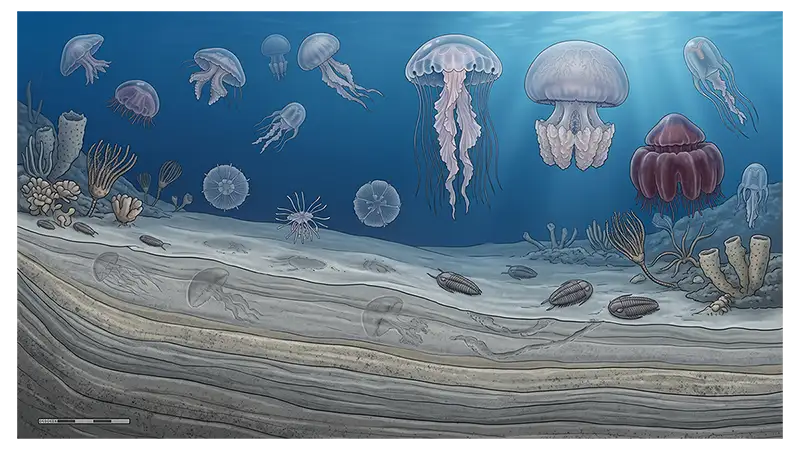
The evolutionary history of Scyphozoa is connected to the much older history of Cnidaria. Cnidarians have a very ancient origin, but reconstructing the early evolution of jellyfish is difficult because their soft bodies rarely fossilize.
The ancestors of modern scyphozoans lived in ancient marine environments long before humans appeared. Over geological time, cnidarian lineages diversified into many forms with different body plans and life strategies.
The Challenge of Ancient Jellyfish Fossils
Soft-bodied animals generally leave a poor fossil record. Unlike organisms with shells, bones, or mineralized skeletons, jellyfish can decay quickly after death.
However, under unusual conditions, their bodies can leave impressions in fine sediments. Some ancient fossils have been interpreted as jellyfish or jellyfish-like organisms. These fossils are valuable because they show that medusa-like animals existed deep in Earth's history.
However, a jellyfish-like fossil is not automatically a member of modern Scyphozoa. Scientists must examine its structures, preservation, and evolutionary relationships before assigning it to a particular group.
This is especially important when studying very ancient fossils from the Precambrian and early Paleozoic eras. Some interpretations remain debated because the fossils preserve limited anatomical information.
Why Fossils Still Matter
Even incomplete fossils can provide evidence about:
- Ancient marine environments
- Early cnidarian body forms
- The development of soft-bodied marine communities
- Changes in ocean ecosystems
- The long-term history of jellyfish-like organisms
Modern anatomy, genetics, development, and fossil evidence are therefore studied together to understand scyphozoan evolution.
Why Are Scyphozoa Important to Science and Marine Biology?
Scyphozoa are important because they provide a useful way to study several major questions in biology and Earth science.
Understanding Cnidarian Evolution
Their simple body organization helps scientists investigate how early animal body plans developed and diversified.
Studying Stinging Cells
Cnidocytes and nematocysts are among the most specialized structures in cnidarians. Researchers study how these cells work, develop, and interact with prey.
Understanding Marine Food Webs
Because jellyfish consume plankton and are eaten by other animals, they help scientists understand energy movement through marine ecosystems.
Studying Population Changes
Jellyfish populations can respond to environmental conditions. Monitoring them can provide information about changes in marine ecosystems, although jellyfish numbers alone cannot be used as a simple measure of ocean health.
Investigating Fossil Preservation
Rare jellyfish fossils demonstrate that even soft-bodied animals can sometimes become part of the geological record. Their preservation helps paleontologists reconstruct ancient marine environments.
Learning About Animal Development
The transition between planula, polyp, ephyra, and medusa stages provides an important example of how one animal can take very different forms during its life.
For paleontology, Scyphozoa also provides a reminder that the fossil record is incomplete. Some organisms may have existed for millions of years while leaving only a small number of recognizable fossils.
Conclusion
Scyphozoa is a diverse class of marine cnidarians best known as true jellyfish. Their gelatinous bodies, stinging cells, sensory structures, and swimming medusa stage make them highly specialized animals despite their relatively simple body organization.
Their life cycle commonly includes a planula, attached polyp, ephyra, and adult medusa, although individual species can differ. They feed mainly on plankton and other small marine organisms and serve as both predators and prey within ocean food webs.
Scyphozoa also has an important connection to paleontology. Because jellyfish have soft bodies, their fossils are uncommon, and identifying ancient forms can be difficult. Nevertheless, rare fossil impressions provide valuable evidence about the long history of jellyfish-like animals and ancient marine ecosystems.
Studying living Scyphozoa alongside fossils, genetics, anatomy, and development helps scientists better understand the evolution of cnidarians and the changing history of marine life.
Scyphozoa is the scientific name of a class of cnidarians commonly known as true jellyfish.
Yes. Scyphozoans are multicellular animals belonging to the phylum Cnidaria.
No. The common term "jellyfish" includes medusoid animals from several cnidarian groups. Scyphozoa represents the true jellyfish.
No. They do not have a centralized brain. Instead, they use a network of nerves and sensory structures to respond to their surroundings.
Yes. They possess cnidocytes, which contain nematocysts used mainly for prey capture and defense.