

Sabertooth animals are among the most recognizable predators in prehistoric mammal history, largely because of their exceptionally long canine teeth. These remarkable creatures appeared in several evolutionary lineages and occupied different environments across ancient continents. Their unusual skulls, powerful bodies, and specialized teeth provide valuable clues about how prehistoric predators adapted to their surroundings.
Fossil discoveries have also helped researchers investigate their feeding habits, hunting strategies, geographic range, and disappearance. From the famous Smilodon to less familiar saber-toothed mammals, these animals reveal how similar predatory features could emerge through different evolutionary paths.
What Is a Sabertooth?
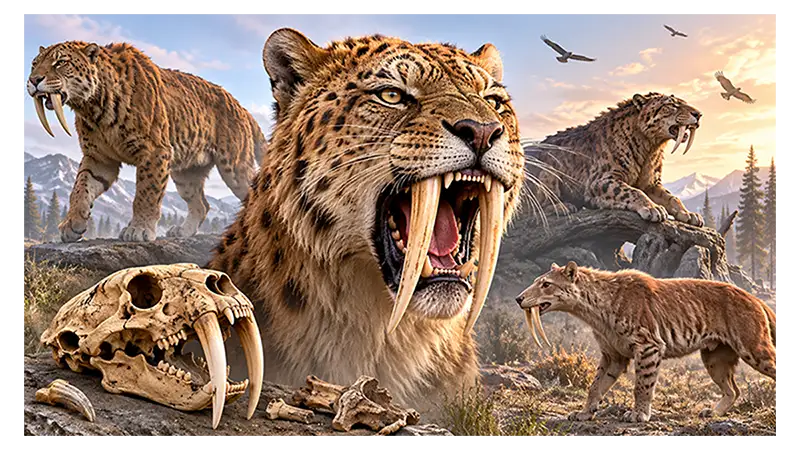
A sabertooth is an animal that evolved greatly enlarged canine teeth, usually in the upper jaw. These teeth could become long, curved, and laterally flattened, giving some species their characteristic blade-like appearance.
The term does not identify one species or a single biological family. Several unrelated mammals developed this feature independently through convergent evolution, meaning similar adaptations arose in different evolutionary lineages.
The name is most strongly associated with saber-toothed cats, an extinct group of carnivorous mammals related to modern cats. Smilodon is the best-known example, but it was neither a modern tiger nor a direct ancestor of living big cats.
Other mammals developed similar teeth outside the cat lineage. Thylacosmilus, a South American marsupial relative, had large saber-like canines that evolved independently from those of Smilodon.
Thus, “sabertooth” describes a specialized tooth adaptation rather than one particular animal. The shape, size, and possible function of these teeth differed among species, creating a diverse group of prehistoric predators.
What Did Sabertooths Look Like?
Sabertooths did not all have the same body shape. Their appearance changed according to their species, habitat, and hunting style. The best-known forms, such as Smilodon, had a powerful and compact build. Their forelimbs were especially strong compared with those of many modern cats. This strength may have helped them grab and control large prey during an attack.
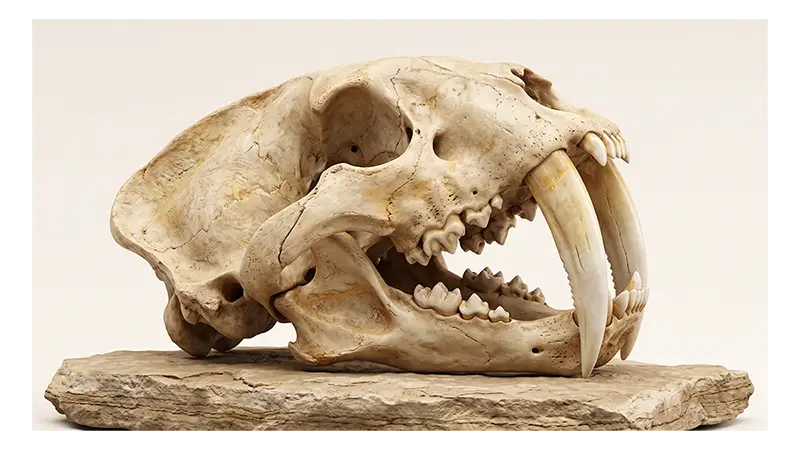
The skull was another major part of their unusual appearance. It was built around the large canine teeth and often had a broad, powerful structure. The jaw could open to a very wide angle in some species, giving the long teeth enough room to move into position.
Smilodon had a relatively short tail compared with many modern large cats. Its body was robust, with strong limbs and a deep chest. These features suggest that it was built more for power than for long-distance pursuit.
Other sabertooths looked quite different. Homotherium, for example, had shorter and more blade-like upper canines and a more lightly built body. Its legs were relatively long, suggesting greater adaptation for movement across open landscapes.
These differences are important because there was no single “sabertooth body plan.” The animals shared enlarged canine teeth, but their other features could vary considerably.
Why Did Sabertooths Have Such Long Canine Teeth?
The most striking feature of many sabertooths was their enormous upper canine teeth. In some species, these teeth extended far below the lower jaw when the mouth was closed.
These canines were different from the shorter canine teeth of modern cats. They were often thin, flattened, and sharply edged. Their shape varied between species, showing that different sabertooths did not all use their teeth in exactly the same way.
The long teeth were probably adapted for attacking prey at close range. A sabertooth could use its strong forelimbs to hold or control an animal while positioning its head for a bite. The large canines could then create deep wounds in soft parts of the body.
The skull also had features that helped accommodate the unusual teeth. Some sabertooths had large jaw openings that allowed their mouths to open much wider than those of modern cats. This was important because extremely long canines would otherwise interfere with the lower jaw.
Their neck muscles were also important. A powerful neck could help control the head during an attack and support movements involved in delivering a bite.
However, long teeth also had disadvantages. They could be more vulnerable to breaking if they struck hard bone. For this reason, sabertooths likely depended on controlled attacks rather than simply biting with maximum force into any part of their prey.
The exact function of the canines remains an area of scientific study. Their shape, wear patterns, breakage, and position within the skull all provide clues about how different species used them.
The Most Famous Sabertooths
Several different animals are commonly described as sabertooths. Some were related to one another, while others developed their saber-like teeth independently.
Smilodon
Smilodon is the most famous sabertooth and is often called the saber-toothed cat. It lived in North and South America during the Pleistocene.
Three species are commonly recognized: Smilodon gracilis, Smilodon fatalis, and Smilodon populator. Smilodon populator was particularly large and lived in South America.
Its long upper canines could reach remarkable lengths, while its strong forelimbs were suited to close contact with prey. Fossils show that Smilodon survived injuries that would have been serious, suggesting that some individuals lived for a considerable time after suffering major trauma.
Homotherium
Homotherium was another important saber-toothed predator. It had shorter, flatter canines than Smilodon and a more lightly built body.
Its fossils have been found across parts of North America, Europe, Asia, and Africa. Some evidence suggests that Homotherium was well suited to hunting in more open environments.
Megantereon
Megantereon was an earlier member of the machairodont group. It had large upper canines and a body form that shows some similarities to later saber-toothed cats.
It is important in the evolutionary history of sabertooths because it helps scientists understand how the specialized saber-toothed form developed over time.
Thylacosmilus
Thylacosmilus is especially interesting because it looked somewhat like a saber-toothed predator but was not a true cat. It was a marsupial relative from South America. Its long canine teeth evolved independently from those of Smilodon and other machairodont cats.
This animal demonstrates why the word “sabertooth” should not be treated as the name of one biological family. Similar teeth evolved more than once in mammalian history.
Where and When Did Sabertooths Live?
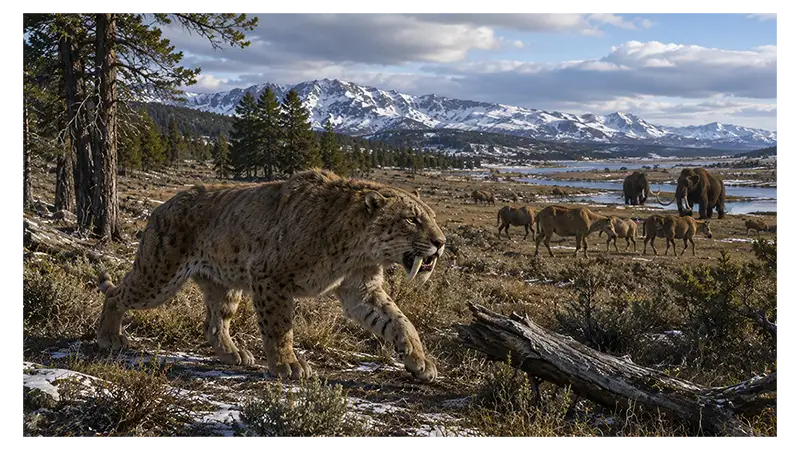
Sabertooth animals appeared at different times, so they did not share one geographic range or one period of history. Some of the earliest saber-toothed mammal forms appeared tens of millions of years ago. Later groups became widespread across parts of Africa, Europe, Asia, and the Americas.
The best-known sabertooths lived during the Pleistocene Epoch, a period that began about 2.58 million years ago and ended about 11,700 years ago. Smilodon was especially widespread in the Americas. Smilodon fatalis lived across much of North America and parts of South America, while Smilodon populator was especially important in South America.
Sabertooths occupied different types of environments. Some lived in forests or wooded areas, while others appear to have been better suited to open landscapes. Their habitats changed repeatedly during the Ice Age. Glacial cycles altered vegetation, water availability, temperature, and the distribution of large mammals.
These environmental changes created new opportunities for predators but also introduced major challenges. Animals that depended on large prey could be strongly affected when ecosystems changed.
What Did Sabertooths Eat?
Sabertooths were mainly meat-eating predators, but their exact diets depended on their species and location. Smilodon lived alongside many large herbivores in the Americas. Possible prey included large ground sloths, bison, horses, camels, and other substantial mammals. The available prey changed from one region to another, so its diet was probably not identical everywhere.
Homotherium also lived among large Ice Age mammals and may have hunted animals such as young mammoths and other large herbivores in some regions. Scientists can investigate ancient diets in several ways. Tooth shape provides information about feeding behavior, while chemical signatures preserved in teeth and bones can reveal information about the types of animals they consumed.
Fossil bones can also contain marks made by carnivores. These marks can help researchers determine which predators fed on a carcass. The strong skulls and specialized teeth of sabertooths show that they were adapted for meat-based diets, but the fossil record does not always reveal the exact prey of a particular individual.
Their diets were also connected to the health of the wider ecosystem. When populations of large herbivores changed, predators that depended on them could also be affected.
Sabertooth Fossils and What They Reveal
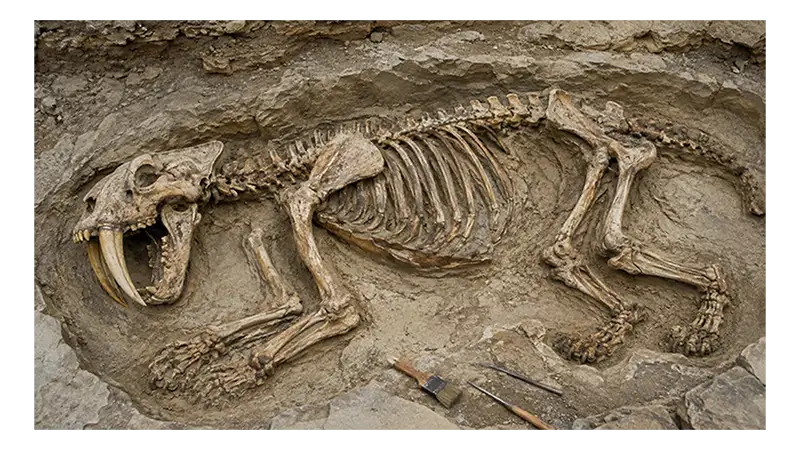
Fossils are the main source of information about sabertooths. Their teeth and skulls are especially valuable because they preserve the features that make these animals distinctive. Fossilized canines can reveal the length, thickness, shape, and wear of the teeth. Researchers can compare these features between species to study differences in feeding behavior.
Skulls provide additional information about the size of the jaw muscles and the movement of the mouth. Limb bones can reveal how strongly an animal was built and provide clues about movement. Some sabertooth fossils also contain evidence of injury. Healed fractures show that an animal survived long enough for damaged bone to repair. Such findings can provide clues about the dangers these predators faced during their lives.
One of the most important fossil sites for Smilodon is the La Brea Tar Pits in California. Thousands of Smilodon fossils have been recovered from the site, making it one of the most important sources of information about the species. The large number of remains allows scientists to study variation, injuries, age, and population patterns in much greater detail than would be possible from a single skeleton.
Fossils also reveal the environments in which sabertooths lived. Associated plant remains, pollen, sediments, and other animal fossils can help reconstruct ancient ecosystems.
Why Did Sabertooths Become Extinct?
Many of the most famous sabertooths disappeared near the end of the Pleistocene. Their extinction occurred during a period of major environmental and ecological change. The climate was changing as the last Ice Age ended. Temperatures increased, glaciers retreated, and vegetation patterns shifted across many regions.
Large mammals were also disappearing or declining in many parts of the world. This was especially important for large predators that depended on substantial prey. Human activity may have contributed to these changes in some regions. Humans hunted large mammals and also altered ecosystems as their populations expanded.
However, extinction was probably not caused by one factor everywhere. Climate change, prey loss, habitat changes, human pressure, and competition may have interacted in different ways.
The disappearance of large herbivores could have reduced the food available to specialized predators. When prey populations become smaller or move into different habitats, predators must either adapt or face increasing difficulty finding enough food.
The extinction of Smilodon and other famous sabertooths therefore represents a broader ecological story. Their disappearance was connected to major changes occurring across Ice Age ecosystems.
Not every saber-toothed animal disappeared at the same time, because different groups lived in different places and faced different environmental pressures.
Conclusion
Sabertooths were a diverse group of prehistoric mammals united by one remarkable adaptation: greatly enlarged canine teeth. Their unusual appearance was the result of different evolutionary histories, with saber-like teeth developing independently in several mammalian groups.
Smilodon remains the most famous example, but animals such as Homotherium, Megantereon, and Thylacosmilus show that the sabertooth form was much more diverse than the familiar image of a single prehistoric cat.
Their skulls, teeth, limbs, and fossil injuries allow scientists to investigate how these predators lived and fed. Evidence suggests that many relied on powerful close-range attacks rather than simply chasing prey over long distances.
The disappearance of the great sabertooths near the end of the Ice Age was part of a much larger ecological change involving climate, habitats, prey animals, and human activity. Their fossils continue to provide valuable evidence about how predators evolved and how ancient ecosystems changed through time.
No. The famous Smilodon was not a tiger. It was an extinct saber-toothed cat related to other members of the machairodont group.
Many sabertooths probably used ambush tactics and relied on close contact with prey. Strong forelimbs may have helped them control animals before using their large canine teeth.
Yes. Some late surviving sabertooths, including Smilodon, lived during periods when humans were present in the Americas.
No known saber-toothed mammal survives today. Modern cats have canine teeth, but they do not have the extremely enlarged saber-like canines seen in extinct sabertooths.
The length varied by species. Some of the largest Smilodon canines were more than 20 centimeters long, measured along the upper curve.