
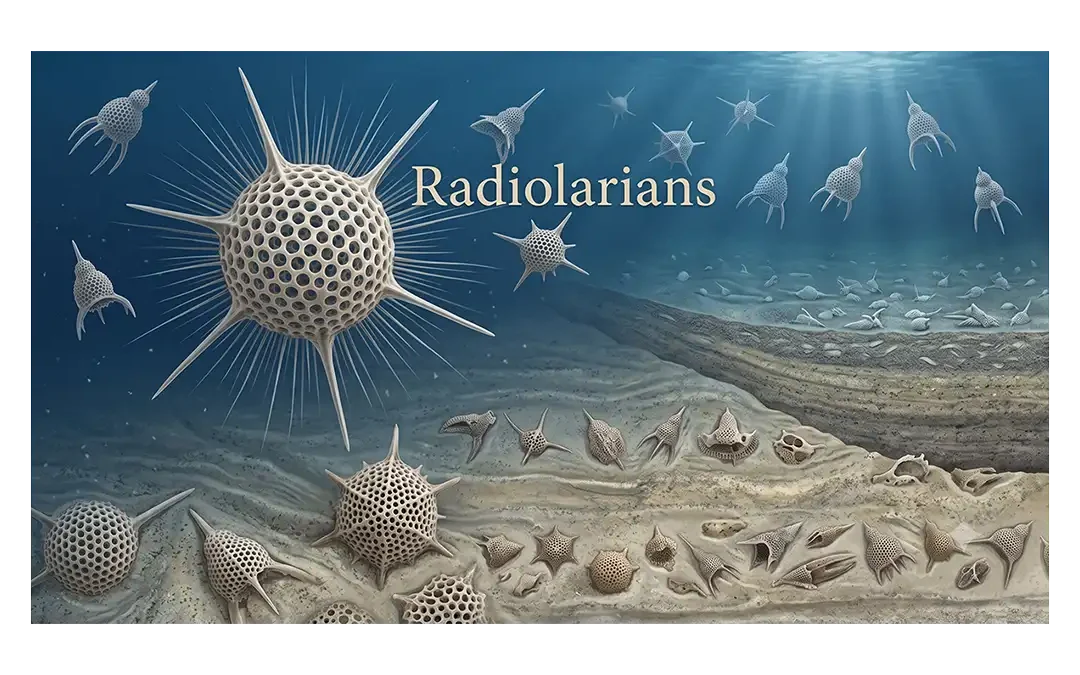
Radiolarian is a microscopic marine organism known for its intricate mineral skeleton and importance in the geological record. Radiolarians live mainly in the open ocean, where they form part of the plankton community. When they die, their mineralized skeletons can sink through the water column and accumulate on the seafloor. Over geological time, these remains can become preserved as radiolarian fossils in marine sediments and sedimentary rocks.
Radiolarian fossils are particularly valuable to geologists because they can help determine the relative ages of marine rocks, correlate sedimentary layers, and reconstruct ancient ocean environments. Their abundance, widespread distribution, and evolutionary changes make them useful in biostratigraphy and paleoenvironmental studies.
What Is a Radiolarian?
Radiolarians (or Radiolaria) are single-celled eukaryotic organisms, classifying them as protists. A radiolarian is a microscopic, single-celled marine organism that belongs to the group commonly known as Radiolaria. Most radiolarians are planktonic, meaning they drift or swim in the water column rather than living permanently on the seafloor.
One of their most distinctive features is a mineral skeleton, commonly called a test. In many radiolarians, this skeleton is composed primarily of opaline silica. The test can have highly complex and symmetrical shapes, including spheres, cones, discs, and structures with numerous spines.
Radiolarians occur throughout the world's oceans and have existed for hundreds of millions of years. Their long geological history and distinctive skeletal forms make their remains especially useful to paleontologists and geologists.
Although radiolarians are extremely small, their accumulated skeletal remains can have a major geological significance. In suitable marine environments, radiolarian tests can accumulate in large quantities on the ocean floor and contribute to the formation of siliceous sediments.
Where Do Radiolarians Live?
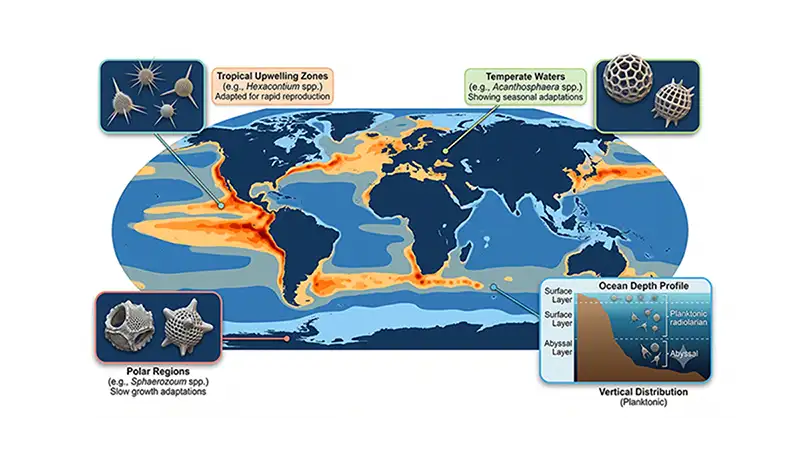
Understanding the habitat of radiolarians helps us interpret the rocks they form. Radiolarians are entirely marine organisms. They do not live in freshwater lakes or rivers. They are found in all the world's oceans, from the sunlit surface waters down to thousands of meters deep.
Most radiolarians are planktonic, meaning they drift with ocean currents rather than swimming actively. They are particularly abundant in regions of oceanic upwelling, where cold, nutrient-rich water from the deep ocean rises to the surface. This abundant nutrient supply (including dissolved silica) allows radiolarian populations to explode. Their geographic distribution is global, but different species are adapted to specific water temperatures, creating distinct populations in tropical, temperate, and polar regions.
Radiolarian Characteristics
Radiolarians have several characteristics that make them important in both marine biology and geology.
They are microscopic organisms, usually requiring a microscope for detailed examination. Their bodies commonly have a distinctive radial or geometric organization, and many species possess elaborate mineral skeletons.
Important characteristics of radiolarians include:
- They are microscopic and generally single-celled.
- They are primarily marine organisms.
- Most species are planktonic.
- They commonly possess mineralized tests or skeletons.
- Their tests are commonly rich in silica.
- Many have radial symmetry and elaborate geometric forms.
- They have delicate structures that can be preserved as microfossils.
- Their evolutionary changes provide useful information for geological dating and correlation.
The structure of the radiolarian test varies considerably between groups and through geological time. This variation is one of the main reasons radiolarian fossils can be identified and compared between different sedimentary sequences.
Radiolarian Structure and Test
The radiolarian test is particularly important from a geological perspective because it is the part most likely to become preserved as a fossil.
The test is a mineralized structure surrounding or supporting the organism. Its shape can vary greatly, with some forms having spherical frameworks while others contain chambers, lattices, pores, and long spines. These features provide useful characteristics for identifying different radiolarian groups.
The test is commonly composed of silica. During the organism's life, the skeleton provides structural support and contributes to the distinctive shape of the cell. After death, the test may remain in the marine environment and eventually settle toward the ocean floor.
The fine details of a radiolarian test are important to paleontologists. Differences in shape, size, symmetry, pore arrangement, and skeletal structure can help distinguish one species or group from another. Because many radiolarian groups evolved through recognizable changes in skeletal morphology, fossil specimens can provide information about the age of the sediments in which they occur.
Radiolarian Fossils and Their Preservation
Radiolarian fossils are the preserved mineral skeletons or tests of ancient radiolarians. They are classified as microfossils because of their microscopic size.
After a radiolarian dies, its test can sink through the water column. If it reaches the seafloor and becomes incorporated into sediment, it may eventually be buried by additional layers of sediment. Under suitable conditions, the test can survive and become part of the geological record.
Preservation is not always complete. Radiolarian tests can be dissolved, altered, broken, or replaced during burial and diagenesis. The quality of preservation therefore depends on factors such as sediment composition, water chemistry, burial conditions, and later geological alteration.
Well-preserved radiolarian fossils can reveal remarkable details of the original skeletal structure. Geologists and paleontologists examine these features to identify radiolarian taxa and determine their stratigraphic significance.
Radiolarian fossils are especially valuable in rocks formed from ancient marine sediments. They can occur in sedimentary rocks and in some rocks that have undergone later geological alteration while retaining identifiable microfossil remains.
Radiolarians in Biostratigraphy
Biostratigraphy is the use of fossils to establish the relative ages of rocks and correlate sedimentary layers. Radiolarians are valuable biostratigraphic organisms because their evolutionary history provides a sequence of recognizable forms through geological time.
Different radiolarian species and groups appeared, diversified, and disappeared at different times. If a fossil assemblage contains taxa known to have existed during a particular interval, geologists can use that information to estimate the relative age of the sediment.
Radiolarian biostratigraphy is especially useful in marine sedimentary sequences. By comparing radiolarian assemblages from different locations, researchers can correlate layers that may be separated by considerable distances.
Several characteristics contribute to their usefulness in biostratigraphy. Their microscopic size means that large numbers of specimens can occur within relatively small samples. Their evolutionary changes can also produce recognizable differences in skeletal morphology.
Radiolarians are therefore useful for establishing detailed age relationships within some marine sedimentary sequences. Their biostratigraphic value is particularly important when combined with other fossil evidence and geological information.
Radiolarian vs. Foraminifera
Radiolarians and foraminifera are both important groups of marine microorganisms that produce fossilizable tests. Their fossils are widely used in geological and paleoenvironmental studies, but their skeletal materials and typical forms differ.
| Feature | Radiolarians | Foraminifera |
|---|---|---|
| Habitat | Mainly marine | Mainly marine |
| Typical lifestyle | Mostly planktonic | Planktonic and benthic forms |
| Test composition | Commonly siliceous | Commonly calcareous |
| Common skeletal form | Often radial and highly geometric | Highly variable, often chambered |
| Major fossil use | Biostratigraphy and paleoenvironmental studies | Biostratigraphy and paleoenvironmental studies |
| Common sediment association | Siliceous sediments | Calcareous sediments |
This distinction is particularly useful in marine geology. Radiolarians are commonly associated with siliceous sedimentation, while many foraminiferal remains contribute to calcareous sediments.
Both groups can provide valuable information about the geological history of marine environments, but they are often used in different geological settings and for somewhat different types of environmental interpretation.
Geological Importance of Radiolarians
Radiolarians have considerable geological importance because their fossilized tests provide information about the age and environment of marine rocks.
One of their most important applications is in the study of deep-marine sedimentary sequences. Radiolarian fossils can occur in rocks where other fossil groups are scarce or poorly preserved. This makes them particularly useful for investigating ancient oceanic environments.
Their geological importance includes:
- Relative dating of marine sedimentary rocks
- Biostratigraphic correlation
- Identification of ancient marine environments
- Reconstruction of past ocean conditions
- Study of deep-ocean sedimentation
- Paleoenvironmental interpretation
- Investigation of ancient oceanic crust and associated sediments
Radiolarians are also important in studies of ancient plate-tectonic settings. Radiolarian-bearing rocks can occur within marine sedimentary sequences associated with oceanic crust. When these rocks are incorporated into tectonic complexes, their fossils may help geologists reconstruct the history of ancient oceans and convergent plate boundaries.
Radiolarian Facts
Here are some important facts about radiolarians:
- Radiolarians are microscopic marine organisms.
- Most radiolarians live as plankton in the ocean.
- They commonly possess intricate mineralized tests.
- Their tests are commonly composed of silica.
- Radiolarian tests can become preserved as microfossils.
- Radiolarian fossils are found in many ancient marine sedimentary sequences.
- Radiolarian-rich sediments can form siliceous marine deposits.
- Radiolarians are useful in biostratigraphy.
- Their fossils can help correlate marine sedimentary rocks.
- Radiolarian assemblages can provide information about ancient marine environments.
- Their long geological history makes them valuable to paleontologists and geologists.
A radiolarian is a microscopic, primarily marine organism that commonly has an intricate mineralized test. Most radiolarians are planktonic and live in the ocean.
Radiolarians themselves are living organisms, but their mineralized tests can become preserved as microfossils after the organisms die.
Radiolarian fossil tests are commonly composed of silica. Their exact composition and preservation can change during burial and diagenesis.
Radiolarian fossils are mainly found in marine sedimentary rocks and sediments, particularly in deposits associated with deep-ocean environments.
Radiolarians are important because their fossils can help determine the relative ages of marine rocks, correlate sedimentary layers, and reconstruct ancient ocean environments.
Conclusion
Radiolarians are microscopic marine organisms with an important place in the geological record. Their intricate mineralized tests can become preserved as microfossils and accumulate within marine sediments, particularly in deep-ocean environments.
For geologists, radiolarian fossils are more than simply remains of ancient microorganisms. Their distinctive skeletal forms and evolutionary history make them valuable tools for biostratigraphy, marine sedimentology, paleontology, and paleoenvironmental reconstruction. Radiolarian-rich sediments can also provide evidence of past ocean conditions and the history of ancient marine environments.
By studying radiolarians and their fossilized tests, scientists can better understand the age, origin, and environmental history of marine sedimentary rocks. Their small size therefore has a surprisingly large significance in understanding Earth's geological past.