
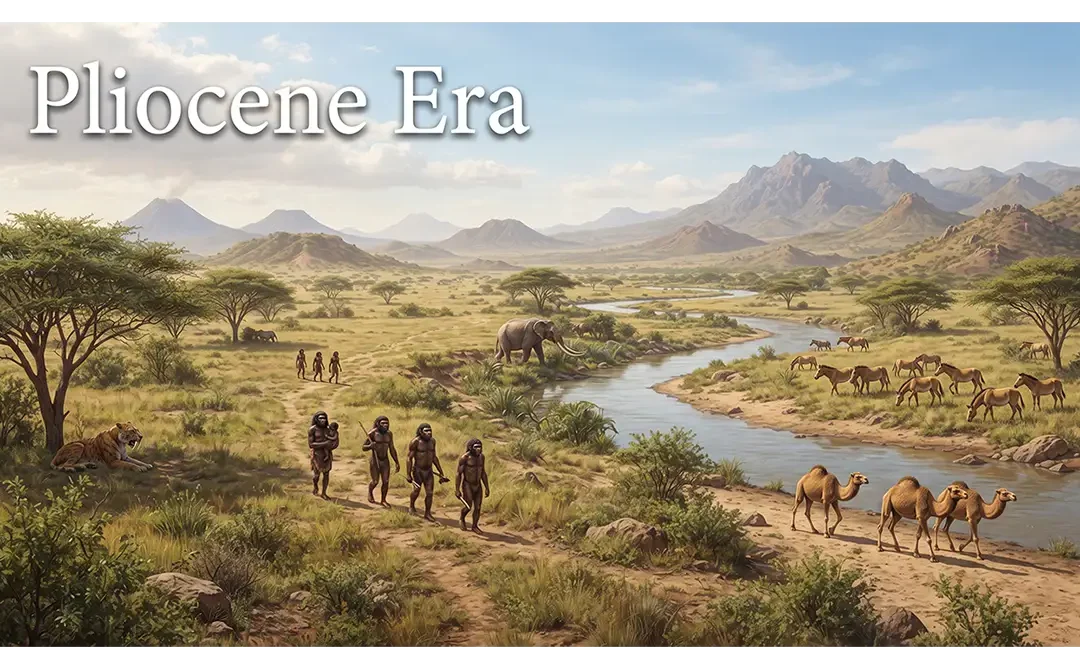
The Pliocene Era was a significant chapter in Earth's history when changing climates reshaped habitats, mammals diversified, and early human ancestors continued to evolve. Spanning approximately 5.333 million to 2.58 million years ago, this interval connects the ancient ecosystems of the Miocene with the colder conditions that characterized much of the Pleistocene.
During this time, grasslands expanded across some regions, forests persisted in wetter areas, and ocean circulation influenced global environmental patterns. Horses, elephants and their relatives, large carnivores, whales, and many other animal groups inhabited the planet. Africa also supported early hominins whose fossils reveal important stages in the evolution of upright walking.
Although “Pliocene Era” is widely used as a search phrase, the formal geological term is the Pliocene Epoch, a subdivision of the Neogene Period within the Cenozoic Era. Understanding this distinction helps place the Pliocene accurately within Earth's geological timescale.
What Was the Pliocene Era?
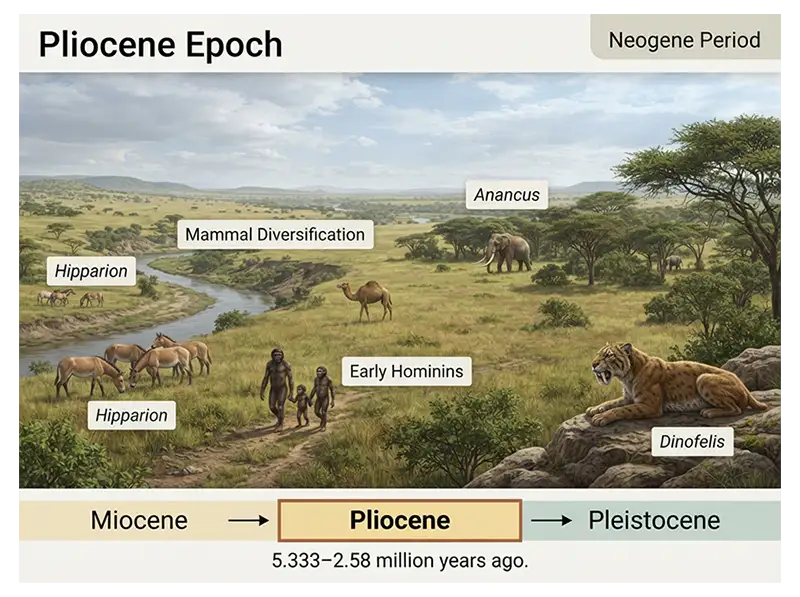
The Pliocene was the final epoch of the Neogene Period. It followed the Miocene Epoch and preceded the Pleistocene, which is famous for repeated glacial and interglacial cycles.
The planet already supported many recognizable groups of mammals, birds, reptiles, and marine organisms. However, numerous species differed from their modern relatives, and their geographic distributions reflected environmental conditions that no longer exist in exactly the same form.
Several major developments characterized this interval:
- Mammalian diversification: Hoofed herbivores, elephants and their relatives, carnivores, and marine mammals continued to evolve.
- Vegetation changes: Grasslands and savannas expanded in certain regions, while forests remained important in humid environments.
- Continental connections: The developing land connection between North and South America facilitated animal migration between the continents.
- Climate fluctuations: Warm conditions during part of the epoch gave way to longer-term cooling toward its end.
- Hominin evolution: Several early human relatives lived in Africa, providing evidence of diverse evolutionary pathways.
These developments did not occur simultaneously across the globe. Tropical forests, temperate woodlands, dry grasslands, wetlands, and marine environments coexisted, each supporting distinct ecological communities.
The Pliocene is particularly valuable to scientists because its fossil record reveals how organisms responded to changing climates and landscapes before the major glacial cycles of the Pleistocene.
When Did the Pliocene Era Begin and End?
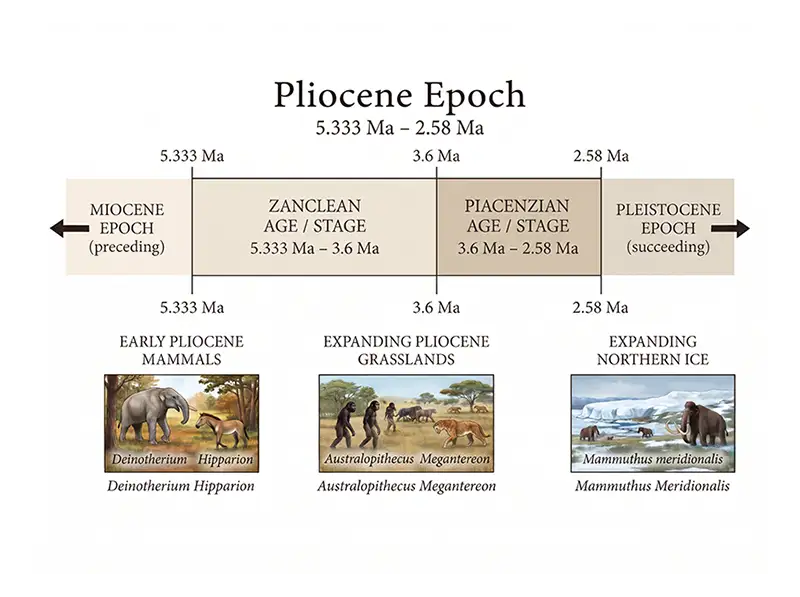
The Pliocene Era began approximately 5.333 million years ago and ended 2.58 million years ago, lasting about 2.75 million years. In formal geological terminology, this interval is called the Pliocene Epoch, which belongs to the Neogene Period of the Cenozoic Era. It followed the Miocene Epoch and came immediately before the Pleistocene Epoch.
The beginning and end of the Pliocene mark important boundaries in Earth's geological history. These dates help scientists organize fossil records, compare ancient climate conditions, and understand how ecosystems changed before the Ice Age cycles of the Pleistocene.
The Beginning of the Pliocene
The Pliocene began 5.333 million years ago, following the end of the Miocene Epoch. Its start coincided with the conclusion of the Messinian Salinity Crisis, an unusual event during which restricted water exchange between the Atlantic Ocean and the Mediterranean Sea caused extensive evaporation and salt deposition in the Mediterranean region.
At the beginning of the Pliocene, renewed Atlantic water inflow refilled the Mediterranean basin. Marine environments recovered, and sedimentary deposits preserved evidence of this dramatic geological transition.
Across the wider world, mammals continued to diversify, grasslands and woodlands supported changing animal communities, and ocean circulation influenced regional climates. Although the Pliocene is often associated with warmer conditions, temperatures and rainfall varied considerably between regions and throughout the epoch.
The Two Stages of the Pliocene
Geologists divide the Pliocene Epoch into two stages. Each stage represents a distinct interval in the geological record.
- Zanclean Stage (5.333–3.6 million years ago): This stage represents the earlier part of the Pliocene. Marine ecosystems recovered after the Messinian Salinity Crisis, while terrestrial mammals continued to evolve. Many regions supported a mixture of forests, woodlands, grasslands, and wetlands.
- Piacenzian Stage (3.6–2.58 million years ago): This stage covers the later Pliocene. It included the mid-Piacenzian Warm Period, when global temperatures were generally higher than preindustrial levels. Later, a longer-term cooling trend contributed to increasing ice accumulation in the Northern Hemisphere.
These stages help researchers compare fossil-bearing rock layers and identify changes in climate, vegetation, and animal distributions. Their boundaries are based on geological evidence rather than sudden biological changes occurring everywhere at once.
The End of the Pliocene
The Pliocene ended 2.58 million years ago, when the Pleistocene Epoch began. This transition occurred during a period of long-term cooling and increasing environmental variability.
Several developments characterized the later Pliocene:
- Northern Hemisphere glaciation: Ice sheets expanded in parts of the Northern Hemisphere, although their growth varied over time.
- Sea-level fluctuations: Changes in the amount of water stored in land ice influenced global sea levels and coastal environments.
- Changing habitats: Temperature and rainfall shifts altered the distribution of forests, grasslands, and other ecosystems.
- Animal migration and adaptation: Mammal populations responded to changing food supplies, habitats, and geographical connections.
The Pliocene–Pleistocene boundary is a formal geological division. It does not mean that a single event suddenly transformed the entire planet at precisely 2.58 million years ago. Cooling and ecosystem changes developed over extended periods, and their effects differed across regions.
Geological Timeline of the Pliocene
| Geological interval | Approximate dates |
|---|---|
| Miocene Epoch ends | 5.333 million years ago |
| Pliocene Epoch begins | 5.333 million years ago |
| Zanclean Stage | 5.333–3.6 million years ago |
| Piacenzian Stage | 3.6–2.58 million years ago |
| Pliocene Epoch ends | 2.58 million years ago |
| Pleistocene Epoch begins | 2.58 million years ago |
Understanding these dates provides a chronological framework for studying the Pliocene fossil record. By comparing dated sediments, animal remains, plant fossils, and climate indicators, scientists can reconstruct how Earth changed during the transition from the relatively warm conditions of much of the Pliocene toward the repeated glacial cycles of the Pleistocene.
What Was Earth Like During the Pliocene?
Continental positions during the Pliocene were broadly similar to those of the modern world, although coastlines, mountain ranges, and regional landforms differed. Plate tectonic movements continued to reshape Earth's surface, while erosion and sedimentation modified rivers, valleys, and coastal plains.
One important development was the formation of a land connection between North and South America through Central America. The emergence of the Isthmus of Panama progressively restricted marine exchange between the Atlantic and Pacific oceans. The timing of its final establishment remains debated, because geological evidence indicates a complex process rather than a single instantaneous event.
This connection also created a route for terrestrial animals to move between the American continents. The resulting Great American Biotic Interchange involved different groups migrating at different times, particularly during the late Pliocene and continuing into the Pleistocene.
Other geographical features shaped the Pliocene world:
- Mountain ranges: Continued uplift in regions such as the Andes influenced rainfall, river systems, and local habitats.
- Coastal plains: Fluctuating sea levels exposed or submerged low-lying land, changing the extent of coastal environments.
- River valleys: Flowing water transported sediments and created fertile floodplains that supported diverse vegetation.
- Ocean basins: Changes in marine connections affected currents and the movement of heat between different parts of the planet.
These geological processes influenced where organisms could live and how populations became separated or connected. They also determined the settings in which sediments accumulated, preserving evidence of the epoch for future study.
What Was the Pliocene Climate Like?
The Pliocene climate changed considerably over its approximately 2.75-million-year duration. Much of the earlier and middle epoch was warmer than the preindustrial climate, while the later interval experienced a general cooling trend, particularly in the Northern Hemisphere.
A particularly important interval was the mid-Piacenzian Warm Period, approximately 3.3–3.0 million years ago. Global temperatures were higher than preindustrial levels, and sea levels were likely substantially higher than today because less water was stored in land-based ice sheets.
Scientists study this warm interval to understand the relationships between atmospheric greenhouse gases, global temperature, ice volume, and sea level. Geological evidence suggests that its environmental conditions differed from those of the modern world, although regional changes were not uniform.
Several factors influenced Pliocene climate:
- Atmospheric carbon dioxide: Greenhouse gases affected how much heat remained in Earth's climate system.
- Ocean circulation: The distribution of warm and cold water influenced regional temperatures and rainfall.
- Orbital variations: Changes in Earth's orbit and axial orientation altered the seasonal distribution of sunlight.
- Ice-sheet development: Expanding ice reflected more incoming solar energy, reinforcing cooling.
- Regional geography: Mountain ranges, ocean connections, and continental positions influenced local weather patterns.
The Pliocene was not consistently warm or uniformly dry. Some regions supported humid forests, while others experienced seasonal rainfall or increasingly open vegetation. Toward the end of the epoch, growing ice sheets and greater climate variability helped establish conditions associated with the Pleistocene glacial cycles.
What Animals Lived During the Pliocene Era?
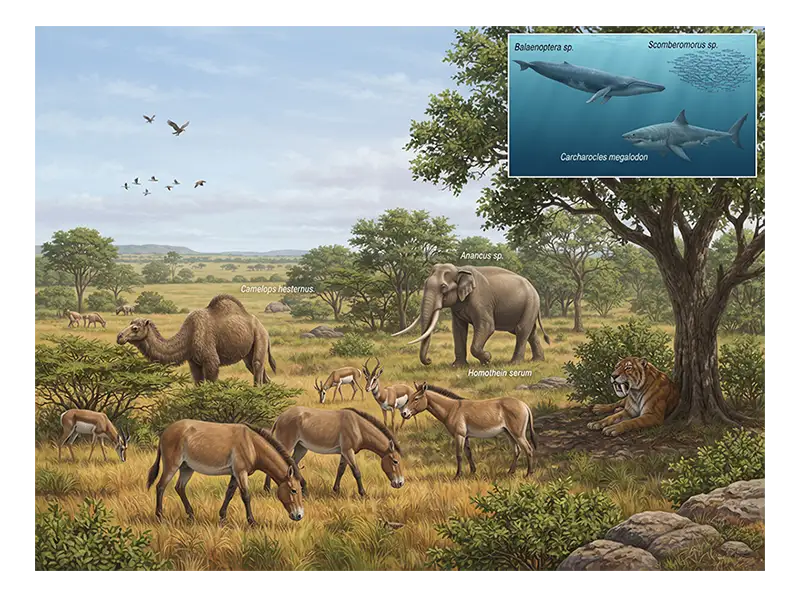
Pliocene ecosystems supported an extensive variety of terrestrial, freshwater, and marine animals. Many familiar mammalian groups had already evolved, although their species and geographical distributions often differed from those of the present day.
errestrial mammals
Herbivores included horses, camels, deer, antelopes, and elephants and their extinct relatives. Some fed primarily on grasses, while others browsed on leaves, shoots, and shrubs. Their diets reflected the vegetation available in different habitats.
Carnivorous mammals included large cats, canids, bears, and other predators. Their body sizes and hunting strategies varied, with some adapted to pursuing prey across open landscapes and others living in more wooded environments.
Several distinctive animals also inhabited particular regions. South America supported unusual native mammals, including glyptodonts and ground sloths, while Africa hosted diverse ungulates and early hominins.
Marine animals
Oceans contained whales, dolphins, seals, sharks, bony fishes, and numerous invertebrates. Many marine mammal groups had already developed body forms suited to aquatic life, although the species living during the Pliocene were not identical to those found today.
Sharks occupied a range of marine food webs, from coastal waters to open oceans. Their fossilized teeth are especially common because teeth preserve more readily than much of the cartilaginous skeleton.
Birds and reptiles
Birds occupied forests, grasslands, wetlands, and coastal habitats. Reptiles included turtles, snakes, lizards, and crocodilians, with their distributions influenced by regional temperatures and water availability.
It is important to distinguish Pliocene animals from older prehistoric species. Non-avian dinosaurs such as Tyrannosaurus rex and Triceratops had disappeared tens of millions of years earlier. Mammoths are strongly associated with the Pleistocene, although the mammoth lineage originated during the Pliocene.
The Pliocene fauna demonstrates how modern animal groups developed through evolutionary change, migration, and extinction rather than appearing in their present forms all at once.
How Did Mammals Evolve During the Pliocene?
Mammalian evolution during the Pliocene involved changes in feeding, movement, body structure, and geographical distribution. Environmental conditions influenced which adaptations were advantageous, but evolution did not follow a single path toward modern species.
In some regions, the spread of open habitats favored herbivores that could consume abundant grasses. Many grazing mammals developed high-crowned teeth that resisted wear from abrasive food and dust. Other species remained browsers or mixed feeders, demonstrating that different dietary strategies could succeed within the same broad interval.
Predators responded to changes in prey availability and habitat structure. Some hunted in open country, while others relied on cover in wooded areas. Competition, environmental variation, migration, and reproductive success all influenced the survival of particular lineages.
One of the epoch's most consequential developments was the movement of mammals between North and South America. Following the emergence of a terrestrial connection through Central America, species from both continents dispersed into unfamiliar environments.
North American migrants entering South America included cats, canids, bears, and various hoofed mammals. South American groups moving north included ground sloths, glyptodonts, and other distinctive animals. The interchange was uneven: some migrants established successful populations, while others remained geographically restricted or eventually disappeared.
Meanwhile, elephants and their relatives, equids, bovids, carnivores, and marine mammals continued to diversify. Some lineages gave rise to multiple species, whereas others became extinct as conditions changed.
The central lesson is that mammalian evolution during the Pliocene was a branching process shaped by ecological opportunity, geographic connections, and environmental pressures.
What Plants and Habitats Existed During the Pliocene?
Pliocene landscapes ranged from tropical forests and temperate woodlands to grasslands, savannas, wetlands, and deserts. The vegetation in any location depended on rainfall, temperature, soil conditions, elevation, and the length of dry seasons.
Grasslands and savannas
Open habitats expanded in some regions, providing feeding grounds for grazing mammals. Scattered trees and shrubs supplied shade, shelter, and browse. These landscapes were particularly important for animals adapted to moving across open terrain.
Forests and woodlands
Wetter areas continued to support trees, shrubs, and diverse understory vegetation. These habitats provided food and shelter for primates, birds, insects, and numerous other organisms.
Wetlands and river valleys
Water-rich environments supported aquatic plants, fish, amphibians, waterbirds, and mammals dependent on reliable freshwater. Floodplains also provided fertile soils and seasonal feeding areas.
Deserts and dry shrublands
Regions receiving limited rainfall supported drought-tolerant vegetation. Plants with reduced leaf surfaces, deep roots, or other water-conserving traits could survive long dry periods.
Researchers reconstruct these habitats through fossil pollen, preserved leaves, wood, soil deposits, and the chemical composition of animal teeth. Such evidence helps establish whether a region contained dense woodland, open grassland, or a mixture of vegetation types.
Plant communities shaped the food available to herbivores, which in turn influenced predator populations and the movement of animals across landscapes. Habitat changes also affected early hominins, whose fossils occur in environments that varied from relatively wooded settings to more open landscapes.
Although grasslands became more widespread in certain regions, it would be inaccurate to describe the entire Pliocene as a global transition from forests to savannas. Vegetation changes were regional and depended on local environmental conditions.
What Was Happening in Human Evolution During the Pliocene?
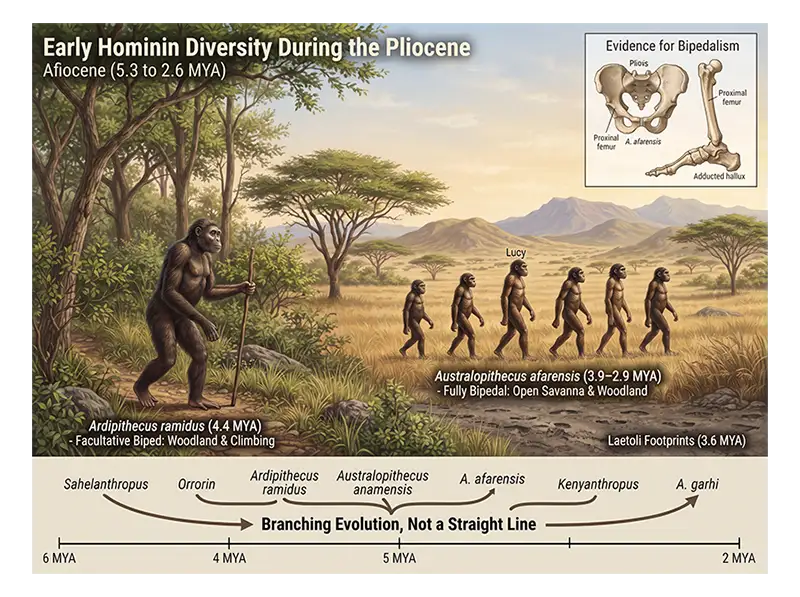
The Pliocene is a crucial interval in human evolutionary history because several early hominin groups lived during this time. Hominins belong to the evolutionary lineage more closely related to modern humans than to chimpanzees after those lineages diverged.
Many important fossils come from Africa, where early hominins developed different combinations of walking, climbing, and feeding adaptations. Their evolutionary history was branching rather than linear, and several species existed without being direct ancestors of modern humans.
Ardipithecus
Ardipithecus ramidus lived approximately 4.4 million years ago, during the Pliocene. Fossils discovered in Ethiopia include teeth, skull material, and parts of the skeleton.
Its anatomy suggests a combination of adaptations for climbing and upright walking. Its feet and other skeletal features differed from those of modern humans, indicating that early hominin locomotion developed through a complex series of changes rather than appearing in a fully modern form.
Australopithecus
Species of Australopithecus lived across parts of Africa during the later Pliocene. Australopithecus afarensis, which lived roughly 3.9–2.9 million years ago, is especially well known because of fossil discoveries such as Lucy and the Laetoli footprints.
Its pelvis, leg bones, and feet provide strong evidence of habitual bipedalism. However, it retained anatomical traits associated with climbing, showing that upright walking did not eliminate all earlier adaptations.
Evidence for early human evolution
Scientists use several types of evidence to investigate hominin evolution:
- Skulls and teeth: Reveal changes in jaw shape, chewing anatomy, and braincase structure.
- Pelvis and leg bones: Provide evidence about body proportions and upright movement.
- Footprints: Preserve direct records of locomotion across ancient surfaces.
- Associated fossils and sediments: Help reconstruct habitats and establish the environmental context in which hominins lived.
Bipedalism evolved well before modern humans appeared. Its origins remain debated, with possible influences including movement between different habitats, access to food, and other ecological pressures.
The earliest widely accepted fossils assigned to the genus Homo date to around 2.8 million years ago, near the end of the Pliocene. The precise timing and classification of the earliest specimens remain subjects of scientific investigation. The epoch therefore provides important evidence for the evolutionary background of our own genus, while much later human development occurred during the Pleistocene.
What Fossils Are Found From the Pliocene Era?
Pliocene fossils preserve evidence of ancient organisms and the environments in which they lived. They occur in sedimentary deposits, caves, river valleys, coastal formations, and other places where remains became buried and survived geological processes.
The major categories include:
- Mammal bones and teeth: Skulls, jaws, limb bones, and teeth help identify species and reveal diet, movement, and evolutionary relationships.
- Marine fossils: Shells, corals, fish remains, whale bones, and fossilized shark teeth provide evidence of ocean ecosystems.
- Plant remains: Leaves, wood, seeds, and pollen help reconstruct vegetation and regional climate.
- Trace fossils: Footprints, burrows, and other preserved traces provide clues about animal movement and behavior.
- Hominin fossils: Teeth, skull fragments, and postcranial bones help researchers investigate early human relatives.
- Sedimentary evidence: Ancient soils, river deposits, and chemical signatures help establish the conditions in which organisms lived.
A fossil becomes more informative when studied alongside its geological context. For example, mammal remains discovered with pollen, plant fragments, and other animal fossils can reveal much more about an ancient ecosystem than an isolated bone alone.
Scientists establish fossil ages through several methods. Radiometric dating can determine the age of suitable volcanic minerals found near fossil-bearing layers. Magnetostratigraphy uses recorded changes in Earth's magnetic field, while biostratigraphy compares fossils with those from other dated deposits.
Not every fossil can be dated directly, so researchers often combine multiple techniques to develop a reliable chronology.
The Pliocene fossil record is particularly valuable for comparing extinct species with living relatives and investigating how environmental conditions influenced mammalian communities and early hominin evolution.
What Caused the End of the Pliocene?
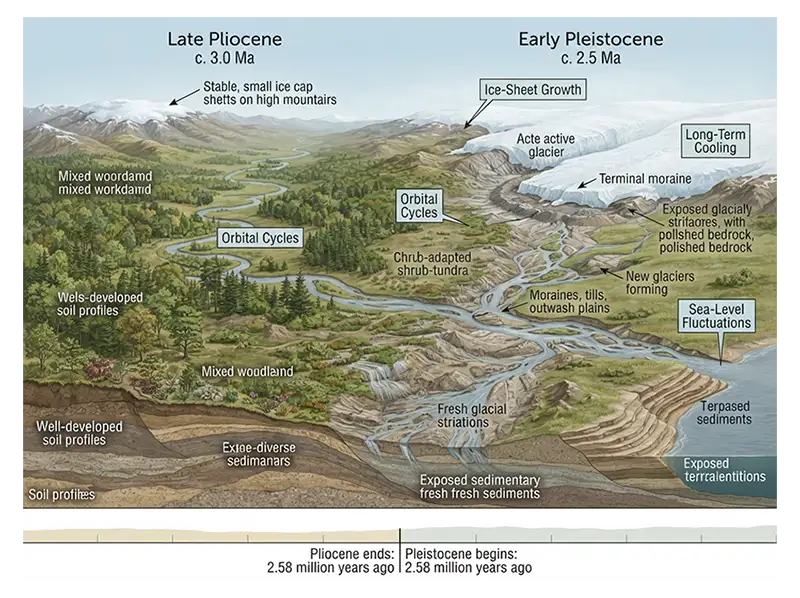
The Pliocene ended approximately 2.58 million years ago, when the Pleistocene Epoch began. This transition followed a long period of climatic change rather than a single global disaster.
During the later Pliocene, cooling became increasingly pronounced in parts of the Northern Hemisphere. Ice accumulated in some regions, sea levels fluctuated, and vegetation patterns changed as temperature and rainfall shifted.
Several processes contributed to these developments:
- Long-term cooling: Declining temperatures changed the distribution of suitable habitats, particularly at higher latitudes.
- Ice-sheet expansion: More water became stored in land ice, influencing global sea levels and Earth's reflectivity.
- Orbital variations: Changes in Earth's orbit and axial orientation altered seasonal sunlight and helped pace climate fluctuations.
- Ocean circulation: Changes in heat transport affected regional temperature and precipitation patterns.
- Ecological adjustments: Plants and animals responded to altered food supplies, habitat availability, and migration routes.
These influences interacted rather than operating independently. Orbital variations, for example, helped shape the timing of climate fluctuations, while greenhouse gases, ice cover, and ocean circulation affected their strength and regional effects.
The transition was not identical everywhere. Some ecosystems became colder or drier, while others retained relatively warm or humid conditions. Animal populations shifted their ranges, adapted to new circumstances, or disappeared.
The beginning of the Pleistocene marks a formal boundary in geological time. The more extensive glacial–interglacial cycles that characterize much of the Pleistocene developed through subsequent climatic changes, so the Pliocene's end should not be treated as the moment when a fully developed Ice Age suddenly began.
Why Is the Pliocene Era Important?
The Pliocene is important because it provides evidence of how climate, geography, and biological evolution interact over geological time. Its rocks and fossils help scientists investigate the development of modern ecosystems, the history of mammals, and the evolutionary background of humans.
Understanding Earth's climate
The mid-Piacenzian Warm Period offers a valuable comparison for studying a warmer global climate. Geological evidence from this interval helps researchers examine relationships between atmospheric carbon dioxide, temperature, ice volume, and sea level. Although the Pliocene was not identical to the modern world, it provides useful evidence for understanding long-term climate responses.
Reconstructing mammalian evolution
Pliocene fossils document the diversification of hoofed mammals, carnivores, elephants and their relatives, and marine animals. They also reveal how migration between continents changed animal communities. These discoveries help explain why modern species have particular geographical distributions and evolutionary relationships.
Investigating human ancestry
Fossils of Ardipithecus, Australopithecus, and other early hominins provide evidence of the development of bipedalism and changes in skeletal anatomy. They also show that human evolution involved multiple species and evolutionary branches rather than a straightforward progression toward modern humans.
Reconstructing ancient ecosystems
Plant fossils, animal teeth, sedimentary deposits, and pollen records help researchers identify former forests, grasslands, wetlands, and other habitats. By comparing these records across locations, scientists can investigate how environmental changes affected food webs, migration, and species survival.
Together, these discoveries make the Pliocene an important reference point for paleontology, geology, climate science, and paleoanthropology. Its record helps connect the world of ancient mammals with the ecosystems and environmental processes that shaped later Earth history.
Conclusion
The Pliocene Era was a major interval of geological and biological change. Its history included shifting continental connections, evolving mammal communities, changing vegetation, and climate fluctuations that helped prepare the way for the Pleistocene.
Fossil evidence from this epoch also reveals important stages in early human evolution, particularly the development of upright walking among hominins. These discoveries demonstrate that the human lineage emerged through a complex evolutionary history involving multiple species and changing environments.
By studying the Pliocene, scientists can better understand ancient ecosystems, the development of modern animal groups, and the relationships between climate and biological change.
The Pliocene Epoch lasted approximately 2.75 million years, from 5.333 million to 2.58 million years ago.
Much of the early and middle Pliocene was warmer than the preindustrial climate. The mid-Piacenzian Warm Period is particularly important for climate research, although conditions varied by region and through time.
Pliocene wildlife included horses, camels, elephants and their relatives, large cats, canids, whales, sharks, and numerous other mammals and marine animals. Their species and distributions differed between continents.
Early hominins lived during this epoch, including Ardipithecus and Australopithecus. The earliest widely accepted fossils assigned to the genus Homo date to approximately 2.8 million years ago, near the Pliocene's end.
The Pliocene preceded the Pleistocene. The Pliocene included a relatively warm interval followed by long-term cooling, while the Pleistocene is especially known for repeated glacial and interglacial cycles.