
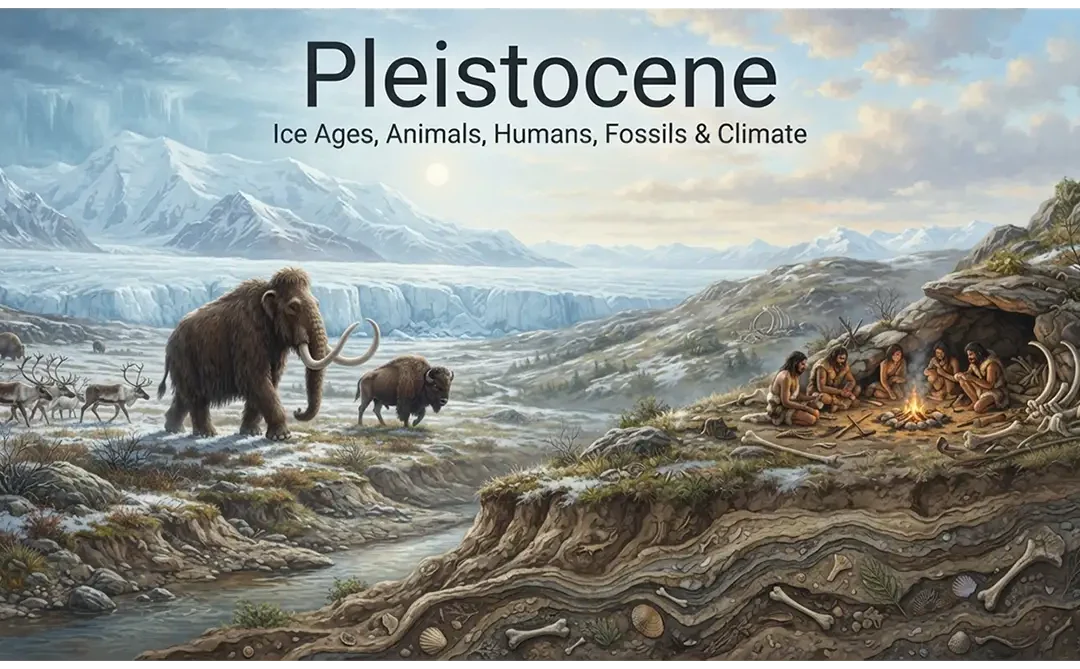
Pleistocene was a major geological epoch known for repeated ice ages, changing climates, large mammals, expanding glaciers, and important stages of human evolution. It lasted from about 2.58 million years ago to 11,700 years ago and formed the first part of the Quaternary Period.
During this long interval, Earth did not remain frozen all the time. Cold glacial periods alternated with warmer interglacial periods. Ice sheets expanded across large parts of the Northern Hemisphere, sea levels fell, and land bridges connected regions that are now separated by water.
The Pleistocene also supported remarkable animals such as mammoths, mastodons, giant ground sloths, woolly rhinoceroses, giant deer, and saber-toothed cats. At the same time, different human species developed new tools, hunting methods, shelters, and ways to cope with changing environments.
What Was the Pleistocene?
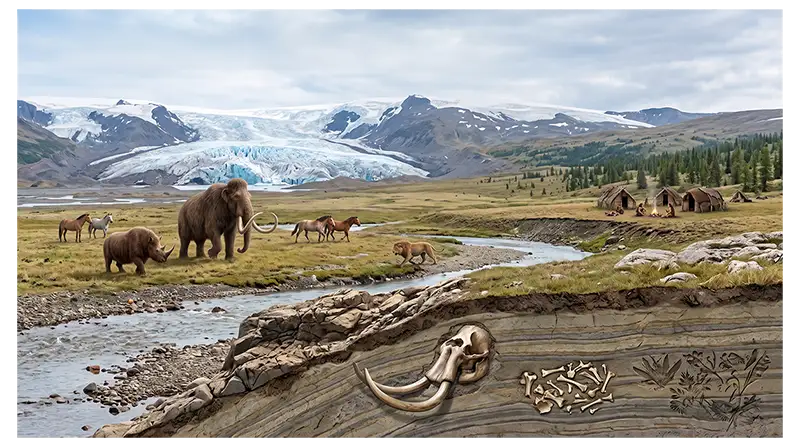
The Pleistocene was an epoch of the Quaternary Period in the Cenozoic Era. It followed the Pliocene Epoch and came before the Holocene, the epoch in which we live today. The period is especially important because it was marked by repeated major changes in temperature and ice cover. Large glaciers spread over northern North America and Eurasia during colder phases, while warmer intervals caused much of the ice to retreat.
Although the term “Ice Age” is often used for the Pleistocene, this does not mean the entire epoch had one continuous cold climate. Instead, the planet moved through cycles of colder and warmer conditions. These changes affected almost every part of the environment. Forests expanded and contracted, grasslands shifted, coastlines moved, and animal populations changed their ranges.
The Pleistocene is also closely connected with human history. Several members of the human genus Homo lived during this time, including Homo erectus, Homo heidelbergensis, Neanderthals, Denisovans, and Homo sapiens. For geologists and paleontologists, the epoch provides an important record of the relationship between climate, landscapes, wildlife, and human development.
When Did the Pleistocene Begin and End?
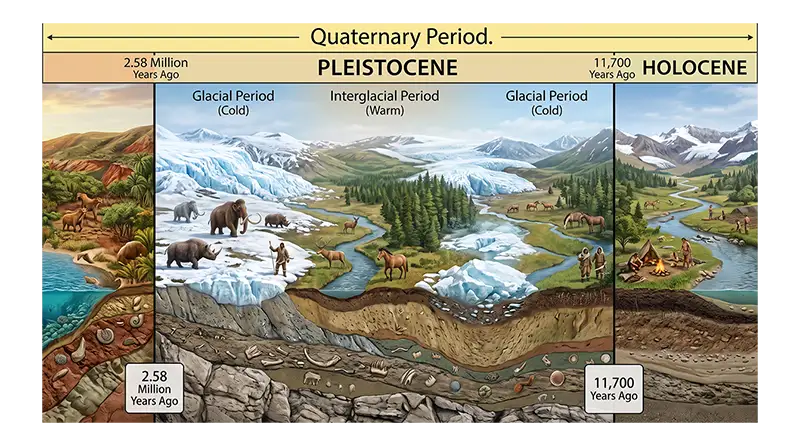
The Pleistocene began about 2.58 million years ago and ended about 11,700 years ago. Its beginning is placed near a major shift toward stronger Northern Hemisphere glaciation. At the end of the epoch, the climate moved into the relatively warm conditions of the Holocene.
The Pleistocene belongs to the Quaternary Period, which continues today.
| Geological unit | Approximate age |
|---|---|
| Pleistocene Epoch | 2.58 million–11,700 years ago |
| Holocene Epoch | 11,700 years ago–present |
The Pleistocene is often divided into several stages based on changes in climate, fossils, sediments, and other geological evidence. Scientists use these divisions to compare events from different parts of the world.
One important feature of its timeline is that glacial and interglacial conditions occurred many times. Therefore, there was no single “Pleistocene climate.” Conditions varied greatly from one stage to another.
What Was Earth Like During the Pleistocene?
Earth looked very different during the colder parts of the Pleistocene. Huge ice sheets covered areas of northern North America and Eurasia. Mountain glaciers also grew in many high-altitude regions. Water stored in these ice masses came largely from the oceans, causing global sea levels to fall.
When sea levels were low, areas that are now underwater became exposed land. One famous example was Beringia, a broad region that connected northeastern Asia with northwestern North America during parts of the Ice Age. Vegetation also changed with temperature and moisture. Cold, dry regions supported tundra and steppe-like environments, while warmer areas could support forests, wetlands, and grasslands.
Animals moved as suitable habitats shifted. A species that lived in a cold northern region during one stage could later move farther north when temperatures increased. The oceans changed as well. Lower sea levels altered coastlines, while changes in temperature and freshwater storage affected marine ecosystems.
So, the Pleistocene was a period of constant environmental adjustment. Ice, water, vegetation, and wildlife repeatedly responded to changing conditions.
Why Did the Pleistocene Have Ice Ages?
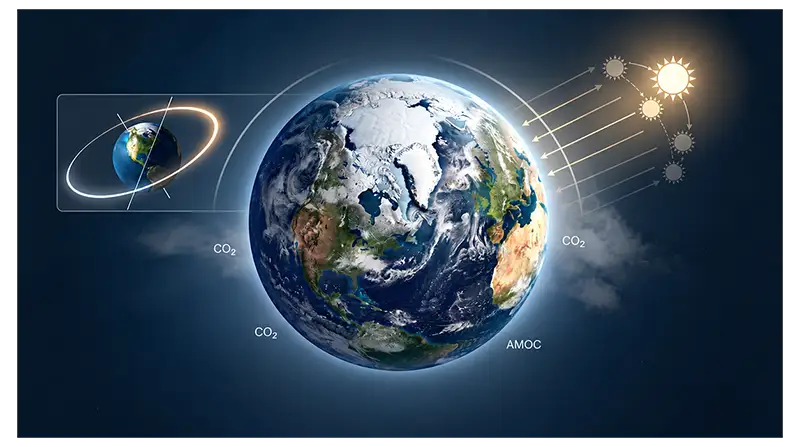
The repeated ice ages of the Pleistocene were linked to several interacting factors. One major influence was Earth’s orbital cycles. The planet's orbit, axial tilt, and the direction of its axis change over long periods. These variations alter how sunlight is distributed across different parts of the planet.
When northern summer conditions became less favorable for melting snow, more snow could remain from one year to the next. Over long periods, this helped ice accumulate. As ice expanded, another important process became stronger: the ice-albedo effect. Bright snow and ice reflect a large amount of sunlight back into space. Less absorbed solar energy can contribute to further cooling.
Greenhouse gases also played an important role. Lower levels of carbon dioxide and other greenhouse gases were associated with colder glacial conditions, while higher concentrations were associated with warmer phases. Ocean circulation and changes in ice sheets also influenced the climate system.
These factors did not operate independently. They interacted through feedbacks involving the atmosphere, oceans, ice, vegetation, and land surface. As a result, the Pleistocene experienced repeated transitions between glacial periods, when large ice sheets expanded, and interglacial periods, when they retreated.
How Did Glaciers Shape the Land?
Pleistocene glaciers were powerful geological forces. Moving slowly under their own weight, thick masses of ice eroded rock and transported enormous amounts of sediment. One common glacial process was abrasion. Rocks carried beneath the ice scraped against the ground, wearing down bedrock and leaving scratches and grooves.
Glaciers also produced distinctive landforms.
- U-shaped valleys formed when moving ice widened and deepened existing valleys.
- Moraines developed from piles of sediment deposited along or beneath glaciers.
- Drumlins formed as elongated hills associated with glacial movement.
- Glacial lakes developed where ice blocked drainage or occupied deepened basins.
- Eskers formed from sediment deposited by streams flowing beneath or within glaciers.
- Striations preserved evidence of the direction in which ice moved.
When glaciers melted, they released large quantities of water and sediment. Meltwater streams transported sand, gravel, and finer material across broad areas. The effects can still be seen today. Many modern lakes, valleys, soils, and sediment deposits in formerly glaciated regions are partly connected to Pleistocene ice.
This makes the epoch especially important to physical geology, because its landscapes preserve evidence of past climate and ice movement.
What Animals Lived in the Pleistocene?
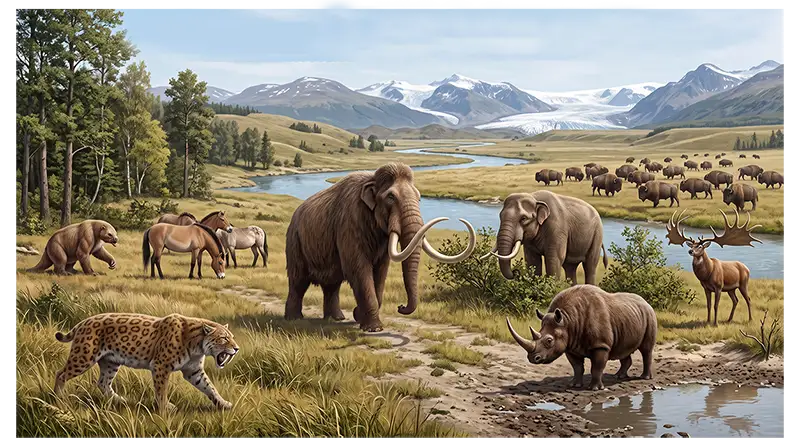
The Pleistocene supported a wide range of mammals, birds, reptiles, and other organisms. Many species were closely related to animals living today, while others belonged to lineages that later disappeared.
Some of the best-known large mammals included:
- Woolly mammoths
- Mastodons
- Woolly rhinoceroses
- Giant ground sloths
- Saber-toothed cats
- Giant deer
- Short-faced bears
- Large bison
- Wild horses
- Large camels
Not every large animal lived in the same place or at the same time. Their ranges depended on local temperature, vegetation, water availability, and other environmental conditions.
Mammoths
Woolly mammoths were among the most recognizable animals of the northern Ice Age. Their thick fur, body fat, and other cold-weather features helped them live in chilly environments. They often occupied open landscapes where grasses and other low-growing plants were available.
Saber-Toothed Cats
Saber-toothed cats included several different species and lineages. Their long upper canine teeth were specialized hunting structures. These predators lived in various environments and preyed on large and medium-sized animals.
Giant Ground Sloths
Giant ground sloths were large herbivorous mammals found mainly in the Americas. Unlike modern tree-dwelling sloths, some species were enormous and lived on the ground.
Giant Deer
The giant deer, often called the Irish elk, had enormous antlers. Despite its common name, it was not restricted to Ireland and lived across parts of Europe and Asia.
Many Pleistocene animals had adaptations that helped them cope with cold, seasonal food supplies, predators, and changing habitats. Some survived into the Holocene, while many large species eventually disappeared.
How Did Humans Live During the Pleistocene?
The Pleistocene was a major period in human evolution. Early members of the genus Homo developed increasingly complex tools and behaviors. Human populations also expanded into new regions as they adapted to different environments.
People commonly depended on hunting, gathering, fishing, and the use of locally available plants and animals. Their exact way of life varied according to location and time. Stone tools were especially important. Different tool traditions show changes in how people shaped rocks for cutting, scraping, hunting, processing food, and other tasks.
Fire also played an important role in many human communities. It provided warmth, light, protection, and a way to cook food. Shelters varied from simple temporary camps to more organized living spaces. In cold regions, people needed ways to reduce heat loss and obtain reliable food during difficult seasons.
Clothing made from animal materials likely helped some populations live in colder areas. Hunting equipment and cooperative behavior also increased the ability to exploit large animals. Human movement across continents was another major feature of the epoch. Homo sapiens eventually spread into many parts of the world, while other human groups occupied Eurasia and other regions.
The Pleistocene therefore provides the environmental background for major stages of human evolution, migration, technology, and cultural development.
What Do Pleistocene Fossils Reveal?
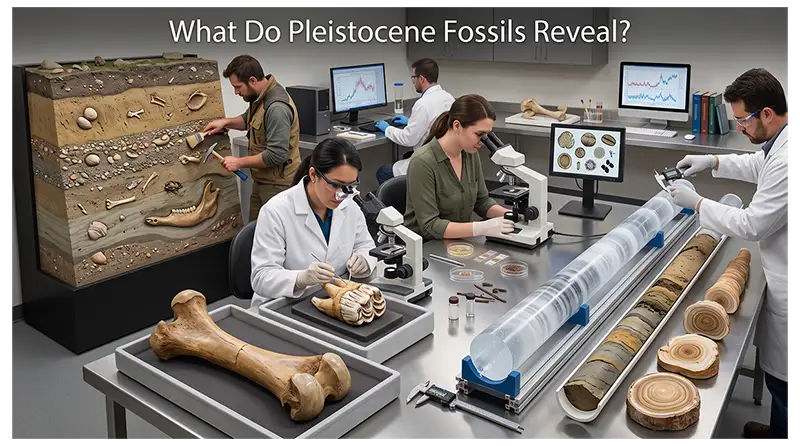
Pleistocene fossils allow scientists to reconstruct environments that disappeared thousands or even hundreds of thousands of years ago. Animal bones and teeth can reveal what species lived in an area, what they ate, and sometimes how they moved or grew.
Plant remains provide another important source of information. Pollen grains, seeds, leaves, and other remains can show which types of vegetation existed in the past. Scientists also study sediments. Layers of sand, mud, gravel, and other deposits can record ancient rivers, lakes, glaciers, floodplains, and changing environmental conditions.
Ice Cores
Ice cores from Greenland and Antarctica contain trapped air bubbles and chemical signals from ancient atmospheres. They provide detailed information about past temperature and greenhouse-gas changes, extending far beyond the most recent part of the Pleistocene.
Cave Deposits
Caves can preserve bones, teeth, pollen, sediments, and chemical evidence. Some cave deposits provide valuable records of both animals and human activity.
Dating Methods
Scientists use several dating techniques to determine when remains or sediments formed. Depending on the material and age, methods can include radiocarbon dating, uranium-series dating, luminescence dating, and other approaches. By combining these sources, researchers can build a much clearer picture of Pleistocene environments than any single fossil could provide.
Why Is the Pleistocene Important?
The Pleistocene is important because it records major changes in climate, ice cover, landscapes, ecosystems, and human history. Its glaciers helped create many landscapes that still exist today. Lakes, valleys, sediments, and other geological features preserve evidence of past ice movement.
The epoch also helps scientists understand how ecosystems respond to major environmental changes. As temperatures shifted, animals and plants changed their geographic ranges, population sizes, and habitats. The fossil record provides an opportunity to study extinct animals and compare them with their living relatives.
The Pleistocene is equally important for understanding humans. Major developments in migration, technology, food gathering, fire use, and adaptation occurred during this period. It also provides a long-term record of natural climate variability. Scientists can compare ancient climate changes with modern observations to better understand how Earth's climate system behaves.
In this way, the Pleistocene connects geology, paleontology, climatology, ecology, and human evolution.
Conclusion
The Pleistocene was a period of repeated climate shifts, expanding and retreating glaciers, changing landscapes, diverse wildlife, and major developments in human evolution. Its cold and warm phases transformed habitats across the planet and left behind evidence in fossils, sediments, ice, and geological landforms.
From woolly mammoths and giant deer to early human communities, the epoch was filled with remarkable changes. Many of its landscapes and environmental records remain visible today.
Studying the Pleistocene helps scientists understand how Earth responds to climate change and how living organisms adapt when their surroundings change. It also provides an important bridge between ancient Earth history and the world we live in now.
The Pleistocene was part of the broader Quaternary Ice Age and contained repeated glacial and interglacial periods. It was not continuously frozen.
Yes. Several human species lived during the epoch, including Homo erectus, Neanderthals, Denisovans, and Homo sapiens.
No. Non-avian dinosaurs had disappeared about 66 million years before the Pleistocene began. Birds, which are living dinosaurs, were present.
Woolly mammoths are among the most famous, but the epoch supported many other remarkable mammals, including mastodons, giant ground sloths, giant deer, and saber-toothed cats.
Large amounts of water became locked in continental ice sheets and glaciers. This reduced the amount of water stored in the oceans and lowered global sea level.