
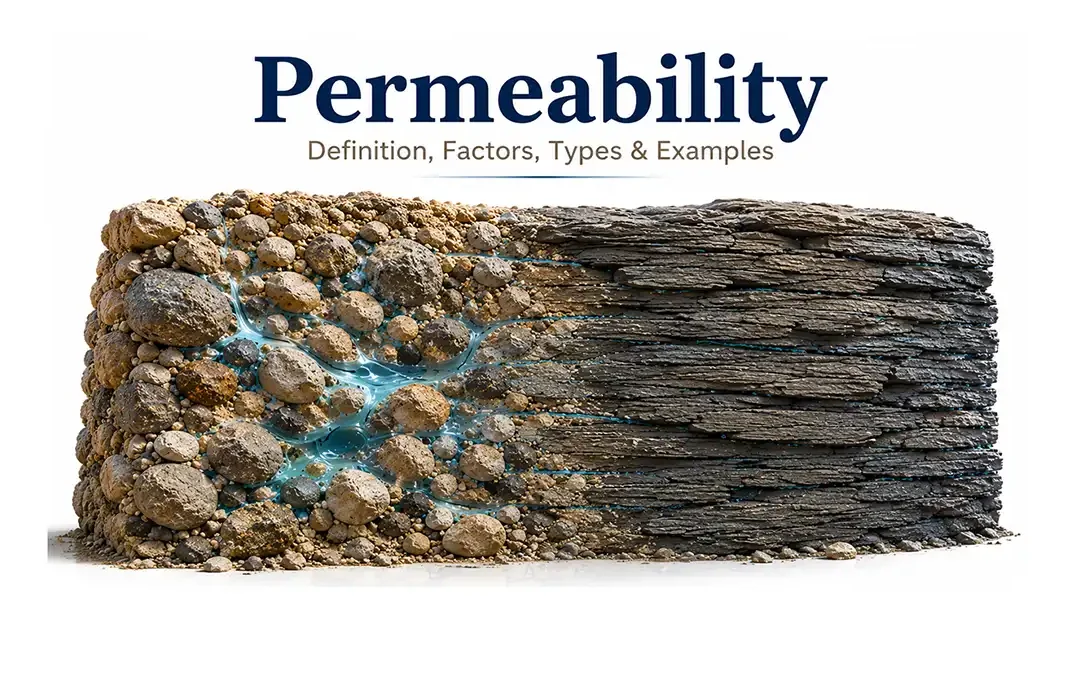
Imagine pouring water onto two different surfaces. One is a layer of clean sand, where the water quickly disappears into the ground. The other is a layer of compact clay, where the water remains on the surface for much longer. The difference between these two materials is largely due to permeability—a property that controls how easily fluids move through rocks and soils.
Permeability is one of the most important concepts in geology because it determines the movement of groundwater, petroleum, natural gas, and other fluids beneath the Earth's surface. It plays a vital role in hydrogeology, petroleum geology, engineering geology, and environmental science. Whether scientists are locating groundwater aquifers, evaluating oil reservoirs, or designing dam foundations, understanding permeability helps them predict how fluids will behave underground.
Although permeability is closely related to porosity, the two terms describe different properties. A rock may contain many pore spaces, but if those pores are poorly connected, fluids cannot move through them efficiently. This is why two rocks with similar porosity can have very different permeability.
What Is Permeability?
Permeability is the ability of a porous material to allow fluids such as water, oil, natural gas, or air to pass through it. In geology, it describes how easily fluids move through the interconnected pore spaces or fractures within rocks and soils. The better these pathways are connected, the more easily fluids can flow.
Permeability is one of the key properties used to evaluate subsurface materials because it controls the movement of groundwater, petroleum, and other fluids. It helps geologists identify productive aquifers, petroleum reservoirs, and suitable locations for engineering projects. Without permeability, fluids would remain trapped within rocks instead of flowing through them.
For example, gravel and coarse sandstone usually have high permeability because they contain large, well-connected pore spaces that allow water to flow freely. In contrast, clay and shale typically have low permeability because their pore spaces are extremely small and poorly connected, making fluid movement slow and difficult.
It is important to remember that permeability measures how easily fluids move, not how much fluid a material can store. A rock may have high porosity but still exhibit low permeability if its pore spaces are isolated from one another. This distinction is one of the most important concepts in hydrogeology and petroleum geology.
Scientists commonly express permeability using the symbol k and measure it in darcies (D) or millidarcies (mD). In most geological studies, permeability is determined using Darcy's Law, which describes how fluids flow through porous materials under the influence of pressure differences.
According to Darcy’s law,
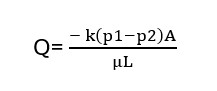
Where:
- Q = Rate of fluid flow
- k = Permeability
- ΔP (P₁ − P₂) = Pressure difference across the sample
- A = Cross-sectional area of the sample
- μ = Dynamic viscosity of the fluid
- L = Length of the sample
The negative sign (−) indicates that fluids naturally flow from an area of higher pressure to an area of lower pressure.
Developed by the French engineer Henry Darcy in 1856, this law remains one of the fundamental principles of hydrogeology and petroleum engineering. It allows scientists to estimate groundwater flow, evaluate petroleum reservoirs, and measure the permeability of rocks and soils under controlled conditions.
Types of Permeability:
Not all rocks and soils allow fluids to move in the same way. Depending on the geological conditions and the fluids present, permeability can be classified into several types. Understanding these classifications helps geologists, hydrogeologists, and petroleum engineers evaluate groundwater flow, oil and gas production, and the movement of other fluids through porous materials.
Absolute Permeability
Absolute permeability, also called specific permeability, describes the ability of a porous rock or soil to transmit a single fluid when the pore spaces are completely saturated with that fluid.
For example, if a rock contains only water with no oil or gas present, the measured permeability is its absolute permeability. Because only one fluid occupies the pore spaces, there is no interference from other fluids during flow.
Absolute permeability is represented by the symbol k and serves as the reference value for calculating other types of permeability.
Effective Permeability
In natural reservoirs, rocks are rarely filled with only one fluid. Most contain a mixture of water, oil, and natural gas, all competing for the same pore spaces.
Effective permeability is the permeability of a rock to one particular fluid when other immiscible fluids are also present. Since these additional fluids partially block the flow pathways, the effective permeability is always less than or equal to the absolute permeability.
Effective permeability is commonly represented as:
- kₒ = Effective permeability to oil
- kᵥ = Effective permeability to water
- kᵍ = Effective permeability to gas
As the saturation of a particular fluid changes, its effective permeability also changes.
Relative Permeability
Relative permeability compares the effective permeability of a fluid with the rock's absolute permeability. It indicates how easily a specific fluid flows when multiple fluids occupy the pore spaces.
It is calculated as:
- kro = ko / k
- krw = kw / k
- krg = kg / k
where:
- ko, kw, kg = Effective permeability to oil, water, and gas
- k = Absolute permeability
Relative permeability is a dimensionless value ranging from 0 to 1.
- A value close to 1 indicates that the fluid flows almost as easily as it would in a single-fluid system.
- A value close to 0 means the fluid has very little ability to move through the rock.
Relative permeability is widely used in petroleum engineering to predict oil, gas, and water production from underground reservoirs.
Methods of measuring permeability:
Three methods are used to measure permeability.
Drill stem test (DST) / Production text:
This is one of the best ways to measure permeability. In this test, engineers measure the rate of flow and the drop in pressure at the commencement by drilling a well into the reservoir rock. Through this well, they determine all parameters needed to calculate permeability using Darcy's law. This method allows geologists to determine the productive capacity of geological formations.
Wireline logs:
This procedure is able to identify permeable zones by SP Log & Caliper log.
Permeameter:
This instrument measures permeability. It opens the fastest and can take many readings over a small mock area. It plays a crucial role in analyzing heterogeneous pore systems and heterogeneous rock fabrics. Researchers use various types of permeameters, such as the Probe permeameter and Mini permeameter.
Factors Affecting Permeability
Permeability is not a fixed property. Even rocks of the same type can have different permeability depending on their physical characteristics and geological history. Several factors influence how easily fluids move through pore spaces or fractures, making permeability highly variable from one material to another.
Understanding these factors helps geologists predict groundwater movement, evaluate petroleum reservoirs, and assess the suitability of rocks and soils for engineering projects.
Grain Size
Grain size is one of the most important factors controlling permeability. Materials made of large grains, such as gravel and coarse sand, usually have larger pore spaces that allow water and other fluids to flow more easily. In contrast, fine-grained materials like silt and clay contain much smaller pores, which greatly restrict fluid movement.
As a result, coarse-grained sediments generally have higher permeability than fine-grained sediments, even when their porosity is similar.
Sorting
Sorting refers to how uniform the grain sizes are within a sediment or rock.
Well-sorted sediments contain grains of nearly the same size, leaving open and interconnected pore spaces that promote fluid flow. Poorly sorted sediments contain a mixture of large and small grains, where the smaller particles fill the spaces between larger grains, reducing permeability.
This is why a well-sorted sandstone often transmits groundwater more efficiently than a poorly sorted sandstone.
Pore Connectivity
The presence of pore spaces alone does not guarantee high permeability. The pores must also be connected to form continuous pathways for fluid movement.
If the pores are isolated from one another, fluids cannot move freely, regardless of how much pore space is present. This explains why some rocks with relatively high porosity still have low permeability.
Pore connectivity is often the most important difference between permeability and porosity.
Compaction
As sediments are buried beneath younger layers, the increasing weight compresses the grains together. This process, known as compaction, reduces the size of pore spaces and decreases their connectivity.
Highly compacted rocks generally have lower permeability because fluids have fewer pathways through which they can flow.
Cementation
Groundwater can deposit minerals such as silica, calcite, or iron oxides between sediment grains. These minerals act as a natural cement, binding the grains together and partially filling the pore spaces.
As cementation increases, the available pathways for fluid movement become smaller, causing permeability to decrease.
Fractures and Joints
Not all permeability depends on original pore spaces. Cracks, fractures, and joints created after a rock forms can significantly increase fluid flow.
For example, dense rocks such as granite have very low primary permeability because they contain few pore spaces. However, if they become fractured, water can move rapidly through the cracks, creating high secondary permeability.
Similarly, dissolved fractures in limestone can form extensive underground drainage systems and productive aquifers.
Fluid Properties
The characteristics of the fluid itself also influence how easily it moves through porous materials.
Low-viscosity fluids, such as water, generally flow more readily than thicker fluids like heavy crude oil. Temperature can also affect fluid movement because warmer fluids usually have lower viscosity.
Although permeability is a property of the rock or soil, the actual flow rate depends on both the material and the physical properties of the fluid passing through it.
Permeability vs. Porosity
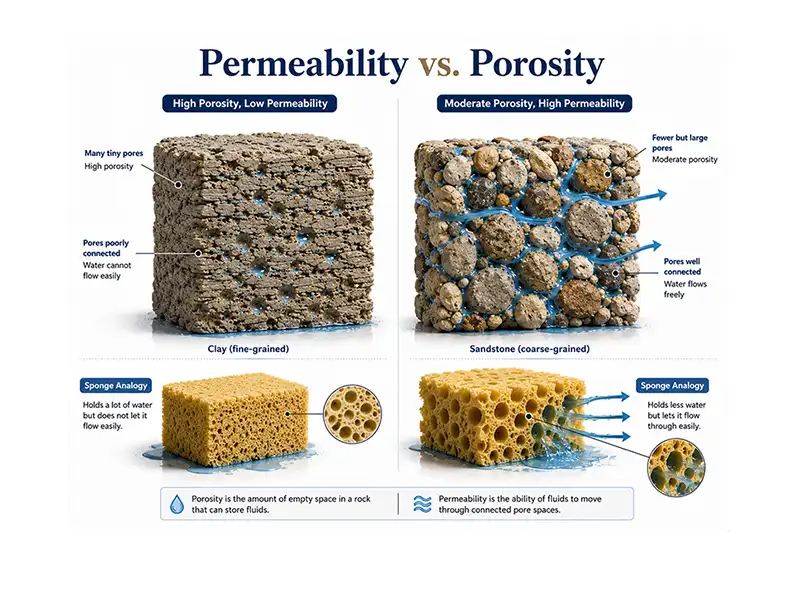
Permeability and porosity are closely related, but they describe different properties of rocks and soils. Because both involve pore spaces, they are often confused. However, understanding the difference is essential in geology, hydrogeology, and petroleum engineering.
Porosity measures how much empty space exists within a rock or soil. It indicates the amount of fluid a material can store. Permeability, on the other hand, measures how easily fluids can move through those pore spaces. In other words, porosity is about storage, while permeability is about flow.
A material can have high porosity but low permeability if its pore spaces are not connected. Clay is a good example. Although it contains many tiny pores, they are so small and poorly connected that water moves through them very slowly.
Conversely, a rock with moderate porosity can have high permeability if its pore spaces are large and well connected. Sandstone is a common example because water can flow relatively easily through its interconnected pores.
The relationship becomes even clearer when comparing different geological materials. Gravel usually has both high porosity and high permeability because its large particles create wide, connected pathways. Shale, however, often has moderate porosity but very low permeability because its microscopic pores restrict fluid movement.
Key Differences Between Permeability and Porosity
| Feature | Permeability | Porosity |
|---|---|---|
| Definition | Ability of a material to transmit fluids | Amount of pore space within a material |
| Measures | Fluid flow | Fluid storage |
| Depends On | Pore connectivity, grain size, fractures | Number and volume of pore spaces |
| Unit | Darcy (D) or millidarcy (mD) | Percentage (%) |
| High Value Means | Fluids move easily | Material can store more fluid |
| Example | Sandstone, gravel | Pumice, unconsolidated sediments |
Applications of Permeability
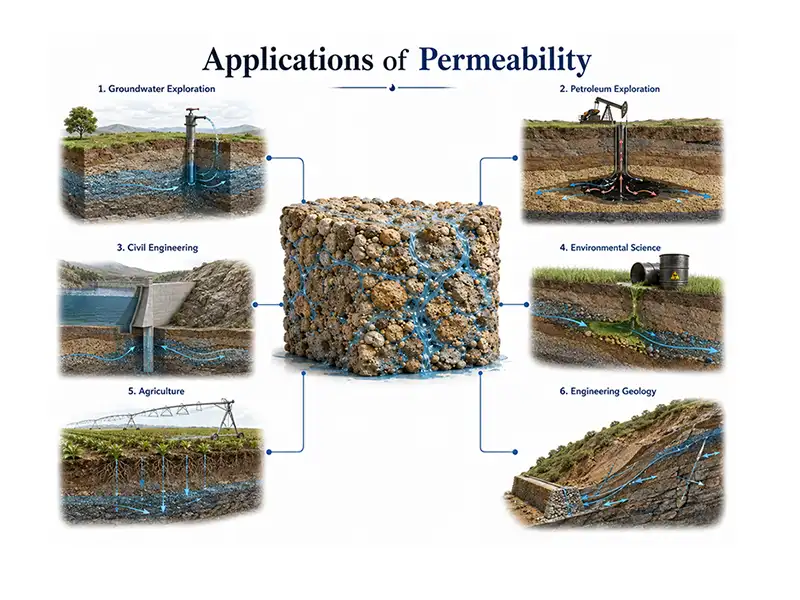
Permeability is much more than a laboratory measurement—it has practical importance in many areas of geology, engineering, and environmental science. By understanding how easily fluids move through rocks and soils, scientists and engineers can make informed decisions about water resources, energy production, infrastructure development, and environmental protection.
From locating groundwater aquifers to producing oil and natural gas, permeability influences many processes that affect everyday life. The following are some of its most important applications.
Groundwater Exploration
One of the most significant applications of permeability is in groundwater exploration. Water moves through permeable rocks and sediments to form aquifers, which serve as natural underground reservoirs.
Materials such as gravel, sand, and sandstone usually have high permeability, allowing groundwater to flow freely and making them excellent aquifers. In contrast, rocks with very low permeability, such as clay and shale, restrict water movement and often act as aquitards, limiting groundwater flow.
Hydrogeologists use permeability data to identify suitable locations for wells, estimate groundwater recharge, and manage water resources sustainably.
Petroleum Exploration and Production
Permeability plays a critical role in the oil and gas industry. Even if a rock contains a large amount of petroleum, it cannot produce oil or natural gas efficiently unless the fluids can flow through its pore spaces.
Reservoir rocks such as sandstone and fractured limestone are often highly permeable, allowing hydrocarbons to migrate toward production wells. Reservoir engineers measure permeability to evaluate reservoir quality, estimate production rates, and design efficient extraction strategies.
Without adequate permeability, significant amounts of oil and gas may remain trapped underground.
Civil and Geotechnical Engineering
Engineers routinely evaluate permeability before constructing dams, highways, tunnels, bridges, and building foundations.
Highly permeable soils may require additional drainage systems to control groundwater, while low-permeability materials are often selected to reduce water seepage beneath dams, canals, and landfill liners.
Understanding permeability helps engineers improve structural stability and reduce the risk of water-related failures.
Environmental Studies
Environmental scientists use permeability to predict how water, pollutants, and chemicals move through the subsurface.
If contaminated water enters highly permeable soil, pollutants can spread rapidly and affect groundwater supplies. In low-permeability materials, contamination usually moves more slowly but may remain trapped for longer periods.
Permeability data therefore play an important role in groundwater protection, contaminated land assessment, waste disposal planning, and environmental remediation projects.
Agriculture and Irrigation
Permeability also influences agricultural productivity by affecting how water moves through soil.
Soils with very high permeability drain quickly and may require more frequent irrigation because water passes beyond the plant root zone. In contrast, soils with very low permeability can retain excess water, reducing soil aeration and affecting crop growth.
Understanding soil permeability helps farmers improve irrigation practices, conserve water, and maintain healthy soil conditions.
Engineering Geology and Hazard Assessment
Permeability is also important in engineering geology and natural hazard assessment. The movement of groundwater through rocks can influence landslides, slope stability, sinkhole formation, and erosion. Engineers often evaluate permeability before constructing roads, tunnels, and other infrastructure in areas with challenging geological conditions.
By understanding how water moves beneath the surface, engineers can identify potential risks early and design safer, more durable structures.
Conclusion
Permeability is one of the most fundamental properties in geology because it determines how easily fluids move through rocks and soils. From groundwater flowing through aquifers to oil migrating within underground reservoirs, permeability controls many natural processes that occur beneath the Earth's surface. It also plays a key role in engineering, environmental studies, and resource exploration by helping scientists understand subsurface conditions without relying solely on drilling.
Although permeability is closely related to porosity, the two properties describe different aspects of a material. Porosity indicates how much fluid a rock or soil can store, while permeability determines how efficiently that fluid can move. Factors such as grain size, pore connectivity, compaction, cementation, and fractures all influence the permeability of geological materials.
As modern exploration techniques continue to evolve, accurate permeability measurements remain essential for groundwater management, petroleum production, civil engineering, and environmental protection. Whether you're studying geology or working in Earth science, understanding permeability provides a strong foundation for interpreting fluid movement and evaluating the behavior of rocks beneath the Earth's surface.
The main factors include grain size, sorting, pore connectivity, compaction, cementation, fractures, and the properties of the fluid moving through the material.
Gravel, coarse sand, sandstone, and fractured limestone generally have high permeability because they contain large, interconnected pathways for fluid flow.
Clay, shale, and unfractured granite usually have low permeability because their pore spaces are either very small or poorly connected.
Permeability is commonly measured using Darcy's Law through laboratory permeameter tests, field pumping tests, drill stem tests (DST), and wireline logging in petroleum reservoirs.
Permeability determines how quickly groundwater moves through aquifers, making it essential for locating water resources, designing wells, and managing groundwater sustainably.